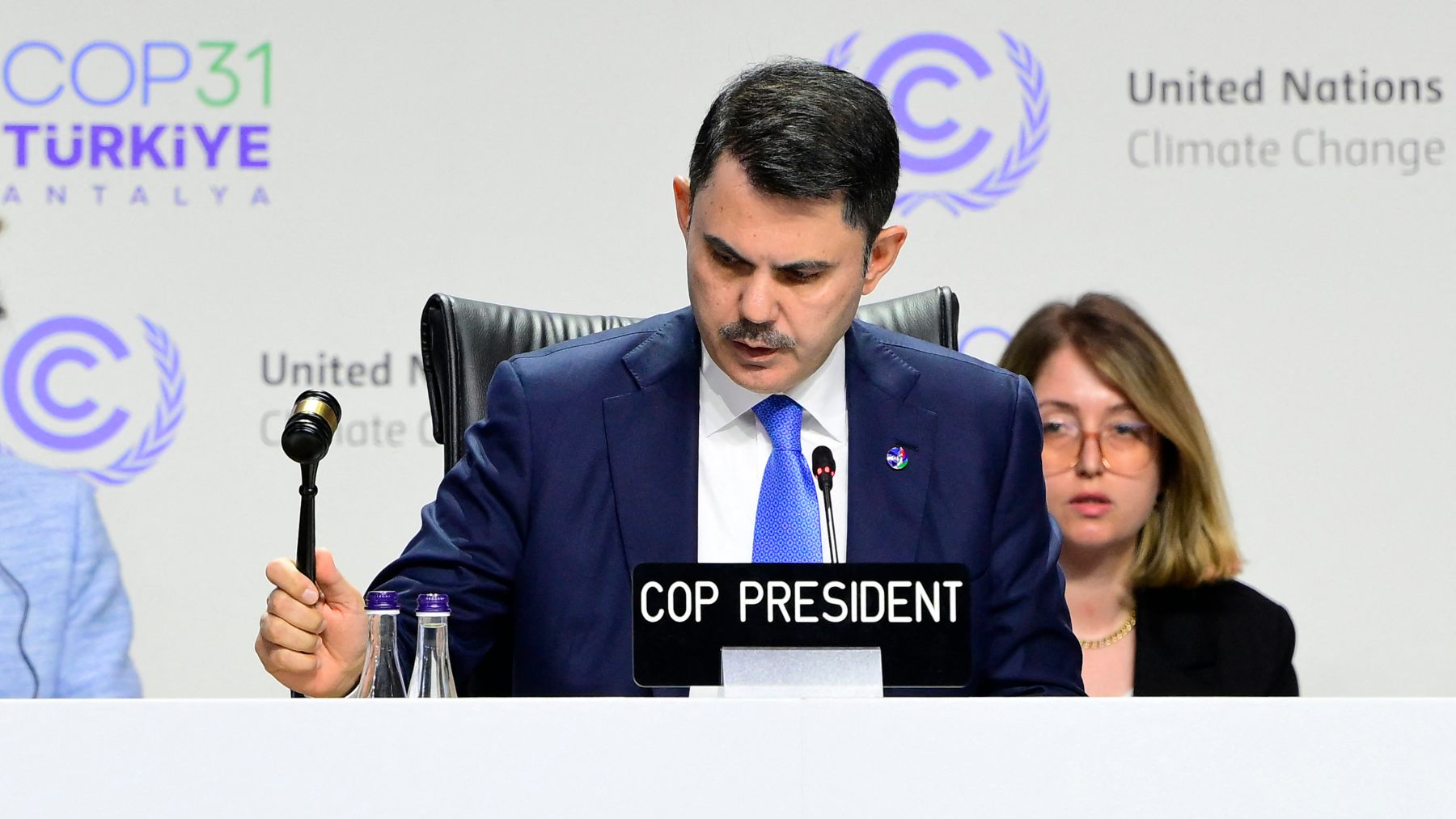
The Cop31 climate summit in Turkey ended without agreement after the European Union and several countries rejected a proposed deal that failed to explicitly address fossil fuels and provide stronger financial support to developing nations.
Cop31 President Murat Kurum said that the negotiations had failed to secure consensus, adding that the proposed decisions had not been adopted.
"It is clear that there are parties in this hall who oppose this text. We recognise that there is no consensus on this document. Therefore, these decisions have not been adopted," he told the closing plenary.
"We have done our utmost. Ultimately, we have not imposed this text on anyone, nor have we issued an ultimatum such as a 'take it or leave it' demand."
The European Union, the Marshall Islands, Panama, Norway and Vanuatu were among those that formally objected to the proposed Antalya Pact.
The talks had been scheduled to end on Friday but continued until Sunday, as negotiators tried to resolve disagreements over the proposed agreement.
The breakdown followed more than two weeks of negotiations, making the summit the longest in the history of the UN climate conference process.
Ireland's Climate Minister Darragh O’Brien, speaking on behalf of the EU, formally rejected the Antalya Pact, saying it failed to meet the urgency of the climate crisis.
"We will not endorse a decision that does not respond to the science, and that actually risks deepening the chasm between global commitments and the action required… that does not even mention fossil fuels," he said.
The dispute centred on the omission of an explicit reference to transitioning away from coal, oil and gas, despite the commitment made by countries at Cop28 in Dubai in 2023.
The latest draft referred to earlier decisions, including the Dubai agreement, but did not explicitly mention fossil fuels.
It also retained provisions on carbon capture and storage, a technology promoted by some oil-producing countries but criticised by environmental groups as a potential means of prolonging fossil fuel production.
'Moves us backwards'
The United Kingdom criticised the proposed agreement. Energy Secretary Miatta Fahnbulleh said the summit had failed to build the consensus required for meaningful climate action.
"This Cop sought to confront hard truths – that global warming is set to overshoot 1.5C and that we must act with ever more urgency to address it.
"The moment required bold ambition, and we have been working tirelessly to try to build consensus. It is immensely disappointing we have been unable to do so," she said.
The UK described the text as a setback, saying: "It moves us backwards; it is the lowest common denominator when it should have been uniting us in action."
Panama also formally rejected the agreement, saying the text failed to address its demands.
"What we cannot accept is that we are asked to drop our stance because the atmosphere does not negotiate, the planet does not negotiate," the representative said.
The Republic of the Marshall Islands also rejected the proposed agreement, warning that it threatened the security of vulnerable island nations.
"We will not be forced to accept false solutions. We will not accept an outcome that undermines our security," its representative said.
"Our needs are so great, but the gap keeps growing. People are dying, the seas are rising."
Norway also joined the objections, while Germany had earlier indicated that it would not accept the draft in its existing form.
'Deserved to fail'
Harjeet Singh, strategic adviser to the Fossil Fuel Treaty Initiative, told Middle East Eye that the proposed agreement had failed on four critical fronts: fossil fuels, climate finance, adaptation and loss and damage.
Singh said a reference to the Cop28 outcome was insufficient, arguing that the Dubai agreement had gone further by calling for a transition away from fossil fuels.
“A mere reference to the Cop28 outcome was never going to be enough. Three years ago in Dubai, we got a far better text that called for a transition away from fossil fuels. This rejection shows the world will not accept going backwards," he said.
Singh, who is a global convenor of the Fill the Fund campaign, accused wealthy countries of resisting efforts to establish measurable financial commitments under the Paris Agreement.
“Rich countries were reminded of the Paris Agreement provision that says they must pay, but they forced the deletion of every number that would show whether they have.
"They even erased the word 'debt' from a finance decision, while countries across Asia and Africa spend more on debt repayments than on protecting their people. That is why this text deserved to fail,” he told MEE.
Singh said the proposed outcome also failed to provide adequate support for adaptation, which he described as a matter of survival for vulnerable communities.
“The Adaptation Fund, which delivers money directly to frontline communities, raised barely $50m here against a target of $300m a year. The text's response was to 'encourage contributions', with no amount, no deadline and no country named," he said.
"With the $120bn figure deleted and the tripling pathway pushed to 2027, the message to the world's most vulnerable was clear: you're on your own."
'Deserved to fail': Cop31 ends in failure as countries reject deal over fossil fuels
The Cop31 climate summit in Turkey ended without agreement after the European Union and several countries rejected a draft that failed to address fossil fuels explicitly or provide adequate financial support to developing nations. Critics argued that the proposed text fell short of the commitments made at Cop28 in Dubai.
Cross Lines newsroom
Share this article
#قمة المناخ#كوب 31#الوقود الأحفوري#الاتحاد الأوروبي#تمويل المناخ#تركيا
Original source: Middle East Eye