The Real Footprint of Trump’s Data Center Boom
Foreign Policy

Foreign Policy
Original Source
As midterm elections loom, American communities are mounting fierce resistance to Trump's data center expansion plans, citing concerns about energy consumption, water depletion, and land use. Projections show data centers could consume up to 20 percent of U.S. electricity by 2035—a fivefold increase from current levels—straining infrastructure and natural resources.
Trump's Data Center Boom Drains Energy, Water, and Land
!Foreign Policy
Foreign Policy Get analysis and alerts more quickly in the mobile app.
Install
Back to Foreign Policy Magazine home page
* Latest
* Regions
+ Asia & the Pacific
+ China
+ Middle East & Africa
+ Americas
+ Europe
* Newsletters
Editors’ Picks
Evening roundup with our editors’ favorite stories of the day
!World Brief Icon
World Brief
Your guide to the most important world stories of the day
!China Brief Icon
China Brief
The latest news, analysis, and data from the country each week
Situation Report
Weekly update on what’s driving U.S. national security policy
FP Weekend
A curation of our best book reviews, deep dives, and other reads
!Africa Brief Icon
Africa Brief
Essential analysis of the stories shaping geopolitics on the continent
!South Asia Brief Icon
South Asia Brief
Weekly update on developments in India and its neighbors
The Reading List
Curated guides on geopolitics and current affairs
FP Bookshelf
A monthly guide to FP’s book reviews, excerpts, and reading recommendations
!Latin America Brief Icon
Latin America Brief
One-stop digest of politics, economics, and culture
!Southeast Asia Brief Icon
Southeast Asia Brief
A weekly dispatch with news from the region’s 11 countries
The New Geopolitics
A five-part masterclass in IR theory with Harvard Professor Stephen M. Walt
View All Newsletters
* FP Live
* Latest
* Trending:
* France's student protests
* Brazil's election
Search this website
* Preferences
* My FP Feed
* Saved Articles
* Newsletters
* Magazine Archive
* Subscription Settings
* FAQs
* Log Out
Sign In
Sign In
Team access Team access
Subscribe Subscribe Team access Team access
Deep Dive: The Real Footprint of Trump’s Data Center Boom
*
*
* Facebook
* Bluesky
* X
* LinkedIn
* WhatsApp
* Reddit
Save
1. Create an FP account to save articles to read later.
Sign Up
ALREADY AN FP SUBSCRIBER? LOGIN
PDF
1. **Downloadable PDFs** are a benefit of an FP subscription.
Subscribe Now
ALREADY AN FP SUBSCRIBER? LOGIN
Gift
*
*
* WhatsApp
1. Gifting articles is a subscriber benefit.
Subscribe Now
ALREADY AN FP SUBSCRIBER? LOGIN
2. This article is an Insider exclusive.
Contact us at [email protected] to learn about upgrade options, unlocking the ability to gift this article.
Deep Dive
The Real Footprint of Trump’s Data Center Boom
What the sprawling buildout means for energy, water, and land.
October 12, 2026, 6:00 AM
By **Christina Lu**, a staff writer at *Foreign Policy*.
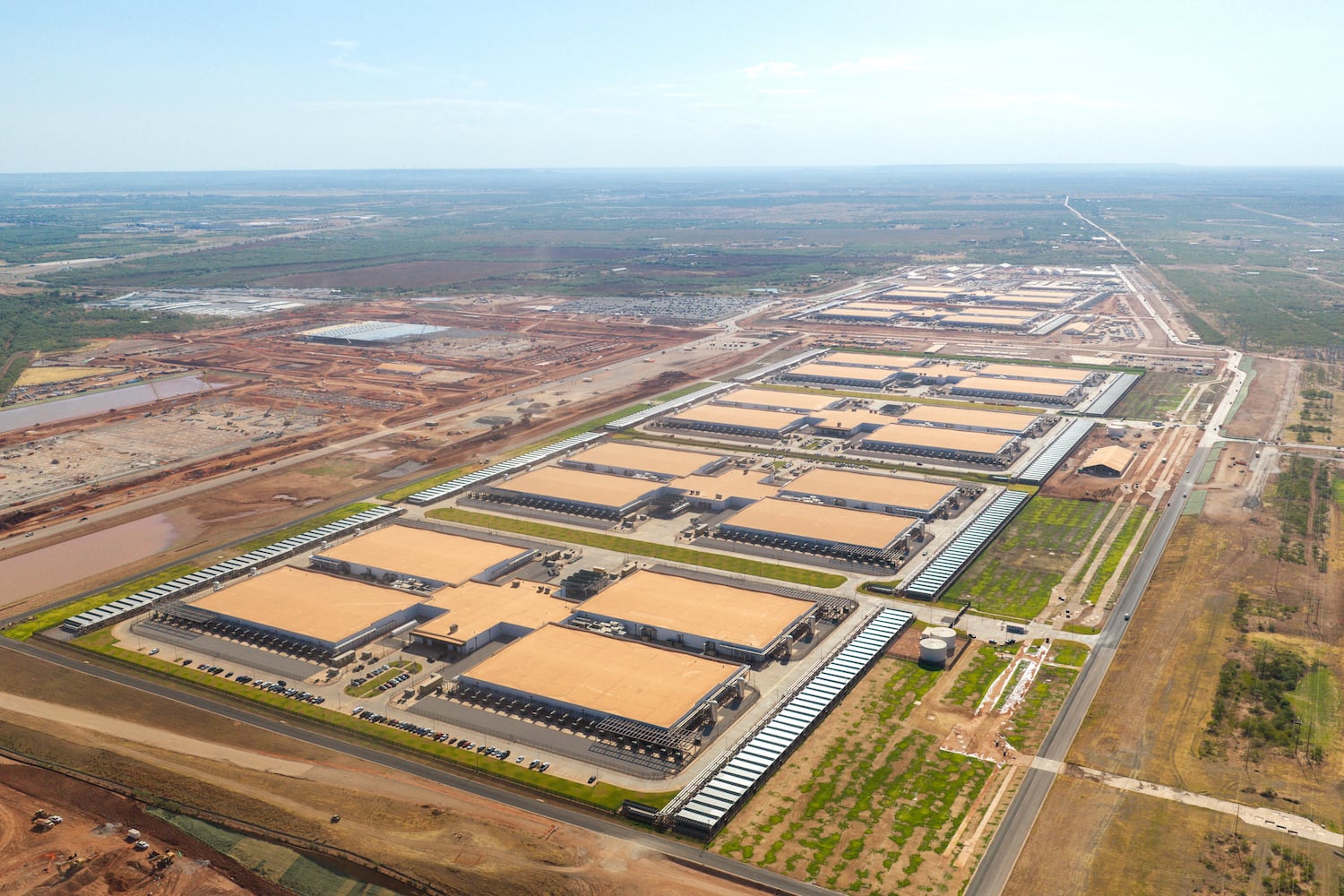
!In an aerial view, the Stargate AI data center campus is seen in Abilene, Texas.
*In an aerial view, the Stargate AI data center campus is seen in Abilene, Texas.*
In an aerial view, the Stargate AI data center campus is seen in Abilene, Texas, on Aug. 26. Brandon Bell/Getty Images
*
*
*
Weeks ahead of high-stakes midterm elections, many Americans are revolting against the data centers being developed in their communities to power President Donald Trump’s artificial intelligence ambitions.
About two-thirds of Americans oppose local data center construction, according to polls, and that resistance has been reflected in sweeping protests. In addition to concerns about the impact a new data center may have on jobs, local residents commonly cite the amounts of water, electricity, and land data centers consume and what that could mean for energy bills and the environment.
Weeks ahead of high-stakes midterm elections, many Americans are revolting against the data centers being developed in their communities to power President Donald Trump’s artificial intelligence ambitions.
About two-thirds of Americans oppose local data center construction, according to polls, and that resistance has been reflected in sweeping protests. In addition to concerns about the impact a new data center may have on jobs, local residents commonly cite the amounts of water, electricity, and land data centers consume and what that could mean for energy bills and the environment.
Most controversial are the “hyperscale” data centers used by companies such as Amazon, Microsoft, and Google, which can dwarf the size of other facilities and have taken off amid the AI boom.
Opposition has grown so fierce that at least 15 states are weighing moratoriums, while lawmakers on both sides of the aisle have aligned themselves with outraged locals. “We’ve finally found something that can unite the left and the right,” quipped Joshua Rhodes, a research scientist at the University of Texas at Austin.
Yet that backlash has done little to deter the Trump administration, which has championed data centers in its bid for global AI dominance. More than 1,500 data centers are now under development, adding to the 3,000 already operating in the country, according to the Pew Research Center.
“The only reason that communities throughout the U.S.A. should not want Data Centers is if they want to end up being backwards and poor,” Trump declared in a post on Truth Social in August. “If they want to be successful and rich, with far lower taxes and jobs all over the place, let Data Reign.”
As tensions threaten to reach a fever pitch ahead of midterms, here’s what we know about data centers’ actual resource footprint.
---
Power
At a time of surging energy costs, national attention has focused on data centers’ power consumption, with half of Americans saying that they spell trouble for energy bills, according to Pew.
Data centers accounted for 4.7 percent of total U.S. electricity consumption in 2024, up from 4.4 percent the year before, according to Lawrence Berkeley National Laboratory.
That share is set to surge in the coming years, though estimates range. Data centers could consume nearly 12 percent of U.S. electricity by 2030, according to Lawrence Berkeley. And by 2035, data centers could suck up so much energy that they make up about one-fifth of U.S. electricity consumption, according to BloombergNEF.
So far, the data center construction frenzy has been largely concentrated in a handful of hot spots, with the biggest in Virginia, Texas, and California. But that is poised to spread as even more data centers are planned, including in Illinois, Georgia, Ohio, and Arizona.
All of those forecasts point to a buildout unfolding at a speed and scale that states are ill-equipped for. “We’re looking at very rapid growth, and what’s been happening in recent years is very flat demand in the power sector,” said Lori Bird, an energy expert at the World Resources Institute. “So this is quite a reversal.”
Texas offers a window into how such an expansion can strain local infrastructure—and ignite a political firestorm. Texas Gov. Greg Abbott once vowed to make the state the “epicenter of AI development,” and at least 248 new data center projects are planned, adding to the state’s existing 335.
“There’s almost no muscle memory in the system to meet those growth rates,” said Ashish Sethia, the global head of commodities at BloombergNEF, citing a scarcity of technicians, transformers, and transmission lines. “Therefore, you’re seeing this kind of scramble to try and get hands on as much power capacity to support your data center.”
Demand has been relentless. Over the summer, the Electric Reliability Council of Texas (ERCOT), which operates the state’s grid, said it was considering about 474 gigawatts (GW) of interconnection requests—or over five times the state’s record peak electricity demand for the operator, according to the state officials; 90 percent of those new power requests are from data centers, ERCOT said. In August, Abbott directed state regulators to stop data center connections and ordered audits.
Read More
*
*A crowd of spectators watches as small humanoid robots play soccer on a green turf
!Foreign Policy
Foreign Policy Get analysis and alerts more quickly in the mobile app.
Install
Back to Foreign Policy Magazine home page
* Latest
* Regions
+ Asia & the Pacific
+ China
+ Middle East & Africa
+ Americas
+ Europe
* Newsletters
Editors’ Picks
Evening roundup with our editors’ favorite stories of the day
!World Brief Icon
World Brief
Your guide to the most important world stories of the day
!China Brief Icon
China Brief
The latest news, analysis, and data from the country each week
Situation Report
Weekly update on what’s driving U.S. national security policy
FP Weekend
A curation of our best book reviews, deep dives, and other reads
!Africa Brief Icon
Africa Brief
Essential analysis of the stories shaping geopolitics on the continent
!South Asia Brief Icon
South Asia Brief
Weekly update on developments in India and its neighbors
The Reading List
Curated guides on geopolitics and current affairs
FP Bookshelf
A monthly guide to FP’s book reviews, excerpts, and reading recommendations
!Latin America Brief Icon
Latin America Brief
One-stop digest of politics, economics, and culture
!Southeast Asia Brief Icon
Southeast Asia Brief
A weekly dispatch with news from the region’s 11 countries
The New Geopolitics
A five-part masterclass in IR theory with Harvard Professor Stephen M. Walt
View All Newsletters
* FP Live
* Latest
* Trending:
* France's student protests
* Brazil's election
Search this website
* Preferences
* My FP Feed
* Saved Articles
* Newsletters
* Magazine Archive
* Subscription Settings
* FAQs
* Log Out
Sign In
Sign In
Team access Team access
Subscribe Subscribe Team access Team access
Deep Dive: The Real Footprint of Trump’s Data Center Boom
*
*
* Bluesky
* X
Save
1. Create an FP account to save articles to read later.
Sign Up
ALREADY AN FP SUBSCRIBER? LOGIN
1. **Downloadable PDFs** are a benefit of an FP subscription.
Subscribe Now
ALREADY AN FP SUBSCRIBER? LOGIN
Gift
*
*
1. Gifting articles is a subscriber benefit.
Subscribe Now
ALREADY AN FP SUBSCRIBER? LOGIN
2. This article is an Insider exclusive.
Contact us at [email protected] to learn about upgrade options, unlocking the ability to gift this article.
Deep Dive
The Real Footprint of Trump’s Data Center Boom
What the sprawling buildout means for energy, water, and land.
October 12, 2026, 6:00 AM
By **Christina Lu**, a staff writer at *Foreign Policy*.
!In an aerial view, the Stargate AI data center campus is seen in Abilene, Texas.
*In an aerial view, the Stargate AI data center campus is seen in Abilene, Texas.*
In an aerial view, the Stargate AI data center campus is seen in Abilene, Texas, on Aug. 26. Brandon Bell/Getty Images
*
*
*
Weeks ahead of high-stakes midterm elections, many Americans are revolting against the data centers being developed in their communities to power President Donald Trump’s artificial intelligence ambitions.
About two-thirds of Americans oppose local data center construction, according to polls, and that resistance has been reflected in sweeping protests. In addition to concerns about the impact a new data center may have on jobs, local residents commonly cite the amounts of water, electricity, and land data centers consume and what that could mean for energy bills and the environment.
Weeks ahead of high-stakes midterm elections, many Americans are revolting against the data centers being developed in their communities to power President Donald Trump’s artificial intelligence ambitions.
About two-thirds of Americans oppose local data center construction, according to polls, and that resistance has been reflected in sweeping protests. In addition to concerns about the impact a new data center may have on jobs, local residents commonly cite the amounts of water, electricity, and land data centers consume and what that could mean for energy bills and the environment.
Most controversial are the “hyperscale” data centers used by companies such as Amazon, Microsoft, and Google, which can dwarf the size of other facilities and have taken off amid the AI boom.
Opposition has grown so fierce that at least 15 states are weighing moratoriums, while lawmakers on both sides of the aisle have aligned themselves with outraged locals. “We’ve finally found something that can unite the left and the right,” quipped Joshua Rhodes, a research scientist at the University of Texas at Austin.
Yet that backlash has done little to deter the Trump administration, which has championed data centers in its bid for global AI dominance. More than 1,500 data centers are now under development, adding to the 3,000 already operating in the country, according to the Pew Research Center.
“The only reason that communities throughout the U.S.A. should not want Data Centers is if they want to end up being backwards and poor,” Trump declared in a post on Truth Social in August. “If they want to be successful and rich, with far lower taxes and jobs all over the place, let Data Reign.”
As tensions threaten to reach a fever pitch ahead of midterms, here’s what we know about data centers’ actual resource footprint.
---
Power
At a time of surging energy costs, national attention has focused on data centers’ power consumption, with half of Americans saying that they spell trouble for energy bills, according to Pew.
Data centers accounted for 4.7 percent of total U.S. electricity consumption in 2024, up from 4.4 percent the year before, according to Lawrence Berkeley National Laboratory.
That share is set to surge in the coming years, though estimates range. Data centers could consume nearly 12 percent of U.S. electricity by 2030, according to Lawrence Berkeley. And by 2035, data centers could suck up so much energy that they make up about one-fifth of U.S. electricity consumption, according to BloombergNEF.
So far, the data center construction frenzy has been largely concentrated in a handful of hot spots, with the biggest in Virginia, Texas, and California. But that is poised to spread as even more data centers are planned, including in Illinois, Georgia, Ohio, and Arizona.
All of those forecasts point to a buildout unfolding at a speed and scale that states are ill-equipped for. “We’re looking at very rapid growth, and what’s been happening in recent years is very flat demand in the power sector,” said Lori Bird, an energy expert at the World Resources Institute. “So this is quite a reversal.”
Texas offers a window into how such an expansion can strain local infrastructure—and ignite a political firestorm. Texas Gov. Greg Abbott once vowed to make the state the “epicenter of AI development,” and at least 248 new data center projects are planned, adding to the state’s existing 335.
“There’s almost no muscle memory in the system to meet those growth rates,” said Ashish Sethia, the global head of commodities at BloombergNEF, citing a scarcity of technicians, transformers, and transmission lines. “Therefore, you’re seeing this kind of scramble to try and get hands on as much power capacity to support your data center.”
Demand has been relentless. Over the summer, the Electric Reliability Council of Texas (ERCOT), which operates the state’s grid, said it was considering about 474 gigawatts (GW) of interconnection requests—or over five times the state’s record peak electricity demand for the operator, according to the state officials; 90 percent of those new power requests are from data centers, ERCOT said. In August, Abbott directed state regulators to stop data center connections and ordered audits.
Read More
*
*A crowd of spectators watches as small humanoid robots play soccer on a green turf
🔗 Share Article
Tags:#الذكاء الاصطناعي#مراكز البيانات#تكساس#الطاقة#الموارد الطبيعية#السياسة الأمريكية
Source: Foreign Policy
For Context
Related reads from the same topic or latest developments