Trapped Ebola health workers rescued after three days of fighting in Congo Jump to content
UK News Website of the Year 2024
Trapped Ebola health workers rescued after three days of fighting in Congo
WHO chief said staff caught in the crossfire had been evacuated from a hospital ‘under very challenging circumstances’
This feature is available for registered users. Please register or log in to continue
RegisterLog in
Gift article
Give full access to this article, free time. You have 15 articles left to gift, this month.
Log in or
Ben Farmer Africa Correspondent Show biography !Ben Farmer
Ben is based in South Africa and also works on The Telegraph's Global Health Security team. He spent five years in Kabul covering the Afghanistan war, five years as Defence Correspondent in London, and four years in Islamabad
Published 24 November 2026 4:18pm GMT
This feature is available for registered users. Please register or log in to continue
RegisterLog in
Log in or
Give full access to this article, free time. You have 15 articles left to gift, this month.
Log in or
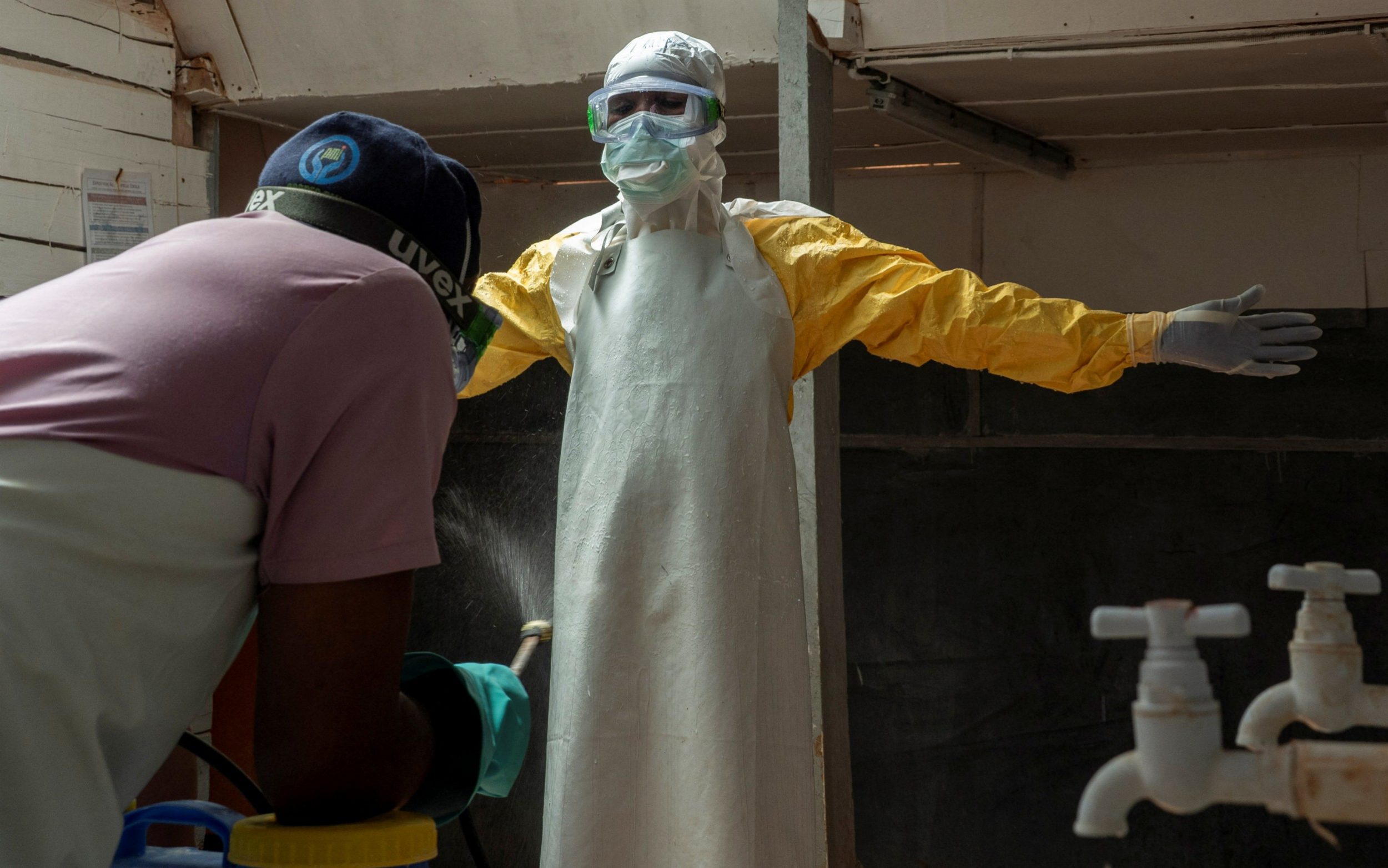
*Medical staff responding to the outbreak had been forced to shelter in a maternity ward amid intense fighting Credit: REUTERS/Gradel Muyisa Mumbere*
Ben Farmer Africa Correspondent Show biography !Ben Farmer
Ben is based in South Africa and also works on The Telegraph's Global Health Security team. He spent five years in Kabul covering the Afghanistan war, five years as Defence Correspondent in London, and four years in Islamabad
Published 24 November 2026 4:18pm GMT
Ebola health workers have been rescued after being trapped by fighting for more than three days, in clashes further hampering efforts to curb the virus in Democratic Republic of Congo (DRC).
Tedros Adhanom Ghebreyesus, head of the World Health Organization, said staff had been evacuated from a hospital in Akwe, Ituri province, “under very challenging circumstances”.
The health chief had earlier pleaded for peace, and warned staff had “been sheltering for their lives in a maternity ward of the facility for over 24 hours”.
Staff were caught in a crossfire between the Congolese army, and the People’s Revolutionary Convention (CRP) group led by former International Criminal Court (ICC) convict, Thomas Lubanga, French RFI radio reported.
Local media reported heavy clashes between the army and the CRP in Ituri in recent days. At least 10 people were killed and a stream of refugees fled to the provincial capital, Bunia.
As security worsened, the WHO said it had relocated health teams from Mongbwalu.
*Congolese civilians flee an attack by Islamic State-linked militants in Cantine-Aloya, North Kivu province Credit: REUTERS/Gradel Muyisa Mumbere*
The fighting has flared in a province which was the early epicentre of what has become the second largest Ebola outbreak on record.
Aid workers warn the flow of panicked residents from the fighting risks spreading the deadly haemorrhagic fever more widely, and disrupting already shaky quarantine and contact tracing operations.
The CRP is one of the largest of scores of armed groups operating in eastern DRC.
Lubanga was sentenced to 14 years in prison by the International Criminal Court in 2012 for war crimes involving the recruitment and use of child soldiers. He was released in March 2020 after serving his sentence and announced the formation of the CRP last year.
Attacks from another group, the Islamic State-linked Allied of Democratic Forces (ADF) have killed more than 100 in recent weeks and caused relief agencies to scale back efforts due to poor security.
Meanwhile, the global vaccine alliance Gavi said it planned to buy up to 1.5 million doses of an experimental new vaccine against the rare Bundibugyo strain responsible for the outbreak, if it proved effective, Reuters reported.
*Congolese warlord Thomas Lubanga during his ICC trial at The Hague in 2012 Credit: REUTERS/Evert-Jan Daniels*
The vaccine, developed by Britain’s University of Oxford and the Serum Institute of India, is currently undergoing trials in the DRC.
There are no approved treatments or vaccines for the strain, which has so far caused nearly 12,000 cases and nearly 6,000 deaths.
Without a vaccine, efforts to stop the spread have relied on spotting and quarantining cases and then tracking down anyone patients may have come into contact with, to isolate them if necessary before they become sick.
Yet eastern DRC’s mix of insecurity, suspicion, remote locations and a patchy health system have meant such disease surveillance, contact tracing and quarantine measures are poorly adhered to.
A situation update late last week from the Africa Centres for Disease Control estimated only 11 per cent of confirmed cases came from the contact lists, against a target of 95 per cent. This is a worrying statistic, meaning that the disease is spreading largely undetected.
The update said: “The response found the other 89 per cent outside those lists, which means many transmission links were identified too late to list and monitor the contacts.”
***Protect yourself and your family by learning more about*** ***Global Health Security***
More stories
We found a living carpet of maggots and slugs beneath our floor
The problem with the NHS is what supposedly makes it great
My wife had our seven-year-old daughter baptised without telling me
Putin herds Russia’s sons into the meat grinder as the body count passes 700k
US air travel in chaos again after plane weight glitch
Nicola Coughlan gets trapped by the ‘manosphere’ in a devastating fable
More from News
* Gunmen hold 25 people hostage at Colombian supermarket
* Top US intelligence agencies hit by cyber security breach
* Labour to consult on staggered age of consent after Brand scandal
* Trump: I’ll pardon turkeys in my missile-proof ballroom
* Mercedes puts 1960s supercar on sale for first time
* Manchester concert ‘tear gas’ could be linked to robberies across Europe
More from The Telegraph
Midges pose a growing health threat to Britons, experts warn
Trapped Ebola health workers rescued after three days of fighting in Congo
Ebola health workers trapped for more than three days by clashes in Ituri province, eastern Democratic Republic of Congo, have been evacuated, according to the World Health Organization. The fighting further complicates efforts to contain what has become the second-largest Ebola outbreak on record.
Cross Lines newsroom
Share this article
#إيبولا#جمهورية الكونغو الديمقراطية#منظمة الصحة العالمية#المؤتمر الثوري الشعبي#الأمن الصحي العالمي#شرق الكونغو
Original source: The Telegraph