America's changing disaster risk hits energy
Axios
A
Axios
Original Source
America's energy infrastructure faces growing risks from severe thunderstorms, which now account for a larger share of insured catastrophic losses than hurricanes. New renewable energy projects and data centers are being built in high-risk zones, amplifying potential losses when storms strike.
Extreme weather risk grows for US energy system
*
* Newsletters
*
* Axios Pro
* Axios Live
* The Axios Show
Axios
Axios
1 hour ago - Energy & Climate
America's changing disaster risk hits energy
* Rebecca Falconer
*
*
*
Add Axios on Google
Add Axios as your preferred source to
see more of our stories on Google.
Add Axios on Google
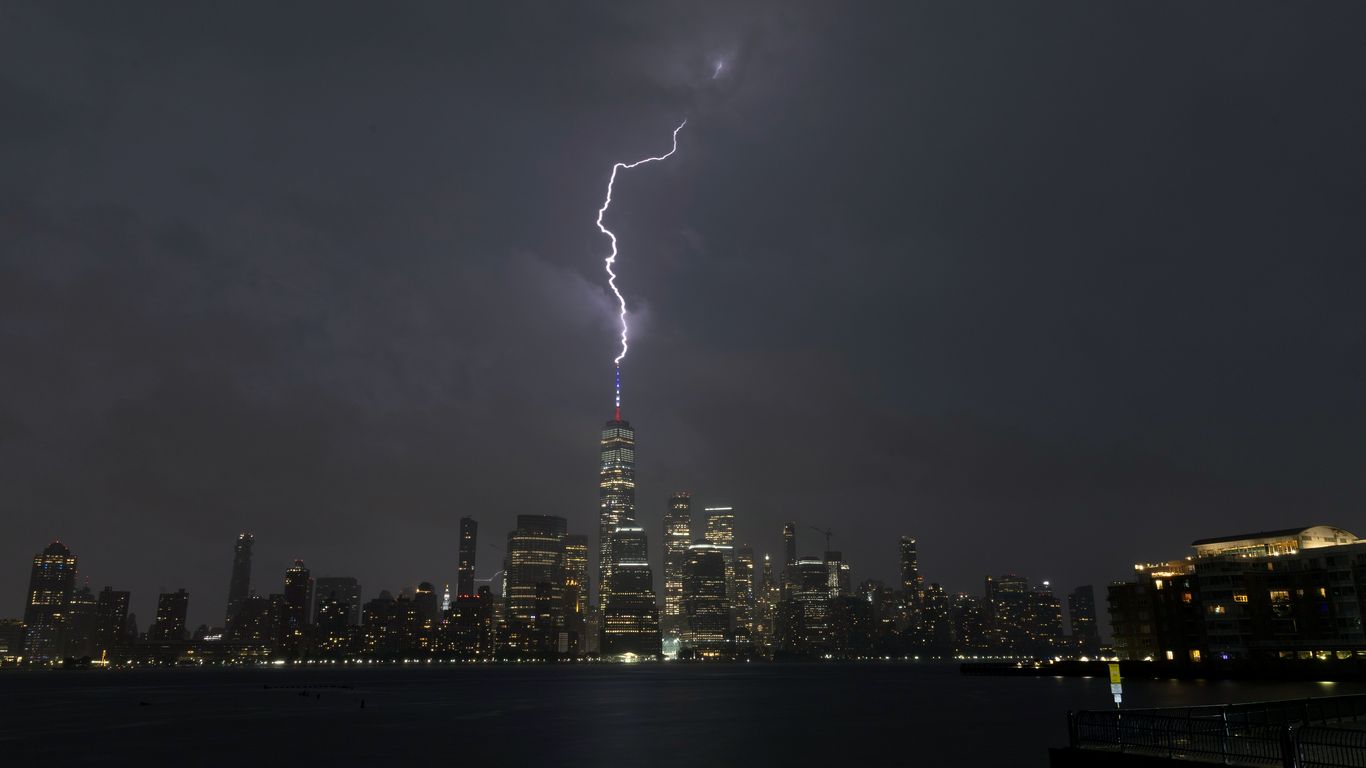
!Nighttime city skyline along the water as a bright lightning bolt descends from dark clouds and strikes the tallest central skyscraper, whose antenna is lit red and blue.
*A lightning bolt strikes One World Trade Center during a thunderstorm in New York City in June. Photo: Gary Hershorn/Getty Images*
Hurricanes have long dominated efforts to make the power system more resilient to extreme weather. But America's energy buildout is running into growing risks from severe thunderstorms.
**Why it matters:** New energy infrastructure and data centers are being built in harm's way as severe weather risks shift, leaving more for developers and insurers to lose when storms hit.
**Driving the news:** Severe thunderstorms account for 40% of modeled global insured catastrophe risk, compared with 27% for hurricanes, according to analysis from risk analytics firm Verisk.
* The U.S. accounts for $117 billion, or 68%, of Verisk's modeled global insured catastrophe losses.
**Threat level:** A warmer atmosphere can hold more moisture, potentially creating more favorable conditions for powerful thunderstorms. But the effects of climate change on severe storms are complicated.
* National Oceanic and Atmospheric Administration research scientist Harold Brooks told Axios that other atmospheric conditions needed for severe storms may become less favorable as the planet warms.
**Reality check:** Verisk's Jay Guin said growing exposure, more than climate change, is the dominant driver of rising insured losses, as more and increasingly valuable property is built in harm's way.
* Guin says climate change contributes, but expanding development and higher reconstruction costs are much larger drivers.
**Zoom in:** America's changing energy system is creating new kinds of exposure.
* Verisk is assessing risks to renewable projects in tornado- and hail-prone areas, where Guin said large hail can cause major damage to solar farms.
* "While they are renewable, you have a new asset class that is quite vulnerable," he said.
* Data-center developers must balance natural-hazard exposure against access to land, power and water. Some sites have billions in property and hardware, raising the stakes for siting and engineering.
**State of play:** Tornado activity has increased about 10% in the Mid-South while declining by roughly the same amount from the Texas Panhandle through western Kansas, Brooks said.
* Population densities in rural areas of the Southeast are roughly 100 times those in the High Plains.
* "It's 10 people per square kilometer in rural areas of northern Mississippi and Alabama, and so a tornado in that area can't miss buildings and can't miss people," Brooks says.
**Zoom out:** For infrastructure, Brooks said the biggest thunderstorm-related concern is flooding.
* Heavy rain and flooding are "a huge threat to virtually all of our infrastructure," he said.
**The bottom line:** "There is no ... safe climate zone," Guin said.
*
*
*
Add Axios on Google
What to read next
*
*
*
*
*
*
Smarter, faster on what matters.
Explore Axios Newsletters
* About Axios
* Advertise with us
* Careers
* Contact us
* Newsletters
* Axios Live
* Axios HQ
* Privacy policy
* Terms of use
*
Axios Homepage
Axios Media Inc., 2026
*
* Newsletters
*
* Axios Pro
* Axios Live
* The Axios Show
Axios
Axios
1 hour ago - Energy & Climate
America's changing disaster risk hits energy
* Rebecca Falconer
*
*
*
Add Axios on Google
Add Axios as your preferred source to
see more of our stories on Google.
Add Axios on Google
!Nighttime city skyline along the water as a bright lightning bolt descends from dark clouds and strikes the tallest central skyscraper, whose antenna is lit red and blue.
*A lightning bolt strikes One World Trade Center during a thunderstorm in New York City in June. Photo: Gary Hershorn/Getty Images*
Hurricanes have long dominated efforts to make the power system more resilient to extreme weather. But America's energy buildout is running into growing risks from severe thunderstorms.
**Why it matters:** New energy infrastructure and data centers are being built in harm's way as severe weather risks shift, leaving more for developers and insurers to lose when storms hit.
**Driving the news:** Severe thunderstorms account for 40% of modeled global insured catastrophe risk, compared with 27% for hurricanes, according to analysis from risk analytics firm Verisk.
* The U.S. accounts for $117 billion, or 68%, of Verisk's modeled global insured catastrophe losses.
**Threat level:** A warmer atmosphere can hold more moisture, potentially creating more favorable conditions for powerful thunderstorms. But the effects of climate change on severe storms are complicated.
* National Oceanic and Atmospheric Administration research scientist Harold Brooks told Axios that other atmospheric conditions needed for severe storms may become less favorable as the planet warms.
**Reality check:** Verisk's Jay Guin said growing exposure, more than climate change, is the dominant driver of rising insured losses, as more and increasingly valuable property is built in harm's way.
* Guin says climate change contributes, but expanding development and higher reconstruction costs are much larger drivers.
**Zoom in:** America's changing energy system is creating new kinds of exposure.
* Verisk is assessing risks to renewable projects in tornado- and hail-prone areas, where Guin said large hail can cause major damage to solar farms.
* "While they are renewable, you have a new asset class that is quite vulnerable," he said.
* Data-center developers must balance natural-hazard exposure against access to land, power and water. Some sites have billions in property and hardware, raising the stakes for siting and engineering.
**State of play:** Tornado activity has increased about 10% in the Mid-South while declining by roughly the same amount from the Texas Panhandle through western Kansas, Brooks said.
* Population densities in rural areas of the Southeast are roughly 100 times those in the High Plains.
* "It's 10 people per square kilometer in rural areas of northern Mississippi and Alabama, and so a tornado in that area can't miss buildings and can't miss people," Brooks says.
**Zoom out:** For infrastructure, Brooks said the biggest thunderstorm-related concern is flooding.
* Heavy rain and flooding are "a huge threat to virtually all of our infrastructure," he said.
**The bottom line:** "There is no ... safe climate zone," Guin said.
*
*
*
Add Axios on Google
What to read next
*
*
*
*
*
*
Smarter, faster on what matters.
Explore Axios Newsletters
* About Axios
* Advertise with us
* Careers
* Contact us
* Newsletters
* Axios Live
* Axios HQ
* Privacy policy
* Terms of use
*
Axios Homepage
Axios Media Inc., 2026
🔗 Share Article
Tags:#الطاقة#المناخ#الكوارث الطبيعية#البنية التحتية#الولايات المتحدة#التأمين
Source: Axios
For Context
Related reads from the same topic or latest developments