Germany's Merz visits Kyiv as Russia steps up attacks on Ukrainian cities
ABC News
A
ABC News
Original Source
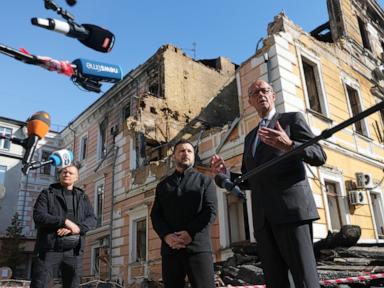
German Chancellor Friedrich Merz visited Kyiv on Sunday in a show of solidarity with Ukraine as Russia intensifies aerial attacks on Ukrainian cities. Merz reaffirmed Germany's commitment to supporting Ukraine, noting that Berlin has provided over €43.3 billion in aid since the war began.
KYIV, Ukraine -- German Chancellor Friedrich Merz arrived in Kyiv Sunday in a show of support as Russia escalated its attacks on Ukrainian cities.
The aerial war has intensified, with Moscow menacing cities across Ukraine with hard-to-intercept ballistic missiles and jet-powered drones, while Kyiv has been striking Russia’s oil industry and businesses.
Merz said he traveled to the Ukrainian capital on his second trip as chancellor to demonstrate his country's solidarity with Ukraine. Germany is Ukraine’s largest donor, sending Kyiv more than €43.3 billion ($48.8 billion) since the war began, along with equipment and weapons.
“If Russia is not stopped, its war machine will sooner or later turn against us,” he said in a statement Sunday, adding that he told Ukrainian President Volodymyr Zelenskyy: “You can continue to count on our help.”
Merz said the partnership between the two countries was “not a one-way street,” pointing to German and Ukrainian companies jointly developing technologies that benefit both sides. “This makes us safer and stronger,” he said.
In a post on X, Zelenskyy thanked Germany and said the two countries would make “important agreements” during the visit to strengthen Ukraine’s defenses and those of the rest of Europe. “Russia must be stopped together,” he wrote.
Ukrainian Foreign Minister Andrii Sybiha said the agenda would focus on "strengthening Ukraine, our defense and resilience, and our shared European security.”
Russia’s Foreign Ministry said Saturday it would continue to carry out “mass retaliatory strikes” on Kyiv and other Ukrainian cities, urging foreign nationals and diplomats to leave the country. It previously issued a similar warning in May.
The German and Russian foreign ministers met on the sidelines of the U.N. General Assembly’s annual gathering of world leaders last month in what was believed to be the first such face-to-face meeting since Russia’s full-scale invasion of Ukraine in 2022. Russia's Sergey Lavrov rejected German calls to ease off its “dangerous path of escalation” toward the country, and instead accused Germany of being Ukraine’s main sponsor and seeking to be a leading military power in Europe.
Ties between Russia and Germany have soured even more in recent weeks, following an attempted drone attack in early September at Leipzig airport. Germany has blamed Russia for the incident and announced the closure of the German consulate in St. Petersburg, the latest in a cycle of tit-for-tat moves.
Meanwhile, Merz's power inside Germany has taken a blow after a string of state election defeats last month, including losses to the anti-migration and Russia-friendly Alternative for Germany party. However, he said he intends to remain chancellor.
On Sunday morning, Russian attacks continued with a drone hitting Kyiv’s Northern Bridge over the Dnipro River again, Zelenskyy said. Video circulating on social media showed the drone flying into the bridge and the explosion as vehicles crossed. There was no immediate word on casualties.
The latest strike came after Russian assaults forced the full or partial closure of three of Kyiv’s six road bridges over the Dnipro River earlier this week, suspending traffic and causing tailbacks in Moscow’s latest effort to disrupt life in the Ukrainian capital. Previously, Russia has hit apartment blocks, supermarket warehouses, gas stations and data centers, among other targets.
Seven people were wounded Sunday in a Russian aerial bomb attack on the Ukrainian city of Sumy, local officials said.
Russia invaded its neighbor more than 4½ years ago, and there are no concrete signs that a peace settlement might be possible. Fighting along the roughly 1,250-kilometer (780-mile) front line snaking through northern, eastern and southern Ukraine has been virtually deadlocked in recent months.
___
Dazio reported from Berlin and Morton from London.
The aerial war has intensified, with Moscow menacing cities across Ukraine with hard-to-intercept ballistic missiles and jet-powered drones, while Kyiv has been striking Russia’s oil industry and businesses.
Merz said he traveled to the Ukrainian capital on his second trip as chancellor to demonstrate his country's solidarity with Ukraine. Germany is Ukraine’s largest donor, sending Kyiv more than €43.3 billion ($48.8 billion) since the war began, along with equipment and weapons.
“If Russia is not stopped, its war machine will sooner or later turn against us,” he said in a statement Sunday, adding that he told Ukrainian President Volodymyr Zelenskyy: “You can continue to count on our help.”
Merz said the partnership between the two countries was “not a one-way street,” pointing to German and Ukrainian companies jointly developing technologies that benefit both sides. “This makes us safer and stronger,” he said.
In a post on X, Zelenskyy thanked Germany and said the two countries would make “important agreements” during the visit to strengthen Ukraine’s defenses and those of the rest of Europe. “Russia must be stopped together,” he wrote.
Ukrainian Foreign Minister Andrii Sybiha said the agenda would focus on "strengthening Ukraine, our defense and resilience, and our shared European security.”
Russia’s Foreign Ministry said Saturday it would continue to carry out “mass retaliatory strikes” on Kyiv and other Ukrainian cities, urging foreign nationals and diplomats to leave the country. It previously issued a similar warning in May.
The German and Russian foreign ministers met on the sidelines of the U.N. General Assembly’s annual gathering of world leaders last month in what was believed to be the first such face-to-face meeting since Russia’s full-scale invasion of Ukraine in 2022. Russia's Sergey Lavrov rejected German calls to ease off its “dangerous path of escalation” toward the country, and instead accused Germany of being Ukraine’s main sponsor and seeking to be a leading military power in Europe.
Ties between Russia and Germany have soured even more in recent weeks, following an attempted drone attack in early September at Leipzig airport. Germany has blamed Russia for the incident and announced the closure of the German consulate in St. Petersburg, the latest in a cycle of tit-for-tat moves.
Meanwhile, Merz's power inside Germany has taken a blow after a string of state election defeats last month, including losses to the anti-migration and Russia-friendly Alternative for Germany party. However, he said he intends to remain chancellor.
On Sunday morning, Russian attacks continued with a drone hitting Kyiv’s Northern Bridge over the Dnipro River again, Zelenskyy said. Video circulating on social media showed the drone flying into the bridge and the explosion as vehicles crossed. There was no immediate word on casualties.
The latest strike came after Russian assaults forced the full or partial closure of three of Kyiv’s six road bridges over the Dnipro River earlier this week, suspending traffic and causing tailbacks in Moscow’s latest effort to disrupt life in the Ukrainian capital. Previously, Russia has hit apartment blocks, supermarket warehouses, gas stations and data centers, among other targets.
Seven people were wounded Sunday in a Russian aerial bomb attack on the Ukrainian city of Sumy, local officials said.
Russia invaded its neighbor more than 4½ years ago, and there are no concrete signs that a peace settlement might be possible. Fighting along the roughly 1,250-kilometer (780-mile) front line snaking through northern, eastern and southern Ukraine has been virtually deadlocked in recent months.
___
Dazio reported from Berlin and Morton from London.
🔗 Share Article
Tags:#ألمانيا#أوكرانيا#روسيا#ميرتس#الصراع الأوكراني#زيلينسكي
Source: ABC News
For Context
Related reads from the same topic or latest developments
Same context
Houthis claim strike on Saudi energy facility as Yemen fighting intensifies
Follow-up
Russia strikes Kyiv bridge in a new tactic to disrupt life in the Ukrainian capital

Follow-up