How to Fix Our Global Malaise
Foreign Policy

Foreign Policy
Original Source
Former British Prime Minister Gordon Brown argues that rebuilding strong local communities can have a surprising international effect in countering populism and global divisions. He warns of the unraveling of the Western-led liberal international order that has dominated for eight decades and calls for a fifth global order rooted in grassroots community strength.
Fixing Global Malaise: How Rebuilding Local Communities Can Counter Populism
By using this website, you agree to our use of cookies. This use includes personalization of content and ads, and traffic analytics. Review our Privacy Policy for more information.
!Foreign Policy
Foreign Policy Get analysis and alerts more quickly in the mobile app.
Install
Back to Foreign Policy Magazine home page
* Latest
* Regions
+ Asia & the Pacific
+ China
+ Middle East & Africa
+ Americas
+ Europe
* Newsletters
Editors’ Picks
Evening roundup with our editors’ favorite stories of the day
!World Brief Icon
World Brief
Your guide to the most important world stories of the day
!China Brief Icon
China Brief
The latest news, analysis, and data from the country each week
Situation Report
Weekly update on what’s driving U.S. national security policy
FP Weekend
A curation of our best book reviews, deep dives, and other reads
!Africa Brief Icon
Africa Brief
Essential analysis of the stories shaping geopolitics on the continent
!South Asia Brief Icon
South Asia Brief
Weekly update on developments in India and its neighbors
The Reading List
Curated guides on geopolitics and current affairs
FP Bookshelf
A monthly guide to FP’s book reviews, excerpts, and reading recommendations
!Latin America Brief Icon
Latin America Brief
One-stop digest of politics, economics, and culture
!Southeast Asia Brief Icon
Southeast Asia Brief
A weekly dispatch with news from the region’s 11 countries
The New Geopolitics
A five-part masterclass in IR theory with Harvard Professor Stephen M. Walt
View All Newsletters
* FP Live
* Latest
* Trending:
* Brazil's election
* Canada-EU ties
Search this website
* Preferences
* My FP Feed
* Saved Articles
* Newsletters
* Magazine Archive
* Subscription Settings
* FAQs
* Log Out
Sign In
Sign In
Team access Team access
Subscribe Subscribe Team access Team access
Essay: How to Fix Our Global Malaise
*
*
* Facebook
* Bluesky
* X
* LinkedIn
* WhatsApp
* Reddit
Save
1. Create an FP account to save articles to read later.
Sign Up
ALREADY AN FP SUBSCRIBER? LOGIN
PDF
1. **Downloadable PDFs** are a benefit of an FP subscription.
Subscribe Now
ALREADY AN FP SUBSCRIBER? LOGIN
Gift
*
*
* WhatsApp
1. Gifting articles is a subscriber benefit.
Subscribe Now
ALREADY AN FP SUBSCRIBER? LOGIN
2. This article is an Insider exclusive.
Contact us at [email protected] to learn about upgrade options, unlocking the ability to gift this article.
Essay
How to Fix Our Global Malaise
Focusing on local communities can have a surprising international effect.
October 5, 2026, 4:00 AM
By **Gordon Brown**, a former prime minister of the United Kingdom and the U.N. special envoy for global education. Brown is the author of *The Future Starts With Us*.
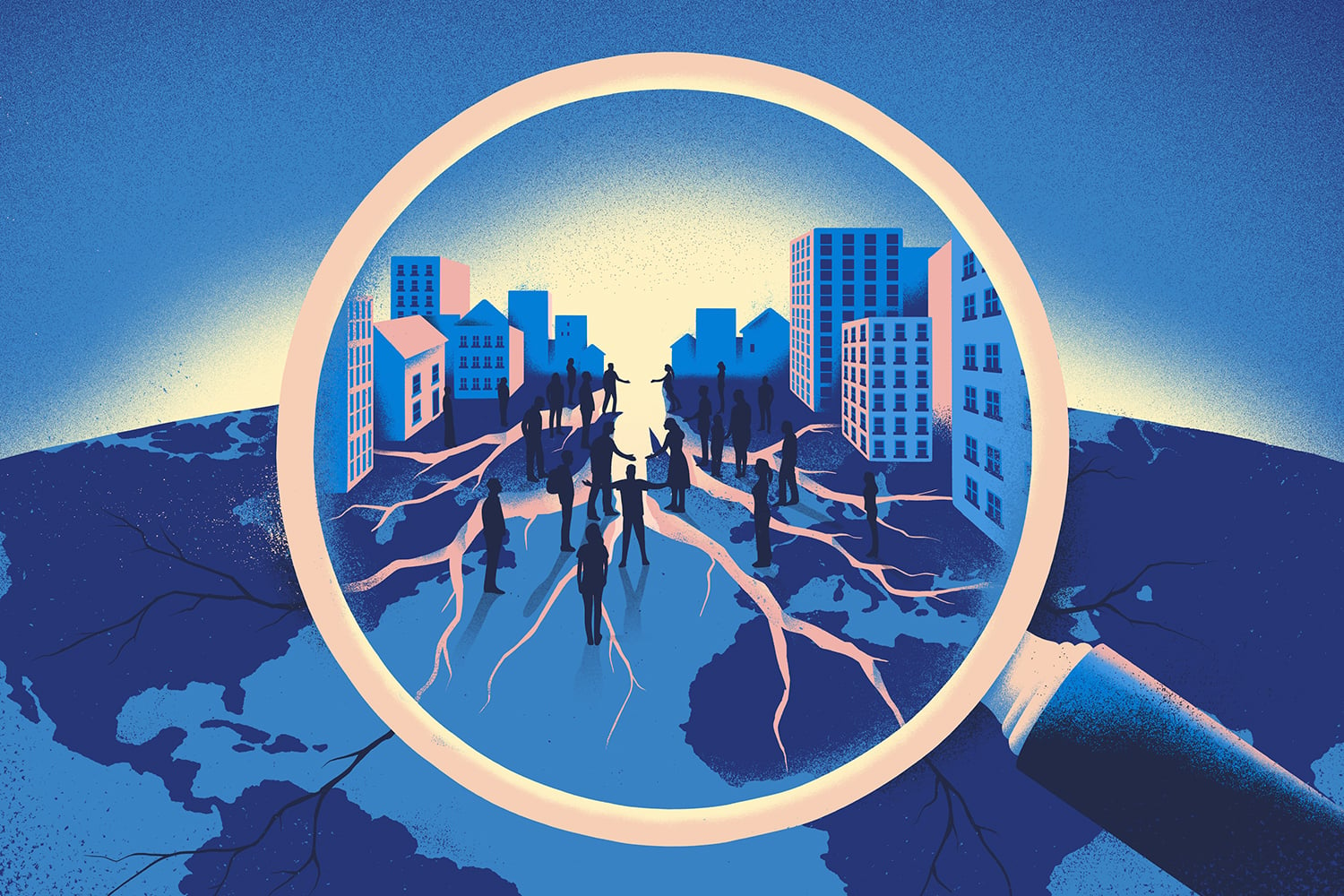
!An illustration showing a magnifying glass focusing on silhouetted figures standing along landmasses split by cracks, surrounded by buildings and a world map in shades of blue and pink.
*An illustration showing a magnifying glass focusing on silhouetted figures standing along landmasses split by cracks, surrounded by buildings and a world map in shades of blue and pink.*
Sebastien Thibault illustration for Foreign Policy
My FP: Follow topics and authors to get straight to what you like. Exclusively for FP subscribers. Subscribe Now | Log In
*
*
In a landmark June speech delivered to the Economic Club of New York commemorating the 250th anniversary of the U.S. Declaration of Independence, U.S. Treasury Secretary Scott Bessent talked of a new economic statecraft, rejecting the long-established U.S. commitments to free trade, the free movement of capital, and an open world economy. The speech turned 80 years of U.S. international policy on its head.
The United States would now practice the “disciplined use of America’s economic power in service of our sovereignty” by weaponizing U.S. assets, including the dollar and U.S. control of the international payments system, by building national capacity and by requiring the world to accept U.S.-imposed protocols. This would, Bessent said, entrench U.S. global leadership even if it meant imposing sanctions not just on adversaries but on long-friendly countries where necessary. These allies would be subject to “non-negotiable obligations.”
In a landmark June speech delivered to the Economic Club of New York commemorating the 250th anniversary of the U.S. Declaration of Independence, U.S. Treasury Secretary Scott Bessent talked of a new economic statecraft, rejecting the long-established U.S. commitments to free trade, the free movement of capital, and an open world economy. The speech turned 80 years of U.S. international policy on its head.
The United States would now practice the “disciplined use of America’s economic power in service of our sovereignty” by weaponizing U.S. assets, including the dollar and U.S. control of the international payments system, by building national capacity and by requiring the world to accept U.S.-imposed protocols. This would, Bessent said, entrench U.S. global leadership even if it meant imposing sanctions not just on adversaries but on long-friendly countries where necessary. These allies would be subject to “non-negotiable obligations.”
The speech followed a November 2024 note by Stephen Miran, who would later become chair of U.S. President Donald Trump’s Council of Economic Advisers, that envisaged a “Mar-a-Lago Accord” with the United States restructuring the global economic order entirely in its national interests. Both signaled that the decades-old Washington Consensus no longer had the support of Washington itself. If in the past the United States acted multilaterally in a unipolar world, now it would act unilaterally—despite the fact that ours is becoming a multipolar world.
We cannot overstate the importance of the changes now underway. Just as three Western-led world orders—the Concert of Europe after 1815, the League of Nations from 1918 to 1939, and the United Nations Charter-led order of 1945—rose and fell in the last two centuries, so too the fourth order, the U.S.-led liberal international order triumphantly announced by George H.W. Bush in 1990, is now declared by its authors to be dead, having lasted little longer than today’s average marriage. But the question that matters is whether we are condemned to return to a world divided into spheres of influence or to a U.S.-China “one world, two systems” future or, simply, to disorder. Or is a fifth and stable world order now possible, and, if so, could it be grounded in something more solid than temporary marriages of diplomatic convenience? And what form might it have to take if we are to restore the domestic legitimacy that the post-1990 order lost—and failed fully to recover—after the global financial crisis?
!A row of young adults sitting on chairs against a weathered wall, reading documents, talking, and looking at mobile devices.
*A row of young adults sitting on chairs against a weathered wall, reading documents, talking, and looking at mobile devices.*
: Unemployed people fill out forms at a jobs fair in Hefei, in China’s Anhui province, on Nov. 11, 2009. AFP/Getty Images
!A line of men gathered alongside a large bus on a street framed by tall modern buildings in the background.
*A line of men gathered alongside a large bus on a street framed by tall modern buildings in the background.*
: Migrant workers line up for a bus to return them to labor camps after a day of work in Dubai on July 11, 2008. Ghaith Abdul Ahad/Getty Images
Left:
Unemployed people fill out forms at a jobs fair in Hefei, in China’s Anhui province, on Nov. 11, 2009. AFP/Getty Images Right:
Migrant workers line up for a bus to return them to labor camps after a
By using this website, you agree to our use of cookies. This use includes personalization of content and ads, and traffic analytics. Review our Privacy Policy for more information.
!Foreign Policy
Foreign Policy Get analysis and alerts more quickly in the mobile app.
Install
Back to Foreign Policy Magazine home page
* Latest
* Regions
+ Asia & the Pacific
+ China
+ Middle East & Africa
+ Americas
+ Europe
* Newsletters
Editors’ Picks
Evening roundup with our editors’ favorite stories of the day
!World Brief Icon
World Brief
Your guide to the most important world stories of the day
!China Brief Icon
China Brief
The latest news, analysis, and data from the country each week
Situation Report
Weekly update on what’s driving U.S. national security policy
FP Weekend
A curation of our best book reviews, deep dives, and other reads
!Africa Brief Icon
Africa Brief
Essential analysis of the stories shaping geopolitics on the continent
!South Asia Brief Icon
South Asia Brief
Weekly update on developments in India and its neighbors
The Reading List
Curated guides on geopolitics and current affairs
FP Bookshelf
A monthly guide to FP’s book reviews, excerpts, and reading recommendations
!Latin America Brief Icon
Latin America Brief
One-stop digest of politics, economics, and culture
!Southeast Asia Brief Icon
Southeast Asia Brief
A weekly dispatch with news from the region’s 11 countries
The New Geopolitics
A five-part masterclass in IR theory with Harvard Professor Stephen M. Walt
View All Newsletters
* FP Live
* Latest
* Trending:
* Brazil's election
* Canada-EU ties
Search this website
* Preferences
* My FP Feed
* Saved Articles
* Newsletters
* Magazine Archive
* Subscription Settings
* FAQs
* Log Out
Sign In
Sign In
Team access Team access
Subscribe Subscribe Team access Team access
Essay: How to Fix Our Global Malaise
*
*
* Bluesky
* X
Save
1. Create an FP account to save articles to read later.
Sign Up
ALREADY AN FP SUBSCRIBER? LOGIN
1. **Downloadable PDFs** are a benefit of an FP subscription.
Subscribe Now
ALREADY AN FP SUBSCRIBER? LOGIN
Gift
*
*
1. Gifting articles is a subscriber benefit.
Subscribe Now
ALREADY AN FP SUBSCRIBER? LOGIN
2. This article is an Insider exclusive.
Contact us at [email protected] to learn about upgrade options, unlocking the ability to gift this article.
Essay
How to Fix Our Global Malaise
Focusing on local communities can have a surprising international effect.
October 5, 2026, 4:00 AM
By **Gordon Brown**, a former prime minister of the United Kingdom and the U.N. special envoy for global education. Brown is the author of *The Future Starts With Us*.
!An illustration showing a magnifying glass focusing on silhouetted figures standing along landmasses split by cracks, surrounded by buildings and a world map in shades of blue and pink.
*An illustration showing a magnifying glass focusing on silhouetted figures standing along landmasses split by cracks, surrounded by buildings and a world map in shades of blue and pink.*
Sebastien Thibault illustration for Foreign Policy
My FP: Follow topics and authors to get straight to what you like. Exclusively for FP subscribers. Subscribe Now | Log In
*
*
In a landmark June speech delivered to the Economic Club of New York commemorating the 250th anniversary of the U.S. Declaration of Independence, U.S. Treasury Secretary Scott Bessent talked of a new economic statecraft, rejecting the long-established U.S. commitments to free trade, the free movement of capital, and an open world economy. The speech turned 80 years of U.S. international policy on its head.
The United States would now practice the “disciplined use of America’s economic power in service of our sovereignty” by weaponizing U.S. assets, including the dollar and U.S. control of the international payments system, by building national capacity and by requiring the world to accept U.S.-imposed protocols. This would, Bessent said, entrench U.S. global leadership even if it meant imposing sanctions not just on adversaries but on long-friendly countries where necessary. These allies would be subject to “non-negotiable obligations.”
In a landmark June speech delivered to the Economic Club of New York commemorating the 250th anniversary of the U.S. Declaration of Independence, U.S. Treasury Secretary Scott Bessent talked of a new economic statecraft, rejecting the long-established U.S. commitments to free trade, the free movement of capital, and an open world economy. The speech turned 80 years of U.S. international policy on its head.
The United States would now practice the “disciplined use of America’s economic power in service of our sovereignty” by weaponizing U.S. assets, including the dollar and U.S. control of the international payments system, by building national capacity and by requiring the world to accept U.S.-imposed protocols. This would, Bessent said, entrench U.S. global leadership even if it meant imposing sanctions not just on adversaries but on long-friendly countries where necessary. These allies would be subject to “non-negotiable obligations.”
The speech followed a November 2024 note by Stephen Miran, who would later become chair of U.S. President Donald Trump’s Council of Economic Advisers, that envisaged a “Mar-a-Lago Accord” with the United States restructuring the global economic order entirely in its national interests. Both signaled that the decades-old Washington Consensus no longer had the support of Washington itself. If in the past the United States acted multilaterally in a unipolar world, now it would act unilaterally—despite the fact that ours is becoming a multipolar world.
We cannot overstate the importance of the changes now underway. Just as three Western-led world orders—the Concert of Europe after 1815, the League of Nations from 1918 to 1939, and the United Nations Charter-led order of 1945—rose and fell in the last two centuries, so too the fourth order, the U.S.-led liberal international order triumphantly announced by George H.W. Bush in 1990, is now declared by its authors to be dead, having lasted little longer than today’s average marriage. But the question that matters is whether we are condemned to return to a world divided into spheres of influence or to a U.S.-China “one world, two systems” future or, simply, to disorder. Or is a fifth and stable world order now possible, and, if so, could it be grounded in something more solid than temporary marriages of diplomatic convenience? And what form might it have to take if we are to restore the domestic legitimacy that the post-1990 order lost—and failed fully to recover—after the global financial crisis?
!A row of young adults sitting on chairs against a weathered wall, reading documents, talking, and looking at mobile devices.
*A row of young adults sitting on chairs against a weathered wall, reading documents, talking, and looking at mobile devices.*
: Unemployed people fill out forms at a jobs fair in Hefei, in China’s Anhui province, on Nov. 11, 2009. AFP/Getty Images
!A line of men gathered alongside a large bus on a street framed by tall modern buildings in the background.
*A line of men gathered alongside a large bus on a street framed by tall modern buildings in the background.*
: Migrant workers line up for a bus to return them to labor camps after a day of work in Dubai on July 11, 2008. Ghaith Abdul Ahad/Getty Images
Left:
Unemployed people fill out forms at a jobs fair in Hefei, in China’s Anhui province, on Nov. 11, 2009. AFP/Getty Images Right:
Migrant workers line up for a bus to return them to labor camps after a
🔗 Share Article
Tags:#السياسة الدولية#الاقتصاد العالمي#الشعبوية#المجتمعات المحلية#النظام الدولي#غوردون براون
Source: Foreign Policy
For Context
Related reads from the same topic or latest developments