The latest Israeli attempt to expel the Palestinian residents of Khirbet Samra, located in the northern Jordan Valley of the occupied West Bank, resulted in the demolition of all structures in the community on Sunday.
The demolition spared nothing, not even livestock troughs, residents told Middle East Eye.
The Israeli army went further, burying the debris to ensure the residents could not salvage or reuse any of it.
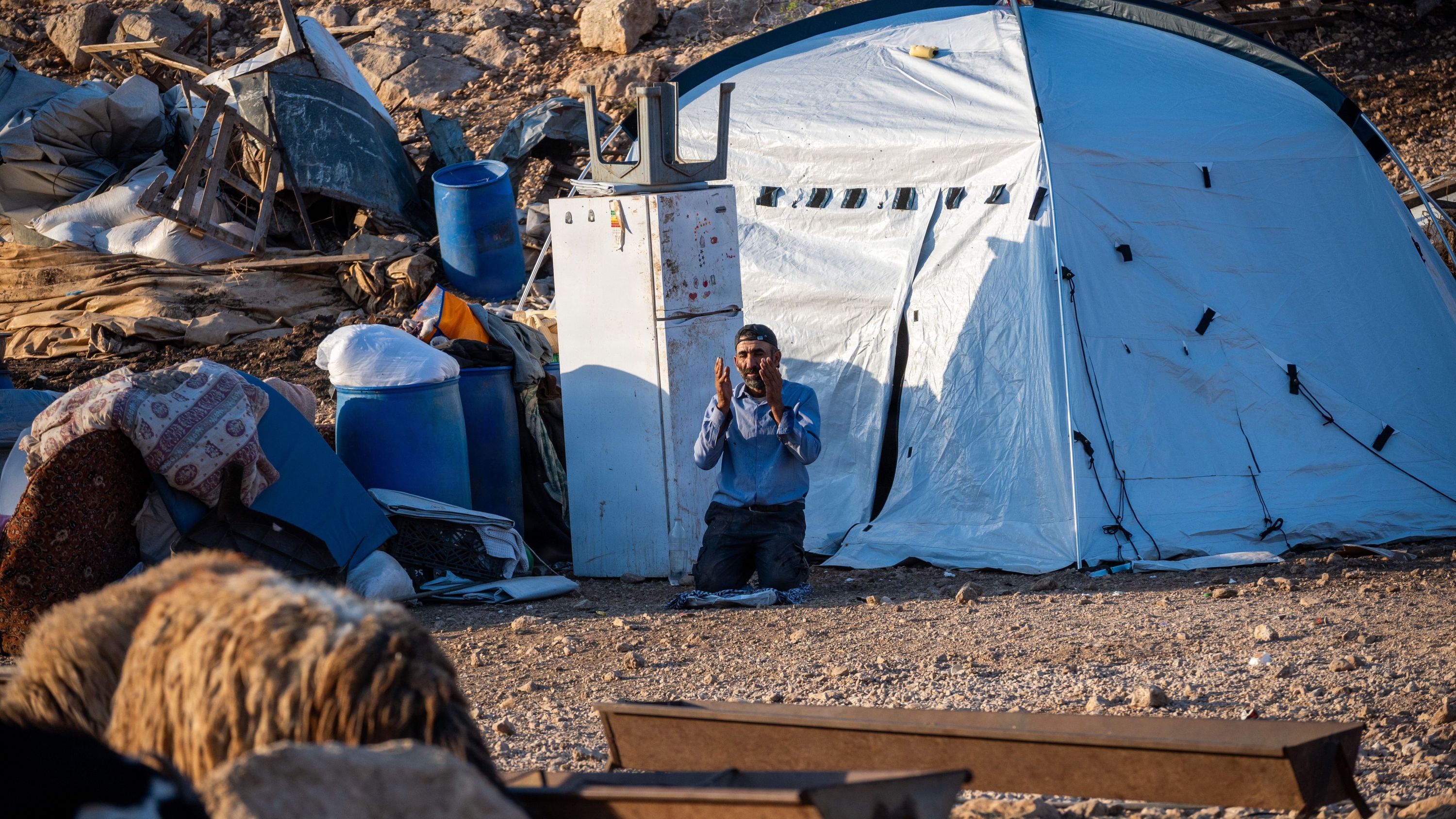
Currently, the remaining residents of Khirbet Samra are living in tents provided by human rights organisations. Yet, despite everything, they say they are determined to stay.
Dhiab Daraghmeh, a resident, said that more than 15 structures were demolished, including family homes, sheep pens, shelters for young livestock, and storage areas for fodder and hay.
He said that the Israeli army arrived unexpectedly on Sunday, accompanied by bulldozers, as the residents were caught off guard, having received no prior notice.
The Israelis gave them only ten minutes to retrieve some of their belongings from their homes. This brief window allowed them to save only a few minor items.
Almost everything else was destroyed: furniture, kitchenware, gas cylinders, refrigerators, livestock troughs, as well as bathrooms, water tanks, solar panels, and fodder storage units.
'For three days, we have been living without shelter, enduring cold nights and high daytime temperatures'
- Dhiab Daraghmeh, resident
Residents now face a grim future. With winter approaching and no shelter available, families are forced to sleep in the open, while their belongings and essential supplies are left exposed to the sun and rain.
"For three days, we have been living without shelter, enduring cold nights and high daytime temperatures. We are also deeply concerned for our newborn lambs, which cannot survive in these conditions," said Daraghmeh.
The families’ needs go beyond food and humanitarian aid; primarily, they seek the right to remain on their land, to rebuild what the Israeli bulldozers destroyed and to secure protection for themselves and their livestock against the winter elements.
Settler attacks
The demolitions are part of a long-standing pattern of attacks by Israeli settlers, a campaign that has persisted for years to displace the local population, with several communities targeted across the northern Jordan Valley.
The assaults have been ongoing since 2017 and have taken various forms, including the killing of livestock and the destruction of residents' property, actions that, three months ago, forced more than half of the community’s residents to leave and relocate to the city of Tubas.
"On June 11, 2025, settlers killed about 50 of my sheep, just one of the incidents in which I have suffered significant losses. Yet, these attacks have not driven the families to leave the area," Dhiyab added.
The residents of Khirbet Samra maintain their right to remain in the community as the land is owned by the families, inherited from their ancestors.
"My grandfather lived in this area before 1977. The family resided in various locations throughout the region before Israeli harassment, along with claims that certain lands were 'nature reserves' or 'military zones', forced them to relocate to the community’s current site," he said.
Only 21 people remain in the community, after repeated attacks by settlers that, months earlier, forced more than 24 others to leave and effectively turned the small community into an open-air prison.
Another resident, Ayman Daraghmeh, said that they had asked the soldiers for permission to access drinking water, but the request was denied shortly before the bulldozers arrived to demolish the structures.
Among the items destroyed by the bulldozers was a tree that had been planted about 16 years ago.
Once a tiny sapling, it had grown over the years to become an integral part of the family’s life and their daily memories.
"I brought it here as a small sapling about 16 years ago; my children and I used to love sitting beneath it. This tree grew up alongside us, and now they have demolished everything around it," Daraghmeh said.
He said that approximately ten tons of barley were buried under the rubble, along with quantities of animal feed and the structures used to store it.
Daraghmeh estimated the material losses for the feeding troughs alone at approximately 1,500 shekels ($451) each.
“The near-daily actions of settlers have confined us to a narrow area, making us feel as though we are living in a prison, unable to move freely beyond the small patch of land where we reside,” he said.
Pattern of displacement
In its humanitarian report issued on 18 November 2026, the United Nations Office for the Coordination of Humanitarian Affairs (Ocha) said that approximately 6,800 Palestinians, including more than 3,200 children, have been displaced since the beginning of 2023 due to settler attacks and associated restrictions on land access.
This displacement has affected 137 Palestinian communities, 51 of which have been completely emptied of their inhabitants.
In 2026 alone, 2,894 Palestinians were displaced as a result of settler attacks and related access restrictions. The Jordan Valley accounted for 44 percent of all displacements linked to settler attacks and access restrictions during 2026.
Mahdi Daraghmeh, head of the Al-Maleh and Bedouin Communities Council, said that for the past two years, the community has faced escalating attacks by settlers that intensified following the establishment of a nearby settler outpost.
'Settlers deliberately bring their own livestock onto these lands and keep them there, effectively preventing the residents from utilizing the area'
- Mahdi Daraghmeh, resident
He told MEE that settlers break into their homes, often calling in army and police forces, who sometimes detain the residents.
The assaults extended to seizing the natural resources upon which the residents depend for their livelihoods.
Settlers have taken control of water wells near the community, blocking families from accessing or using them. They have also seized vast areas of grazing land, preventing residents from taking their livestock out to pasture.
This pressure has further extended to rain-fed agricultural lands that families traditionally cultivated on a seasonal basis, using them for both grazing and harvesting crops.
“Settlers deliberately bring their own livestock onto these lands and keep them there, effectively preventing the residents from utilising the area,” he said.
According to Draghmeh, the Israeli army continues to maintain a daily presence in the community, threatening residents against constructing any new facilities and demanding that they leave the area.
"The residents of Khirbet Samra rely primarily on livestock farming for their livelihood. Consequently, the seizure of grazing lands and water wells along with the destruction of animal pens and fodder storage poses a direct threat to their ability to continue living in the region," he added.
According to local Palestinians, the happenings in Khirbet Samra are part of a broader pattern of attacks and encirclement targeting Bedouin communities in the northern Jordan Valley.
According to Draghmeh, six Bedouin communities have been completely depopulated, with approximately 200 families displaced in the last two years.
Residents of Jordan Valley vow to remain after Israeli bulldozers raze homes
Israeli forces demolished every structure in the Khirbet Samra community in the northern Jordan Valley, leaving nothing standing, not even livestock troughs, yet residents insist on staying on their land despite living in tents through a harsh winter. The demolition is part of a sustained campaign of settler attacks that has displaced thousands of Palestinians across the Jordan Valley since 2023.
Cross Lines newsroom
Share this article
#خربة سمرة#غور الأردن#الضفة الغربية#المستوطنون#التهجير القسري#الأغوار الشمالية
Original source: Middle East Eye