The story of a book in Gaza: A treasured possession given new lease of life
Al Jazeera

Al Jazeera
Original Source
Amid Gaza's widespread destruction, volunteers have rescued thousands of books from rubble to return them to children desperate for education. From a tent library to a lending library, Gaza's books struggle to reclaim their role in spreading knowledge during siege and displacement.
Aya al-Shawa, 10, sits in sixth grade at a school in northern Gaza, holding a book she recently received and what is now one of her most treasured possessions.
Before it reached Aya’s hands, it had a difficult journey. It once sat on a bookshelf before an Israeli attack demolished the building it was housed in, leaving it buried beneath the rubble. Then one day someone recovered it, cleaned it, sorted its pages and repaired them. The book then found its way to a new reader.
Recommended Stories
list of 4 items
list 1 of 4How can Jordan respond to Israel’s escalation across the West Bank?
list 2 of 4Israeli air attack on residential apartment in Gaza kills 5 Palestinians
list 3 of 4Funeral held at Gaza church for mother and daughter killed in Gaza strike
list 4 of 4Gaza’s Christians mourn mother and daughter killed in Israeli attack
end of list
Amid the widespread destruction in Israel’s genocidal war on Gaza, books – one of the most vulnerable of all items – have become a rare commodity.
About 98 percent of school buildings in the Gaza Strip have been destroyed or damaged, according to UNICEF.
With approximately 700,000 children in Gaza deprived of regular in-person education since the war began in October 2023, books have also become a vital way for children to reconnect with learning.
UNESCO has documented widespread damage to cultural sites and institutions in Gaza, including libraries. With a “ceasefire” in Gaza since October 2025, during which there has been a relative decrease in Israeli bombing, books have begun to take a second life.
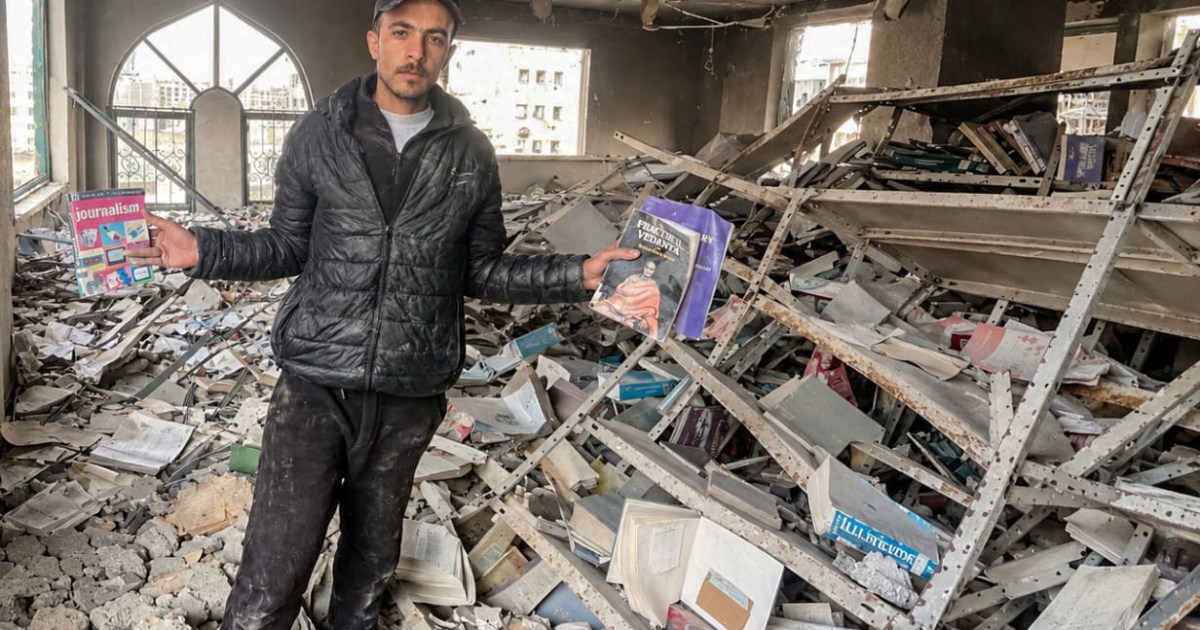
Mohammed Saad, 54, from Beit Lahiya, has spent more than 35 years collecting books, and before the war, he estimated that he had between 50,000 and 100,000 titles in his library.
On December 7, 2023, the library was destroyed.
After being displaced 16 times in total, Saad returned to Beit Lahiya again to see what remained of his book collection. From the rubble of his home, he began to pull out the surviving books.
“I risked my life to save these books from beneath the rubble,” Saad said.
He managed to recover about 12,000 books from the rubble and moved what he could to Deir el-Balah, where he erected a tent and established a library called Athar, meaning “impact” but also relating to antiquities or historical relics.
From the tent, Saad and his son Mohammed began cleaning and repairing the thousands of books in their possession.
But Saad’s goal is not only to save the books from damage. He also wants them to reach people, particularly children.
The library now sees children coming every day, looking for stories that might help them find some escape from their hardships.
They buy some of them at symbolic prices ranging from 5 shekels to 15 shekels ($1.63-$4.89), given that books have become unaffordable for most families.
Giving children access to books is a key reason for saving them in the first place: to keep knowledge accessible and give them a path back to reading and learning despite war and displacement.
But the books Saad rescues still face other dangers. Inside the tent, there is little protection from the sun, heat, humidity and rain.
“I saved them from beneath the rubble and from the fire. Today, I cannot save them from the rain,” Saad said.
Elsewhere, Omar Hamad, 30, a displaced person from Beit Hanoon in northern Gaza, has also been searching for destroyed libraries for books.
He traced the locations of libraries in northern Gaza and Gaza City and contacted their owners. So far, Hamad says, he and his team have extricated some 3,000 books.
Not all of the books came from rubble. Some were donated by the families of people who were killed and had private libraries, while the team bought or reprinted others.
Among the books Omar rescued was The Catastrophe of Palestine, printed in 1956. He found it in the destroyed Islamic University of Gaza library, where books were scattered among the rubble.
Retrieving the book was only the beginning of his task.
Omar and his friend Ibrahim cleaned the books, removed dust and traces of rubble, sorted and arranged the pages, and tried to repair whatever they could.
When a book required more specialised restoration, he turned to Jameel Mikdad, 71, in the Shati refugee camp in Gaza City.
Mikdad has worked in bookbinding and book repair for more than 45 years. His library and printing shop were destroyed during the war, but he continued working with limited resources, using his experience to rearrange pages, glue torn sections of the works, sew books and rebind them.
There is no single cost for repairing a book; it depends on the extent of the damage and the materials required. But the cost of materials has risen sharply.
Mikdad says a 3kg (6.6-pound) container of white glue cost 30-35 shekels ($9.78-11.48) before the war. Its price has now risen to 450-500 shekels ($146.74-163.05) due to Israel’s siege on Gaza and the damage caused by the war.
Repairing a damaged book can take two days to a week, depending on its condition. Sometimes the cost of repair can exceed the value of the book.
Not every book can be repaired. Omar says some of the books they found were 80 or 90 percent damaged and had to be left behind because they were no longer repairable or restorable.
At other times, they kept books that could no longer be read because bullet holes or fire damage made them witnesses to the genocide in Gaza.
“We took them with us so they could remain witnesses to this crime,” Omar said.
For the books that can be saved, Omar does not want them to remain on library shelves but to be distributed throughout a population known for their love of literature.
At the Phoenix Library, books are lent rather than sold. Readers can borrow one or two books a week after paying a refundable deposit of 50 shekels ($16.30). The library has books on literature, medicine, law, history, economics and science. There are also books for children and for students related to specialised fields of study.
Omar also organises initiatives to deliver books to students at schools, so they can be used once again for their original purpose: reading and learning.
Aya, 10, ends up with one such book: The Adventure of the Empty House by Sir Arthur Conan Doyle.
She sees the novel as a way of continuing her education when schools, often taking the form of a crowded tent, struggle to resume their role in teaching children.
And so, the journey of the book is complete.
It began on a shelf in a home or library in Gaza before the building was levelled in one of Israel’s thousands of air raids. It then remained beneath the rubble for months before being rescued by a person who risked their life to rescue lost books. It was then passed on to a restoration expert who repaired and cleaned it. Finally, it ended up in the hands of a student who will continue to love learning and overcome Israel’s genocidal war on Gaza.
Ultimately, the book survived destruction and returned to its first purpose: to be opened and read.
Before it reached Aya’s hands, it had a difficult journey. It once sat on a bookshelf before an Israeli attack demolished the building it was housed in, leaving it buried beneath the rubble. Then one day someone recovered it, cleaned it, sorted its pages and repaired them. The book then found its way to a new reader.
Recommended Stories
list of 4 items
list 1 of 4How can Jordan respond to Israel’s escalation across the West Bank?
list 2 of 4Israeli air attack on residential apartment in Gaza kills 5 Palestinians
list 3 of 4Funeral held at Gaza church for mother and daughter killed in Gaza strike
list 4 of 4Gaza’s Christians mourn mother and daughter killed in Israeli attack
end of list
Amid the widespread destruction in Israel’s genocidal war on Gaza, books – one of the most vulnerable of all items – have become a rare commodity.
About 98 percent of school buildings in the Gaza Strip have been destroyed or damaged, according to UNICEF.
With approximately 700,000 children in Gaza deprived of regular in-person education since the war began in October 2023, books have also become a vital way for children to reconnect with learning.
UNESCO has documented widespread damage to cultural sites and institutions in Gaza, including libraries. With a “ceasefire” in Gaza since October 2025, during which there has been a relative decrease in Israeli bombing, books have begun to take a second life.
Mohammed Saad, 54, from Beit Lahiya, has spent more than 35 years collecting books, and before the war, he estimated that he had between 50,000 and 100,000 titles in his library.
On December 7, 2023, the library was destroyed.
After being displaced 16 times in total, Saad returned to Beit Lahiya again to see what remained of his book collection. From the rubble of his home, he began to pull out the surviving books.
“I risked my life to save these books from beneath the rubble,” Saad said.
He managed to recover about 12,000 books from the rubble and moved what he could to Deir el-Balah, where he erected a tent and established a library called Athar, meaning “impact” but also relating to antiquities or historical relics.
From the tent, Saad and his son Mohammed began cleaning and repairing the thousands of books in their possession.
But Saad’s goal is not only to save the books from damage. He also wants them to reach people, particularly children.
The library now sees children coming every day, looking for stories that might help them find some escape from their hardships.
They buy some of them at symbolic prices ranging from 5 shekels to 15 shekels ($1.63-$4.89), given that books have become unaffordable for most families.
Giving children access to books is a key reason for saving them in the first place: to keep knowledge accessible and give them a path back to reading and learning despite war and displacement.
But the books Saad rescues still face other dangers. Inside the tent, there is little protection from the sun, heat, humidity and rain.
“I saved them from beneath the rubble and from the fire. Today, I cannot save them from the rain,” Saad said.
Elsewhere, Omar Hamad, 30, a displaced person from Beit Hanoon in northern Gaza, has also been searching for destroyed libraries for books.
He traced the locations of libraries in northern Gaza and Gaza City and contacted their owners. So far, Hamad says, he and his team have extricated some 3,000 books.
Not all of the books came from rubble. Some were donated by the families of people who were killed and had private libraries, while the team bought or reprinted others.
Among the books Omar rescued was The Catastrophe of Palestine, printed in 1956. He found it in the destroyed Islamic University of Gaza library, where books were scattered among the rubble.
Retrieving the book was only the beginning of his task.
Omar and his friend Ibrahim cleaned the books, removed dust and traces of rubble, sorted and arranged the pages, and tried to repair whatever they could.
When a book required more specialised restoration, he turned to Jameel Mikdad, 71, in the Shati refugee camp in Gaza City.
Mikdad has worked in bookbinding and book repair for more than 45 years. His library and printing shop were destroyed during the war, but he continued working with limited resources, using his experience to rearrange pages, glue torn sections of the works, sew books and rebind them.
There is no single cost for repairing a book; it depends on the extent of the damage and the materials required. But the cost of materials has risen sharply.
Mikdad says a 3kg (6.6-pound) container of white glue cost 30-35 shekels ($9.78-11.48) before the war. Its price has now risen to 450-500 shekels ($146.74-163.05) due to Israel’s siege on Gaza and the damage caused by the war.
Repairing a damaged book can take two days to a week, depending on its condition. Sometimes the cost of repair can exceed the value of the book.
Not every book can be repaired. Omar says some of the books they found were 80 or 90 percent damaged and had to be left behind because they were no longer repairable or restorable.
At other times, they kept books that could no longer be read because bullet holes or fire damage made them witnesses to the genocide in Gaza.
“We took them with us so they could remain witnesses to this crime,” Omar said.
For the books that can be saved, Omar does not want them to remain on library shelves but to be distributed throughout a population known for their love of literature.
At the Phoenix Library, books are lent rather than sold. Readers can borrow one or two books a week after paying a refundable deposit of 50 shekels ($16.30). The library has books on literature, medicine, law, history, economics and science. There are also books for children and for students related to specialised fields of study.
Omar also organises initiatives to deliver books to students at schools, so they can be used once again for their original purpose: reading and learning.
Aya, 10, ends up with one such book: The Adventure of the Empty House by Sir Arthur Conan Doyle.
She sees the novel as a way of continuing her education when schools, often taking the form of a crowded tent, struggle to resume their role in teaching children.
And so, the journey of the book is complete.
It began on a shelf in a home or library in Gaza before the building was levelled in one of Israel’s thousands of air raids. It then remained beneath the rubble for months before being rescued by a person who risked their life to rescue lost books. It was then passed on to a restoration expert who repaired and cleaned it. Finally, it ended up in the hands of a student who will continue to love learning and overcome Israel’s genocidal war on Gaza.
Ultimately, the book survived destruction and returned to its first purpose: to be opened and read.
🔗 Share Article
Tags:#غزة#الكتب#التعليم#الحرب#النزوح#الثقافة
Source: Al Jazeera
For Context
Related reads from the same topic or latest developments
Same context
Houthis claim strike on Saudi energy facility as Yemen fighting intensifies
Follow-up
Russia strikes Kyiv bridge in a new tactic to disrupt life in the Ukrainian capital

Follow-up