InternationalAvailable in English
Why Are France’s Students Protesting?
Editorial
Cross Lines editing
Source
New York Times
New York Times
N
New York Times
Original Source
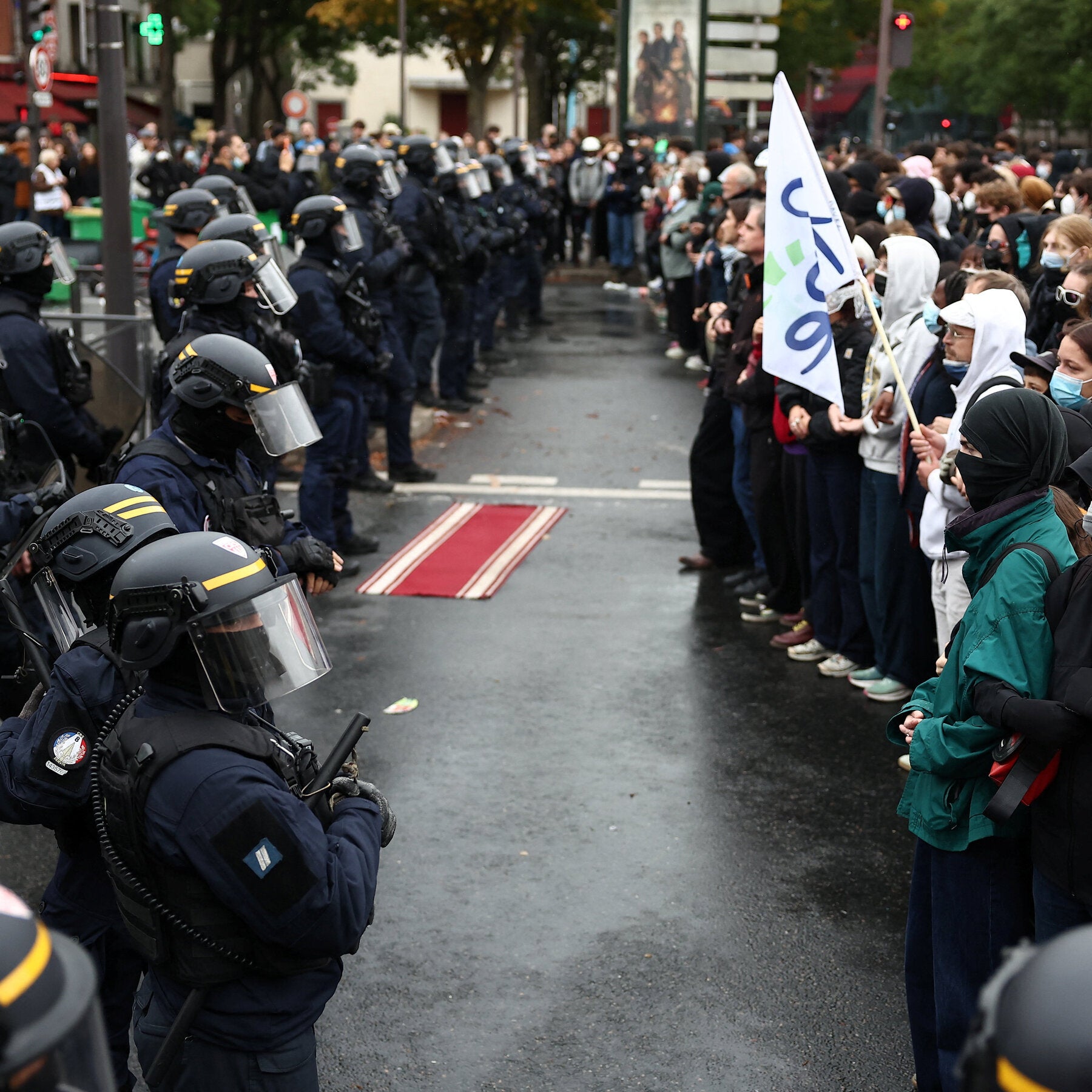
Demonstrators across France rallied on Saturday against rising living and fuel costs, adding to weeks of student-led protests over school conditions. Clashes between police and protesters erupted in several cities, including Marseille, where demonstrators briefly entered City Hall.
Why Are There Protests in France? - The New York Times
Skip to contentSkip to site index
Europe
Log in
Saturday, October 17, 2026
Today’s Paper
* Home
* + U.S.
+ International
+ Canada
+ Español
+ 中文
Student Protests in France
* What to Know
* Photos
* Movement Broadens
* Macron’s Term
* History of French Protests
Advertisement
SKIP ADVERTISEMENT
Supported by
SKIP ADVERTISEMENT
France’s Protests Spread to 140 Cities: What to Know
Student demonstrations converged on Saturday with a broader protest movement against rising living costs, heightening a national reckoning.
Listen · 5:44 min
*
*
*
!Several people in dark protective gear are in a physical struggle with an individual on a paved street. Closed storefronts with "JD" and "JDSPORTS.FR" are in the background.
*Riot police detaining a protester during clashes before a demonstration in Marseille, France, on Saturday.Credit...Thibaud Moritz/Agence France-Presse — Getty Images*
By Lynsey ChutelZane Irwin and Catherine Porter
Published Oct. 3, 2026Updated Oct. 17, 2026, 8:39 a.m. ET
Leer en español
See more of our coverage in your search results.Encuentra más de nuestra cobertura en los resultados de búsqueda. Add The New York Times on GoogleAgrega The New York Times en Google
Demonstrators rallied across France on Saturday against rising living and fuel costs, building on weeks of student-led protests for better school conditions that have heightened a sense of fiscal and social crisis in the country.
Some of the calls for demonstrations were made by social media accounts associated with the “yellow vest” protest movement that roiled France nearly a decade ago with its roadside demonstrations against high gas prices, among other complaints.
Officials said there had been rallies in roughly 140 places by the early afternoon, with larger marches expected in about 80 locations. The protests marked a convergence between a student-focused movement that has spurred unrest in hundreds of schools, and a broader social movement that appeals to French citizens of different ages.
There were confrontation between police officers and protesters in several cities, including in Marseille, France’s second city, where the mayor said people briefly broke into the City Hall.
Hundreds of people have been injured since the student protests began last month amid escalating clashes with riot police. Thousands have been arrested, most of them minors, law enforcement officials said.
The protests erupted in a heated climate, as the government tries to pass a belt-tightening budget and as France approaches presidential elections next year. The French government has acknowledged that some of the students’ demands are legitimate but has condemned “urban violence.” It has also accused the far-left party, France Unbowed, of stoking the demonstrations, an accusation that the party has rejected.
Lynsey Chutel is a Times reporter based in London who covers breaking news in Africa, the Middle East and Europe.
Zane Irwin is an international reporter and a member of the 2026-27 Times Fellowship, a program for journalists early in their careers.
Catherine Porter is an international reporter for The Times, covering France. She is based in Paris.
A version of this article appears in print on Oct. 4, 2026, Section A, Page 10 of the New York edition with the headline: French Students Blockading Schools Seek Reforms. Order Reprints | Today’s Paper | Subscribe
*
*
*
Related Content
*
*
*
*
*
*
*
*
*
*
*
*
*
*
*
*
*
*
*
Advertisement
SKIP ADVERTISEMENT
Site Index
Site Information Navigation
* © 2026 The New York Times Company
+ NYTCo
+ Contact Us
+ Accessibility
+ Work with us
+ Advertise
+ T Brand Studio
+ Privacy Policy
+ Cookie Policy
+ Terms of Service
+ Terms of Sale
+ Site Map
+ Canada
+ International
+ Help
+ Subscriptions
+
Skip to contentSkip to site index
Europe
Log in
Saturday, October 17, 2026
Today’s Paper
* Home
* + U.S.
+ International
+ Canada
+ Español
+ 中文
Student Protests in France
* What to Know
* Photos
* Movement Broadens
* Macron’s Term
* History of French Protests
Advertisement
SKIP ADVERTISEMENT
Supported by
SKIP ADVERTISEMENT
France’s Protests Spread to 140 Cities: What to Know
Student demonstrations converged on Saturday with a broader protest movement against rising living costs, heightening a national reckoning.
Listen · 5:44 min
*
*
*
!Several people in dark protective gear are in a physical struggle with an individual on a paved street. Closed storefronts with "JD" and "JDSPORTS.FR" are in the background.
*Riot police detaining a protester during clashes before a demonstration in Marseille, France, on Saturday.Credit...Thibaud Moritz/Agence France-Presse — Getty Images*
By Lynsey ChutelZane Irwin and Catherine Porter
Published Oct. 3, 2026Updated Oct. 17, 2026, 8:39 a.m. ET
Leer en español
See more of our coverage in your search results.Encuentra más de nuestra cobertura en los resultados de búsqueda. Add The New York Times on GoogleAgrega The New York Times en Google
Demonstrators rallied across France on Saturday against rising living and fuel costs, building on weeks of student-led protests for better school conditions that have heightened a sense of fiscal and social crisis in the country.
Some of the calls for demonstrations were made by social media accounts associated with the “yellow vest” protest movement that roiled France nearly a decade ago with its roadside demonstrations against high gas prices, among other complaints.
Officials said there had been rallies in roughly 140 places by the early afternoon, with larger marches expected in about 80 locations. The protests marked a convergence between a student-focused movement that has spurred unrest in hundreds of schools, and a broader social movement that appeals to French citizens of different ages.
There were confrontation between police officers and protesters in several cities, including in Marseille, France’s second city, where the mayor said people briefly broke into the City Hall.
Hundreds of people have been injured since the student protests began last month amid escalating clashes with riot police. Thousands have been arrested, most of them minors, law enforcement officials said.
The protests erupted in a heated climate, as the government tries to pass a belt-tightening budget and as France approaches presidential elections next year. The French government has acknowledged that some of the students’ demands are legitimate but has condemned “urban violence.” It has also accused the far-left party, France Unbowed, of stoking the demonstrations, an accusation that the party has rejected.
Lynsey Chutel is a Times reporter based in London who covers breaking news in Africa, the Middle East and Europe.
Zane Irwin is an international reporter and a member of the 2026-27 Times Fellowship, a program for journalists early in their careers.
Catherine Porter is an international reporter for The Times, covering France. She is based in Paris.
A version of this article appears in print on Oct. 4, 2026, Section A, Page 10 of the New York edition with the headline: French Students Blockading Schools Seek Reforms. Order Reprints | Today’s Paper | Subscribe
*
*
*
Related Content
*
*
*
*
*
*
*
*
*
*
*
*
*
*
*
*
*
*
*
Advertisement
SKIP ADVERTISEMENT
Site Index
Site Information Navigation
* © 2026 The New York Times Company
+ NYTCo
+ Contact Us
+ Accessibility
+ Work with us
+ Advertise
+ T Brand Studio
+ Privacy Policy
+ Cookie Policy
+ Terms of Service
+ Terms of Sale
+ Site Map
+ Canada
+ International
+ Help
+ Subscriptions
+
🔗 Share Article
Tags:#فرنسا#احتجاجات#الطلاب#السترات الصفراء#تكاليف المعيشة#ماكرون
Source: New York Times
For Context
Related reads from the same topic or latest developments