OpenAI's math breakthrough points beyond math
Axios
A
Axios
Original Source
OpenAI has released hundreds of newly generated mathematical proofs, signaling AI's expansion into specialized fields where human expertise has long reigned unchallenged. While the breakthrough generates scientific excitement, it also raises concerns among mathematicians about originality and implications for training future theorists.
OpenAI's math breakthrough points beyond math
*
* Newsletters
*
* Axios Pro
* Axios Live
* The Axios Show
Axios
Axios
6 hours ago - Business
OpenAI's math breakthrough points beyond math
* Bradley Olson
*
*
*
Add Axios on Google
Add Axios as your preferred source to
see more of our stories on Google.
Add Axios on Google
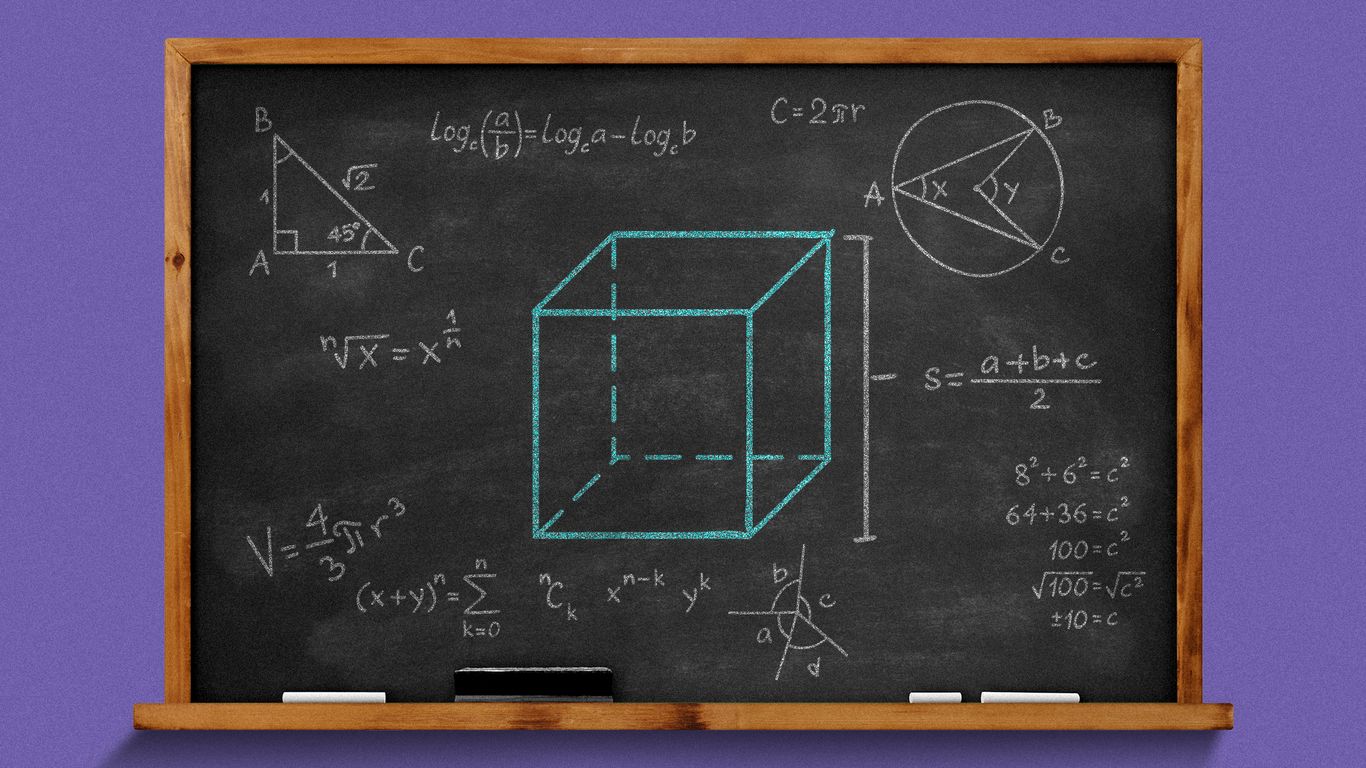
!Illustration of a cube and equations written on a chalkboard.
*Illustration: Lindsey Bailey/Axios*
AI's conquest of computer programming offered an early demonstration of what happens when models become good enough at a specialized field that experts can no longer treat them as a novelty.
* Mathematics appears to be next.
**Why it matters:** OpenAI's latest mathematical results — which involved releasing hundreds of new proofs generated by a powerful, unreleased model — demonstrate that the startling advances of AI are likely to continue moving across entirely new fields.
**Catch up quick:** OpenAI on Tuesday released 722 manuscripts organized into 372 groups of findings ("families") on long-standing mathematical problems, inviting academics and researchers to examine and build on the material.
* The reception has mixed scientific excitement with genuine unease. One Rutgers University mathematician said on X that a result connected to the Riemann hypothesis would warrant an automatic Fields Medal if a human had done the work.
* Some mathematicians have questioned these results, as well as another solution OpenAI released last month, asking whether they represent original breakthroughs or draw heavily from previous human input.
* Others downplayed the utility of AI-generated math. "You can discover new math easily," Stephen Wolfram, a renowned computer scientist and physicist who has followed AI closely for years, said at a Tuesday event for the National Museum of Mathematics. "You can make a trillion theorems easily. The problem is most of those theorems are not ones that anybody will care about."
**Zoom in:** Like computer programming, mathematics gives AI something unusually valuable: a way to tell when it is right.
* A proof can be scrutinized by mathematicians and, increasingly, translated into formal languages that computers can verify line by line. Similarly, it is immediately possible to know whether autonomously written AI code actually works.
**The big picture:** Software engineers have already lived through this transition.
* AI coding tools progressed from autocomplete and debugging to agents capable of writing substantial amounts of software and carrying out complex engineering tasks.
* The shift has changed not only how code gets written, but what it means to be a programmer, bringing a fair dose of awe, amazement and dread to many lifelong software engineers.
* Much as software engineers did before them, mathematicians have begun to question the implications of some of the OpenAI discoveries on graduate work, and on training a new generation of theorists.
**Yes, but:** Some software engineers have successfully mapped out the roles humans still play in generating quality products. While new AI coding tools have dramatically increased the code one engineer can ship, humans still play a crucial role in building quality software.
* Mathematicians have begun to echo that point, noting that the most meaningful advances in their field often involve building a framework or bringing structure to a complex idea. Many are skeptical about whether any AI system will be able to replicate human originality.
**Between the lines:** Beyond mathematics, the results do point to the likelihood that AI disruption will continue moving into new areas, partially answering a long-standing question from AI skeptics.
* While researchers at rival startups questioned the utility of OpenAI's mathematical findings because of limited practical applications, some acknowledged that they provide evidence of AI's rapid advances.
*
*
*
Add Axios on Google
What to read next
*
*
*
*
*
*
Smarter, faster on what matters.
Explore Axios Newsletters
* About Axios
* Advertise with us
* Careers
* Contact us
* Newsletters
* Axios Live
* Axios HQ
* Privacy policy
* Terms of use
*
Axios Homepage
Axios Media Inc., 2026
*
* Newsletters
*
* Axios Pro
* Axios Live
* The Axios Show
Axios
Axios
6 hours ago - Business
OpenAI's math breakthrough points beyond math
* Bradley Olson
*
*
*
Add Axios on Google
Add Axios as your preferred source to
see more of our stories on Google.
Add Axios on Google
!Illustration of a cube and equations written on a chalkboard.
*Illustration: Lindsey Bailey/Axios*
AI's conquest of computer programming offered an early demonstration of what happens when models become good enough at a specialized field that experts can no longer treat them as a novelty.
* Mathematics appears to be next.
**Why it matters:** OpenAI's latest mathematical results — which involved releasing hundreds of new proofs generated by a powerful, unreleased model — demonstrate that the startling advances of AI are likely to continue moving across entirely new fields.
**Catch up quick:** OpenAI on Tuesday released 722 manuscripts organized into 372 groups of findings ("families") on long-standing mathematical problems, inviting academics and researchers to examine and build on the material.
* The reception has mixed scientific excitement with genuine unease. One Rutgers University mathematician said on X that a result connected to the Riemann hypothesis would warrant an automatic Fields Medal if a human had done the work.
* Some mathematicians have questioned these results, as well as another solution OpenAI released last month, asking whether they represent original breakthroughs or draw heavily from previous human input.
* Others downplayed the utility of AI-generated math. "You can discover new math easily," Stephen Wolfram, a renowned computer scientist and physicist who has followed AI closely for years, said at a Tuesday event for the National Museum of Mathematics. "You can make a trillion theorems easily. The problem is most of those theorems are not ones that anybody will care about."
**Zoom in:** Like computer programming, mathematics gives AI something unusually valuable: a way to tell when it is right.
* A proof can be scrutinized by mathematicians and, increasingly, translated into formal languages that computers can verify line by line. Similarly, it is immediately possible to know whether autonomously written AI code actually works.
**The big picture:** Software engineers have already lived through this transition.
* AI coding tools progressed from autocomplete and debugging to agents capable of writing substantial amounts of software and carrying out complex engineering tasks.
* The shift has changed not only how code gets written, but what it means to be a programmer, bringing a fair dose of awe, amazement and dread to many lifelong software engineers.
* Much as software engineers did before them, mathematicians have begun to question the implications of some of the OpenAI discoveries on graduate work, and on training a new generation of theorists.
**Yes, but:** Some software engineers have successfully mapped out the roles humans still play in generating quality products. While new AI coding tools have dramatically increased the code one engineer can ship, humans still play a crucial role in building quality software.
* Mathematicians have begun to echo that point, noting that the most meaningful advances in their field often involve building a framework or bringing structure to a complex idea. Many are skeptical about whether any AI system will be able to replicate human originality.
**Between the lines:** Beyond mathematics, the results do point to the likelihood that AI disruption will continue moving into new areas, partially answering a long-standing question from AI skeptics.
* While researchers at rival startups questioned the utility of OpenAI's mathematical findings because of limited practical applications, some acknowledged that they provide evidence of AI's rapid advances.
*
*
*
Add Axios on Google
What to read next
*
*
*
*
*
*
Smarter, faster on what matters.
Explore Axios Newsletters
* About Axios
* Advertise with us
* Careers
* Contact us
* Newsletters
* Axios Live
* Axios HQ
* Privacy policy
* Terms of use
*
Axios Homepage
Axios Media Inc., 2026
🔗 Share Article
Tags:#الذكاء الاصطناعي#أوبن إيه آي#الرياضيات#تطور تكنولوجي#البراهين الرياضية#مستقبل البحث العلمي
Source: Axios
For Context
Related reads from the same topic or latest developments