Western Hemisphere Progressives Plot a Comeback
Foreign Policy

Foreign Policy
Original Source
Progressive lawmakers from across the Americas convened in Uruguay to counter Trump's interventionist doctrine, reflecting an organized effort to revitalize the region's left after years of right-wing dominance.
Panamerican Congress: Progressives Gather in Uruguay
!Foreign Policy
Foreign Policy
Get analysis and alerts more quickly in the mobile app.
Install
Back to Foreign Policy Magazine home page
* Latest
* Regions
+ Asia & the Pacific
+ China
+ Middle East & Africa
+ Americas
+ Europe
* Newsletters
Editors’ Picks
Evening roundup with our editors’ favorite stories of the day
!World Brief Icon
World Brief
Your guide to the most important world stories of the day
!China Brief Icon
China Brief
The latest news, analysis, and data from the country each week
Situation Report
Weekly update on what’s driving U.S. national security policy
FP Weekend
A curation of our best book reviews, deep dives, and other reads
!Africa Brief Icon
Africa Brief
Essential analysis of the stories shaping geopolitics on the continent
!South Asia Brief Icon
South Asia Brief
Weekly update on developments in India and its neighbors
The Reading List
Curated guides on geopolitics and current affairs
FP Bookshelf
A monthly guide to FP’s book reviews, excerpts, and reading recommendations
!Latin America Brief Icon
Latin America Brief
One-stop digest of politics, economics, and culture
!Southeast Asia Brief Icon
Southeast Asia Brief
A weekly dispatch with news from the region’s 11 countries
The New Geopolitics
A five-part masterclass in IR theory with Harvard Professor Stephen M. Walt
View All Newsletters
* FP Live
* Latest
* Trending:
* Iran war
* China's bet on AI
Search this website
* Preferences
* My FP Feed
* Saved Articles
* Newsletters
* Magazine Archive
* Subscription Settings
* FAQs
* Log Out
Sign In
Sign In
Partner with FP at UNGA81 Partner with FP at UNGA81
Subscribe SubscribePartner with FP at UNGA81 Partner with FP at UNGA81
Latin America Brief:
Western Hemisphere Progressives Plot a Comeback
*
*
* Facebook
* Bluesky
* X
* LinkedIn
* WhatsApp
* Reddit
Save
1. Create an FP account to save articles to read later.
Sign Up
ALREADY AN FP SUBSCRIBER? LOGIN
PDF
1. **Downloadable PDFs** are a benefit of an FP subscription.
Subscribe Now
ALREADY AN FP SUBSCRIBER? LOGIN
Gift
*
*
* WhatsApp
1. Gifting articles is a subscriber benefit.
Subscribe Now
ALREADY AN FP SUBSCRIBER? LOGIN
2. This article is an Insider exclusive.
Contact us at [email protected] to learn about upgrade options, unlocking the ability to gift this article.
Latin America Brief
A one-stop weekly digest of politics, economics, technology, and culture in Latin America. Delivered Friday.
Western Hemisphere Progressives Plot a Comeback
A gathering in Uruguay sought to counter the “Donroe Doctrine.”
!Osborn-Catherine-foreign-policy-columnist15
*Osborn-Catherine-foreign-policy-columnist15*
*Catherine Osborn*
By **Catherine Osborn**, the writer of *Foreign Policy*’s weekly Latin America Brief.
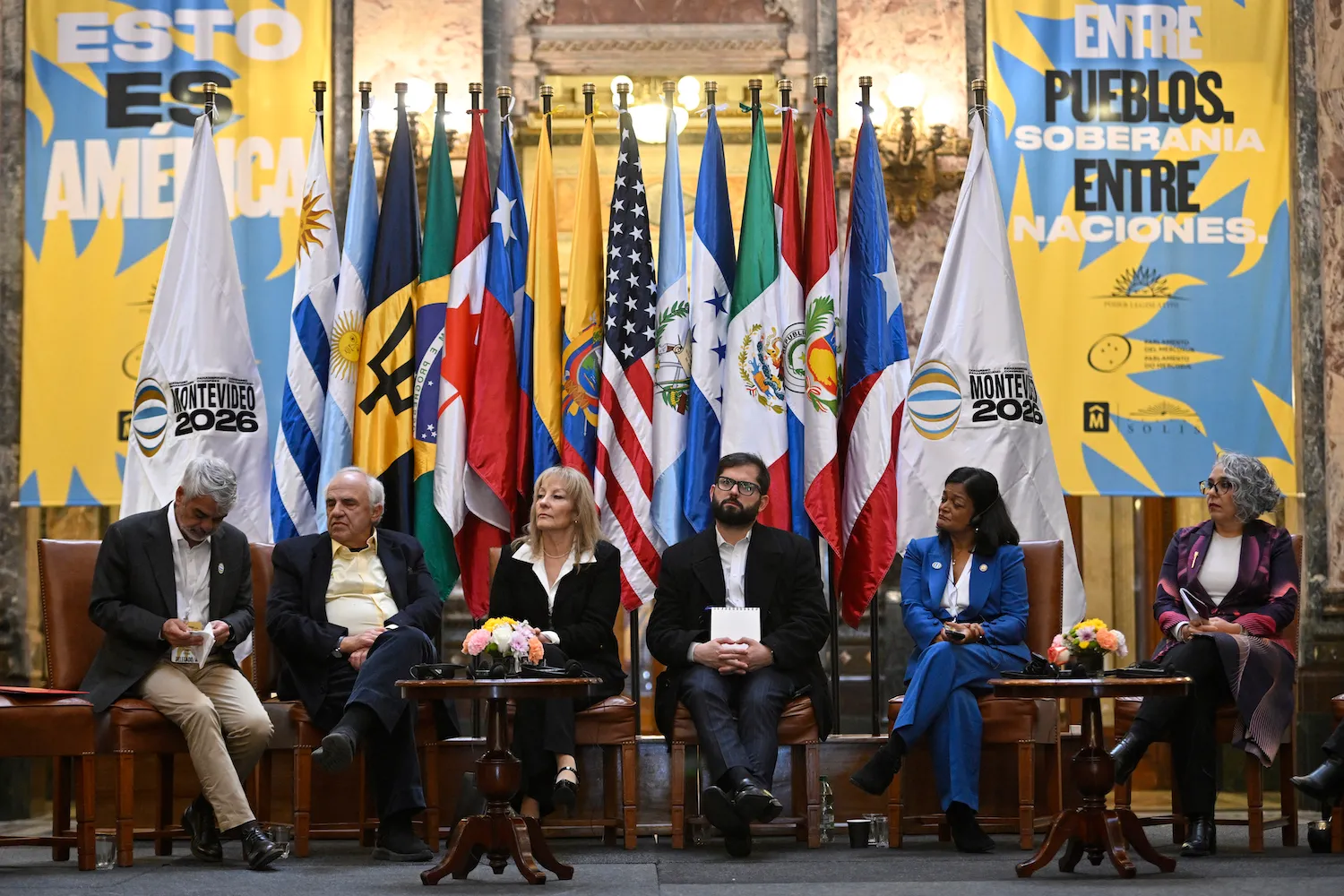
!Six lawmakers sit in chairs in front of flags of various Western Hemisphere countries. All are dressed in business formal attire; most have their legs crossed and their hands on their laps.
*Six lawmakers sit in chairs in front of flags of various Western Hemisphere countries. All are dressed in business formal attire; most have their legs crossed and their hands on their laps.*
From left to right, Brazilian Sen. Humberto Costa, former Colombian President Ernesto Samper, Uruguayan Vice President Carolina Cosse, former Chilean President Gabriel Boric, U.S. Rep. Pramila Jayapal, and artist and Colombian Sen. María José Pizarro attend the inauguration of the third Panamerican Congress, seen at the Legislative Palace in Montevideo, Uruguay, on Aug. 21. Santiago Mazzarovich/AFP via Getty Images
*
*
*
*
August 28, 2026, 8:00 AM
Welcome back to *Foreign Policy*’s Latin America Brief.
The highlights this week: **Left-wing lawmakers** from across the hemisphere hold a strategy session in Uruguay, Mexico reacts to the **U.S.-Canada trade war**, and the **race for the next United Nations secretary-general** moves forward.
Welcome back to *Foreign Policy*’s Latin America Brief.
The highlights this week: **Left-wing lawmakers** from across the hemisphere hold a strategy session in Uruguay, Mexico reacts to the **U.S.-Canada trade war**, and the **race for the next United Nations secretary-general** moves forward.
Sign up to receive Latin America Brief in your inbox every Friday.
---
Shadow Governments Convene
For years, right-wing politicians from across Latin America have gathered at the U.S. Conservative Political Action Conference (CPAC) and spinoff events in the region. This visibility helped elevate the far right across the Western Hemisphere. Once-fringe CPAC speakers have become national leaders, including Argentina’s Javier Milei and Chile’s José Antonio Kast.
While right-wing leaders currently dominate democratic politics in the Americas, a different set of gatherings is trying to boost the hemisphere’s left. Last weekend, the Panamerican Congressheld its third annual meeting in Montevideo, Uruguay. The event featured politicians from Canada to Chile and showcased mounting pushback to U.S. President Donald Trump’s interventionist doctrine for the region.
Aside from Canadian Prime Minister Mark Carney, the region’s left-leaning leaders have generally tempered their criticism of Trump. Brazilian President Luiz Inácio Lula da Silva and Mexican President Claudia Sheinbaum have spoken up for national sovereignty, but they have been open to dialogue to try to remove U.S. tariffs—and to preempt U.S. military action on their territories.
Further from the international spotlight, however, progressive lawmakers are resisting what Trump has termed the “Donroe Doctrine.”
U.S. lawmakers have held hearings to question the Trump administration’s boat strikes. Argentine lawmakers have staged inquiries into the opaque terms of Milei’s recent economic agreements with Trump. And in Ecuador, campaigning from opposition lawmakers helped public opinion coalesce against a proposal that would have allowed U.S. military bases in the country. The prospect was defeated in a national referendum last November.
In countries with right-wing leaders, “the progressive opposition’s main tools are their national legislatures,” said Chilean lawmaker Gonzalo Winter, who attended the Panamerican Congress. He argued that the gathering was important “in order to build a more familiar relationship between lawmakers of different countries.”
CPAC Latin America events have platformed issues such as financial deregulation, hard-line security policies, and skepticism toward climate change. The Panamerican Congress, meanwhile, focused on topics including green industrial policies, smarter regulation of Big Tech companies, and strengthening democratic institutions.
Participants floated the idea of a regional rapid-alert network in cases where countries’ sovereignty comes under threat, according to a draft summary of the event’s closed discussions seen by *Foreign Policy*.
Left-wing politicians have held regular gatherings in the region in previous decades. Perhaps most notable was a group called the São Paulo Forum, which was founded by Lula and Cuban leaderFidel Castro in the 1990s. However, it defended the autocratic Cuban, Nicaraguan, and Venezuelan political models and was also male-dominated.
The Panamerican Congress has a different flavor. In addition to emphasizing the importance of democracy, it featured women as prominent organizers of the event. This year’s iteration devoted significant energy to debating policies such as establishing government-backed care work programs that are designed to lower costs for working women.
The gathering also featured self-critique among the Latin American left, according to lawmaker Alfonso Ramírez Cuéllar of Mexico’s ruling Morena party*.* “The fight against corruption and the fight for security at times remains an unresolved issue in both Latin America and Mexico,” he said. “Sometimes the right takes ownership of those issues from us, and we cannot al
!Foreign Policy
Foreign Policy
Get analysis and alerts more quickly in the mobile app.
Install
Back to Foreign Policy Magazine home page
* Latest
* Regions
+ Asia & the Pacific
+ China
+ Middle East & Africa
+ Americas
+ Europe
* Newsletters
Editors’ Picks
Evening roundup with our editors’ favorite stories of the day
!World Brief Icon
World Brief
Your guide to the most important world stories of the day
!China Brief Icon
China Brief
The latest news, analysis, and data from the country each week
Situation Report
Weekly update on what’s driving U.S. national security policy
FP Weekend
A curation of our best book reviews, deep dives, and other reads
!Africa Brief Icon
Africa Brief
Essential analysis of the stories shaping geopolitics on the continent
!South Asia Brief Icon
South Asia Brief
Weekly update on developments in India and its neighbors
The Reading List
Curated guides on geopolitics and current affairs
FP Bookshelf
A monthly guide to FP’s book reviews, excerpts, and reading recommendations
!Latin America Brief Icon
Latin America Brief
One-stop digest of politics, economics, and culture
!Southeast Asia Brief Icon
Southeast Asia Brief
A weekly dispatch with news from the region’s 11 countries
The New Geopolitics
A five-part masterclass in IR theory with Harvard Professor Stephen M. Walt
View All Newsletters
* FP Live
* Latest
* Trending:
* Iran war
* China's bet on AI
Search this website
* Preferences
* My FP Feed
* Saved Articles
* Newsletters
* Magazine Archive
* Subscription Settings
* FAQs
* Log Out
Sign In
Sign In
Partner with FP at UNGA81 Partner with FP at UNGA81
Subscribe SubscribePartner with FP at UNGA81 Partner with FP at UNGA81
Latin America Brief:
Western Hemisphere Progressives Plot a Comeback
*
*
* Bluesky
* X
Save
1. Create an FP account to save articles to read later.
Sign Up
ALREADY AN FP SUBSCRIBER? LOGIN
1. **Downloadable PDFs** are a benefit of an FP subscription.
Subscribe Now
ALREADY AN FP SUBSCRIBER? LOGIN
Gift
*
*
1. Gifting articles is a subscriber benefit.
Subscribe Now
ALREADY AN FP SUBSCRIBER? LOGIN
2. This article is an Insider exclusive.
Contact us at [email protected] to learn about upgrade options, unlocking the ability to gift this article.
Latin America Brief
A one-stop weekly digest of politics, economics, technology, and culture in Latin America. Delivered Friday.
Western Hemisphere Progressives Plot a Comeback
A gathering in Uruguay sought to counter the “Donroe Doctrine.”
!Osborn-Catherine-foreign-policy-columnist15
*Osborn-Catherine-foreign-policy-columnist15*
*Catherine Osborn*
By **Catherine Osborn**, the writer of *Foreign Policy*’s weekly Latin America Brief.
!Six lawmakers sit in chairs in front of flags of various Western Hemisphere countries. All are dressed in business formal attire; most have their legs crossed and their hands on their laps.
*Six lawmakers sit in chairs in front of flags of various Western Hemisphere countries. All are dressed in business formal attire; most have their legs crossed and their hands on their laps.*
From left to right, Brazilian Sen. Humberto Costa, former Colombian President Ernesto Samper, Uruguayan Vice President Carolina Cosse, former Chilean President Gabriel Boric, U.S. Rep. Pramila Jayapal, and artist and Colombian Sen. María José Pizarro attend the inauguration of the third Panamerican Congress, seen at the Legislative Palace in Montevideo, Uruguay, on Aug. 21. Santiago Mazzarovich/AFP via Getty Images
*
*
*
*
August 28, 2026, 8:00 AM
Welcome back to *Foreign Policy*’s Latin America Brief.
The highlights this week: **Left-wing lawmakers** from across the hemisphere hold a strategy session in Uruguay, Mexico reacts to the **U.S.-Canada trade war**, and the **race for the next United Nations secretary-general** moves forward.
Welcome back to *Foreign Policy*’s Latin America Brief.
The highlights this week: **Left-wing lawmakers** from across the hemisphere hold a strategy session in Uruguay, Mexico reacts to the **U.S.-Canada trade war**, and the **race for the next United Nations secretary-general** moves forward.
Sign up to receive Latin America Brief in your inbox every Friday.
---
Shadow Governments Convene
For years, right-wing politicians from across Latin America have gathered at the U.S. Conservative Political Action Conference (CPAC) and spinoff events in the region. This visibility helped elevate the far right across the Western Hemisphere. Once-fringe CPAC speakers have become national leaders, including Argentina’s Javier Milei and Chile’s José Antonio Kast.
While right-wing leaders currently dominate democratic politics in the Americas, a different set of gatherings is trying to boost the hemisphere’s left. Last weekend, the Panamerican Congressheld its third annual meeting in Montevideo, Uruguay. The event featured politicians from Canada to Chile and showcased mounting pushback to U.S. President Donald Trump’s interventionist doctrine for the region.
Aside from Canadian Prime Minister Mark Carney, the region’s left-leaning leaders have generally tempered their criticism of Trump. Brazilian President Luiz Inácio Lula da Silva and Mexican President Claudia Sheinbaum have spoken up for national sovereignty, but they have been open to dialogue to try to remove U.S. tariffs—and to preempt U.S. military action on their territories.
Further from the international spotlight, however, progressive lawmakers are resisting what Trump has termed the “Donroe Doctrine.”
U.S. lawmakers have held hearings to question the Trump administration’s boat strikes. Argentine lawmakers have staged inquiries into the opaque terms of Milei’s recent economic agreements with Trump. And in Ecuador, campaigning from opposition lawmakers helped public opinion coalesce against a proposal that would have allowed U.S. military bases in the country. The prospect was defeated in a national referendum last November.
In countries with right-wing leaders, “the progressive opposition’s main tools are their national legislatures,” said Chilean lawmaker Gonzalo Winter, who attended the Panamerican Congress. He argued that the gathering was important “in order to build a more familiar relationship between lawmakers of different countries.”
CPAC Latin America events have platformed issues such as financial deregulation, hard-line security policies, and skepticism toward climate change. The Panamerican Congress, meanwhile, focused on topics including green industrial policies, smarter regulation of Big Tech companies, and strengthening democratic institutions.
Participants floated the idea of a regional rapid-alert network in cases where countries’ sovereignty comes under threat, according to a draft summary of the event’s closed discussions seen by *Foreign Policy*.
Left-wing politicians have held regular gatherings in the region in previous decades. Perhaps most notable was a group called the São Paulo Forum, which was founded by Lula and Cuban leaderFidel Castro in the 1990s. However, it defended the autocratic Cuban, Nicaraguan, and Venezuelan political models and was also male-dominated.
The Panamerican Congress has a different flavor. In addition to emphasizing the importance of democracy, it featured women as prominent organizers of the event. This year’s iteration devoted significant energy to debating policies such as establishing government-backed care work programs that are designed to lower costs for working women.
The gathering also featured self-critique among the Latin American left, according to lawmaker Alfonso Ramírez Cuéllar of Mexico’s ruling Morena party*.* “The fight against corruption and the fight for security at times remains an unresolved issue in both Latin America and Mexico,” he said. “Sometimes the right takes ownership of those issues from us, and we cannot al
🔗 Share Article
Tags:#أميركا اللاتينية#ترامب#اليسار السياسي#أوروغواي#السياسة الخارجية الأمريكية
Source: Foreign Policy
For Context
Related reads from the same topic or latest developments


