Big Tech Has Undermined Democracy. Here’s How to Reverse the Trend.
By using this website, you agree to our use of cookies. This use includes personalization of content and ads, and traffic analytics. Review our Privacy Policy for more information.
Foreign Policy Get analysis and alerts more quickly in the mobile app.
Install
Back to Foreign Policy Magazine home page
Evening roundup with our editors’ favorite stories of the day
World Brief
Your guide to the most important world stories of the day
China Brief
The latest news, analysis, and data from the country each week
Situation Report
Weekly update on what’s driving U.S. national security policy
FP Weekend
A curation of our best book reviews, deep dives, and other reads
Africa Brief
Essential analysis of the stories shaping geopolitics on the continent
South Asia Brief
Weekly update on developments in India and its neighbors
The Reading List
Curated guides on geopolitics and current affairs
FP Bookshelf
A monthly guide to FP’s book reviews, excerpts, and reading recommendations
Latin America Brief
One-stop digest of politics, economics, and culture
Southeast Asia Brief
A weekly dispatch with news from the region’s 11 countries
The New Geopolitics
A five-part masterclass in IR theory with Harvard Professor Stephen M. Walt
View All Newsletters
Give a gift Give a gift
Subscribe Subscribe Give a gift Give a gift
Argument: Big Tech Has Undermined Democracy. Here’s How to Reverse the Trend.
1. Create an FP account to save articles to read later.
Sign Up
ALREADY AN FP SUBSCRIBER? LOGIN
PDF
1. **Downloadable PDFs** are a benefit of an FP subscription.
ALREADY AN FP SUBSCRIBER? LOGIN
Gift
1. Gifting articles is a subscriber benefit.
ALREADY AN FP SUBSCRIBER? LOGIN
2. This article is an Insider exclusive.
Contact us at [email protected] to learn about upgrade options, unlocking the ability to gift this article.
Argument
Big Tech Has Undermined Democracy. Here’s How to Reverse the Trend.
The answer begins with restoring trust among citizens at the local level.
November 27, 2026, 8:00 AM
By **Dan Honig**, an associate professor at Georgetown University’s McCourt School of Public Policy and University College London’s department of political science, and **Devesh Kapur**, the Starr Foundation professor of South Asian studies at the School of Advanced International Studies at Johns Hopkins University.
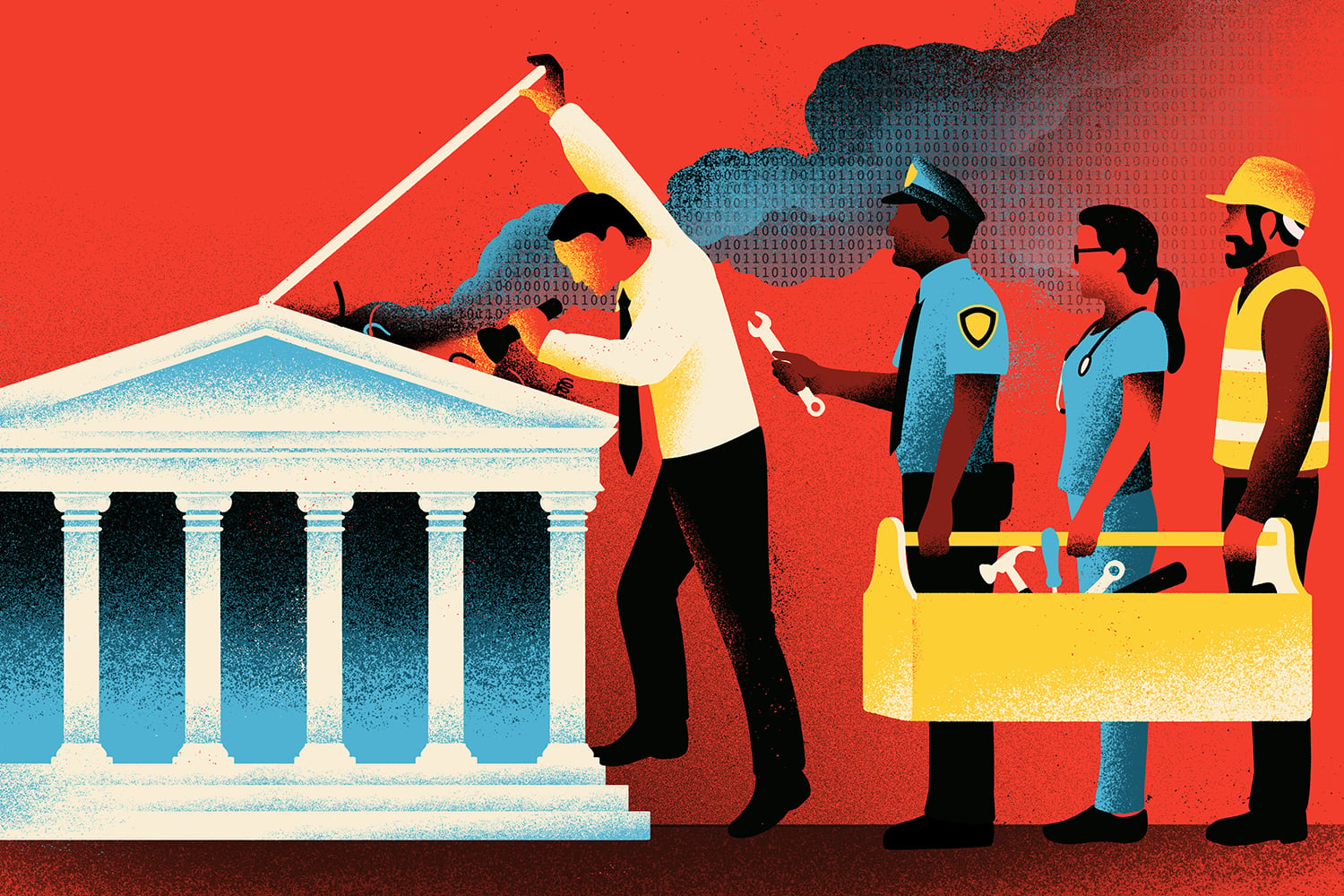
*An illustration against a red background shows a person in a white shirt and tie lifting the roof off a columned building to shine a flashlight inside, revealing black smoke filled with binary code, while a police officer, a healthcare worker, and a construction worker stand beside them with a yellow toolbox and a wrench.*
Sébastien Thibault illustration for Foreign Policy
1. Get audio access with any FP subscription.
ALREADY AN FP SUBSCRIBER? LOGIN
It is now common to lament a crisis in the system of democracy. Confidence in public institutions has declined, experts are dismissed, and politics is becoming a contest over not only values and interests but reality itself.
These trends have come alongside a corresponding rise in attempts to explain this phenomenon, ranging from feckless leadership and rising inequality to globalization and economic shocks. While those are all factors, a more compelling explanation could lie in how the digital revolution has undermined trust in facts, governments, and democracy itself.
To be clear, falsehoods and disinformation are not new. Manipulating information has long been a tool of statecraft. The ancient Indian political treatise, the Arthashastra, advised rulers to spread rumors to control public opinion. But while modern media has vastly expanded the scale, scope, and reach of information, it has also turbocharged the dissemination of propaganda and misinformation.
This degradation of informational systems is precipitating a crisis of legitimacy in the core institutions of democracies. Meanwhile, there is a growing mismatch between inherited democratic institutions and our new social realities. In some countries, the central problem is the decay of once-strong mass intermediaries such as political parties, unions, a free press, and civic organizations. In others, mass intermediaries never achieved the authority imagined in the classic democratic model. In others, the state itself remains too uneven or predatory to serve as a reliable object of trust. But in all cases, democracies face a similar problem: how to make collective self-government credible when citizens no longer accept inherited intermediaries as authoritative or trustworthy.
What is the solution? There is no easy answer, but a path to restoring faith in democracy can only begin by making the democratic process more observable, relational, and capable. And this process must take place first at the local level, building from the bottom up—just as democracy was designed to do.
*A crowd sits in a dark room with many people holding up glowing smartphones against a bright blue and white background.*
Audience members hold up their phones during fashion week in Sao Paulo on Oct. 28, 2018. Mauricio Santana/Getty Images
Trust—among citizens and between citizens and their governments—is the bedrock of democracy. Trust represents a pact between the trustor—the party extending the trust—and the trustee, or the party being trusted. Such a transaction requires a degree of vulnerability on the part of the trustor. Trust is a psychological condition that allows the trustor to set aside a purely rational calculus and make a leap of faith toward positive expectations about the trustee.
We can distinguish between two types of trust: cognition-based and affect-based. The former is an evidence-driven process by which individuals use updated information to judge the reliability, character, and ability of the trustee. Affect-based trust, in contrast, underpins social relationships and is based on emotions of care and concern for others.
In politics, cognitive trust is based on calculated assessments of the competence of politicians and
Big Tech Has Undermined Democracy. Here’s How to Reverse the Trend.
Georgetown University's Dan Honig and Johns Hopkins' Devesh Kapur argue that the digital revolution has eroded trust in facts, governments, and democracy itself. They contend that restoring that trust must begin at the local level, by making democratic processes more transparent, relational, and capable.
Cross Lines newsroom
Share this article
#الشركات التقنية#الديمقراطية#الثقة العامة#التضليل الإعلامي#المؤسسات#الحوكمة المحلية
Original source: Foreign Policy