Hezbollah's Nasrallah commemoration exposes its lost standing in Lebanon, expert says - jpost.com
أخبار لبنان
أ
أخبار لبنان
Original Source
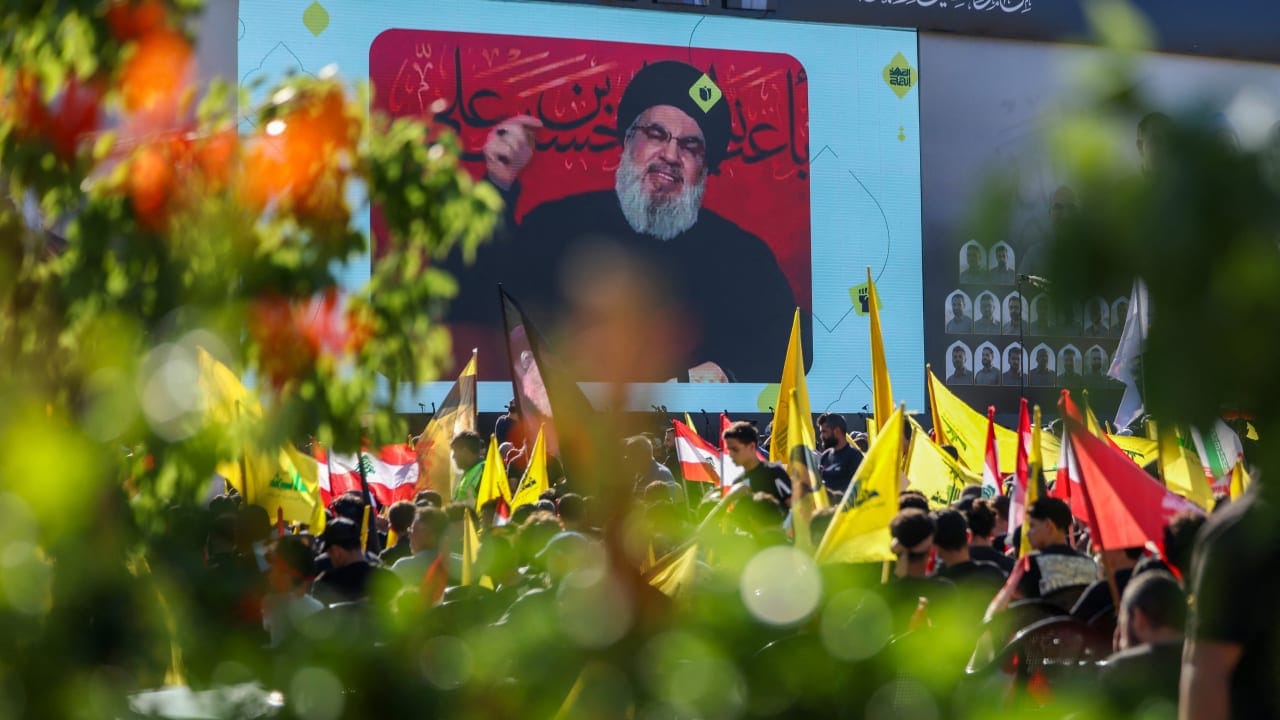
Tens of thousands of Hezbollah supporters gathered in southern Beirut on Sunday to commemorate the second anniversary of Hassan Nasrallah's death, yet the notable absence of senior Lebanese officials signals a sharp decline in the group's political standing. The commemoration underscores mounting tensions between Hezbollah and legitimate Lebanese authorities over the group's refusal to disarm and its role in reigniting conflict with Israel.
Though tens of thousands ofHezbollahsupporters gathered in Lebanon on Sunday to mark the second anniversary of the death of Hezbollah secretary-general Hassan Nasrallah, the Iranian-backed group’s standing in Lebanon was clear, Lt.-Col (res.) Moran Levanoni, a researcher at the Institute for National Security Studies (INSS), told The Jerusalem Post on Monday.
Pictures from the commemoration showed the bulk of attendees mourning Nasrallah at his burial site in Dahiyeh, Hezbollah’s southern Beirut stronghold, while government officials were notably absent, Levanoni highlighted.
“No Lebanese high-ranking officials or political figures from Lebanon came over to participate,” he noted. “Hezbollah is still in a very big problem within Lebanese politics, and it’s losing ground.”
Levanoni theorized that Hezbollah’s efforts to once again center itself at the heart of the political arena, by holding the mass event in Beirut, were falling short, especially as it has been unable to refund residents ofsouthern Lebanonfor all they have lost in the war it restarted on behalf of Iran.
Even among its Shi’ite base, Levanoni noted that Hezbollah’s refusal to hand over Ali al-Taher Ridge to the Lebanese Armed Forces (LAF), allowing it to be seized by Israel, had cost the group significant support.
The underground terrorist infrastructure, which extended for over two kilometers, held dozens of Iranian-made rockets, missiles, and UAVs, along with machine guns, dozens of anti-tank missiles, and hundreds of mines and explosive devices, according to the IDF. It took two decades of Iranian investment to build up the infrastructure and arsenal.
Lebanese journalist Hasan Illaik, who has repeatedly expressed views sympathetic to Hezbollah, said on X/Twitter that Lebanese President Joseph Aoun had ordered all security agency chiefs to refrain from sending representatives to participate in the commemoration, without providing background for his claim.
“Joseph Aoun’s authority bases its decisions primarily on hatred. This is an authority that opposes us. The authority that pressures to prevent the families of the child martyrs from commemorating their sons in Martyrs’ Square is an authority that opposes us,” Illaik said.
“Nawaf Salam’s speech at theUnited Nationsis a speech full of hatred toward the war’s victims in general and toward the southerners in particular, and [he] is ready to support Netanyahu personally against us. The orders of Joseph Aoun mentioned below express hatred toward us. It is up to the honorable officers to rebel against these orders. This is a test for them.”
Despite his accusations, no high-ranking officials outside Hezbollah attended the first anniversary events for Nasrallah last year, and Salam pushed for legal action after Hezbollah projected an unauthorized image of Nasrallah onto Beirut’s landmark Raouché Rock.
The divide between Hezbollah and the legitimate authorities in Lebanon was further displayed on Sunday when Hezbollah leaderNaim Qassemdelivered a fiery speech against Beirut, accusing the government of “contributing to the Israeli project instead of opposing it.”
Qassem directly criticized Aoun, claiming he wanted a head of state who was “an arbiter and a unifying figure, not a party to the conflict,” before insisting that Hezbollah would continue to disregard Lebanese law by continuing to pursue “the path of resistance.”
“How can we engage in dialogue with someone who has declared that the resistance and its people are outlawed?” Qassem asked.
Despite the apparent divisions in Lebanon, Lt.-Col. (res.) Sarit Zehavi, founder and president of the Alma Research and Education Center, toldThe Jerusalem Postthat Sunday’s events made clear that Hezbollah maintains a “solid” support base, and the voices against Hezbollah needed to translate into action against the group.
The center noted in its report that ahead of the demonstrations there were also tensions over whether Hezbollah should prioritize the needs of the displaced or symbolic displays of strength.
Plans to expand Nasrallah’s tomb were rejected by his son, Jawad Nasrallah, who insisted that a grand complex should not be built while the organization’s support base continues to suffer from a lack of housing.
The one email that makes sense of the Middle East. Iran, the Gulf, Syria, Turkey, and whatever moved that day, from The Jerusalem Post, every evening.
Pictures from the commemoration showed the bulk of attendees mourning Nasrallah at his burial site in Dahiyeh, Hezbollah’s southern Beirut stronghold, while government officials were notably absent, Levanoni highlighted.
“No Lebanese high-ranking officials or political figures from Lebanon came over to participate,” he noted. “Hezbollah is still in a very big problem within Lebanese politics, and it’s losing ground.”
Levanoni theorized that Hezbollah’s efforts to once again center itself at the heart of the political arena, by holding the mass event in Beirut, were falling short, especially as it has been unable to refund residents ofsouthern Lebanonfor all they have lost in the war it restarted on behalf of Iran.
Even among its Shi’ite base, Levanoni noted that Hezbollah’s refusal to hand over Ali al-Taher Ridge to the Lebanese Armed Forces (LAF), allowing it to be seized by Israel, had cost the group significant support.
The underground terrorist infrastructure, which extended for over two kilometers, held dozens of Iranian-made rockets, missiles, and UAVs, along with machine guns, dozens of anti-tank missiles, and hundreds of mines and explosive devices, according to the IDF. It took two decades of Iranian investment to build up the infrastructure and arsenal.
Lebanese journalist Hasan Illaik, who has repeatedly expressed views sympathetic to Hezbollah, said on X/Twitter that Lebanese President Joseph Aoun had ordered all security agency chiefs to refrain from sending representatives to participate in the commemoration, without providing background for his claim.
“Joseph Aoun’s authority bases its decisions primarily on hatred. This is an authority that opposes us. The authority that pressures to prevent the families of the child martyrs from commemorating their sons in Martyrs’ Square is an authority that opposes us,” Illaik said.
“Nawaf Salam’s speech at theUnited Nationsis a speech full of hatred toward the war’s victims in general and toward the southerners in particular, and [he] is ready to support Netanyahu personally against us. The orders of Joseph Aoun mentioned below express hatred toward us. It is up to the honorable officers to rebel against these orders. This is a test for them.”
Despite his accusations, no high-ranking officials outside Hezbollah attended the first anniversary events for Nasrallah last year, and Salam pushed for legal action after Hezbollah projected an unauthorized image of Nasrallah onto Beirut’s landmark Raouché Rock.
The divide between Hezbollah and the legitimate authorities in Lebanon was further displayed on Sunday when Hezbollah leaderNaim Qassemdelivered a fiery speech against Beirut, accusing the government of “contributing to the Israeli project instead of opposing it.”
Qassem directly criticized Aoun, claiming he wanted a head of state who was “an arbiter and a unifying figure, not a party to the conflict,” before insisting that Hezbollah would continue to disregard Lebanese law by continuing to pursue “the path of resistance.”
“How can we engage in dialogue with someone who has declared that the resistance and its people are outlawed?” Qassem asked.
Despite the apparent divisions in Lebanon, Lt.-Col. (res.) Sarit Zehavi, founder and president of the Alma Research and Education Center, toldThe Jerusalem Postthat Sunday’s events made clear that Hezbollah maintains a “solid” support base, and the voices against Hezbollah needed to translate into action against the group.
The center noted in its report that ahead of the demonstrations there were also tensions over whether Hezbollah should prioritize the needs of the displaced or symbolic displays of strength.
Plans to expand Nasrallah’s tomb were rejected by his son, Jawad Nasrallah, who insisted that a grand complex should not be built while the organization’s support base continues to suffer from a lack of housing.
The one email that makes sense of the Middle East. Iran, the Gulf, Syria, Turkey, and whatever moved that day, from The Jerusalem Post, every evening.
🔗 Share Article
Tags:#حزب الله#لبنان#نصرالله#السياسة اللبنانية#الشرق الأوسط#إسرائيل
Source: أخبار لبنان
For Context
Related reads from the same topic or latest developments