"National security" becomes Trump's executive sledgehammer
Axios
A
Axios
Original Source
President Trump invokes national security to justify sweeping policies ranging from journalist restrictions to Washington architecture projects and Greenland sovereignty demands. Constitutional experts warn this unprecedented expansion of security pretexts as a catch-all justification threatens legal and constitutional boundaries.
Trump wields a national security sledgehammer to bust presidential norms
*
* Newsletters
*
* Axios Pro
* Axios Live
* The Axios Show
Axios
Axios
3 hours ago - Politics & Policy
"National security" becomes Trump's executive sledgehammer
* Avery Lotz
*
*
*
Add Axios on Google
Add Axios as your preferred source to
see more of our stories on Google.
Add Axios on Google
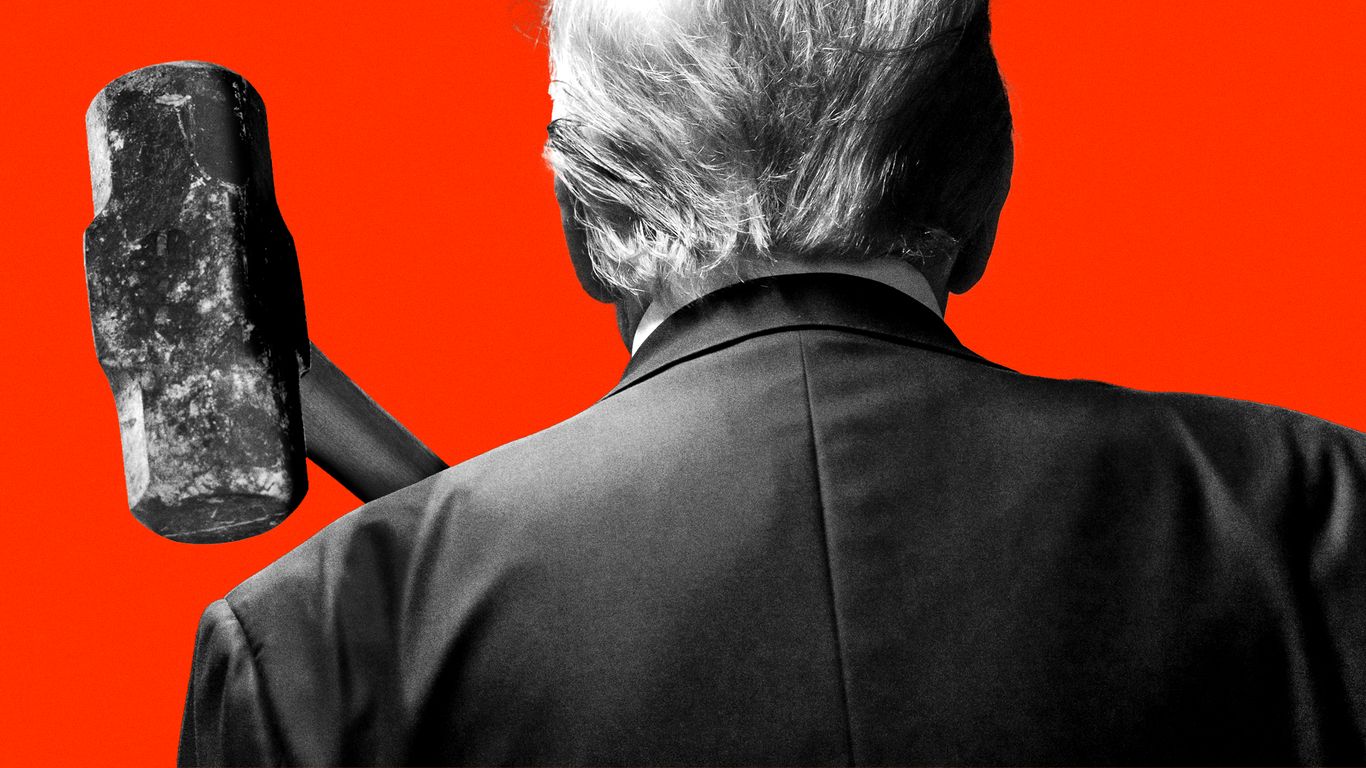
!Photo illustration of Donald Trump with a sledgehammer over his shoulder.
*Photo illustration: Maura Losch/Axios. Photo: Justin Lane via Pool/Getty Images.*
What do a White House ban on journalists, a 250-foot arch near the nation's capital and Greenland have in common?
* President Trump needs all of them for national security purposes, he and his administration have argued.
**Why it matters:** As he's unilaterally shattered presidential norms, Trump has justified his sweeping policy priorities with a familiar two-word rationale: national security.
**Driving the news:** On the morning that the three banned outlets (CNN, MS NOW and Politico) sued the administration, Trump claimed that "FAKE NEWS" is "a threat to our National Security."
* It's not the first time the administration has said its press restrictions were a national security must: That was also part of the reasoning for new rules for Pentagon reporters, a war on leakers and subpoenas of journalists.
**National security purposes** are a broad bucket that the president has also used to justify his D.C. redesign:
* Trump pitched his proposed "triumphal arch" as a dual-use facility housing snipers, drones and ammunition storage "for National Security purposes." That's also why the president was adamant his White House ballroom project must proceed (after he demolished the East Wing).
* The White House declined to comment beyond the president's post.
**Zoom out:** The national security rationale has also fueled the administration's deregulatory AI approach.
* Earlier this month, Justice Department attorneys argued that laws that get in the way of a growing AI industry "threaten national security" in a statement of interest backing AI companies in The New York Times' copyright infringement lawsuit.
**What they're saying:** The executive's use of national security as a justification for policy can trigger "extreme deference" in the courts, says Kimberly Wehle, a University of Baltimore law professor.
* Wehle notes the expanded executive power seen in Trump 2.0 has its origins in the Bush-era advancement of the unitary executive theory — though the national psyche today does not necessarily reflect the urgency of the 9/11 era.
* "It appears that the Trump administration has taken a page from that era and understands that it's easier to justify power from the standpoint of the public, and even in the courts, if you can say it's in the interest of national security," she says.
**Friction point:** The argument hasn't always found a receptive audience.
* An appeals court considering Trump's White House ballroom project concluded last month that "\[w]hile this court accords great weight and deference to invocations of national security and the safety of the President, such arguments are not an automatic get-out-of-law-free card."
* Elizabeth Goitein, senior director of the Brennan Center's Liberty and National Security Program, says the ambiguity of "national security" has moved "toward this dangerous zone where the words … become a blank check" and "take on this talismanic significance in the courts."
* Trump didn't start it, she says. But "Trump's willingness to claim national security for things that so patently have nothing to do with national security is at a new level."
**Worth noting:** The administration has also busted norms in the more traditional national security realm.
* After months of demanding U.S. ownership of Greenland as a national security necessity, Trump announced last week that the U.S. struck a deal with Denmark and Greenland to give America "permanent control over security" on the island, where the U.S. already had military access.
* South of the border, the administration has waged a year-long campaign against alleged narcoterrorists, killing some 230 people in boat strikes and fueling broad international law concerns.
* And while immigration policy is a key pillar of the nation's security apparatus, Trump's far-reaching crackdown has lumped international students, Temporary Protected Status holders and travelers from certain designated nations together under the guise of national security threats.
**The bottom line:** National security concerns have long been fuel for the expansion of presidential authority.
* Trump, however, has used national security to justify acting not only as the commander in chief, but, recently, as a builder in chief and editor in chief as well.
**Go deeper:** Trump's proposed Washington arch to become sniper, drone facility
*
*
*
Add Axios on Google
What to read next
*
*
*
*
*
*
Smarter, faster on what matters.
Explore Axios Newsletters
* About Axios
* Advertise with us
* Careers
* Contact us
* Newsletters
* Axios Live
* Axios HQ
* Privacy policy
* Terms of use
*
Axios Homepage
Axios Media Inc., 2026
*
* Newsletters
*
* Axios Pro
* Axios Live
* The Axios Show
Axios
Axios
3 hours ago - Politics & Policy
"National security" becomes Trump's executive sledgehammer
* Avery Lotz
*
*
*
Add Axios on Google
Add Axios as your preferred source to
see more of our stories on Google.
Add Axios on Google
!Photo illustration of Donald Trump with a sledgehammer over his shoulder.
*Photo illustration: Maura Losch/Axios. Photo: Justin Lane via Pool/Getty Images.*
What do a White House ban on journalists, a 250-foot arch near the nation's capital and Greenland have in common?
* President Trump needs all of them for national security purposes, he and his administration have argued.
**Why it matters:** As he's unilaterally shattered presidential norms, Trump has justified his sweeping policy priorities with a familiar two-word rationale: national security.
**Driving the news:** On the morning that the three banned outlets (CNN, MS NOW and Politico) sued the administration, Trump claimed that "FAKE NEWS" is "a threat to our National Security."
* It's not the first time the administration has said its press restrictions were a national security must: That was also part of the reasoning for new rules for Pentagon reporters, a war on leakers and subpoenas of journalists.
**National security purposes** are a broad bucket that the president has also used to justify his D.C. redesign:
* Trump pitched his proposed "triumphal arch" as a dual-use facility housing snipers, drones and ammunition storage "for National Security purposes." That's also why the president was adamant his White House ballroom project must proceed (after he demolished the East Wing).
* The White House declined to comment beyond the president's post.
**Zoom out:** The national security rationale has also fueled the administration's deregulatory AI approach.
* Earlier this month, Justice Department attorneys argued that laws that get in the way of a growing AI industry "threaten national security" in a statement of interest backing AI companies in The New York Times' copyright infringement lawsuit.
**What they're saying:** The executive's use of national security as a justification for policy can trigger "extreme deference" in the courts, says Kimberly Wehle, a University of Baltimore law professor.
* Wehle notes the expanded executive power seen in Trump 2.0 has its origins in the Bush-era advancement of the unitary executive theory — though the national psyche today does not necessarily reflect the urgency of the 9/11 era.
* "It appears that the Trump administration has taken a page from that era and understands that it's easier to justify power from the standpoint of the public, and even in the courts, if you can say it's in the interest of national security," she says.
**Friction point:** The argument hasn't always found a receptive audience.
* An appeals court considering Trump's White House ballroom project concluded last month that "\[w]hile this court accords great weight and deference to invocations of national security and the safety of the President, such arguments are not an automatic get-out-of-law-free card."
* Elizabeth Goitein, senior director of the Brennan Center's Liberty and National Security Program, says the ambiguity of "national security" has moved "toward this dangerous zone where the words … become a blank check" and "take on this talismanic significance in the courts."
* Trump didn't start it, she says. But "Trump's willingness to claim national security for things that so patently have nothing to do with national security is at a new level."
**Worth noting:** The administration has also busted norms in the more traditional national security realm.
* After months of demanding U.S. ownership of Greenland as a national security necessity, Trump announced last week that the U.S. struck a deal with Denmark and Greenland to give America "permanent control over security" on the island, where the U.S. already had military access.
* South of the border, the administration has waged a year-long campaign against alleged narcoterrorists, killing some 230 people in boat strikes and fueling broad international law concerns.
* And while immigration policy is a key pillar of the nation's security apparatus, Trump's far-reaching crackdown has lumped international students, Temporary Protected Status holders and travelers from certain designated nations together under the guise of national security threats.
**The bottom line:** National security concerns have long been fuel for the expansion of presidential authority.
* Trump, however, has used national security to justify acting not only as the commander in chief, but, recently, as a builder in chief and editor in chief as well.
**Go deeper:** Trump's proposed Washington arch to become sniper, drone facility
*
*
*
Add Axios on Google
What to read next
*
*
*
*
*
*
Smarter, faster on what matters.
Explore Axios Newsletters
* About Axios
* Advertise with us
* Careers
* Contact us
* Newsletters
* Axios Live
* Axios HQ
* Privacy policy
* Terms of use
*
Axios Homepage
Axios Media Inc., 2026
🔗 Share Article
Tags:#الأمن القومي#ترامب#السلطات الرئاسية#الحريات الصحفية#القانون الدستوري
Source: Axios
For Context
Related reads from the same topic or latest developments