Why Treasury yields are ripping higher
Axios
A
Axios
Original Source
U.S. Treasury yields surged sharply Thursday, with the 30-year bond reaching its highest level since 2004, driven by strong economic data that reignited inflation concerns. Market indicators now suggest significant odds of Federal Reserve rate hikes to combat mounting inflationary pressures in the economy.
Why Treasury yields are ripping higher
*
* Newsletters
*
* Axios Pro
* Axios Live
* The Axios Show
Axios
Axios
1 hour ago - Business
Treasury yields rip higher on renewed inflation fear
* Matt Phillips
*
*
*
Add Axios on Google
Add Axios as your preferred source to
see more of our stories on Google.
Add Axios on Google
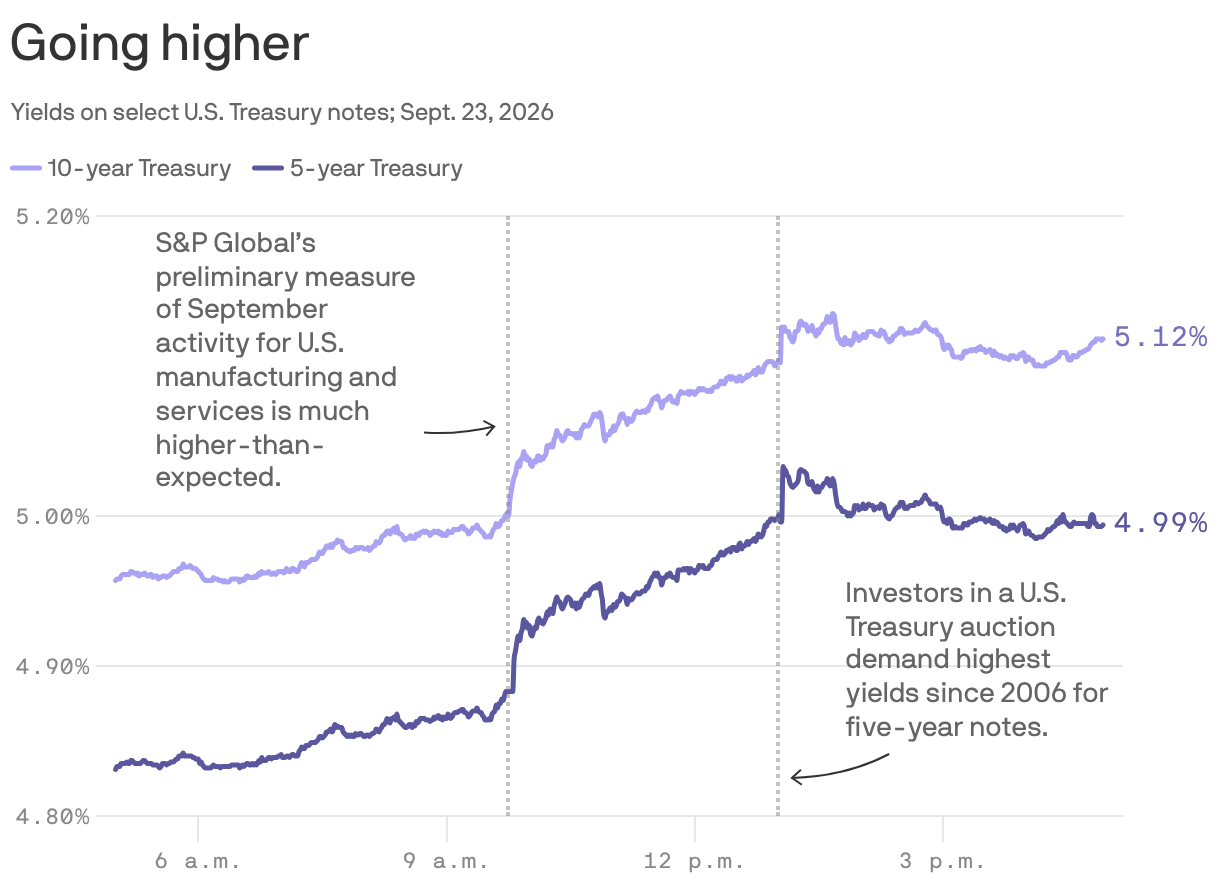
*Data: FactSet; Chart: Axios/Matt Phillips*
Treasury yields are soaring, with the 30-year Treasury bond climbing to its highest level since 2004 Thursday.
* The selloff in bonds started to accelerate Wednesday after a sizzling early report on the economy in September.
**The big picture:** For the bond market, these moves have been big. Bigly even.
* On Thursday morning, the 30-year yield rose as high as 5.44%. The yield on the 10-year Treasury note was 5.13%.
* Wednesday's gain of roughly 0.15 percentage point in the 10-year Treasury yield was the biggest since April 2025, when President Trump's "Liberation Day" tariff announcement rocked markets.
**Flashback:** Markets heads remember that it was ructions in the bond market — "They were getting yippy," the president famously said at the time — that prompted Trump to walk back some of the most extreme tariff policies.
**Yes, but:** This time, the dynamics driving the bond market are more complicated, global and difficult to manage.
* Treasury yields have been moving higher for months on a combination of stronger-than-expected economic activity coupled with uncomfortably high inflation.
* The surge in data center-related borrowing in the bond market is also pushing up interest rates, as tech borrowers compete with the U.S. Treasury for investor dollars.
**Case in point:** The big driver of Wednesday's surge in yields — which means, remember, that bond prices were falling — was one of the earliest economic reports on the U.S. economy in September.
* These surveys of corporate purchasing managers suggested booming business in both the U.S. manufacturing and services industries. (JPMorgan economists said they were consistent with a 5% annual run rate for GDP growth.)
* But they also showed that the prices these companies were paying were soaring as well. (In other words, more inflationary pressures are in the pipeline.)
**Zoom out:** Inflation is anathema for bond market investors as it erodes the value of the interest payments bondholders collect, making them less attractive assets.
* The September survey data kicked off a wave of selling of Treasurys that rippled through the financial markets.
* In the money markets — essentially very short-term bond markets — traders began to price in rising odds that Fed will have to pursue a serious cycle of rate hikes to get inflation under control.
* The markets are now putting more than 50% odds on quarter-point increases at the Fed's October and December meeting.
**Between the lines:** Lurking in the background of the inflation-driven market move is the specter of a U.S. diesel export ban, which the Trump administration is reportedly considering.
* But there's deep uncertainty about what such a ban would mean for overall inflation.
* Some industry voices warn that such a ban could actually push prices of other refined products, like gasoline, sharply higher because of the way refineries operate.
**What they're saying:** "The proposed U.S. diesel export ban will not play out as the U.S. administration expects," wrote Susan Bell, an oil analyst with the consulting firm Rystad Energy. "While it may temporarily lower domestic diesel prices, it will cause the prices for all other refined products to soar as U.S. refineries cut run rates to balance their diesel production with the domestic demand."
* "There is little flexibility to minimize diesel yield without cutting overall refinery throughput," Bell said.
**The bottom line:** The inflationary pressures appear to be building in the economy, which will be a headache both for politicians in the final stretch of the midterm elections and for policymakers like Federal Reserve chairman Kevin Warsh.
*
*
*
Add Axios on Google
What to read next
*
*
*
*
*
*
Smarter, faster on what matters.
Explore Axios Newsletters
* About Axios
* Advertise with us
* Careers
* Contact us
* Newsletters
* Axios Live
* Axios HQ
* Privacy policy
* Terms of use
*
Axios Homepage
Axios Media Inc., 2026
*
* Newsletters
*
* Axios Pro
* Axios Live
* The Axios Show
Axios
Axios
1 hour ago - Business
Treasury yields rip higher on renewed inflation fear
* Matt Phillips
*
*
*
Add Axios on Google
Add Axios as your preferred source to
see more of our stories on Google.
Add Axios on Google
*Data: FactSet; Chart: Axios/Matt Phillips*
Treasury yields are soaring, with the 30-year Treasury bond climbing to its highest level since 2004 Thursday.
* The selloff in bonds started to accelerate Wednesday after a sizzling early report on the economy in September.
**The big picture:** For the bond market, these moves have been big. Bigly even.
* On Thursday morning, the 30-year yield rose as high as 5.44%. The yield on the 10-year Treasury note was 5.13%.
* Wednesday's gain of roughly 0.15 percentage point in the 10-year Treasury yield was the biggest since April 2025, when President Trump's "Liberation Day" tariff announcement rocked markets.
**Flashback:** Markets heads remember that it was ructions in the bond market — "They were getting yippy," the president famously said at the time — that prompted Trump to walk back some of the most extreme tariff policies.
**Yes, but:** This time, the dynamics driving the bond market are more complicated, global and difficult to manage.
* Treasury yields have been moving higher for months on a combination of stronger-than-expected economic activity coupled with uncomfortably high inflation.
* The surge in data center-related borrowing in the bond market is also pushing up interest rates, as tech borrowers compete with the U.S. Treasury for investor dollars.
**Case in point:** The big driver of Wednesday's surge in yields — which means, remember, that bond prices were falling — was one of the earliest economic reports on the U.S. economy in September.
* These surveys of corporate purchasing managers suggested booming business in both the U.S. manufacturing and services industries. (JPMorgan economists said they were consistent with a 5% annual run rate for GDP growth.)
* But they also showed that the prices these companies were paying were soaring as well. (In other words, more inflationary pressures are in the pipeline.)
**Zoom out:** Inflation is anathema for bond market investors as it erodes the value of the interest payments bondholders collect, making them less attractive assets.
* The September survey data kicked off a wave of selling of Treasurys that rippled through the financial markets.
* In the money markets — essentially very short-term bond markets — traders began to price in rising odds that Fed will have to pursue a serious cycle of rate hikes to get inflation under control.
* The markets are now putting more than 50% odds on quarter-point increases at the Fed's October and December meeting.
**Between the lines:** Lurking in the background of the inflation-driven market move is the specter of a U.S. diesel export ban, which the Trump administration is reportedly considering.
* But there's deep uncertainty about what such a ban would mean for overall inflation.
* Some industry voices warn that such a ban could actually push prices of other refined products, like gasoline, sharply higher because of the way refineries operate.
**What they're saying:** "The proposed U.S. diesel export ban will not play out as the U.S. administration expects," wrote Susan Bell, an oil analyst with the consulting firm Rystad Energy. "While it may temporarily lower domestic diesel prices, it will cause the prices for all other refined products to soar as U.S. refineries cut run rates to balance their diesel production with the domestic demand."
* "There is little flexibility to minimize diesel yield without cutting overall refinery throughput," Bell said.
**The bottom line:** The inflationary pressures appear to be building in the economy, which will be a headache both for politicians in the final stretch of the midterm elections and for policymakers like Federal Reserve chairman Kevin Warsh.
*
*
*
Add Axios on Google
What to read next
*
*
*
*
*
*
Smarter, faster on what matters.
Explore Axios Newsletters
* About Axios
* Advertise with us
* Careers
* Contact us
* Newsletters
* Axios Live
* Axios HQ
* Privacy policy
* Terms of use
*
Axios Homepage
Axios Media Inc., 2026
🔗 Share Article
Tags:#الاقتصاد الأمريكي#السندات الحكومية#التضخم#أسعار الفائدة#الاحتياطي الفيدرالي#الأسواق المالية
Source: Axios
For Context
Related reads from the same topic or latest developments