The True Meaning of Russia’s Sham Election
Foreign Policy

Foreign Policy
Original Source
Russia's recent parliamentary elections are not a genuine democratic process, but a political tool Putin uses to reinforce his false legal legitimacy and legitimize the occupation of Ukrainian territories. Even in authoritarian systems, rigged elections carry deeper meanings beyond predetermined outcomes.
What Putin's Sham Elections Say About Russia
!Foreign Policy
Foreign Policy Get analysis and alerts more quickly in the mobile app.
Install
Back to Foreign Policy Magazine home page
* Latest
* Regions
+ Asia & the Pacific
+ China
+ Middle East & Africa
+ Americas
+ Europe
* Newsletters
Editors’ Picks
Evening roundup with our editors’ favorite stories of the day
!World Brief Icon
World Brief
Your guide to the most important world stories of the day
!China Brief Icon
China Brief
The latest news, analysis, and data from the country each week
Situation Report
Weekly update on what’s driving U.S. national security policy
FP Weekend
A curation of our best book reviews, deep dives, and other reads
!Africa Brief Icon
Africa Brief
Essential analysis of the stories shaping geopolitics on the continent
!South Asia Brief Icon
South Asia Brief
Weekly update on developments in India and its neighbors
The Reading List
Curated guides on geopolitics and current affairs
FP Bookshelf
A monthly guide to FP’s book reviews, excerpts, and reading recommendations
!Latin America Brief Icon
Latin America Brief
One-stop digest of politics, economics, and culture
!Southeast Asia Brief Icon
Southeast Asia Brief
A weekly dispatch with news from the region’s 11 countries
The New Geopolitics
A five-part masterclass in IR theory with Harvard Professor Stephen M. Walt
View All Newsletters
* FP Live
* Latest
* Trending:
* Trump-Xi meeting
Search this website
* Preferences
* My FP Feed
* Saved Articles
* Newsletters
* Magazine Archive
* Subscription Settings
* FAQs
* Log Out
Sign In
Sign In
Team access Team access
Subscribe Subscribe Team access Team access
Analysis: The True Meaning of Russia’s Sham Election
*
*
* Facebook
* Bluesky
* X
* LinkedIn
* WhatsApp
* Reddit
Save
1. Create an FP account to save articles to read later.
Sign Up
ALREADY AN FP SUBSCRIBER? LOGIN
PDF
1. **Downloadable PDFs** are a benefit of an FP subscription.
Subscribe Now
ALREADY AN FP SUBSCRIBER? LOGIN
Gift
*
*
* WhatsApp
1. Gifting articles is a subscriber benefit.
Subscribe Now
ALREADY AN FP SUBSCRIBER? LOGIN
2. This article is an Insider exclusive.
Contact us at [email protected] to learn about upgrade options, unlocking the ability to gift this article.
Analysis
The True Meaning of Russia’s Sham Election
Even rigged elections used to be an outlet for discontent. That avenue is now closed.
By **Alexander Baunov**, a senior fellow at the Carnegie Russia Eurasia Center.
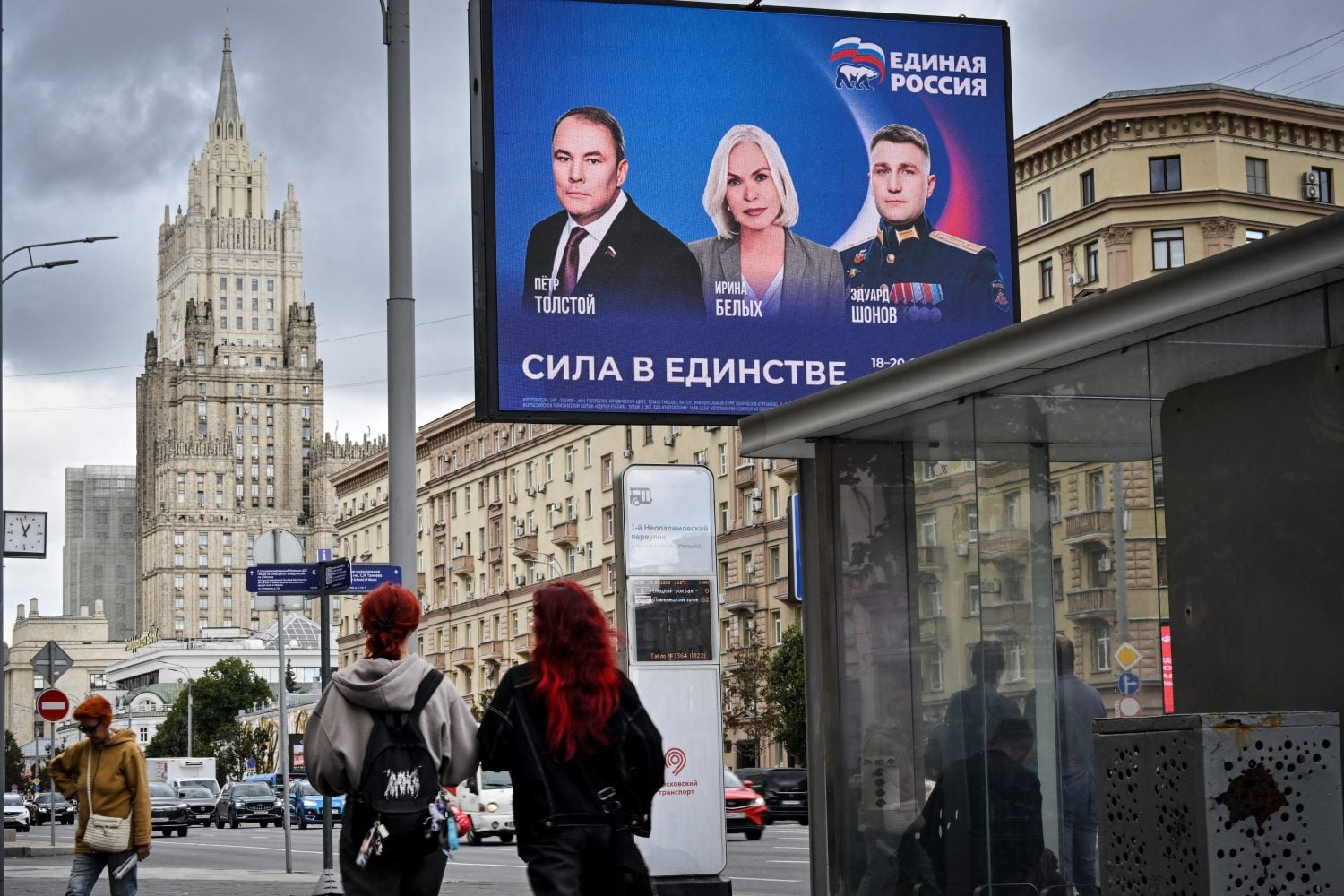
!Election billboard in Moscow
*Election billboard in Moscow*
An election campaign billboard for the ruling United Russia party is seen near the Russian Foreign Ministry building in central Moscow on Sept. 2. Alexander NEMENOV / AFP via Getty Images
1. Get audio access with any FP subscription.
Subscribe Now
ALREADY AN FP SUBSCRIBER? LOGIN
September 29, 2026, 5:56 AM
What passes for elections in Russia these days bears little resemblance to any recognizably democratic process. Opposition figures are jailed, exiled, or dead. Remaining candidates are carefully screened. In Russian-occupied parts of Ukraine, ballots are cast at gunpoint. Some precincts’ vote tallies are mathematically impossible, and most Russians know that the outcome is predetermined. But in a dictatorship, even a rigged election has meaning. What matters is not the predictable victory declared by the ruling party, United Russia, following the Sept. 18-20 parliamentary elections but the signals that this completely orchestrated piece of political theater sends across Russia and to the world.
The first signal is the illusion of legitimacy. By adhering to constitutionally mandated electoral cycles, an autocrat asserts his legal claim to power—never mind that Russian President Vladimir Putin’s mandate from the last more or less genuine election in 2000 has long expired. Putin is very fond of recalling his studies to become a lawyer, and one of the words he has used most often in all his public speeches is “law.” In the process of building his dictatorship, Putin always thought to keep the legal fabric intact. On the surface at least, procedures should be followed—a sham legality we know from other dictatorships, including the Soviet Union and Nazi Germany.
What passes for elections in Russia these days bears little resemblance to any recognizably democratic process. Opposition figures are jailed, exiled, or dead. Remaining candidates are carefully screened. In Russian-occupied parts of Ukraine, ballots are cast at gunpoint. Some precincts’ vote tallies are mathematically impossible, and most Russians know that the outcome is predetermined. But in a dictatorship, even a rigged election has meaning. What matters is not the predictable victory declared by the ruling party, United Russia, following the Sept. 18-20 parliamentary elections but the signals that this completely orchestrated piece of political theater sends across Russia and to the world.
The first signal is the illusion of legitimacy. By adhering to constitutionally mandated electoral cycles, an autocrat asserts his legal claim to power—never mind that Russian President Vladimir Putin’s mandate from the last more or less genuine election in 2000 has long expired. Putin is very fond of recalling his studies to become a lawyer, and one of the words he has used most often in all his public speeches is “law.” In the process of building his dictatorship, Putin always thought to keep the legal fabric intact. On the surface at least, procedures should be followed—a sham legality we know from other dictatorships, including the Soviet Union and Nazi Germany.
Right now, holding elections generates an extra sense of self-righteousness for Putin as he seeks to delegitimize his Ukrainian counterpart, Volodymyr Zelensky. The Ukrainian Constitution, like that of various other democracies, bans the holding of elections during wartime. Putin will thus try to argue that Zelensky’s term in office has expired while he himself is legitimately elected and just scored another resounding “victory” for his party. Never mind that the word “election” has a completely different meaning in the two countries. In Russia, voters cannot loosen Putin’s grip on power. This distinction will, of course, be lost on U.S. President Donald Trump, who echoes Putin’s lies about Zelensky’s electoral legitimacy.
The second signal of this recent vote concerns Russia’s borders. Holding national elections—first presidential, then parliamentary—in the occupied parts of Ukraine is supposed to shore up the legitimacy of Russian control, even if those elections take place at gunpoint and are otherwise manipulated. If the residents of illegally annexed territory vote in Russian national elections, after all, that must mean they are Russians now and acknowledge Moscow’s authority. This is how the Kremlin spins it both in Russia and abroad.
No one knows how many Ukrainians remain in these areas or how many current residents moved there from Russia since 2014 (and especially since 2022), not to mention the number of Russian military and security personnel voting in these front-line areas. This attempt to legitimize Russia’s illegal annexations may hold no weight outside the bubble that surrounds the Russian dictator and his supporters. But it is part of Putin’s logic of sham legality.
The third signal is about shifting popular support. Elections may not pose a direct threat to the regime in terms of losing power, but even highly manipulated results can be a political barometer. What the regime chooses to ban sends a message as well.
For example, the most fervently militaristic party, A Just Russia, lost 11 of its 27 seats after struggling even to clear the minimum threshold needed to enter the Duma. (T
!Foreign Policy
Foreign Policy Get analysis and alerts more quickly in the mobile app.
Install
Back to Foreign Policy Magazine home page
* Latest
* Regions
+ Asia & the Pacific
+ China
+ Middle East & Africa
+ Americas
+ Europe
* Newsletters
Editors’ Picks
Evening roundup with our editors’ favorite stories of the day
!World Brief Icon
World Brief
Your guide to the most important world stories of the day
!China Brief Icon
China Brief
The latest news, analysis, and data from the country each week
Situation Report
Weekly update on what’s driving U.S. national security policy
FP Weekend
A curation of our best book reviews, deep dives, and other reads
!Africa Brief Icon
Africa Brief
Essential analysis of the stories shaping geopolitics on the continent
!South Asia Brief Icon
South Asia Brief
Weekly update on developments in India and its neighbors
The Reading List
Curated guides on geopolitics and current affairs
FP Bookshelf
A monthly guide to FP’s book reviews, excerpts, and reading recommendations
!Latin America Brief Icon
Latin America Brief
One-stop digest of politics, economics, and culture
!Southeast Asia Brief Icon
Southeast Asia Brief
A weekly dispatch with news from the region’s 11 countries
The New Geopolitics
A five-part masterclass in IR theory with Harvard Professor Stephen M. Walt
View All Newsletters
* FP Live
* Latest
* Trending:
* Trump-Xi meeting
Search this website
* Preferences
* My FP Feed
* Saved Articles
* Newsletters
* Magazine Archive
* Subscription Settings
* FAQs
* Log Out
Sign In
Sign In
Team access Team access
Subscribe Subscribe Team access Team access
Analysis: The True Meaning of Russia’s Sham Election
*
*
* Bluesky
* X
Save
1. Create an FP account to save articles to read later.
Sign Up
ALREADY AN FP SUBSCRIBER? LOGIN
1. **Downloadable PDFs** are a benefit of an FP subscription.
Subscribe Now
ALREADY AN FP SUBSCRIBER? LOGIN
Gift
*
*
1. Gifting articles is a subscriber benefit.
Subscribe Now
ALREADY AN FP SUBSCRIBER? LOGIN
2. This article is an Insider exclusive.
Contact us at [email protected] to learn about upgrade options, unlocking the ability to gift this article.
Analysis
The True Meaning of Russia’s Sham Election
Even rigged elections used to be an outlet for discontent. That avenue is now closed.
By **Alexander Baunov**, a senior fellow at the Carnegie Russia Eurasia Center.
!Election billboard in Moscow
*Election billboard in Moscow*
An election campaign billboard for the ruling United Russia party is seen near the Russian Foreign Ministry building in central Moscow on Sept. 2. Alexander NEMENOV / AFP via Getty Images
1. Get audio access with any FP subscription.
Subscribe Now
ALREADY AN FP SUBSCRIBER? LOGIN
September 29, 2026, 5:56 AM
What passes for elections in Russia these days bears little resemblance to any recognizably democratic process. Opposition figures are jailed, exiled, or dead. Remaining candidates are carefully screened. In Russian-occupied parts of Ukraine, ballots are cast at gunpoint. Some precincts’ vote tallies are mathematically impossible, and most Russians know that the outcome is predetermined. But in a dictatorship, even a rigged election has meaning. What matters is not the predictable victory declared by the ruling party, United Russia, following the Sept. 18-20 parliamentary elections but the signals that this completely orchestrated piece of political theater sends across Russia and to the world.
The first signal is the illusion of legitimacy. By adhering to constitutionally mandated electoral cycles, an autocrat asserts his legal claim to power—never mind that Russian President Vladimir Putin’s mandate from the last more or less genuine election in 2000 has long expired. Putin is very fond of recalling his studies to become a lawyer, and one of the words he has used most often in all his public speeches is “law.” In the process of building his dictatorship, Putin always thought to keep the legal fabric intact. On the surface at least, procedures should be followed—a sham legality we know from other dictatorships, including the Soviet Union and Nazi Germany.
What passes for elections in Russia these days bears little resemblance to any recognizably democratic process. Opposition figures are jailed, exiled, or dead. Remaining candidates are carefully screened. In Russian-occupied parts of Ukraine, ballots are cast at gunpoint. Some precincts’ vote tallies are mathematically impossible, and most Russians know that the outcome is predetermined. But in a dictatorship, even a rigged election has meaning. What matters is not the predictable victory declared by the ruling party, United Russia, following the Sept. 18-20 parliamentary elections but the signals that this completely orchestrated piece of political theater sends across Russia and to the world.
The first signal is the illusion of legitimacy. By adhering to constitutionally mandated electoral cycles, an autocrat asserts his legal claim to power—never mind that Russian President Vladimir Putin’s mandate from the last more or less genuine election in 2000 has long expired. Putin is very fond of recalling his studies to become a lawyer, and one of the words he has used most often in all his public speeches is “law.” In the process of building his dictatorship, Putin always thought to keep the legal fabric intact. On the surface at least, procedures should be followed—a sham legality we know from other dictatorships, including the Soviet Union and Nazi Germany.
Right now, holding elections generates an extra sense of self-righteousness for Putin as he seeks to delegitimize his Ukrainian counterpart, Volodymyr Zelensky. The Ukrainian Constitution, like that of various other democracies, bans the holding of elections during wartime. Putin will thus try to argue that Zelensky’s term in office has expired while he himself is legitimately elected and just scored another resounding “victory” for his party. Never mind that the word “election” has a completely different meaning in the two countries. In Russia, voters cannot loosen Putin’s grip on power. This distinction will, of course, be lost on U.S. President Donald Trump, who echoes Putin’s lies about Zelensky’s electoral legitimacy.
The second signal of this recent vote concerns Russia’s borders. Holding national elections—first presidential, then parliamentary—in the occupied parts of Ukraine is supposed to shore up the legitimacy of Russian control, even if those elections take place at gunpoint and are otherwise manipulated. If the residents of illegally annexed territory vote in Russian national elections, after all, that must mean they are Russians now and acknowledge Moscow’s authority. This is how the Kremlin spins it both in Russia and abroad.
No one knows how many Ukrainians remain in these areas or how many current residents moved there from Russia since 2014 (and especially since 2022), not to mention the number of Russian military and security personnel voting in these front-line areas. This attempt to legitimize Russia’s illegal annexations may hold no weight outside the bubble that surrounds the Russian dictator and his supporters. But it is part of Putin’s logic of sham legality.
The third signal is about shifting popular support. Elections may not pose a direct threat to the regime in terms of losing power, but even highly manipulated results can be a political barometer. What the regime chooses to ban sends a message as well.
For example, the most fervently militaristic party, A Just Russia, lost 11 of its 27 seats after struggling even to clear the minimum threshold needed to enter the Duma. (T
🔗 Share Article
Tags:#روسيا#الانتخابات#بوتين#الاستبداد#أوكرانيا#السياسة
Source: Foreign Policy
For Context
Related reads from the same topic or latest developments