InternationalAvailable in English
Italy’s Young Protesters Return to the Streets
Editorial
Cross Lines editing
Source
New York Times
New York Times
N
New York Times
Original Source
Young Italians took to the streets across the country on Saturday to protest the rising cost of living, under heavy police presence that prevented a repeat of the looting and violence seen the previous week. The demonstrations followed student protests in France that have sparked a nationwide wave of anger.
France Protest Updates: Hundreds of Thousands March Amid Heavy Security - The New York Times
Skip to contentSkip to site index
Sunday, October 25, 2026
Today’s Paper
* Home
* + U.S.
+ International
+ Canada
+ Español
+ 中文
Unrest in France
* New Round of Protests
* How Movement Began
* Riot Suspects
* Looters in Marseille
SKIP ADVERTISEMENT
France Protest Updates: Hundreds of Thousands March Amid Heavy Security
The marches were largely peaceful until evening, when clashes popped up and the police used tear gas and water cannons to disperse some protesters in Marseille and Paris.
Oct. 24, 2026
*
*
*
1.
Thibault Camus/Associated Press
2. Paris
Reuters
3. Orléans
Agence-France Presse
4. Marseille
Thibaud Moritz/Agence France-Presse — Getty Images
5. Marseille
Thibaud Moritz/Agence France-Presse — Getty Images
6. Paris
Dylan Martinez/Reuters
7. Lyon
Reuters
8. Marseille
Reuters
9. Orléans
Simon Wohlfahrt/Agence France-Presse — Getty Images
10. Marseille
Associated Press
11. Orléans
Teresa Suarez/Associated Press
See more of our coverage in your search results.Encuentra más de nuestra cobertura en los resultados de búsqueda. Add The New York Times on GoogleAgrega The New York Times en Google
Latest
Mark Landler
Reporting from Paris
Here’s the latest.
Hundreds of thousands of protesters gathered across France on Saturday, marching through streets alongside large-scale security forces the authorities had deployed to prevent a repeat of last weekend, when demonstrations degenerated into arson, looting and other violence.
The marches were largely peaceful until evening, when clashes popped up and the police used tear gas and water cannons to disperse some protesters in Marseille and in Paris. The authorities said some 110,000 people had gathered in Paris, even after organizers were forced to change the location of the demonstration at the last minute.
In Marseille, where looters ravaged a commercial avenue last week, a protest march produced few confrontations with the police until it reached the arch where it was supposed to end. Then clashes broke out between some masked demonstrators who erected barricades and the police, who used tear gas on the crowd.
In Orléans, south of Paris, a protest against France’s main far-right party, the National Rally, which is holding its convention in the city, ended peacefully in the afternoon. The local authorities said 11,000 protesters had gathered, while organizers in the crowd said 26,000 had joined.
There were major discrepancies in crowd estimates nationwide as well, with the Interior Ministry saying there were 410,000 protesters across the country, and the C.G.T., a labor union that organized today’s marches, putting the figure at 800,000.
As evening fell and some clashes broke out, it underscored the test France faces: whether it can get a grip on the outbreak of urban violence that has shocked the public and thrown the country’s leaders on the defensive.
What began as a student-led protest movement has mutated into something darker — a nationwide cycle of violence that raises basic questions about France’s ability to preserve law and order. Last weekend, the police failed to control marauding bands as they shattered shop windows, looted merchandise, incinerated vehicles and besieged public buildings.
But on Saturday, as many as 70,000 police officers and gendarmes, reinforced by elite military troops, armored vehicles, drones and helicopters, filled streets and the skies in Paris, Marseille, Lyon and other cities. Several cities, including Le Havre, Toulon and Nice, banned all demonstrations in their downtown areas.
Here’s what to know:
* **Economic backdrop:** Fears about France’s ballooning government deficit pushed the yield on its 10-year bond to above 5 percent on Friday for the first time since 2002, raising the prospect of a full-blown financial crisis. The government was spared another blow on Friday when the ratings agency Moody’s opted to maintain its rating on France’s sovereign debt. It had been widely expected to downgrade the rating. Read more ›
* **Closures:** Shops across Paris boarded up their windows. The Louvre and other cultural institutions announced they would close on Saturday, and the Art Basel fair ended on Friday, two days early. A Sunday soccer match between Paris Saint-Germain and Olympique Lyonnais was postponed.
* **Nationwide unrest:** The protest movement began with a handful of student demonstrations at high schools in suburban Paris last month. It has since broadened spread. Read more ›
* **Student protesters:** On Friday, President Emmanuel Macron invited representatives of the high school students to his office, the first time he has engaged with them since they began protesting the state of the education system last month.
* **Political ramifications:** Mr. Macron has accused left-wing agitators of hijacking the student movement in a bid to polarize the country before a presidential election in April. The unrest has been a boon for France’s main far-right party, the National Rally, whose presidential candidate, Marine Le Pen, leads in most polls. The right has condemned Mr. Macron’s response as dilatory and has promised to restore order.
Oct. 24, 2026, 9:26 p.m. ETOct. 24, 2026
Josephine de La Bruyère
Reporting from Milan
Italy’s Young Protesters Return to the Streets
Image
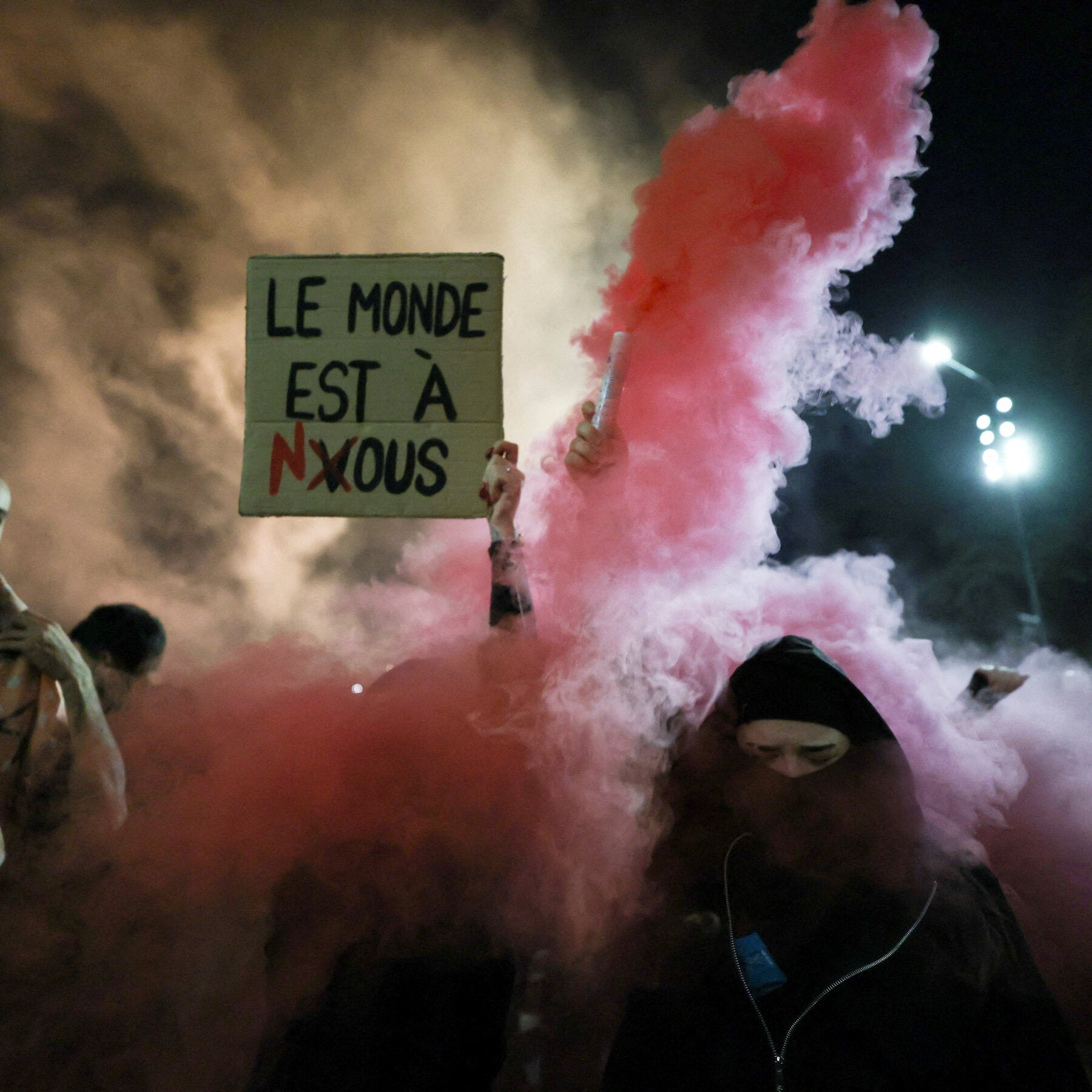
!A crowd of people walking at night is engulfed by red smoke. One person holds up a sign that says “the world is ours” in French.
*Young people protested the rising cost of living in Milan on Saturday, a week after similar demonstrations in cities across northern Italy ended in violent clashes and looting. Credit...Yara Nardi/Reuters*
Young people demonstrated across Italy on Saturday amid a heavy police presence to prevent the looting and violence that occurred during protests last weekend.
The demonstrations echoed student protests in France that have unleashed a nationwide groundswell of frustration there, sparking the country’s worst rioting in decades.
Italy’s marches on Saturday were largely peaceful, though protesters clashed with the police in Turin, Padua, Bologna and Rome, where a small group of demonstrators stormed the Colosseum. The police arrested just nine people nationwide and reported 87 to prosecutors, the Italian news agency ANSA reported.
In Milan, the site of last week’s largest and most violent demonstrations, some 10,000 people hit the streets, the police estimated — five times as many as had marched the previous weekend.
Throngs of young people chanted about their frustration with the high cost of living and Italy’s political establishment. They held hand-drawn signs denouncing low wages, high rents, economic inequality and Italy’s financial support of Israel, whose war in Gaza is deeply unpopular with Italians.
Protesters said that the country’s sluggish job market and a government they saw as more focused on military spending than on investing in young people had set their generation up to fail.
“I look for work abroad every day of my life,” said Ilaria Carrozza, 27, a design engineer. “And that’s not fair: This is my country, I want to stay here. But I can’t live like this.”
Manfredi Cacioppo, a 26-year-old sales assistant from Sicily, said he was demonstrating in solidarity with truckers and farmers in southern Italy, who had recently blockaded roads and ports to protest high fuel prices caused by the war in Iran.
“It all comes from the same issue: money being spent on war,” he said. “That money would be better to invest in health, education, transport, the housing crisis and help for the workers.”
Last weekend’s demonstrations took Italy’s northern cities by surprise. In Milan, groups of masked young people set fires, looted stores and lobbed projectiles at the police, causing an estimated $1.1 million in damage, according to a local business association. Fift
Share Article
Tags:#إيطاليا#احتجاجات#الشباب#ميلانو#تكاليف المعيشة#البطالة
Source: New York Times
For Context
Related reads from the same topic or latest developments