The New Middle East Is a Perennial Fantasy
By using this website, you agree to our use of cookies. This use includes personalization of content and ads, and traffic analytics. Review our Privacy Policy for more information.
Foreign Policy Get analysis and alerts more quickly in the mobile app.
Install
Back to Foreign Policy Magazine home page
Evening roundup with our editors’ favorite stories of the day
World Brief
Your guide to the most important world stories of the day
China Brief
The latest news, analysis, and data from the country each week
Situation Report
Weekly update on what’s driving U.S. national security policy
FP Weekend
A curation of our best book reviews, deep dives, and other reads
Africa Brief
Essential analysis of the stories shaping geopolitics on the continent
South Asia Brief
Weekly update on developments in India and its neighbors
The Reading List
Curated guides on geopolitics and current affairs
FP Bookshelf
A monthly guide to FP’s book reviews, excerpts, and reading recommendations
Latin America Brief
One-stop digest of politics, economics, and culture
Southeast Asia Brief
A weekly dispatch with news from the region’s 11 countries
The New Geopolitics
A five-part masterclass in IR theory with Harvard Professor Stephen M. Walt
View All Newsletters
Subscribe Subscribe Team access Team access
Analysis: There’s Never a New Middle East
1. Create an FP account to save articles to read later.
Sign Up
ALREADY AN FP SUBSCRIBER? LOGIN
PDF
1. **Downloadable PDFs** are a benefit of an FP subscription.
ALREADY AN FP SUBSCRIBER? LOGIN
Gift
1. Gifting articles is a subscriber benefit.
ALREADY AN FP SUBSCRIBER? LOGIN
2. This article is an Insider exclusive.
Contact us at [email protected] to learn about upgrade options, unlocking the ability to gift this article.
Analysis
There’s Never a New Middle East
Washington’s fantasies of transformation keep failing to pan out.
By **Steven Simon**, a distinguished fellow and visiting professor at Dartmouth College and the author of *Grand Delusion: The Rise and Fall of American Ambition in the Middle East*.
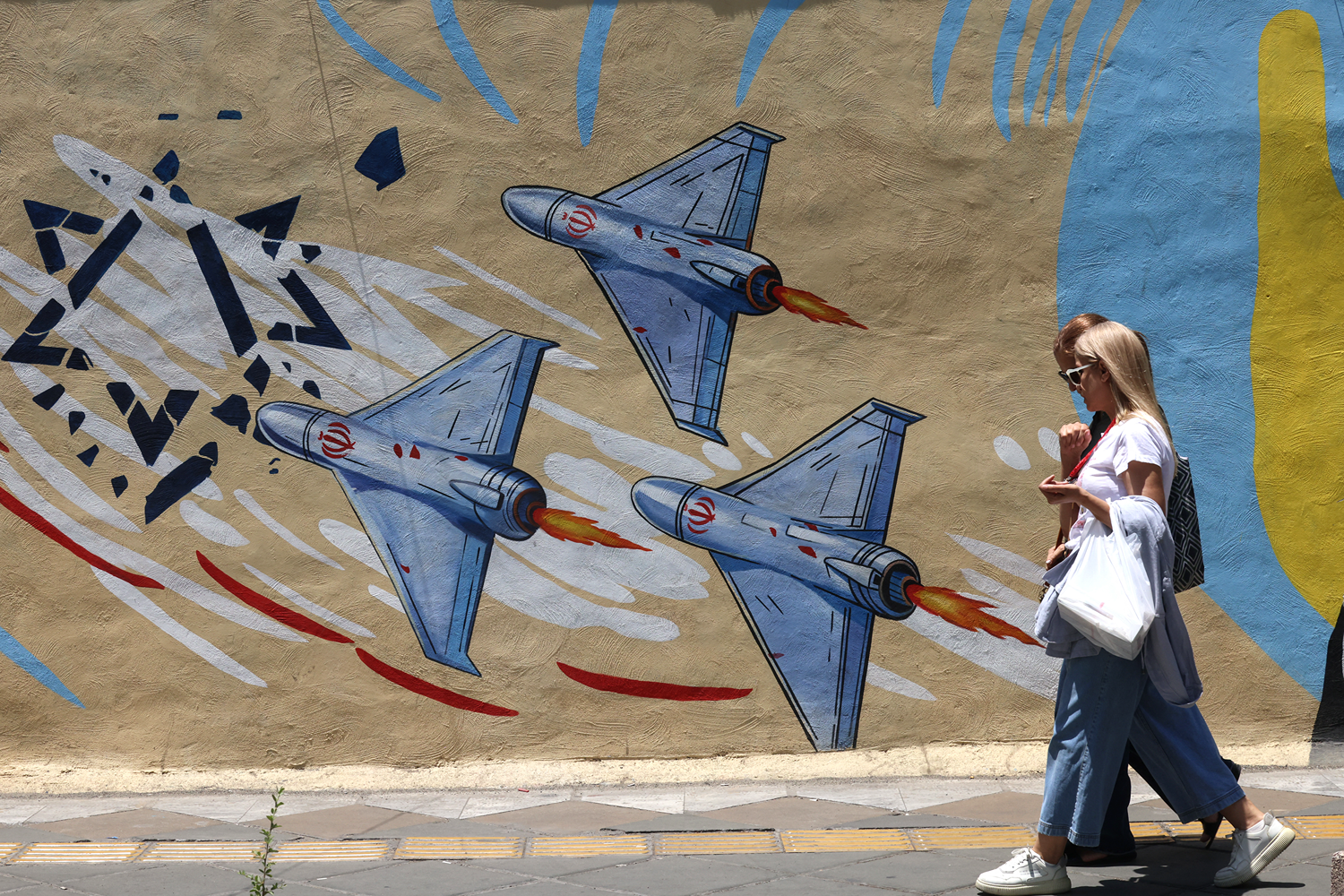
*Two young women walk past a mural showing Iranian planes attacking the Star of David.*
Iranian women walk past an anti-U.S. and anti-Israeli mural in Tehran on June 3. Atta Kanare/AFP via Getty Images
1. Get audio access with any FP subscription.
ALREADY AN FP SUBSCRIBER? LOGIN
November 10, 2026, 2:21 PM
This year’s op-eds and magazine features induce déjà vu. The 2003 invasion of Iraq was supposed to clear the way for a new, democratic Middle East. The 2006 Lebanon War was, in U.S. Secretary of State Condoleezza Rice’s phrase, the “birth pangs” of a new Middle East. The Arab Spring in 2009 was its dawn. Hamas’s assault on Israel in 2023 was said to be ushering in a new Middle East.
The U.S. attacks on Iran and the fight over the Strait of Hormuz are said to be bringing yet another one into being. Per U.S. President Donald Trump, “The Middle East will be transformed, and the future of that region has never—I don’t think it’s ever looked brighter.” *Foreign Affairs* weighed in with an article titled “The Iran Imperative: How America and Israel Can Shape a New Middle East.”
Bloody and chaotic events like the Iran war induce fantasies of comprehensive change, but reality keeps coming up short. As Sam Rayburn, House speaker in an earlier era observed: “Any jackass can kick down a barn, but it takes a carpenter to build one.” Decisive change for the better—in the United States’ conception—demands an actual preponderance of U.S. military power and the ability to convert that power into enduring political arrangements. The United States has imagined itself as wielding both attributes while possessing neither.
The use of force halfway around the world requires political leaders to show that the stakes are commensurate with the cost and risk. That means war aims are framed in extravagant terms that are eventually revealed as detached from quotidian reality.
On the other side, adversaries have agency. They are not passive objects of U.S. power projection or a substrate onto which Washington can project its fantasies. And, ironically, the weakness and fragmentation of regional states makes it more, not less, difficult for an outside power to impose its will.
When the war ends, as it eventually will, Iran will still be a poor, militarized oil exporter with two good friends—China and Russia—and a strong relationship with Iraq. In short, not terribly different than it was before the war.
Iraq will look much as it does now, a state with a hybrid army trying to fend off pressure from Iran, with which it shares a long border, and from the United States, which controls its finances.
Syria will look as it did the day before the United States and Israel struck Iran. It will be poor, shattered by 13 years of civil war and many more of sanctions, run by a sectarian clique, penetrated by outside powers from Turkey to Israel and Saudi Arabia, and still riven by ethnic and religious rivalries.
Lebanon will still be living with the results of the 1989 Taif Accord, which ended Lebanon’s civil war by rebalancing power among its sects and calling for every militia to disarm. Under Syrian tutelage, every militia did except Hezbollah, which kept its guns as “the resistance.” This, in turn, inadvertently but predictably locked in Hezbollah’s status as an armed rival to the state and a picker of pointless fights with its far more powerful neighbor to the south. It will still be engaged in the Sisyphean task of satisfying the International Monetary Fund (IMF) without a parliament willing to decide who absorbs the banking system’s losses.
Egypt, whose economy suffered badly when the Houthis were firing on ships in the Red Sea two years ago, will still be the same authoritarian state, propped up by Gulf largesse and embarked on gigantic infrastructure projects, that it was the day before the war.
Jordan, necessarily careful given the mayhem on its Israeli, Syrian, and Iraqi borders, will look exactly as it did before the war. So, too, will Libya, Morocco, Algeria, and Sudan—which will all be what they were last year and the year before that.
Re
There’s Never a New Middle East
Steven Simon argues that every major regional war, from the invasion of Iraq to the current confrontation with Iran, has been billed in Washington as the birth of a new Middle East, yet the region ends up looking much as it did before. He attributes this to America's lack of decisive military preponderance and its inability to turn power into lasting political arrangements.
Cross Lines newsroom
Share this article
#الشرق الأوسط#إيران#السياسة الأمريكية#مضيق هرمز#العراق#لبنان
Original source: Foreign Policy