PoliticsAvailable in English
China Is Building Its Way Around Europe’s EV Tariffs
Editorial
Cross Lines editing
Source
Foreign Policy
Foreign Policy

Foreign Policy
Original Source
Foreign Policy argues that China is circumventing European tariffs on electric vehicles by building integrated supply chains in Morocco, backed by a state-led network of investment and infrastructure projects. The authors warn that attributing China's advantage solely to subsidies understates the scale of the challenge facing Europe's auto industry.
How Morocco Could Help China Sidestep Europe's EV Tariffs
By using this website, you agree to our use of cookies. This use includes personalization of content and ads, and traffic analytics. Review our Privacy Policy for more information.
!Foreign Policy
Foreign Policy Get analysis and alerts more quickly in the mobile app.
Install
Back to Foreign Policy Magazine home page
* Latest
* Regions
+ Asia & the Pacific
+ China
+ Middle East & Africa
+ Americas
+ Europe
* Newsletters
Editors’ Picks
Evening roundup with our editors’ favorite stories of the day
!World Brief Icon
World Brief
Your guide to the most important world stories of the day
!China Brief Icon
China Brief
The latest news, analysis, and data from the country each week
Situation Report
Weekly update on what’s driving U.S. national security policy
FP Weekend
A curation of our best book reviews, deep dives, and other reads
!Africa Brief Icon
Africa Brief
Essential analysis of the stories shaping geopolitics on the continent
!South Asia Brief Icon
South Asia Brief
Weekly update on developments in India and its neighbors
The Reading List
Curated guides on geopolitics and current affairs
FP Bookshelf
A monthly guide to FP’s book reviews, excerpts, and reading recommendations
!Latin America Brief Icon
Latin America Brief
One-stop digest of politics, economics, and culture
!Southeast Asia Brief Icon
Southeast Asia Brief
A weekly dispatch with news from the region’s 11 countries
The New Geopolitics
A five-part masterclass in IR theory with Harvard Professor Stephen M. Walt
View All Newsletters
* FP Live
* Latest
* Trending:
* Israel votes
* U.S. midterms
* France in crisis
Search this website
* Preferences
* My FP Feed
* Saved Articles
* Newsletters
* Magazine Archive
* Subscription Settings
* FAQs
* Log Out
Sign In
Sign In
Team access Team access
Subscribe Subscribe Team access Team access
Argument: China Is Building Its Way Around Europe’s EV Tariffs
*
*
* Facebook
* Bluesky
* X
* LinkedIn
* WhatsApp
* Reddit
Save
1. Create an FP account to save articles to read later.
Sign Up
ALREADY AN FP SUBSCRIBER? LOGIN
PDF
1. **Downloadable PDFs** are a benefit of an FP subscription.
Subscribe Now
ALREADY AN FP SUBSCRIBER? LOGIN
Gift
*
*
* WhatsApp
1. Gifting articles is a subscriber benefit.
Subscribe Now
ALREADY AN FP SUBSCRIBER? LOGIN
2. This article is an Insider exclusive.
Contact us at [email protected] to learn about upgrade options, unlocking the ability to gift this article.
Argument
An expert’s point of view on a current event.
China Is Building Its Way Around Europe’s EV Tariffs
Beijing’s evolving industrial playbook is taking shape in Morocco.
By **Aaron Glasserman**, a distinguished fellow at the Weatherhead East Asian Institute at Columbia University and a fellow on foreign policy at the Asia Society Policy Institute’s Center for China Analysis, and **Jessie Jiexi Lin**, a student pursuing a master’s in public administration at Columbia University’s School of International and Public Affairs.
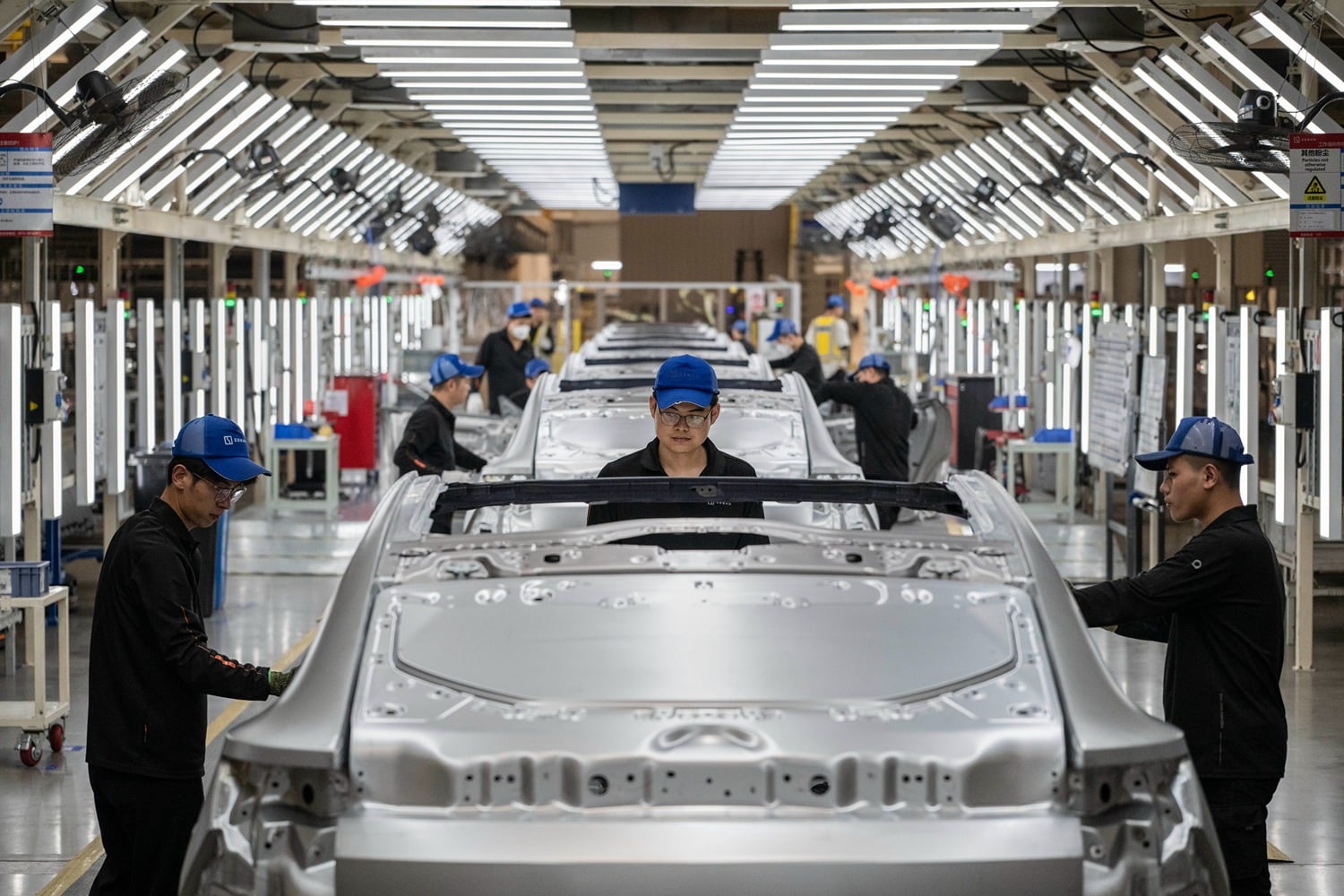
!Workers in dark uniforms and blue baseball caps inspect the metal frames of silver, unpainted electric vehicles along a brightly lit assembly line on a factory floor. The line of cars extends backward to the far wall, with similar small groups of workers bustling around each one.
*Workers in dark uniforms and blue baseball caps inspect the metal frames of silver, unpainted electric vehicles along a brightly lit assembly line on a factory floor. The line of cars extends backward to the far wall, with similar small groups of workers bustling around each one.*
Workers check vehicle frames on the production line for electric vehicle maker Zeekr at its factory in Ningbo, China, on May 29, 2025. Kevin Frayer/Getty Images
My FP: Follow topics and authors to get straight to what you like. Exclusively for FP subscribers. Subscribe Now | Log In
*
*
October 27, 2026, 5:00 AM
In recent years, Europe’s auto industry has reeled from the influx of low-cost, high-quality Chinese electric vehicles (EVs). Even as Brussels imposes tariffs on Chinese-made EVs, their market share only continues to grow. As of December, more than 9 percent of all new automobiles sold in Europe were made in China, with some estimates expecting Chinese EVs to account for roughly 20 percent of the Western European market by 2028.
Brussels’s retaliatory tariffs reflect a common Western view that high-value Chinese products are competitive in global markets largely because of state subsidies. To be sure, China’s EV industry has benefited immensely from Beijing’s subsidies, easy credit, and tax relief. That explanation, however, is far too narrow and risks severely underestimating the scale of the challenge ahead.
The more consequential story—that will likely make Chinese EVs even more competitive in the near future—is Beijing’s evolving approach to overseas industrial policy. At the core of this approach is an increasingly coordinated model of public- and private-sector activity.
State-owned enterprises (SOE) lay the groundwork for favorable investment environments abroad by undertaking massive infrastructure projects and securing access to strategic resources. Boosted by Beijing’s diplomatic ties and international clout, private companies leverage these state-backed platforms as a springboard for trade by bringing in investment, production capacity, and industry-specific expertise.
The advantages of this approach for Beijing—and the challenge that it poses to foreign companies—are already on full display in Morocco, where years of existing strategic investment, infrastructure development, and geopolitical maneuvering are pushing China closer to vertically integrating EV supply chains, bypassing tariffs, and further reshaping Europe’s auto industry.
---
It is only in recent years that Morocco has emerged as a key node in China’s EV empire.
For decades, Beijing maintained much closer ties with Morocco’s neighbor and rival, Algeria, but that began to change in the early 2010s as the Belt and Road Initiative (BRI) took off. In 2016, Morocco joined the growing ranks of countries signing “strategic partnerships” with China, making mutual commitments to expand economic cooperation and recognize each other’s core interests.
The next year, Morocco officially entered the BRI, and China has since poured millions of dollars into Morocco’s energy and transportation sectors. Almost a decade later, that economic relationship has expanded dramatically: In March, China’s committed investment in the country exceeded $10 billion, concentrated mostly in the EV and energy sectors.
China’s EV manufacturing capacity in Morocco builds on years of large-scale, state-backed investment in transportation infrastructure and natural resources. Over the past decade, Chinese SOEs have collaborated on major infrastructure and development projects in Morocco, including bridges, highways, and smart ci
By using this website, you agree to our use of cookies. This use includes personalization of content and ads, and traffic analytics. Review our Privacy Policy for more information.
!Foreign Policy
Foreign Policy Get analysis and alerts more quickly in the mobile app.
Install
Back to Foreign Policy Magazine home page
* Latest
* Regions
+ Asia & the Pacific
+ China
+ Middle East & Africa
+ Americas
+ Europe
* Newsletters
Editors’ Picks
Evening roundup with our editors’ favorite stories of the day
!World Brief Icon
World Brief
Your guide to the most important world stories of the day
!China Brief Icon
China Brief
The latest news, analysis, and data from the country each week
Situation Report
Weekly update on what’s driving U.S. national security policy
FP Weekend
A curation of our best book reviews, deep dives, and other reads
!Africa Brief Icon
Africa Brief
Essential analysis of the stories shaping geopolitics on the continent
!South Asia Brief Icon
South Asia Brief
Weekly update on developments in India and its neighbors
The Reading List
Curated guides on geopolitics and current affairs
FP Bookshelf
A monthly guide to FP’s book reviews, excerpts, and reading recommendations
!Latin America Brief Icon
Latin America Brief
One-stop digest of politics, economics, and culture
!Southeast Asia Brief Icon
Southeast Asia Brief
A weekly dispatch with news from the region’s 11 countries
The New Geopolitics
A five-part masterclass in IR theory with Harvard Professor Stephen M. Walt
View All Newsletters
* FP Live
* Latest
* Trending:
* Israel votes
* U.S. midterms
* France in crisis
Search this website
* Preferences
* My FP Feed
* Saved Articles
* Newsletters
* Magazine Archive
* Subscription Settings
* FAQs
* Log Out
Sign In
Sign In
Team access Team access
Subscribe Subscribe Team access Team access
Argument: China Is Building Its Way Around Europe’s EV Tariffs
*
*
* Bluesky
* X
Save
1. Create an FP account to save articles to read later.
Sign Up
ALREADY AN FP SUBSCRIBER? LOGIN
1. **Downloadable PDFs** are a benefit of an FP subscription.
Subscribe Now
ALREADY AN FP SUBSCRIBER? LOGIN
Gift
*
*
1. Gifting articles is a subscriber benefit.
Subscribe Now
ALREADY AN FP SUBSCRIBER? LOGIN
2. This article is an Insider exclusive.
Contact us at [email protected] to learn about upgrade options, unlocking the ability to gift this article.
Argument
An expert’s point of view on a current event.
China Is Building Its Way Around Europe’s EV Tariffs
Beijing’s evolving industrial playbook is taking shape in Morocco.
By **Aaron Glasserman**, a distinguished fellow at the Weatherhead East Asian Institute at Columbia University and a fellow on foreign policy at the Asia Society Policy Institute’s Center for China Analysis, and **Jessie Jiexi Lin**, a student pursuing a master’s in public administration at Columbia University’s School of International and Public Affairs.
!Workers in dark uniforms and blue baseball caps inspect the metal frames of silver, unpainted electric vehicles along a brightly lit assembly line on a factory floor. The line of cars extends backward to the far wall, with similar small groups of workers bustling around each one.
*Workers in dark uniforms and blue baseball caps inspect the metal frames of silver, unpainted electric vehicles along a brightly lit assembly line on a factory floor. The line of cars extends backward to the far wall, with similar small groups of workers bustling around each one.*
Workers check vehicle frames on the production line for electric vehicle maker Zeekr at its factory in Ningbo, China, on May 29, 2025. Kevin Frayer/Getty Images
My FP: Follow topics and authors to get straight to what you like. Exclusively for FP subscribers. Subscribe Now | Log In
*
*
October 27, 2026, 5:00 AM
In recent years, Europe’s auto industry has reeled from the influx of low-cost, high-quality Chinese electric vehicles (EVs). Even as Brussels imposes tariffs on Chinese-made EVs, their market share only continues to grow. As of December, more than 9 percent of all new automobiles sold in Europe were made in China, with some estimates expecting Chinese EVs to account for roughly 20 percent of the Western European market by 2028.
Brussels’s retaliatory tariffs reflect a common Western view that high-value Chinese products are competitive in global markets largely because of state subsidies. To be sure, China’s EV industry has benefited immensely from Beijing’s subsidies, easy credit, and tax relief. That explanation, however, is far too narrow and risks severely underestimating the scale of the challenge ahead.
In recent years, Europe’s auto industry has reeled from the influx of low-cost, high-quality Chinese electric vehicles (EVs). Even as Brussels imposes tariffs on Chinese-made EVs, their market share only continues to grow. As of December, more than 9 percent of all new automobiles sold in Europe were made in China, with some estimates expecting Chinese EVs to account for roughly 20 percent of the Western European market by 2028.
Brussels’s retaliatory tariffs reflect a common Western view that high-value Chinese products are competitive in global markets largely because of state subsidies. To be sure, China’s EV industry has benefited immensely from Beijing’s subsidies, easy credit, and tax relief. That explanation, however, is far too narrow and risks severely underestimating the scale of the challenge ahead.
The more consequential story—that will likely make Chinese EVs even more competitive in the near future—is Beijing’s evolving approach to overseas industrial policy. At the core of this approach is an increasingly coordinated model of public- and private-sector activity.
State-owned enterprises (SOE) lay the groundwork for favorable investment environments abroad by undertaking massive infrastructure projects and securing access to strategic resources. Boosted by Beijing’s diplomatic ties and international clout, private companies leverage these state-backed platforms as a springboard for trade by bringing in investment, production capacity, and industry-specific expertise.
The advantages of this approach for Beijing—and the challenge that it poses to foreign companies—are already on full display in Morocco, where years of existing strategic investment, infrastructure development, and geopolitical maneuvering are pushing China closer to vertically integrating EV supply chains, bypassing tariffs, and further reshaping Europe’s auto industry.
---
It is only in recent years that Morocco has emerged as a key node in China’s EV empire.
For decades, Beijing maintained much closer ties with Morocco’s neighbor and rival, Algeria, but that began to change in the early 2010s as the Belt and Road Initiative (BRI) took off. In 2016, Morocco joined the growing ranks of countries signing “strategic partnerships” with China, making mutual commitments to expand economic cooperation and recognize each other’s core interests.
The next year, Morocco officially entered the BRI, and China has since poured millions of dollars into Morocco’s energy and transportation sectors. Almost a decade later, that economic relationship has expanded dramatically: In March, China’s committed investment in the country exceeded $10 billion, concentrated mostly in the EV and energy sectors.
China’s EV manufacturing capacity in Morocco builds on years of large-scale, state-backed investment in transportation infrastructure and natural resources. Over the past decade, Chinese SOEs have collaborated on major infrastructure and development projects in Morocco, including bridges, highways, and smart ci
Share Article
Tags:#السيارات الكهربائية#المغرب#الصين#الاتحاد الأوروبي#مبادرة الحزام والطريق#الرسوم الجمركية
Source: Foreign Policy
For Context
Related reads from the same topic or latest developments