InternationalAvailable in English
Funding shortages force World Food Programme to cut aid to Gaza
Editorial
Cross Lines editing
Source
BBC World
BBC World

BBC World
Original Source
The World Food Programme says it must sharply cut its food aid to Gaza by about a third due to funding shortages, just as winter approaches and most of the population depends on assistance. The agency urgently needs $450 million to maintain its critical operations over the next six months.
One of the main suppliers of food aid to the Gaza Strip, the World Food Programme (WFP), says that it is being forced to "drastically reduce lifesaving assistance" to the Palestinian territory due to funding shortages.
Overall, the number of people helped by the UN agency will drop by about a third - from 1.6 million to 1.1 million.
The cuts will hit as winter approaches and at a time when many families in Gaza are still struggling to feed themselves.
One effect is that the number of hot meals that are currently being provided by community kitchens will be cut from 250,000 to 150,000 each day.
Families living in hard-to-reach areas, for example near the so-called Yellow Line, which demarcates Israel's area of military control, will receive a meal every other day instead of daily.
Nearly all of Gaza's 2.1 million population remains displaced and two-thirds rely on food aid to survive.
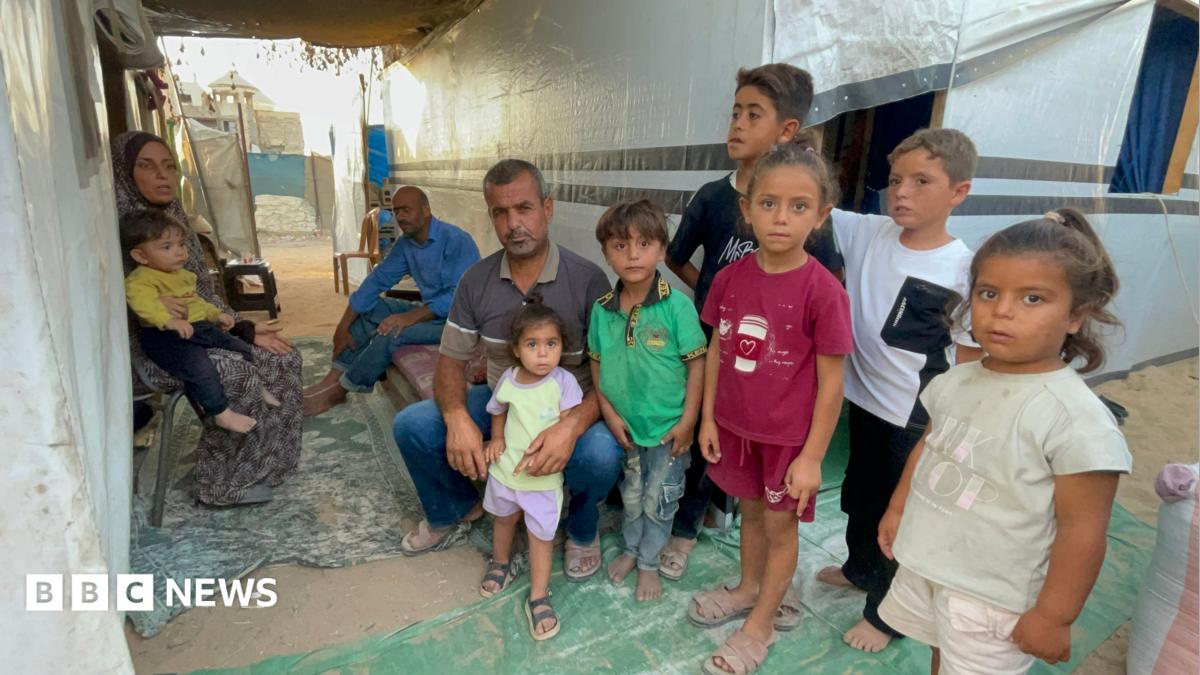
"It's a disaster! What will we do with these reduced rations? How will we provide for the little ones?" said Mervat al-Satari, a displaced Palestinian mother-of-five at a camp in the al-Mawasi area of Khan Younis after being told of the WFP's news. "Sometimes we wait for these meals to eat."
"This will affect us a lot. The daily aid was somehow ticking the box but now it will be every two days," said Sawsan Bahloul, who is also from al-Mawasi and is a mother of three. She added that the portions given by the community kitchen - usually pasta or lentils with occasional potatoes and aubergines - were already too small to feed her family.
The Palestine director for the WFP, Shaun Hughes, is clear that the cuts are being made because of finances, and "not because the needs are coming down, or because we don't have access - we do."
Already, since July, there have been reductions in cash transfers provided to some half a million people, meaning they have less money to buy food in local markets. The number of Gazans given bags of flour and ration boxes by the WFP will now fall from 1.1 million to 600,000 each month.
The WFP received less than half as much funding for its Palestinian operations in 2026 as in previous years. The agency says it urgently needs $450m (£338m) to maintain "critical" operations over the next six months.
Despite a ceasefire between Hamas and Israel that was agreed a year ago, violence has continued, including almost daily Israeli strikes, and humanitarian conditions in Gaza remain dire.
There has been no reconstruction and little recovery, with Israel tightly controlling the entry of goods through crossings. While food markets are now well stocked, few can afford to buy from them. More than 80% of people in Gaza are unemployed so most of the population relies on aid.
Humanitarian workers say that despite a modest improvement in Gaza compared to a year ago, acute food insecurity and the risk of famine returning continue to loom over the territory.
In July, the Integrated Phase Classification (IPC) - the world's foremost experts on food security - reported that two-thirds of the population - 1.4 million people - were "expected to face crisis or worse levels of acute food insecurity in July-December 2026".
For now, the WFP says it can continue supporting bakeries that provide one-third of Gaza's bread needs and provide nutritional assistance to about 300,000 women and children. It also delivers health food snacks to some 200,000 children.
In the occupied West Bank, the WFP is continuing to give assistance to some 200,000 Palestinians, having halved the number of recipients in September.
The agency says food insecurity is rising in the territory mostly due to increased Israeli settler violence and Palestinian displacement.
Share Article
Tags:#برنامج الأغذية العالمي#غزة#المساعدات الإنسانية#انعدام الأمن الغذائي#الضفة الغربية#نقص التمويل
Source: BBC World
For Context
Related reads from the same topic or latest developments