Hollywood Is Oblivious to the New Reality of War
By using this website, you agree to our use of cookies. This use includes personalization of content and ads, and traffic analytics. Review our Privacy Policy for more information.
Foreign Policy Get analysis and alerts more quickly in the mobile app.
Install
Back to Foreign Policy Magazine home page
Evening roundup with our editors’ favorite stories of the day
World Brief
Your guide to the most important world stories of the day
China Brief
The latest news, analysis, and data from the country each week
Situation Report
Weekly update on what’s driving U.S. national security policy
FP Weekend
A curation of our best book reviews, deep dives, and other reads
Africa Brief
Essential analysis of the stories shaping geopolitics on the continent
South Asia Brief
Weekly update on developments in India and its neighbors
The Reading List
Curated guides on geopolitics and current affairs
FP Bookshelf
A monthly guide to FP’s book reviews, excerpts, and reading recommendations
Latin America Brief
One-stop digest of politics, economics, and culture
Southeast Asia Brief
A weekly dispatch with news from the region’s 11 countries
The New Geopolitics
A five-part masterclass in IR theory with Harvard Professor Stephen M. Walt
View All Newsletters
Give a gift Give a gift
Subscribe Subscribe Give a gift Give a gift
Essay: Pop Culture Still Can’t Figure Out Drone Warfare
1. Create an FP account to save articles to read later.
Sign Up
ALREADY AN FP SUBSCRIBER? LOGIN
PDF
1. **Downloadable PDFs** are a benefit of an FP subscription.
ALREADY AN FP SUBSCRIBER? LOGIN
Gift
1. Gifting articles is a subscriber benefit.
ALREADY AN FP SUBSCRIBER? LOGIN
2. This article is an Insider exclusive.
Contact us at [email protected] to learn about upgrade options, unlocking the ability to gift this article.
Essay
Pop Culture Still Can’t Figure Out Drone Warfare
Hollywood seems oblivious to the radically new nature of war. Why, exactly?
November 20, 2026, 2:20 PM
*A pencil drawn headshot of Christian Caryl wearing glasses a jacket and button-up shirt.*
*Christian Caryl*
By **Christian Caryl**, a columnist at *Foreign Policy* and a former Moscow bureau chief for *Newsweek* and *U.S. News & World Report*.
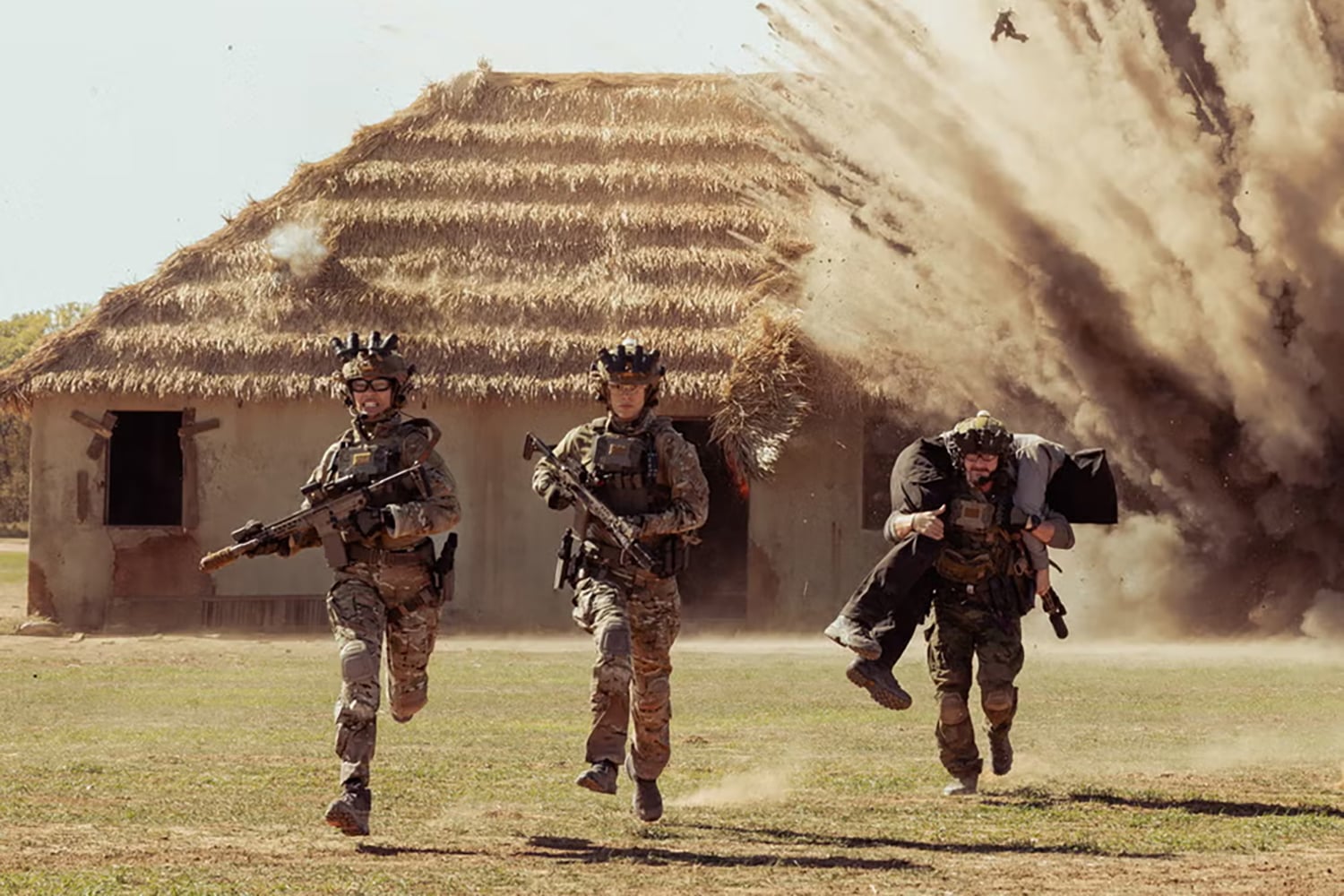
*Three people in military tactical gear run across a grassy field away from a building as a large plume of dust and debris erupts behind them, with one person carrying an unconscious individual over their shoulders.*
A scene from Season 3 of *Lioness*. Paramount Plus
1. Get audio access with any FP subscription.
ALREADY AN FP SUBSCRIBER? LOGIN
Military experts don’t really talk much about a “front line” in the war in Ukraine anymore. They prefer the term “kill zone,” used to describe the 10- to 20-mile-wide no-man’s-land between the two armies. The reason for this conceptual shift is simple: Omnipresent drone surveillance has made it nearly impossible for anyone to get close to enemy-controlled territory without being detected.
Hollywood doesn’t seem to have gotten the memo. In a recent episode of the hit TV show *Lioness*, Zoe Saldaña’s character leads a small group of U.S. covert operators on a secret mission to capture an enemy spy who is hanging out with Russian forces in Ukraine. To do so, the Americans have to cross from the Ukrainian side to the Russian one—which they do by simply walking across, in broad daylight, tightly bunched together. In the real world, they would have been shredded by kamikaze drones or artillery as soon as they started their stroll. Plus, the sky above them is filled with so many drones that it calls to mind one of those spectacular drone light shows. But that’s far from the modus operandi in Ukraine: You don’t need mega-swarms to keep a large area under surveillance; a bunch of individual operators searching in assigned sectors is enough. Compounding the absurdity, Saldaña’s character and her team only get attacked on their way back from their mission. Did it really take that long for the Russians to notice them?
But perhaps the makers of *Lioness* deserve some credit simply for tackling the subject. Four and a half years after the start of Russia’s full-scale invasion, cultural depictions of how the war is actually being fought are strikingly thin on the ground. A few journalists have written solid first-person accounts of the conflict, and documentary filmmakers, many of them Ukrainian, have explored it with astonishing intimacy. Yet their works have reached relatively small audiences. Where are the gripping stories for the broader public?
Combat drones have certainly made a mark on the broader culture. You see them everywhere, from movies like *The Terminal List: Dark Wolf* , where an assassin uses a drone to blow up a car, to the BBC’s police procedural Vigil, which includes a sequence in which military drones are turned against their own side by a hostile hacker. It’s striking how often drones turn up in dystopian science fiction films—such as *The Gorge*, where two snipers fight off autonomous drones, and *The Outer Threat*, in which a man with a dramatic secret has to protect his family from a hostile government equipped with drone swarms. A few years ago, the drone designs in these films probably would have resembled the exquisitely engineered aircraft of the so-called global war on terror. Now, even sci-fi creato
Pop Culture Still Can’t Figure Out Drone Warfare
The essay argues that Hollywood and popular culture still fail to grasp how drones have transformed modern warfare, as illustrated by a recent episode of Lioness. It notes that although documentaries and first-hand accounts of the war in Ukraine are often powerful, they reach limited audiences, even as drones have become a familiar presence on screen.
Cross Lines newsroom
Share this article
#الطائرات المسيّرة#هوليوود#الحرب في أوكرانيا#الثقافة الشعبية#مسلسل ليونيس#السياسة الأمنية
Original source: Foreign Policy