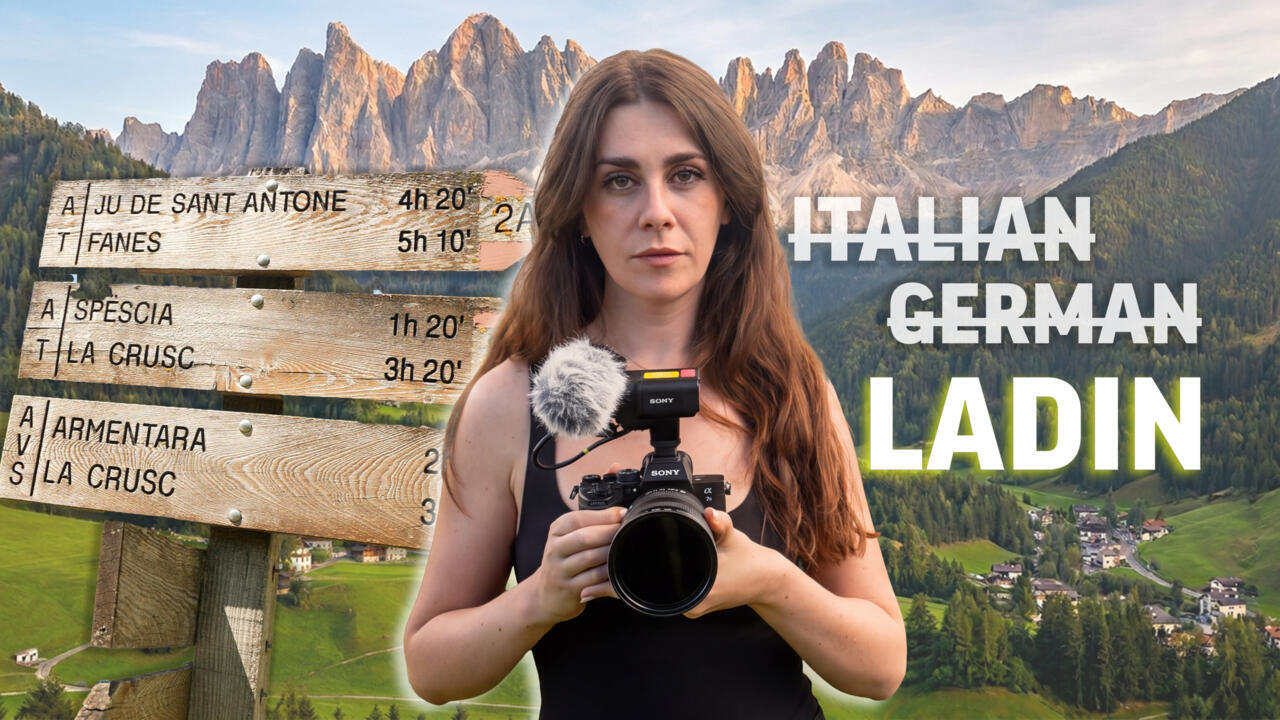
Ladin: Dolomites villages refuse to give up on ancient language
France 24
F
France 24
Original Source
Residents of five Italian valleys are resisting tourism pressures and globalization to preserve Ladin, one of Europe's oldest surviving languages. Young locals are employing art and education as tools to keep this 2,000-year-old tongue alive.
Tourists crammed onto a ridge, hikers stuck on the trails, long queues to reach a mountain hut... This past summer, hundreds of videos posted on social media showed the flip side of the Dolomites, a mountain range in northern Italy.
Long favoured by Italians themselves, the Dolomites have become a highly popular destination for foreign visitors in recent years. Today, the mountain range welcomes several million tourists every year, boosted by the 2026 Winter Olympics.
This growing influx of visitors worries people in the valleys as much as it contributes to their economy. "This tourism that's settling in almost everywhere in Val Badia scares us a bit, because it risks forcing young people like us to leave for financial reasons," explains Marco, a 29-year-old graphic designer.
Marco and his brother Samuel, a 32-year-old pharmacist, both grew up in the Badia Valley, in a small town of less than 4,000 inhabitants. The brothers have watched prices skyrocket, and locals forced to leave their land. "We need to preserve our community, otherwise it will become a bit like a box that’s beautiful, but empty."
'Why do you speak that language? Speak Italian, no?'
The community Samuel is talking about is the Ladin community: about 30,000 people, located in five valleys across the Italian regions of Trentino Alto-Adige and Veneto. Most of these Italians speak both German and Italian, but they also speak Ladin, one of the very last living alpine languages and one of the oldest in all of Europe.
At school, at home, at work, in the mouths of the locals, Ladin naturally comes first. "If you're with Ladins, you speak Ladin. If there's an Italian in the group, you try to speak Italian, or German. You manage about five minutes in Italian, then you go back to Ladin. And for the Italian... too bad, he has to learn it!" laughs Fabian, a cheesemaker and childhood friend of Samuel's.
Read moreGrecanico: Ancient Greek language still spoken in southern Italy
In these valleys, Ladin is the majority language, and hardly understandable to tourists, even Italian ones. "In some restaurants or hotels, they have menus in Ladin. So there are those who wonder what it is, people who have been coming here for years who sometimes aren't even aware that Ladin exists. And then there are people who get annoyed and say: 'Why do you speak that language? Speak Italian, no?'" Samuel recounts.
Rap to keep this 2,000-year-old language alive
If Ladin takes up such an important place in the daily life of South Tyroleans, it is thanks to the autonomous status granted to the region in 1972. In addition to guaranteeing the Italian/German bilingualism of South Tyrol, the decree places particular emphasis on the teaching of Ladin. "Ladin is used in nursery schools and is taught in the primary schools of Ladin-speaking areas," the text reads. In the Ladin valleys, there is therefore a system of trilingual schools, where classes are taught in Italian and German, and where Ladin is used as the everyday language.
"Everyone who was born with this language cares about it, and tries to keep it alive." Samuel is a fervent defender of his mother tongue. With a group of friends, he set up a rap group several years ago, Cooperaziun Planta. "Doing rap in Italian would have just been a passion project. But, since we're Ladins, doing it in Ladin is something a bit special."
Even if rhymes are harder to find in Ladin than in Italian, Samuel and his group make it a point of honor to sing only in Ladin. It’s a way, according to the young rapper, of contributing to its survival. "The best weapon to keeping a language alive is to enjoy it."
Long favoured by Italians themselves, the Dolomites have become a highly popular destination for foreign visitors in recent years. Today, the mountain range welcomes several million tourists every year, boosted by the 2026 Winter Olympics.
This growing influx of visitors worries people in the valleys as much as it contributes to their economy. "This tourism that's settling in almost everywhere in Val Badia scares us a bit, because it risks forcing young people like us to leave for financial reasons," explains Marco, a 29-year-old graphic designer.
Marco and his brother Samuel, a 32-year-old pharmacist, both grew up in the Badia Valley, in a small town of less than 4,000 inhabitants. The brothers have watched prices skyrocket, and locals forced to leave their land. "We need to preserve our community, otherwise it will become a bit like a box that’s beautiful, but empty."
'Why do you speak that language? Speak Italian, no?'
The community Samuel is talking about is the Ladin community: about 30,000 people, located in five valleys across the Italian regions of Trentino Alto-Adige and Veneto. Most of these Italians speak both German and Italian, but they also speak Ladin, one of the very last living alpine languages and one of the oldest in all of Europe.
At school, at home, at work, in the mouths of the locals, Ladin naturally comes first. "If you're with Ladins, you speak Ladin. If there's an Italian in the group, you try to speak Italian, or German. You manage about five minutes in Italian, then you go back to Ladin. And for the Italian... too bad, he has to learn it!" laughs Fabian, a cheesemaker and childhood friend of Samuel's.
Read moreGrecanico: Ancient Greek language still spoken in southern Italy
In these valleys, Ladin is the majority language, and hardly understandable to tourists, even Italian ones. "In some restaurants or hotels, they have menus in Ladin. So there are those who wonder what it is, people who have been coming here for years who sometimes aren't even aware that Ladin exists. And then there are people who get annoyed and say: 'Why do you speak that language? Speak Italian, no?'" Samuel recounts.
Rap to keep this 2,000-year-old language alive
If Ladin takes up such an important place in the daily life of South Tyroleans, it is thanks to the autonomous status granted to the region in 1972. In addition to guaranteeing the Italian/German bilingualism of South Tyrol, the decree places particular emphasis on the teaching of Ladin. "Ladin is used in nursery schools and is taught in the primary schools of Ladin-speaking areas," the text reads. In the Ladin valleys, there is therefore a system of trilingual schools, where classes are taught in Italian and German, and where Ladin is used as the everyday language.
"Everyone who was born with this language cares about it, and tries to keep it alive." Samuel is a fervent defender of his mother tongue. With a group of friends, he set up a rap group several years ago, Cooperaziun Planta. "Doing rap in Italian would have just been a passion project. But, since we're Ladins, doing it in Ladin is something a bit special."
Even if rhymes are harder to find in Ladin than in Italian, Samuel and his group make it a point of honor to sing only in Ladin. It’s a way, according to the young rapper, of contributing to its survival. "The best weapon to keeping a language alive is to enjoy it."
🔗 Share Article
Tags:#لغات أوروبية#إيطاليا#السياحة#الحفاظ على التراث#اللادينية#جنوب تيرول
Source: France 24
For Context
Related reads from the same topic or latest developments