U.S. and China Both Seek to Derisk a Tangled Relationship
By using this website, you agree to our use of cookies. This use includes personalization of content and ads, and traffic analytics. Review our Privacy Policy for more information.
Foreign Policy Get analysis and alerts more quickly in the mobile app.
Install
Back to Foreign Policy Magazine home page
Evening roundup with our editors’ favorite stories of the day
World Brief
Your guide to the most important world stories of the day
China Brief
The latest news, analysis, and data from the country each week
Situation Report
Weekly update on what’s driving U.S. national security policy
FP Weekend
A curation of our best book reviews, deep dives, and other reads
Africa Brief
Essential analysis of the stories shaping geopolitics on the continent
South Asia Brief
Weekly update on developments in India and its neighbors
The Reading List
Curated guides on geopolitics and current affairs
FP Bookshelf
A monthly guide to FP’s book reviews, excerpts, and reading recommendations
Latin America Brief
One-stop digest of politics, economics, and culture
Southeast Asia Brief
A weekly dispatch with news from the region’s 11 countries
The New Geopolitics
A five-part masterclass in IR theory with Harvard Professor Stephen M. Walt
View All Newsletters
Give a gift Give a gift
Subscribe Subscribe Give a gift Give a gift
Analysis: America and China Are Trying to Alter Their Economic Bargain
1. Create an FP account to save articles to read later.
Sign Up
ALREADY AN FP SUBSCRIBER? LOGIN
PDF
1. **Downloadable PDFs** are a benefit of an FP subscription.
ALREADY AN FP SUBSCRIBER? LOGIN
Gift
1. Gifting articles is a subscriber benefit.
ALREADY AN FP SUBSCRIBER? LOGIN
2. This article is an Insider exclusive.
Contact us at [email protected] to learn about upgrade options, unlocking the ability to gift this article.
Analysis
America and China Are Trying to Alter Their Economic Bargain
With decoupling too painful, derisking is on the menu instead.
By **Aaron L. Friedberg**, a professor emeritus of politics and international affairs at Princeton University.
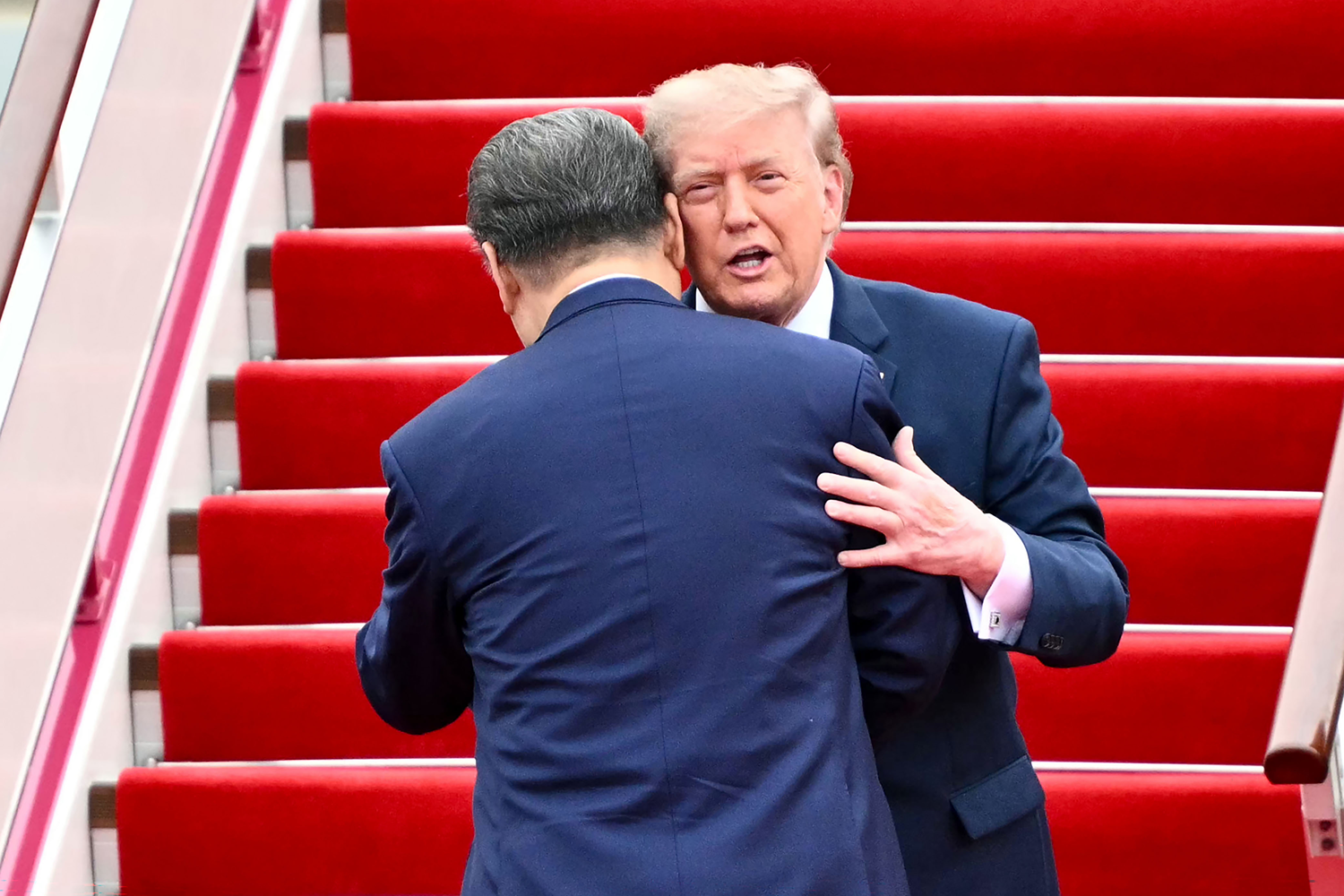
*Xi Jinping, viewed from behind, hugs Donald Trump on a red carpet lined airport staircase.*
Chinese President Xi Jinping greets U.S. President Donald Trump as he arrives at Shenzhen Baoan International Airport in Shenzhen, China, on Nov. 18. Mandel Ngan/Getty Images
1. Get audio access with any FP subscription.
ALREADY AN FP SUBSCRIBER? LOGIN
November 18, 2026, 3:22 PM
The United States and China are locked in a derisking race. After decades of actively entwining their economies, both are now trying to achieve a degree of separation between them. Neither side seeks at this point to decouple completely from its rival. Each is trying instead to alter the terms of their economic relationship, reducing their own vulnerability to leverage, coercion or attacks that could damage its long-term prosperity and security, while working to acquire advantages over its counterparty. This is a struggle for power, waged through trade, investment and technology development.
Today’s derisking race signals the failure of the third attempt by the United States to build an open, fully integrated world economy. At the end of the Cold War, as after the two world wars, American policymakers were motivated by a mix of pragmatism and principle. They believed that there were enormous gains to be had from trade with large and potentially fast-growing markets. But they also hoped to bring to fruition the liberal dream of a ‘one-world’ global trading system in which freer flows of goods, capital and people would promote peace and freedom, as well as prosperity.
In 1919 America had the world’s biggest economy, but the international political system was still multipolar, with other great powers in both Europe and Asia. Although Woodrow Wilson tried to persuade the victors, and his own people, of the wisdom of lowering tariff barriers and creating an open global trading system, both at home and abroad he lacked the ability to compel others to accept his ideas. Once rebuffed, America drew back into isolationism and protectionism. With no nation willing and able to hold it together, in the 1930s the global economy split apart.
By 1945 the world had become bipolar, with the United States and the Soviet Union standing above all other nations—and America alone briefly accounting for as much as half of global GDP. American planners at first entertained hopes of reviving Wilson’s vision, but the onset of the Cold War soon forced them to abandon the idea. Instead of cooperating to create a single unified system, each superpower proceeded to build its own largely separate bloc. Organised along predominantly liberal, free-market lines, the American-led bloc was ultimately able to out-produce, out-innovate, and out-last its Communist opponent.
With the demise of its former rival, the United States finally seemed set to restructure the entire world economy into a unified trading system. America and its allies hoped in the process to encourage the domestic transformation of their former enemies, preparing them to become members in good standing of what would finally be a globe-spanning liberal order.
The main instrument of this strategy in the economic realm was the World Trade Organization, and its most important target was China. To gain entry to the WTO China was required to make detailed commitments that, if followed, would bring its economic policies into closer alignment with liberal principles of open markets, limited state intervention and freer trade.
Political change was expected to follow close on the heels of economic liberalisation. Increased reliance on markets would lead to rising prosperity and, as had already happened in Western Europe and parts of
America and China Are Trying to Alter Their Economic Bargain
Princeton professor emeritus Aaron L. Friedberg argues that Washington and Beijing are no longer seeking a complete economic decoupling but are engaged in a « derisking » race that reshapes their deep interdependence. He frames the contest as a struggle for power waged through trade, investment and technology, marking the failure of America's third attempt to build an open, integrated global economy.
Cross Lines newsroom
Share this article
#الولايات المتحدة#الصين#تقليص المخاطر#فك الارتباط الاقتصادي#منظمة التجارة العالمية#الحرب الباردة
Original source: Foreign Policy