How to prepare for wildfires — now and for the future
Axios
A
Axios
Original Source
Wildfires demand action across multiple timelines, from immediate evacuation plans to forest management spanning decades ahead. As the Pacific Northwest faces a record fire season, experts emphasize that climate change is intensifying underlying risks, making emissions reduction integral to long-term preparedness strategies.
How to prepare for wildfires — now and for the future
*
* Newsletters
*
* Axios Pro
* Axios Live
* The Axios Show
Axios
Axios
10 hours ago - Energy & Climate
How to prepare for wildfires — now and for the future
* Amy Harder
*
*
*
Add Axios on Google
Add Axios as your preferred source to
see more of our stories on Google.
Add Axios on Google
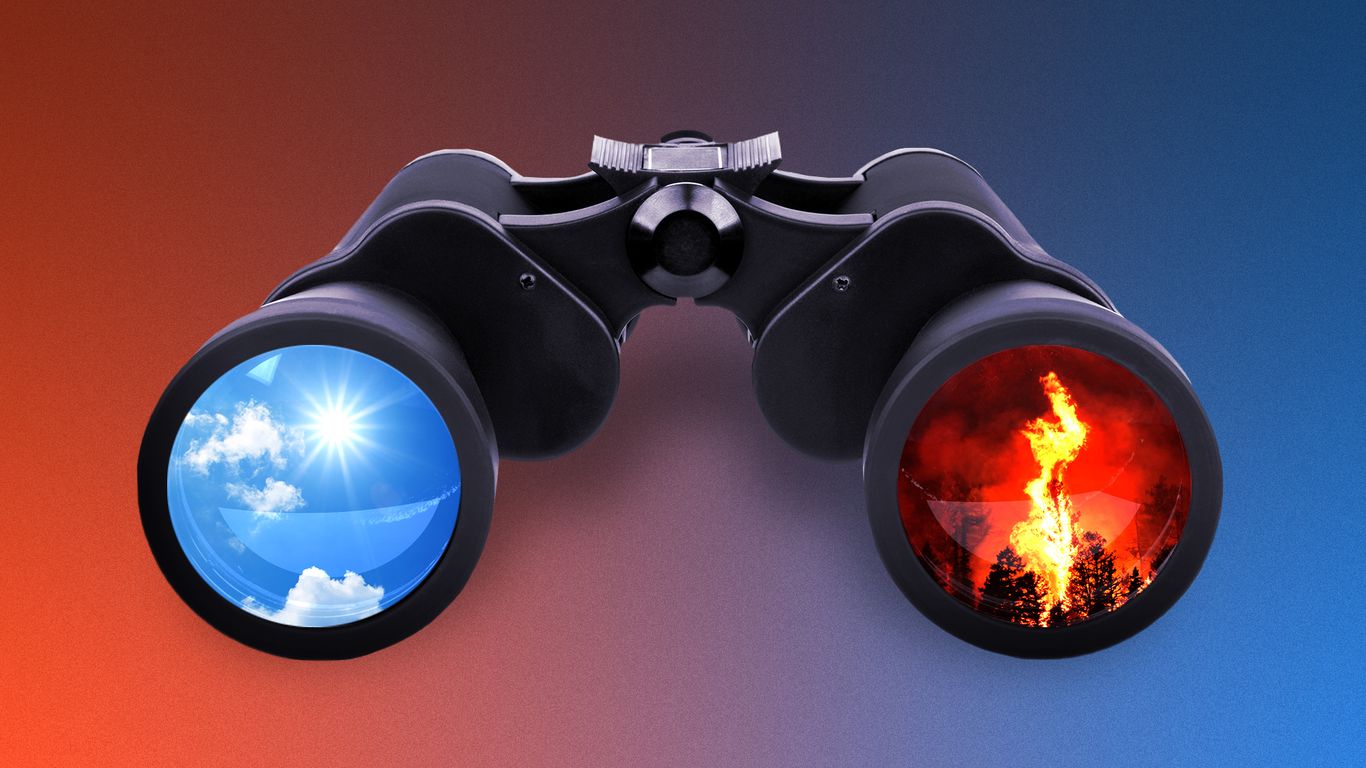
!Illustration of binoculars. One lens is a sunny blue sky, the other shows a wildfire.
*Illustration: Shoshana Gordon/Axios*
Wildfires demand action on radically different timelines: during the crisis, before the next fire season and over the coming decades.
**Why it matters:** Climate change is worsening the underlying risk, making everything from evacuation plans to forest management and cutting emissions part of the response.
**Driving the news:** America's northwestern corner is having arecord-breaking wildfire year, and the traditional fire season still has months to go.
**"Even if not a single** other acre or structure burned, we already have the most active fire season in recorded history for the Pacific Northwest," said climate scientist Daniel Swain in an Aug. 18 virtual presentation.
* "Washington and Oregon together \[are] already breaking their historical record for the most area burned in any full wildfire season."
**My thought bubble:** My family lives in Spokane, Washington. They don't live in the neighborhoods where hundreds of homes burned Aug. 1, but the disaster was a wake-up call because they also live near forested land.
* In the immediate aftermath, we feverishly discussed making an evacuation plan. We haven't followed through. Our conversations have shifted back to normal life.
**"If we perceive** that we can't manage a chronic risk, we will tend to manage our fear about that risk," said Claire Rapp, a Colorado State University scientist specializing in behavioral science and wildfires.
* That doesn't mean wholly denying the risk, she said, but "simply deprioritizing it and managing our fear of it."
**The big picture:** The challenge is that wildfire preparedness operates on different timelines, with different actions needed at every stage.
* During an active fire: Evacuating people, fighting fires and protecting communities from smoke.
* Before the next fire season: Making homes less vulnerable, reducing nearby fuels and improving community preparedness and evacuation plans.
* Over the coming decades: Managing forests and mitigating climate change through government action at the local, national and even global levels.
**Zoom in:** Rapp recommends writing down what you'll need to do during an evacuation before that chaotic moment arrives, including preparing a go-bag and figuring out how you'll quickly gather medications and pets.
* Think of it as a psychological hedge against panic.
* "To the extent that 'calm, deliberate, rational you' can prepare 'panicked you' for evacuation, you will be more effective," Rapp said.
**Zoom out:** Preparing for next year's wildfire season means reducing the vulnerability of homes and communities.
* That includes surprisingly simple but important steps, like clearing flammable materials within 5 feet of your home and ensuring vents don't allow embers inside, said Matt Weiner, CEO of Megafire Action, a nonprofit focused on reducing catastrophic wildfire risk.
* Broader community measures include reducing nearby fuels and adopting building and land-use practices designed for wildfire-prone areas.
**Between the lines:** Whenever a major wildfire erupts, attention inevitably turns to how it started.
* A man was charged with arson for allegedly starting one of Spokane's most destructive fires on Aug. 1, which destroyed hundreds of homes. Federal prosecutors are also exploring possible charges.
* But whether a fire begins with arson, lightning or something else doesn't change the basic preparedness calculus. Hot, dry and windy conditions help determine whether an ignition becomes a catastrophe.
**What they're saying:** "I have empathy for the complicated web of emotions that occurs when fire is started by different sources," Rapp said. "But there are things that we can do to prepare for a wildfire, no matter what the source is."
**State of play:** The government's role becomes more important the longer the planning horizon.
* Policies that cut greenhouse gas emissions can limit future warming, helping constrain the growth in wildfire risk over decades and beyond.
* This year's severe fire season, concentrated in the Pacific Northwest, could add urgency to federal legislation aimed at lessening the severity of wildfires in the future.
**What we're watching:** The bipartisan Fix Our Forests Act would seek to reduce wildfire risk by speeding up forest management, including thinning and prescribed burns, while boosting community preparedness and coordination among governments.
* The House overwhelmingly passed its version last year, 279-141. A bipartisan Senate version subsequently cleared the chamber's Agriculture Committee but has yet to receive a floor vote.
* The legislation has drawn support from groups ranging from environmental organizations to the timber industry.
* "This is the first time we've had a really bad fire season where there's actually something big and meaningful that is substantially through the \[congressional] process," Weiner said.
**What's next:** If you haven't made the evacuation plan you meant to make after the last wildfire scare, that's precisely the point: Do it before the next one.
*
*
*
Add Axios on Google
What to read next
*
*
*
*
*
*
Smarter, faster on what matters.
Explore Axios Newsletters
* About Axios
* Advertise with us
* Careers
* Contact us
* Newsletters
* Axios Live
* Axios HQ
* Privacy policy
* Terms of use
*
Axios Homepage
Axios Media Inc., 2026
*
* Newsletters
*
* Axios Pro
* Axios Live
* The Axios Show
Axios
Axios
10 hours ago - Energy & Climate
How to prepare for wildfires — now and for the future
* Amy Harder
*
*
*
Add Axios on Google
Add Axios as your preferred source to
see more of our stories on Google.
Add Axios on Google
!Illustration of binoculars. One lens is a sunny blue sky, the other shows a wildfire.
*Illustration: Shoshana Gordon/Axios*
Wildfires demand action on radically different timelines: during the crisis, before the next fire season and over the coming decades.
**Why it matters:** Climate change is worsening the underlying risk, making everything from evacuation plans to forest management and cutting emissions part of the response.
**Driving the news:** America's northwestern corner is having arecord-breaking wildfire year, and the traditional fire season still has months to go.
**"Even if not a single** other acre or structure burned, we already have the most active fire season in recorded history for the Pacific Northwest," said climate scientist Daniel Swain in an Aug. 18 virtual presentation.
* "Washington and Oregon together \[are] already breaking their historical record for the most area burned in any full wildfire season."
**My thought bubble:** My family lives in Spokane, Washington. They don't live in the neighborhoods where hundreds of homes burned Aug. 1, but the disaster was a wake-up call because they also live near forested land.
* In the immediate aftermath, we feverishly discussed making an evacuation plan. We haven't followed through. Our conversations have shifted back to normal life.
**"If we perceive** that we can't manage a chronic risk, we will tend to manage our fear about that risk," said Claire Rapp, a Colorado State University scientist specializing in behavioral science and wildfires.
* That doesn't mean wholly denying the risk, she said, but "simply deprioritizing it and managing our fear of it."
**The big picture:** The challenge is that wildfire preparedness operates on different timelines, with different actions needed at every stage.
* During an active fire: Evacuating people, fighting fires and protecting communities from smoke.
* Before the next fire season: Making homes less vulnerable, reducing nearby fuels and improving community preparedness and evacuation plans.
* Over the coming decades: Managing forests and mitigating climate change through government action at the local, national and even global levels.
**Zoom in:** Rapp recommends writing down what you'll need to do during an evacuation before that chaotic moment arrives, including preparing a go-bag and figuring out how you'll quickly gather medications and pets.
* Think of it as a psychological hedge against panic.
* "To the extent that 'calm, deliberate, rational you' can prepare 'panicked you' for evacuation, you will be more effective," Rapp said.
**Zoom out:** Preparing for next year's wildfire season means reducing the vulnerability of homes and communities.
* That includes surprisingly simple but important steps, like clearing flammable materials within 5 feet of your home and ensuring vents don't allow embers inside, said Matt Weiner, CEO of Megafire Action, a nonprofit focused on reducing catastrophic wildfire risk.
* Broader community measures include reducing nearby fuels and adopting building and land-use practices designed for wildfire-prone areas.
**Between the lines:** Whenever a major wildfire erupts, attention inevitably turns to how it started.
* A man was charged with arson for allegedly starting one of Spokane's most destructive fires on Aug. 1, which destroyed hundreds of homes. Federal prosecutors are also exploring possible charges.
* But whether a fire begins with arson, lightning or something else doesn't change the basic preparedness calculus. Hot, dry and windy conditions help determine whether an ignition becomes a catastrophe.
**What they're saying:** "I have empathy for the complicated web of emotions that occurs when fire is started by different sources," Rapp said. "But there are things that we can do to prepare for a wildfire, no matter what the source is."
**State of play:** The government's role becomes more important the longer the planning horizon.
* Policies that cut greenhouse gas emissions can limit future warming, helping constrain the growth in wildfire risk over decades and beyond.
* This year's severe fire season, concentrated in the Pacific Northwest, could add urgency to federal legislation aimed at lessening the severity of wildfires in the future.
**What we're watching:** The bipartisan Fix Our Forests Act would seek to reduce wildfire risk by speeding up forest management, including thinning and prescribed burns, while boosting community preparedness and coordination among governments.
* The House overwhelmingly passed its version last year, 279-141. A bipartisan Senate version subsequently cleared the chamber's Agriculture Committee but has yet to receive a floor vote.
* The legislation has drawn support from groups ranging from environmental organizations to the timber industry.
* "This is the first time we've had a really bad fire season where there's actually something big and meaningful that is substantially through the \[congressional] process," Weiner said.
**What's next:** If you haven't made the evacuation plan you meant to make after the last wildfire scare, that's precisely the point: Do it before the next one.
*
*
*
Add Axios on Google
What to read next
*
*
*
*
*
*
Smarter, faster on what matters.
Explore Axios Newsletters
* About Axios
* Advertise with us
* Careers
* Contact us
* Newsletters
* Axios Live
* Axios HQ
* Privacy policy
* Terms of use
*
Axios Homepage
Axios Media Inc., 2026
🔗 Share Article
Tags:#حرائق غابية#الساحل الشمالي الغربي#تغير المناخ#الاستعداد للكوارث#إدارة الغابات#الولايات المتحدة
Source: Axios
For Context
Related reads from the same topic or latest developments