What can halt Fifa’s authoritarian turn under Infantino? Change from the outside | Jules Boykoff
The Guardian US
T
The Guardian US
Original Source
Under Gianni Infantino's leadership, FIFA has evolved into an increasingly authoritarian institution mirroring the dictatorial regimes he courts, exemplified by his failed attempt to privatize the World Cup for $20 billion. Genuine reform cannot emerge from within FIFA's corrupted structure but requires independent government oversight and human-rights enforcement.
The 2026 World Cup was a whirling swirl of scintillating soccer that prompted much-needed conversations about the vitality of diaspora, the fortitude of the underdog, the power of sport. In a world fractured along myriad cultural axes floating in an entertainment system dominated by on-demand content, the tournament provided a moment, perhaps unlike any other event, that brought together people from different backgrounds to simultaneously experience something meaningful.
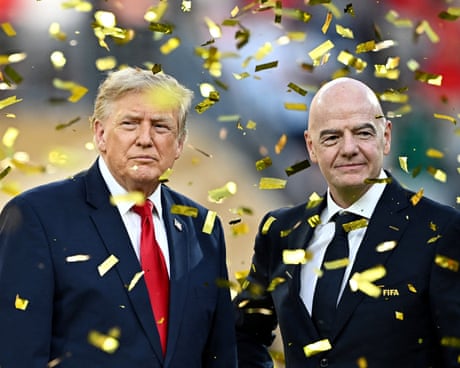
After the tournament concluded, Fifa president Gianni Infantino dropped a political pipebomb into the after-party, proposing to privatize the World Cup by injecting $20bn in private capital, with an assist from JP Morgan and Thrive Capital, the investment vehicle orchestrated by Joshua Kushner, brother to Jared Kushner, Donald Trump’s son-in-law.
Turns out, Infantino hadn’t just been sucking up to Trump the whole time – from hand-delivering the confected Fifa peace prize to obliging him with the red card reversal heard ’round the world – ostensibly to ensure the World Cup money spigot remained winched wide open. Apparently, Infantino was also studying Trump’s nepotism-flecked smash-and-grab techniques. Not unlike the Trump administration nixing energy-project grants for states “based solely” on whether they supported him in the 2024 presidential election, football associations that backed Infantino’s private-equity scheme would get more money while those that disagreed would receive less. And just as Trump and the rightwing media ecosystem have destabilized the very notion of truth in US political discourse, Fifa subverted the notion of fairness when it nullified the red card for a US player.
But something deeper and even more important is going on. Amid the rising tide of authoritarianism around the world, including in the US under Trump, Fifa under Infantino has itself become increasingly dictatorial. Although Fifa claims it acts “in full respect” of its self-trumpeted “democratic and governance principles”, and that its president’s private-equity fever dream was “about the democratization of football worldwide”, the reality is that Fifa emulates the dictatorships before whom Infantino so readily genuflects. Many within the governing body learned about the privatization gambit through the news rather than proper consultation (just as they had heard of Infantino’s decision to hand Trump the peace prize). Although Fifa statutes limit presidents to “no more than three terms of office”, and Infantino was first elected in 2016 and then re-elected – unopposed by acclamation – in 2019 and 2023, he has declared that he could run again in 2027. Infantino is infamous for besmirching journalists and avoiding press conferences. Tough questions are signs of reporters “spreading hate”. For him, information is meant to flow unidirectionally, cascading from on high.
What can be done? Yes, it’s past time to “give Fifa’s boss the boot”, as a US Soccer vice-president put it. But despite Infantino’s spectacular miscalculations and dictatorial shifts, those who have the power to “boot” him have instead made him the frontrunner in next year’s election. Although soccer’s regional governing bodies in Europe (Uefa), Asia (AFC), as well as North, Central America and the Caribbean (Concacaf) have publicly rebuked Infantino, with Europe even threatening to boycott international competitions, fissures have emerged: Mexico, Qatar and several Asian national associations have broken ranks to signal support for the beleaguered Infantino. The Confederation of African Football (CAF), which represents 54 countries, “unanimously reconfirmed its support” for Infantino, who needs only 106 votes to survive his re-election bid next March. Dislodging Infantino is an uphill fight.
That’s because Fifa’s patronage system is a powerful sedative for dissent: it distributes millions to football associations around the globe under a system of clientelism grounded in fidelity and orchestrated with scant public oversight. This is soccer symbiosis awash in cash and lacking accountability.
Even though Fifa’s proposed privatization could have hurt players, fans and clubs alike, plenty of federations were ready to support it. Sure, private equity has an ignominious record of acquiring holdings with social value, stripping them for parts and leaving a husk of what once was. Exhibit A: sports media. Exhibit B: hospitals. Making football into Exhibit C would not only have risked destroying the world’s most popular sport. It would have been a crime against collective joy. Nevertheless, administrators around the world were happy to back the gambit. This is a testament to the power of that patronage system, built up over decades by successive presidents, from João Havelange to Sepp Blatter to Gianni Infantino.
The top candidates to replace Infantino are freighted with cumbersome baggage. Victor Montagliani rose to become head of Concacaf and a Fifa Council vice-president despite controversial handlings of scandals and partnerships. Another possibility, Fifa Council member Nasser Al-Khelaifi of Qatar, stated that he had “no ambition, no intention and no interest in the Fifa role”. Sheikh Salman bin Ibrahim Al Khalifa, top man at the Asian Football Confederation, already lost to Infantino back in 2016 and has long been dogged by allegations of human-rights violations in Bahrain, which he denies. Lise Klaveness, who heads the Norwegian FA, would bring principle and panache to the presidency – and she has a strong record of standing up to Infantino – but she is essentially unelectable in an organization drenched in sexism.
Let’s be clear: change at Fifa must come from outside the organization. For too long, Fifa has monitored itself. The 2026 World Cup and its aftermath demonstrate unequivocally that Fifa requires independent oversight, toothy regulation carried out by governments and NGOs dedicated to preserving the people’s game as a social good.
Toward that end, FairSquare, the London-based nonprofit human-rights organization on whose advisory board I serve, recently launched a “Reboot Fifa” campaign to declare Infantino ineligible for the March election and to create the biggest-ever class-action complaint against Infantino for openly violating Fifa’s own governing statutes on political neutrality by consistently cozying up to Trump. Donning a red Maga-style cap with “45—47” and “USA” emblazoned on it at a Board of Peace meeting cannot be considered “Fifa remain[ing] neutral in matters of politics”.
Infantino’s clumsy overstepping has galvanized calls for reform and created a chance to reject authoritarianism creep.
After the tournament concluded, Fifa president Gianni Infantino dropped a political pipebomb into the after-party, proposing to privatize the World Cup by injecting $20bn in private capital, with an assist from JP Morgan and Thrive Capital, the investment vehicle orchestrated by Joshua Kushner, brother to Jared Kushner, Donald Trump’s son-in-law.
Turns out, Infantino hadn’t just been sucking up to Trump the whole time – from hand-delivering the confected Fifa peace prize to obliging him with the red card reversal heard ’round the world – ostensibly to ensure the World Cup money spigot remained winched wide open. Apparently, Infantino was also studying Trump’s nepotism-flecked smash-and-grab techniques. Not unlike the Trump administration nixing energy-project grants for states “based solely” on whether they supported him in the 2024 presidential election, football associations that backed Infantino’s private-equity scheme would get more money while those that disagreed would receive less. And just as Trump and the rightwing media ecosystem have destabilized the very notion of truth in US political discourse, Fifa subverted the notion of fairness when it nullified the red card for a US player.
But something deeper and even more important is going on. Amid the rising tide of authoritarianism around the world, including in the US under Trump, Fifa under Infantino has itself become increasingly dictatorial. Although Fifa claims it acts “in full respect” of its self-trumpeted “democratic and governance principles”, and that its president’s private-equity fever dream was “about the democratization of football worldwide”, the reality is that Fifa emulates the dictatorships before whom Infantino so readily genuflects. Many within the governing body learned about the privatization gambit through the news rather than proper consultation (just as they had heard of Infantino’s decision to hand Trump the peace prize). Although Fifa statutes limit presidents to “no more than three terms of office”, and Infantino was first elected in 2016 and then re-elected – unopposed by acclamation – in 2019 and 2023, he has declared that he could run again in 2027. Infantino is infamous for besmirching journalists and avoiding press conferences. Tough questions are signs of reporters “spreading hate”. For him, information is meant to flow unidirectionally, cascading from on high.
What can be done? Yes, it’s past time to “give Fifa’s boss the boot”, as a US Soccer vice-president put it. But despite Infantino’s spectacular miscalculations and dictatorial shifts, those who have the power to “boot” him have instead made him the frontrunner in next year’s election. Although soccer’s regional governing bodies in Europe (Uefa), Asia (AFC), as well as North, Central America and the Caribbean (Concacaf) have publicly rebuked Infantino, with Europe even threatening to boycott international competitions, fissures have emerged: Mexico, Qatar and several Asian national associations have broken ranks to signal support for the beleaguered Infantino. The Confederation of African Football (CAF), which represents 54 countries, “unanimously reconfirmed its support” for Infantino, who needs only 106 votes to survive his re-election bid next March. Dislodging Infantino is an uphill fight.
That’s because Fifa’s patronage system is a powerful sedative for dissent: it distributes millions to football associations around the globe under a system of clientelism grounded in fidelity and orchestrated with scant public oversight. This is soccer symbiosis awash in cash and lacking accountability.
Even though Fifa’s proposed privatization could have hurt players, fans and clubs alike, plenty of federations were ready to support it. Sure, private equity has an ignominious record of acquiring holdings with social value, stripping them for parts and leaving a husk of what once was. Exhibit A: sports media. Exhibit B: hospitals. Making football into Exhibit C would not only have risked destroying the world’s most popular sport. It would have been a crime against collective joy. Nevertheless, administrators around the world were happy to back the gambit. This is a testament to the power of that patronage system, built up over decades by successive presidents, from João Havelange to Sepp Blatter to Gianni Infantino.
The top candidates to replace Infantino are freighted with cumbersome baggage. Victor Montagliani rose to become head of Concacaf and a Fifa Council vice-president despite controversial handlings of scandals and partnerships. Another possibility, Fifa Council member Nasser Al-Khelaifi of Qatar, stated that he had “no ambition, no intention and no interest in the Fifa role”. Sheikh Salman bin Ibrahim Al Khalifa, top man at the Asian Football Confederation, already lost to Infantino back in 2016 and has long been dogged by allegations of human-rights violations in Bahrain, which he denies. Lise Klaveness, who heads the Norwegian FA, would bring principle and panache to the presidency – and she has a strong record of standing up to Infantino – but she is essentially unelectable in an organization drenched in sexism.
Let’s be clear: change at Fifa must come from outside the organization. For too long, Fifa has monitored itself. The 2026 World Cup and its aftermath demonstrate unequivocally that Fifa requires independent oversight, toothy regulation carried out by governments and NGOs dedicated to preserving the people’s game as a social good.
Toward that end, FairSquare, the London-based nonprofit human-rights organization on whose advisory board I serve, recently launched a “Reboot Fifa” campaign to declare Infantino ineligible for the March election and to create the biggest-ever class-action complaint against Infantino for openly violating Fifa’s own governing statutes on political neutrality by consistently cozying up to Trump. Donning a red Maga-style cap with “45—47” and “USA” emblazoned on it at a Board of Peace meeting cannot be considered “Fifa remain[ing] neutral in matters of politics”.
Infantino’s clumsy overstepping has galvanized calls for reform and created a chance to reject authoritarianism creep.
🔗 Share Article
Tags:#الفيفا#جياني إنفانتينو#كأس العالم#الفساد الرياضي#الاستبدادية#الإصلاح الرياضي
Source: The Guardian US
For Context
Related reads from the same topic or latest developments