Will Inuit in Canada Turn to China?
Foreign Policy

Foreign Policy
Original Source
Amid mounting tensions with Ottawa, Canada's Inuit leaders are signaling openness to new international partnerships, including with China. This shift comes after the federal government under Prime Minister Mark Carney changed its approach to Arctic governance, sidelining Indigenous organizations in major infrastructure decisions.
Will Inuit in Canada Seek Chinese Partnerships Amid Strained Ties With Ottawa?
!Foreign Policy
Foreign Policy Get analysis and alerts more quickly in the mobile app.
Install
Back to Foreign Policy Magazine home page
* Latest
* Regions
+ Asia & the Pacific
+ China
+ Middle East & Africa
+ Americas
+ Europe
* Newsletters
Editors’ Picks
Evening roundup with our editors’ favorite stories of the day
!World Brief Icon
World Brief
Your guide to the most important world stories of the day
!China Brief Icon
China Brief
The latest news, analysis, and data from the country each week
Situation Report
Weekly update on what’s driving U.S. national security policy
FP Weekend
A curation of our best book reviews, deep dives, and other reads
!Africa Brief Icon
Africa Brief
Essential analysis of the stories shaping geopolitics on the continent
!South Asia Brief Icon
South Asia Brief
Weekly update on developments in India and its neighbors
The Reading List
Curated guides on geopolitics and current affairs
FP Bookshelf
A monthly guide to FP’s book reviews, excerpts, and reading recommendations
!Latin America Brief Icon
Latin America Brief
One-stop digest of politics, economics, and culture
!Southeast Asia Brief Icon
Southeast Asia Brief
A weekly dispatch with news from the region’s 11 countries
The New Geopolitics
A five-part masterclass in IR theory with Harvard Professor Stephen M. Walt
View All Newsletters
* FP Live
* Latest
* Trending:
* Trump-Xi meeting
* United Nations General Assembly
Search this website
* Preferences
* My FP Feed
* Saved Articles
* Newsletters
* Magazine Archive
* Subscription Settings
* FAQs
* Log Out
Sign In
Sign In
Partner with FP at UNGA81 Partner with FP at UNGA81
Subscribe Subscribe Partner with FP at UNGA81 Partner with FP at UNGA81
Analysis: Will Inuit in Canada Turn to China?
*
*
* Facebook
* Bluesky
* X
* LinkedIn
* WhatsApp
* Reddit
Save
1. Create an FP account to save articles to read later.
Sign Up
ALREADY AN FP SUBSCRIBER? LOGIN
PDF
1. **Downloadable PDFs** are a benefit of an FP subscription.
Subscribe Now
ALREADY AN FP SUBSCRIBER? LOGIN
Gift
*
*
* WhatsApp
1. Gifting articles is a subscriber benefit.
Subscribe Now
ALREADY AN FP SUBSCRIBER? LOGIN
2. This article is an Insider exclusive.
Contact us at [email protected] to learn about upgrade options, unlocking the ability to gift this article.
Analysis
Will Inuit in Canada Turn to China?
Amid strained ties with Ottawa, some Indigenous leaders are suggesting that they may pursue new partnerships.
By **John Last**, a freelance journalist and researcher based in Ottawa, Canada.
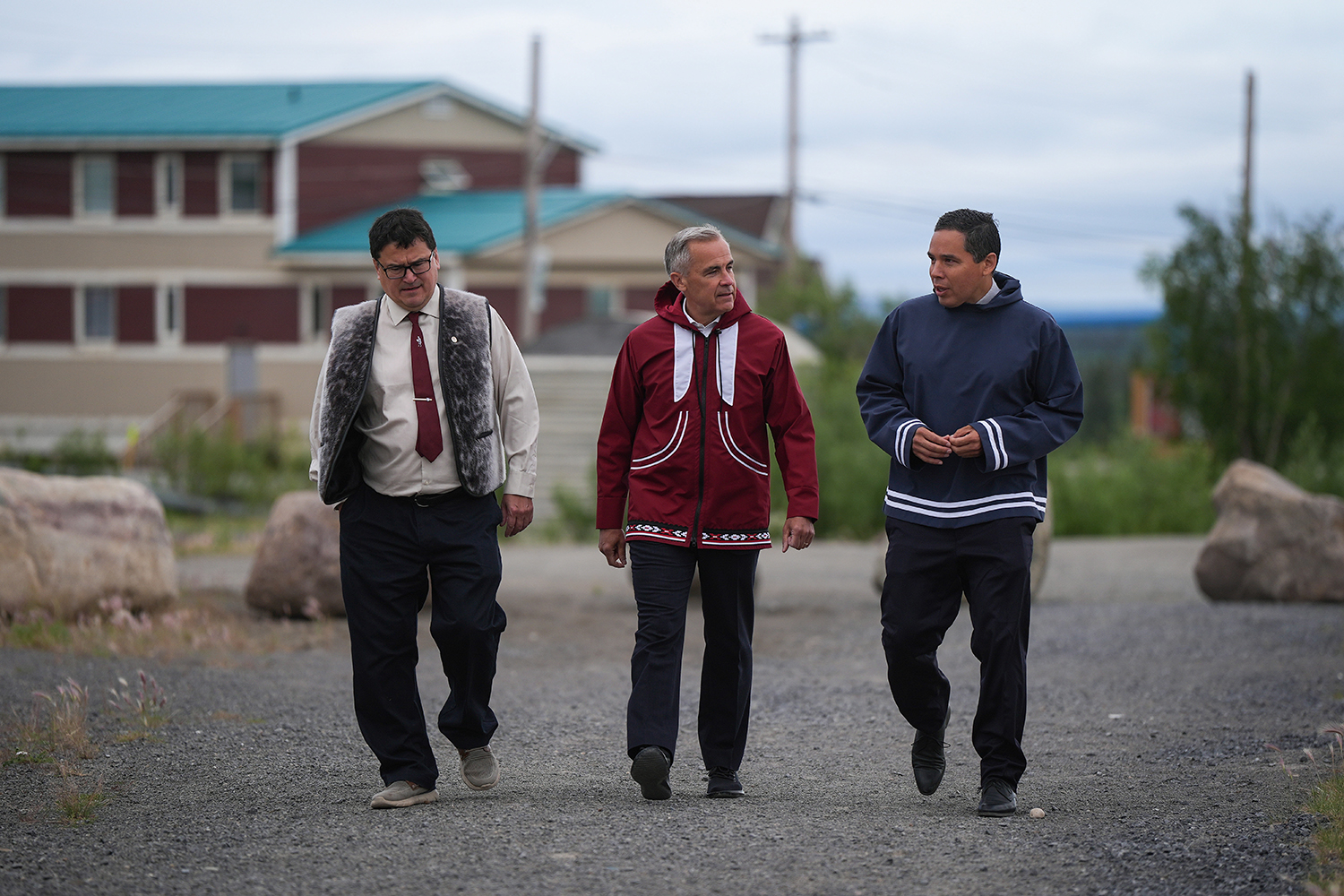
!Three men walk side by side down a gravel path outdoors. The man on the left wears a red tie and a fur-lined vest. The man in the center wears a red zippered hooded jacket with white accents on the hem. The man on the right wears a dark blue pullover hooded top with white stripes near the bottom. In the background, there is a wide, two-story reddish-brown building with a teal roof under an overcast sky.
*Three men walk side by side down a gravel path outdoors. The man on the left wears a red tie and a fur-lined vest. The man in the center wears a red zippered hooded jacket with white accents on the hem. The man on the right wears a dark blue pullover hooded top with white stripes near the bottom. In the background, there is a wide, two-story reddish-brown building with a teal roof under an overcast sky.*
Canadian Prime Minister Mark Carney (center) walks with Duane Smith (left), the chair and CEO of the Inuvialuit Regional Corporation, and Natan Obed (right), the president of the Inuit Tapiriit Kanatami, in Inuvik, Canada, on July 24, 2025. Darryl Dyck/the Canadian Press via Reuters
*
*
*
September 22, 2026, 7:00 AM
These days in Canada, all eyes are on the country’s west. Alberta is hurtling toward a controversial Oct. 19 independence referendum, with reported meddling by both U.S. influencers and Russian bot farms. In response, Ottawa is promising billions in new investments in the province’s fossil fuel industry despite Supreme Court judgements that the entire separatist campaign is likely unconstitutional—and polling suggesting that it will lose.
But while this noisy sideshow distracts policymakers and pundits, a much more serious challenge to Canadian unity has arisen in the country’s far north, where the nation’s Inuit leadership has decried what one leader called “a very large shift” in the federal government’s dealings in the region.
These days in Canada, all eyes are on the country’s west. Alberta is hurtling toward a controversial Oct. 19 independence referendum, with reported meddling by both U.S. influencers and Russian bot farms. In response, Ottawa is promising billions in new investments in the province’s fossil fuel industry despite Supreme Court judgements that the entire separatist campaign is likely unconstitutional—and polling suggesting that it will lose.
But while this noisy sideshow distracts policymakers and pundits, a much more serious challenge to Canadian unity has arisen in the country’s far north, where the nation’s Inuit leadership has decried what one leader called “a very large shift” in the federal government’s dealings in the region.
In the past few decades, modern treaties signed across Inuit Nunangat—the Inuit homeland that spans parts of Yukon, the Northwest Territories, Nunavut, Quebec, and Labrador—have affirmed the right for Inuit organizations to play a role in dictating resource and infrastructure developments across the region, which is home to vast strategic reserves of minerals used in green and military technologies. In some cases, that extends to outright ownership of the lands and resources in question; in others, treaties grant broad powers to reject developments that infringe upon traditional hunting and gathering activities.
Under the leadership of former Prime Minister Justin Trudeau, treaty organizations such as Inuit Tapiriit Kanatami (ITK), the representative body for all Inuit in Canada, were often called upon for consultations—and respected for their views. When it came to funding for new initiatives, like food and childcare subsidies, regional Inuit organizations were often the federal government’s preferred partners over territorial governments. Inuit representatives could veto the expansion plans of billion-dollar corporations with little fear of federal intervention.
But under Trudeau’s successor, Mark Carney, the federal government has changed tack. Inuit leaders have grumbled that Carney has been quicker to deal with territorial governments, which represent Inuit and non-Inuit alike—and often find corporate developments more palatable. When Ottawa in March announced a plan to invest $40 billion “to defend, build, and transform Canada’s Northern and Arctic region” via a series of massive, multiyear infrastructure projects, Inuit organizations were not invited to consult, according to Natan Obed, ITK’s president.
“We are not an essential part of those conversations, even though they are in our homeland,” Obed said at a June summit on Arctic sovereignty held in Ottawa. The feeling has only been deepened by an ongoing devolution process, in which the federal government has begun passing responsibility for land, water, and mineral rights to territorial governments. Though presented by the federal government as deepening Inuit self-determination, critics have decried the devolution as colonial for transferring powers from one largely non-Indigenous government to another.
“Since its creation \[in 1999], the promise of a representative territorial government \[in Nunavut] has not been fulfilled,” Kunuk Inutiq, an Inuit researcher, wrote in a 2022 brief for the Yellowhead Institute, an Ind
!Foreign Policy
Foreign Policy Get analysis and alerts more quickly in the mobile app.
Install
Back to Foreign Policy Magazine home page
* Latest
* Regions
+ Asia & the Pacific
+ China
+ Middle East & Africa
+ Americas
+ Europe
* Newsletters
Editors’ Picks
Evening roundup with our editors’ favorite stories of the day
!World Brief Icon
World Brief
Your guide to the most important world stories of the day
!China Brief Icon
China Brief
The latest news, analysis, and data from the country each week
Situation Report
Weekly update on what’s driving U.S. national security policy
FP Weekend
A curation of our best book reviews, deep dives, and other reads
!Africa Brief Icon
Africa Brief
Essential analysis of the stories shaping geopolitics on the continent
!South Asia Brief Icon
South Asia Brief
Weekly update on developments in India and its neighbors
The Reading List
Curated guides on geopolitics and current affairs
FP Bookshelf
A monthly guide to FP’s book reviews, excerpts, and reading recommendations
!Latin America Brief Icon
Latin America Brief
One-stop digest of politics, economics, and culture
!Southeast Asia Brief Icon
Southeast Asia Brief
A weekly dispatch with news from the region’s 11 countries
The New Geopolitics
A five-part masterclass in IR theory with Harvard Professor Stephen M. Walt
View All Newsletters
* FP Live
* Latest
* Trending:
* Trump-Xi meeting
* United Nations General Assembly
Search this website
* Preferences
* My FP Feed
* Saved Articles
* Newsletters
* Magazine Archive
* Subscription Settings
* FAQs
* Log Out
Sign In
Sign In
Partner with FP at UNGA81 Partner with FP at UNGA81
Subscribe Subscribe Partner with FP at UNGA81 Partner with FP at UNGA81
Analysis: Will Inuit in Canada Turn to China?
*
*
* Bluesky
* X
Save
1. Create an FP account to save articles to read later.
Sign Up
ALREADY AN FP SUBSCRIBER? LOGIN
1. **Downloadable PDFs** are a benefit of an FP subscription.
Subscribe Now
ALREADY AN FP SUBSCRIBER? LOGIN
Gift
*
*
1. Gifting articles is a subscriber benefit.
Subscribe Now
ALREADY AN FP SUBSCRIBER? LOGIN
2. This article is an Insider exclusive.
Contact us at [email protected] to learn about upgrade options, unlocking the ability to gift this article.
Analysis
Will Inuit in Canada Turn to China?
Amid strained ties with Ottawa, some Indigenous leaders are suggesting that they may pursue new partnerships.
By **John Last**, a freelance journalist and researcher based in Ottawa, Canada.
!Three men walk side by side down a gravel path outdoors. The man on the left wears a red tie and a fur-lined vest. The man in the center wears a red zippered hooded jacket with white accents on the hem. The man on the right wears a dark blue pullover hooded top with white stripes near the bottom. In the background, there is a wide, two-story reddish-brown building with a teal roof under an overcast sky.
*Three men walk side by side down a gravel path outdoors. The man on the left wears a red tie and a fur-lined vest. The man in the center wears a red zippered hooded jacket with white accents on the hem. The man on the right wears a dark blue pullover hooded top with white stripes near the bottom. In the background, there is a wide, two-story reddish-brown building with a teal roof under an overcast sky.*
Canadian Prime Minister Mark Carney (center) walks with Duane Smith (left), the chair and CEO of the Inuvialuit Regional Corporation, and Natan Obed (right), the president of the Inuit Tapiriit Kanatami, in Inuvik, Canada, on July 24, 2025. Darryl Dyck/the Canadian Press via Reuters
*
*
*
September 22, 2026, 7:00 AM
These days in Canada, all eyes are on the country’s west. Alberta is hurtling toward a controversial Oct. 19 independence referendum, with reported meddling by both U.S. influencers and Russian bot farms. In response, Ottawa is promising billions in new investments in the province’s fossil fuel industry despite Supreme Court judgements that the entire separatist campaign is likely unconstitutional—and polling suggesting that it will lose.
But while this noisy sideshow distracts policymakers and pundits, a much more serious challenge to Canadian unity has arisen in the country’s far north, where the nation’s Inuit leadership has decried what one leader called “a very large shift” in the federal government’s dealings in the region.
These days in Canada, all eyes are on the country’s west. Alberta is hurtling toward a controversial Oct. 19 independence referendum, with reported meddling by both U.S. influencers and Russian bot farms. In response, Ottawa is promising billions in new investments in the province’s fossil fuel industry despite Supreme Court judgements that the entire separatist campaign is likely unconstitutional—and polling suggesting that it will lose.
But while this noisy sideshow distracts policymakers and pundits, a much more serious challenge to Canadian unity has arisen in the country’s far north, where the nation’s Inuit leadership has decried what one leader called “a very large shift” in the federal government’s dealings in the region.
In the past few decades, modern treaties signed across Inuit Nunangat—the Inuit homeland that spans parts of Yukon, the Northwest Territories, Nunavut, Quebec, and Labrador—have affirmed the right for Inuit organizations to play a role in dictating resource and infrastructure developments across the region, which is home to vast strategic reserves of minerals used in green and military technologies. In some cases, that extends to outright ownership of the lands and resources in question; in others, treaties grant broad powers to reject developments that infringe upon traditional hunting and gathering activities.
Under the leadership of former Prime Minister Justin Trudeau, treaty organizations such as Inuit Tapiriit Kanatami (ITK), the representative body for all Inuit in Canada, were often called upon for consultations—and respected for their views. When it came to funding for new initiatives, like food and childcare subsidies, regional Inuit organizations were often the federal government’s preferred partners over territorial governments. Inuit representatives could veto the expansion plans of billion-dollar corporations with little fear of federal intervention.
But under Trudeau’s successor, Mark Carney, the federal government has changed tack. Inuit leaders have grumbled that Carney has been quicker to deal with territorial governments, which represent Inuit and non-Inuit alike—and often find corporate developments more palatable. When Ottawa in March announced a plan to invest $40 billion “to defend, build, and transform Canada’s Northern and Arctic region” via a series of massive, multiyear infrastructure projects, Inuit organizations were not invited to consult, according to Natan Obed, ITK’s president.
“We are not an essential part of those conversations, even though they are in our homeland,” Obed said at a June summit on Arctic sovereignty held in Ottawa. The feeling has only been deepened by an ongoing devolution process, in which the federal government has begun passing responsibility for land, water, and mineral rights to territorial governments. Though presented by the federal government as deepening Inuit self-determination, critics have decried the devolution as colonial for transferring powers from one largely non-Indigenous government to another.
“Since its creation \[in 1999], the promise of a representative territorial government \[in Nunavut] has not been fulfilled,” Kunuk Inutiq, an Inuit researcher, wrote in a 2022 brief for the Yellowhead Institute, an Ind
🔗 Share Article
Tags:#كندا#الإينويت#الصين#القطب الشمالي#السياسة الفيدرالية#الموارد الاستراتيجية
Source: Foreign Policy
For Context
Related reads from the same topic or latest developments