PoliticsAvailable in English
25 Years After 9/11, Muslims Are Still Politicians’ Favorite Scapegoat
Editorial
Cross Lines editing
Source
The Intercept
The Intercept
T
The Intercept
Original Source
A quarter-century after 9/11, Islamophobia remains a powerful tool in American politics, intensifying during election cycles rather than subsiding. Troublingly, political rhetoric is shifting from targeted bans to framing Islam itself as a political ideology, threatening to criminalize an entire faith.
25 Years After 9/11, Muslims Are Still Politicians’ Favorite Scapegoat
Support Us
Support Us
* Iran
* Midterms
* Justice
* War on Gaza
* Unmasking ICE
* Chilling Dissent
Support Us
* Special Investigations
* Voices
* Podcasts
* TomDispatch
* Press Freedom Defense Fund
* Join the Newsletter
* About
* Contact Us
* How to Donate
* Impact & Reports
* Jobs
* Become a Source
*
*
*
*
*
*
*
*
*
© THE INTERCEPT
ALL RIGHTS RESERVED
Terms of UsePrivacy
* Iran
* Midterms
* Justice
* War on Gaza
* Unmasking ICE
* Chilling Dissent
* About
* Support Us
25 Years After 9/11, Muslims Are Still Politicians’ Favorite Scapegoat
Rozina Ali on the rise of Islamophobia in America and the vague terrorism laws now being wielded against dissidents like the Prairieland protesters.
The Intercept Briefing
September 4 2026, 6:00 a.m. ET
*
* Share on Facebook
*
* Share on X
* Share on LinkedIn
* Share on WhatsApp
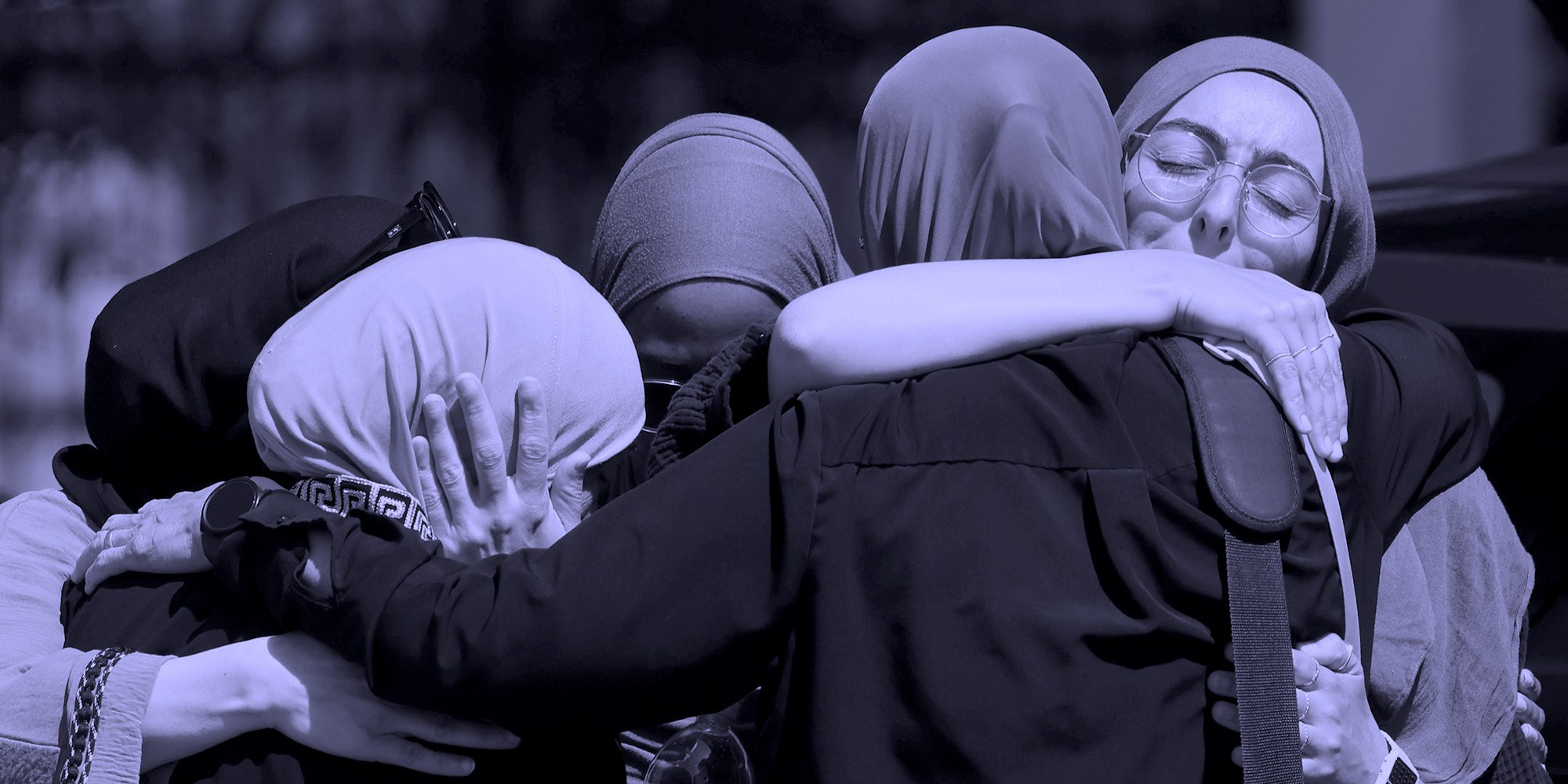
Mosque members embrace in the parking lot of the Islamic Center of San Diego on May 19, 2026, a day after three people were shot and killed at the mosque.
Photo: Sandy Huffaker/Getty Images
A quarter century
after the September 11 attacks emboldened then-President George W. Bush to launch the “war on terror,” many Americans might like to think they’re wiser than the politicians and pundits who unleashed a flood of anti-Muslim hatred and eroded civil liberties through warrantless wiretaps and racist deportation campaigns.
But some of the most notorious Bush-era advents — like the Department of Homeland Security and the prison colony at Guantánamo Bay — don’t appear to be going anywhere. Nor does the phenomenon of Islamophobia, which is playing a major role in the current political cycle. Michigan Democratic Senate nominee Abdul El-Sayed — who, if elected, would be the first Muslim U.S. senator — has been called a terrorist, a radical Islamist, and a threat to national security, as pro-corporate and pro-Israel super PACs spend millions on ads that paint him as a terrorist sympathizer. In New York City, meanwhile, local media has suggested that the city’s first Muslim mayor, Zohran Mamdani, should not attend the commemoration of the World Trade Center attacks, as if to do so would be an insult to the victims and their families.
“Islamophobia actually becomes more rampant during election season — not necessarily after a terrorist attack, but actually during election season in the U.S.,” journalist Rozina Ali tells The Intercept Briefing. “What’s happened over the last three decades is that Islamophobia has become a feature of American politics. … When you can’t actually discuss the policies, when we’re not willing to engage in facts, it’s really easy to throw racist rhetoric at people.”
“The fight that we’re seeing now is whether we are willing to accept all forms of religion in this country. And as much as I want to say this is just more of what we’ve seen in the past, I think what does frighten me is how quickly we are moving to a place where some governor or some local official might try to outlaw Islam altogether. And mind you, this is even a policy shift from 10 years ago when Trump called for a Muslim ban,” says Ali. “What has been happening recently is that the rhetoric … has been shifting toward, ‘Islam is not a religion, it’s a political ideology.’ This is not a new talking point, but it is becoming institutionalized. There are efforts to make it into law, which is a frightening place to be.”
This week on the podcast, host Akela Lacy speaks to Ali about how anti-Muslim rhetoric and policies are on the rise and have endured, or even worsened, in the post-9/11 world, as well as her new book, “Seasons of Fury: Four Families and the Rise of Islamophobia in America.” Ali shares the first case in which the NSA admitted to spying on a U.S. citizen, Arab American attorney Abdeen Jabara, as well as the story of imam Yassin Aref, a victim of a controversial sting operation who served 15 years in federal prison due to the ambiguous “material support” for terrorism law first passed in the ’90s. It was the same charge used to convict anti-ICE protesters at Prairieland Detention Center to decades in prison this year.
“This was something lot of civil rights lawyers and activists were warning about even back then, because they recognized that this law and this war on terror can be used to attack dissidents and eventually will be used to attack a lot more people than the Muslim community. And that is what we’re seeing now,” says Ali.
“Because we’ve given so much power to the executive branch, because we’ve given so much power to the government over the last 25 years, the government gets to decide who they consider enemies, who they consider terrorists, and what they consider support for terrorism,” says Ali. “The Trump administration can say, ‘I now consider leftists terrorists,’ and unfortunately, there are laws in the books that allow him to do that.”
For more, listen to the full conversation of The Intercept Briefing on Apple Podcasts, Spotify, YouTube, or wherever you listen.
**Transcript**
**Akela Lacy:** Welcome to The Intercept Briefing, I’m Akela Lacy, senior politics reporter at The Intercept.
**Jessica Washington:** And, I’m Jessica Washington, politics reporter at The Intercept.
**AL:** Jessie, it’s Labor Day weekend. Unless you’re a summer-truther like me, this marks the end of summer for most people. And accordingly, things are taking a hard pivot toward November.
I’m going to run through a few things that caught my eye in the last few days: ICE is planning to pay $5 million to create a national voter database, per reporting from Wired. Nothing to see there, I’m sure.
The Trump administration is also deploying hundreds of Department of Homeland Security agents to conduct a witch hunt for unspecified voter fraud, despite lacking evidence that that’s a real issue.
In Congress, Democrats are considering whether to punish two lawmakers who sided with Republicans this week to advance a key procedural vote. And they’re weighing new rules for the caucus that worry progressives and several other caucuses across the ideological spectrum. But progressives in particular are worried that these new rules, if passed, could ice out the new class of socialists who are on track to take office in January. Separately, but perhaps most importantly, the United Nations said we’ve basically lost any chance to stop the worst of global warming.
**JW:** OK, I’m really going to avoid making a heat joke. But I will say that August in Washington is officially over and that means not only is the weather getting a little bit cooler, although, I guess, we’ll see. It also means there is a lot more news to cover. Although, I would say it is hard to argue we’ve gotten much rest this last month.
In Massachusetts on Tuesday night, Democratic Sen. Ed Markey easily defeated his challenger, Democratic congressman Seth Moulton. Moulton had run on his relative youth, but was hamstrung by people’s perception that he was both inauthentic and far too conservative for the state. After the 2024 presidential election, Moulton had made this very public appeal to the right, arguing that protecting transgender children had harmed Democrats electorally and that it made them seem out of touch. But as it turned out, from Tuesday night, Moulton ended up being the one who seemed out of touch with his voters in Massachusetts.
In some more somber news, this week marks one year since the Trump administration began carrying out strikes on civilians in the Caribbean Sea and Pacific Ocean. The Intercept’s Nick Turse reported that the United States has killed 227 civilians in the more than 65 attacks that have been carried out in the name of defeating so-called narco terrorists. There’s this one passage from Nick’s piece on the anniversary that really sticks with me.
> “It’s been a year of murders,” said a defense official who was horrified by the first strike and has remained so a
Support Us
Support Us
* Iran
* Midterms
* Justice
* War on Gaza
* Unmasking ICE
* Chilling Dissent
Support Us
* Special Investigations
* Voices
* Podcasts
* TomDispatch
* Press Freedom Defense Fund
* Join the Newsletter
* About
* Contact Us
* How to Donate
* Impact & Reports
* Jobs
* Become a Source
*
*
*
*
*
*
*
*
*
© THE INTERCEPT
ALL RIGHTS RESERVED
Terms of UsePrivacy
* Iran
* Midterms
* Justice
* War on Gaza
* Unmasking ICE
* Chilling Dissent
* About
* Support Us
25 Years After 9/11, Muslims Are Still Politicians’ Favorite Scapegoat
Rozina Ali on the rise of Islamophobia in America and the vague terrorism laws now being wielded against dissidents like the Prairieland protesters.
The Intercept Briefing
September 4 2026, 6:00 a.m. ET
*
* Share on Facebook
*
* Share on X
* Share on LinkedIn
* Share on WhatsApp
Mosque members embrace in the parking lot of the Islamic Center of San Diego on May 19, 2026, a day after three people were shot and killed at the mosque.
Photo: Sandy Huffaker/Getty Images
A quarter century
after the September 11 attacks emboldened then-President George W. Bush to launch the “war on terror,” many Americans might like to think they’re wiser than the politicians and pundits who unleashed a flood of anti-Muslim hatred and eroded civil liberties through warrantless wiretaps and racist deportation campaigns.
But some of the most notorious Bush-era advents — like the Department of Homeland Security and the prison colony at Guantánamo Bay — don’t appear to be going anywhere. Nor does the phenomenon of Islamophobia, which is playing a major role in the current political cycle. Michigan Democratic Senate nominee Abdul El-Sayed — who, if elected, would be the first Muslim U.S. senator — has been called a terrorist, a radical Islamist, and a threat to national security, as pro-corporate and pro-Israel super PACs spend millions on ads that paint him as a terrorist sympathizer. In New York City, meanwhile, local media has suggested that the city’s first Muslim mayor, Zohran Mamdani, should not attend the commemoration of the World Trade Center attacks, as if to do so would be an insult to the victims and their families.
“Islamophobia actually becomes more rampant during election season — not necessarily after a terrorist attack, but actually during election season in the U.S.,” journalist Rozina Ali tells The Intercept Briefing. “What’s happened over the last three decades is that Islamophobia has become a feature of American politics. … When you can’t actually discuss the policies, when we’re not willing to engage in facts, it’s really easy to throw racist rhetoric at people.”
“The fight that we’re seeing now is whether we are willing to accept all forms of religion in this country. And as much as I want to say this is just more of what we’ve seen in the past, I think what does frighten me is how quickly we are moving to a place where some governor or some local official might try to outlaw Islam altogether. And mind you, this is even a policy shift from 10 years ago when Trump called for a Muslim ban,” says Ali. “What has been happening recently is that the rhetoric … has been shifting toward, ‘Islam is not a religion, it’s a political ideology.’ This is not a new talking point, but it is becoming institutionalized. There are efforts to make it into law, which is a frightening place to be.”
This week on the podcast, host Akela Lacy speaks to Ali about how anti-Muslim rhetoric and policies are on the rise and have endured, or even worsened, in the post-9/11 world, as well as her new book, “Seasons of Fury: Four Families and the Rise of Islamophobia in America.” Ali shares the first case in which the NSA admitted to spying on a U.S. citizen, Arab American attorney Abdeen Jabara, as well as the story of imam Yassin Aref, a victim of a controversial sting operation who served 15 years in federal prison due to the ambiguous “material support” for terrorism law first passed in the ’90s. It was the same charge used to convict anti-ICE protesters at Prairieland Detention Center to decades in prison this year.
“This was something lot of civil rights lawyers and activists were warning about even back then, because they recognized that this law and this war on terror can be used to attack dissidents and eventually will be used to attack a lot more people than the Muslim community. And that is what we’re seeing now,” says Ali.
“Because we’ve given so much power to the executive branch, because we’ve given so much power to the government over the last 25 years, the government gets to decide who they consider enemies, who they consider terrorists, and what they consider support for terrorism,” says Ali. “The Trump administration can say, ‘I now consider leftists terrorists,’ and unfortunately, there are laws in the books that allow him to do that.”
For more, listen to the full conversation of The Intercept Briefing on Apple Podcasts, Spotify, YouTube, or wherever you listen.
**Transcript**
**Akela Lacy:** Welcome to The Intercept Briefing, I’m Akela Lacy, senior politics reporter at The Intercept.
**Jessica Washington:** And, I’m Jessica Washington, politics reporter at The Intercept.
**AL:** Jessie, it’s Labor Day weekend. Unless you’re a summer-truther like me, this marks the end of summer for most people. And accordingly, things are taking a hard pivot toward November.
I’m going to run through a few things that caught my eye in the last few days: ICE is planning to pay $5 million to create a national voter database, per reporting from Wired. Nothing to see there, I’m sure.
The Trump administration is also deploying hundreds of Department of Homeland Security agents to conduct a witch hunt for unspecified voter fraud, despite lacking evidence that that’s a real issue.
In Congress, Democrats are considering whether to punish two lawmakers who sided with Republicans this week to advance a key procedural vote. And they’re weighing new rules for the caucus that worry progressives and several other caucuses across the ideological spectrum. But progressives in particular are worried that these new rules, if passed, could ice out the new class of socialists who are on track to take office in January. Separately, but perhaps most importantly, the United Nations said we’ve basically lost any chance to stop the worst of global warming.
**JW:** OK, I’m really going to avoid making a heat joke. But I will say that August in Washington is officially over and that means not only is the weather getting a little bit cooler, although, I guess, we’ll see. It also means there is a lot more news to cover. Although, I would say it is hard to argue we’ve gotten much rest this last month.
In Massachusetts on Tuesday night, Democratic Sen. Ed Markey easily defeated his challenger, Democratic congressman Seth Moulton. Moulton had run on his relative youth, but was hamstrung by people’s perception that he was both inauthentic and far too conservative for the state. After the 2024 presidential election, Moulton had made this very public appeal to the right, arguing that protecting transgender children had harmed Democrats electorally and that it made them seem out of touch. But as it turned out, from Tuesday night, Moulton ended up being the one who seemed out of touch with his voters in Massachusetts.
In some more somber news, this week marks one year since the Trump administration began carrying out strikes on civilians in the Caribbean Sea and Pacific Ocean. The Intercept’s Nick Turse reported that the United States has killed 227 civilians in the more than 65 attacks that have been carried out in the name of defeating so-called narco terrorists. There’s this one passage from Nick’s piece on the anniversary that really sticks with me.
> “It’s been a year of murders,” said a defense official who was horrified by the first strike and has remained so a
Share Article
Tags:#الإسلاموفوبيا#السياسة الأمريكية#انتخابات 2026#حقوق المسلمين#قوانين الإرهاب#الحريات المدنية
Source: The Intercept
For Context
Related reads from the same topic or latest developments