Live Updates: At Least 95 Killed and Hundreds Missing as Floods Sweep Away Villages in Nepal
New York Times
N
New York Times
Original Source
A massive ice avalanche triggered catastrophic floods in the Himalayan valley between Nepal and Tibet, killing at least 160 people and leaving hundreds missing, including foreign tourists. The disaster destroyed entire villages, swept away bridges, and damaged critical infrastructure across the border region.
Live Updates: At Least 160 Killed and Hundreds Missing as Floods Sweep Away Villages in Nepal - The New York Times
Skip to contentSkip to site index
Log in
Wednesday, August 26, 2026
Today’s Paper
* Home
* + U.S.
+ International
+ Canada
+ Español
+ 中文
Deadly Floods
in Nepal
* Updates
* What to Know
* Hundreds Missing
* Cause of Flooding
* Videos
SKIP ADVERTISEMENT
Current time in
Nepal
12:28 a.m. Aug. 27
Live
Updated
Aug. 26, 2026, 2:27 p.m. ET
16 minutes ago
Live Updates: At Least 160 Killed and Hundreds Missing as Floods Sweep Away Villages in Nepal
A wall of water crashed through a Himalayan river valley between Nepal and the Chinese territory of Tibet, the Nepali authorities said. The missing included border officials, port workers and foreign tourists.
*
*
*
Video
Deadly Flooding Devastates Parts of Nepal and Tibet
*Hundreds of people were missing in Nepal and Tibet, an autonomous region of China, officials said, after waves of floodwaters ripped through river valleys and damaged settlements.
Credit
Credit...
Prabin Ranabhat/Agence France-Presse — Getty Images*
See more of our coverage in your search results. Encuentra más de nuestra cobertura en los resultados de búsqueda. Add The New York Times on Google Agrega The New York Times en Google
Latest
Updated
Aug. 26, 2026, 2:10 p.m. ET
33 minutes ago
Binod GhimireLeo Sands and Lily Kuo
Here’s the latest.
At least 160 people were killed and hundreds of others, many of them tourists, were missing in Nepal and the Chinese autonomous region of Tibet on Wednesday after waves of floodwaters crashed through river valleys and destroyed settlements, officials said.
Officials in Nepal reported 157 deaths. So far, Chinese officials have reported three deaths, but the toll was expected to rise, with the Chinese state news agency Xinhua saying there had been “significant” casualties at the Gyirong port of entry, at the border with Nepal. Surveillance footage circulating on social media and verified by The New York Times shows crowds running up a road near the port before torrents of water and thick clouds engulf the parking lot and surrounding buildings, destroying the area.
Nepal’s foreign minister, Shisir Khanal, said the government had received information that an avalanche had occurred Wednesday morning in the affected region. Scientists studying the disaster said their initial assessment was that an ice avalanche was caused by a large chunk of ice that broke off from a glacier, sending a torrent of water, rocks and mud through river valleys.
“There was no rain in Nepal, so we were not expecting anything like this,” said Narendra Pariyar, the chief district officer of Rasuwa, one of the areas affected by the floods.
As many as 391 tourists, including 291 foreigners, had been reported missing in Nepal, the country’s tourism board said in a statement. They included more than 100 visitors from India, a dozen Britons and at least three Americans. Citizens from Australia, the Netherlands, Malaysia and South Africa were also among the missing.
Thousands of people live in riverside settlements downstream from the flooding. The authorities have not estimated the number of people missing and the extent of damage but said that bridges, schools and hydropower projects had been swept away.
Here’s what else we’re covering:
* **Initial Assessment:** A preliminary analysis of satellite imagery indicates that an ice avalanche set off the flooding, said Simon Cook, a glaciologist at the University of Dundee in Scotland who is part of a team of scientists studying the disaster. According to their initial assessment, he said, a large chunk of ice broke off from a high-altitude glacier and tumbled thousands of feet toward the Bhotekoshi River in Nepal, releasing vast amounts of energy that pulverized the ice into a significant volume of flood water. Read more ›
* **Destruction in China:** Footage released by Chinese state media shows surging waters overwhelming buildings at the Gyirong port, taking out trees and making roads impassable. Read more ›
* **Rescue Effort:** Security teams led by the Nepali Army have been carrying out rescue operations, airlifting at least 114 people to safety. The army has mobilized 12 helicopters, set up a temporary hospital in the flood zone and evacuated at least 25 seriously injured people to Kathmandu, Nepal’s capital.
* **Nepal’s Government:** The disaster adds to the woes of Nepal’s recently elected government, and its 36-year-old prime minister, Balendra Shah, who swept to power on the back of a youth-led protest movement last year.
Pei-Lin Wu and Alex Travelli contributed reporting from Taipei.
!Binod Ghimire
Aug. 26, 2026, 2:06 p.m. ET
37 minutes ago
Binod Ghimire
Reporting from Kathmandu, Nepal
The death toll from the floods in Nepal has risen to 157, Nepal’s police said in a statement on Wednesday night.
Aug. 26, 2026, 1:23 p.m. ET
1 hour ago
Zane Irwin
Here’s what to know about the deadly flash floods in Nepal and Tibet.
Image
!A wide, muddy river flows through a valley, with buildings partially submerged in mud. Green hills flank the river.
*After a flash flood at Trishuli in Nuwakot district, Nepal, on Wednesday.
Credit...
Navesh Chitrakar/Reuters*
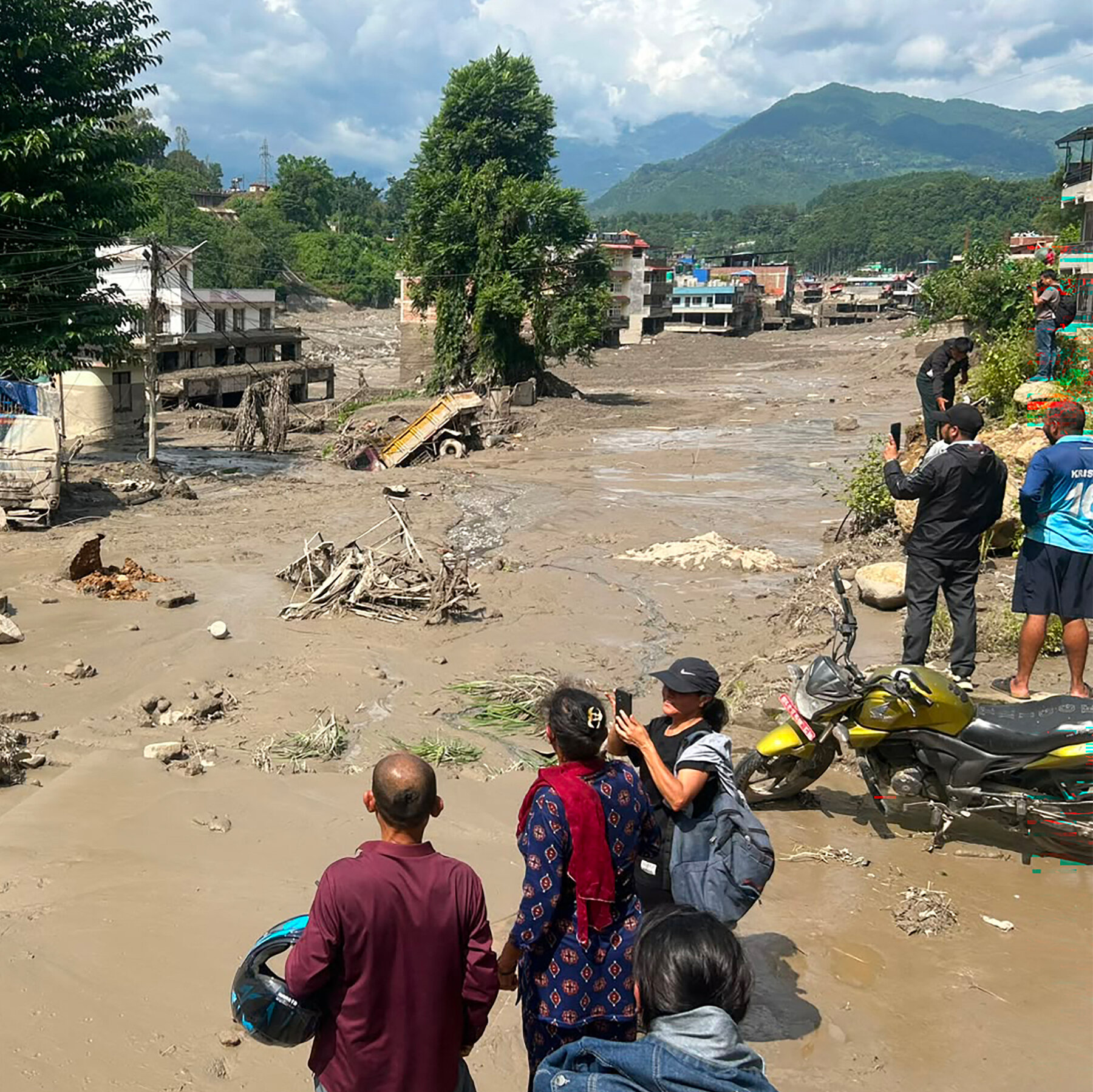
Floodwaters and mud crashed through Himalayan river valleys and swallowed villages on Wednesday, creating a cross-border crisis in Nepal and the Chinese territory of Tibet, with an unknown number of people swept away or buried.
Thousands of people live in riverside settlements downstream from the flooding, and hundreds are dead or missing, including foreign tourists. At least 19 vehicle bridges and 40 kilometers of roads have been swept away, according to a statement from Nepal’s prime minister.
Here’s what to know about the flash floods.
Where did the floods hit?
The torrents rushed through the valley of the Trishuli River, which is flanked by steep mountains and straddles the border between Tibet and the Rasuwa district of Nepal.
Officials in Nepal reported 157 deaths. The Chinese state news agency Xinhua reported that a mudslide killed at least three people and left 265 people missing. The agency said there had been “significant” casualties at the Gyirong Port in China, where footage released by state media showed surging waters and mud overwhelming buildings, uprooting trees and rendering roads impassable.
Video and images from Nepal showed the debris-choked river wiping out bridges, and towns partially buried in mud.
Gyirong Port, a small town with a border crossing into Nepal, is within the Tibetan Autonomous Region, an area that the Chinese government keeps under tight control as part of efforts to quash any dissent over its control of Tibet. The authorities invested in the port, about 40 miles north of Kathmandu, Nepal’s capital, as part of efforts to incorporate Tibet into China’s signature Belt and Road infrastructure project, through trade with Nepal and India.
From there, the Trishuli flows southwest across Nepal.
How can a flash flood happen without heavy rain?
Officials were caught off guard by the floods on Wednesday because it was not raining, according Narendra Pariyar, the chief district officer of Rasuwa.
Nepal’s foreign minister, Shisir Khanal, said the government had received preliminary information that an avalanche had occurred Wednesday morning in the affected region. Landslides in the region caused shaking intense enough to initially register as a 5.2.-magnitude earthquake, according to the U.S. Geological Survey.
The disaster was likely set off at least in part by an enormous chunk of ice snapping off a glacier and cascading thousands of feet to the valley below, according to an initial assessment by a group of geologists and glaciologists. The phenomenon is known as an ice avalanche.
The scientists said the impact released vast amounts of energy that pulverized the ice into a significant volume of floodwater.
Flash fl
Skip to contentSkip to site index
Log in
Wednesday, August 26, 2026
Today’s Paper
* Home
* + U.S.
+ International
+ Canada
+ Español
+ 中文
Deadly Floods
in Nepal
* Updates
* What to Know
* Hundreds Missing
* Cause of Flooding
* Videos
SKIP ADVERTISEMENT
Current time in
Nepal
12:28 a.m. Aug. 27
Live
Updated
Aug. 26, 2026, 2:27 p.m. ET
16 minutes ago
Live Updates: At Least 160 Killed and Hundreds Missing as Floods Sweep Away Villages in Nepal
A wall of water crashed through a Himalayan river valley between Nepal and the Chinese territory of Tibet, the Nepali authorities said. The missing included border officials, port workers and foreign tourists.
*
*
*
Video
Deadly Flooding Devastates Parts of Nepal and Tibet
*Hundreds of people were missing in Nepal and Tibet, an autonomous region of China, officials said, after waves of floodwaters ripped through river valleys and damaged settlements.
Credit
Credit...
Prabin Ranabhat/Agence France-Presse — Getty Images*
See more of our coverage in your search results. Encuentra más de nuestra cobertura en los resultados de búsqueda. Add The New York Times on Google Agrega The New York Times en Google
Latest
Updated
Aug. 26, 2026, 2:10 p.m. ET
33 minutes ago
Binod GhimireLeo Sands and Lily Kuo
Here’s the latest.
At least 160 people were killed and hundreds of others, many of them tourists, were missing in Nepal and the Chinese autonomous region of Tibet on Wednesday after waves of floodwaters crashed through river valleys and destroyed settlements, officials said.
Officials in Nepal reported 157 deaths. So far, Chinese officials have reported three deaths, but the toll was expected to rise, with the Chinese state news agency Xinhua saying there had been “significant” casualties at the Gyirong port of entry, at the border with Nepal. Surveillance footage circulating on social media and verified by The New York Times shows crowds running up a road near the port before torrents of water and thick clouds engulf the parking lot and surrounding buildings, destroying the area.
Nepal’s foreign minister, Shisir Khanal, said the government had received information that an avalanche had occurred Wednesday morning in the affected region. Scientists studying the disaster said their initial assessment was that an ice avalanche was caused by a large chunk of ice that broke off from a glacier, sending a torrent of water, rocks and mud through river valleys.
“There was no rain in Nepal, so we were not expecting anything like this,” said Narendra Pariyar, the chief district officer of Rasuwa, one of the areas affected by the floods.
As many as 391 tourists, including 291 foreigners, had been reported missing in Nepal, the country’s tourism board said in a statement. They included more than 100 visitors from India, a dozen Britons and at least three Americans. Citizens from Australia, the Netherlands, Malaysia and South Africa were also among the missing.
Thousands of people live in riverside settlements downstream from the flooding. The authorities have not estimated the number of people missing and the extent of damage but said that bridges, schools and hydropower projects had been swept away.
Here’s what else we’re covering:
* **Initial Assessment:** A preliminary analysis of satellite imagery indicates that an ice avalanche set off the flooding, said Simon Cook, a glaciologist at the University of Dundee in Scotland who is part of a team of scientists studying the disaster. According to their initial assessment, he said, a large chunk of ice broke off from a high-altitude glacier and tumbled thousands of feet toward the Bhotekoshi River in Nepal, releasing vast amounts of energy that pulverized the ice into a significant volume of flood water. Read more ›
* **Destruction in China:** Footage released by Chinese state media shows surging waters overwhelming buildings at the Gyirong port, taking out trees and making roads impassable. Read more ›
* **Rescue Effort:** Security teams led by the Nepali Army have been carrying out rescue operations, airlifting at least 114 people to safety. The army has mobilized 12 helicopters, set up a temporary hospital in the flood zone and evacuated at least 25 seriously injured people to Kathmandu, Nepal’s capital.
* **Nepal’s Government:** The disaster adds to the woes of Nepal’s recently elected government, and its 36-year-old prime minister, Balendra Shah, who swept to power on the back of a youth-led protest movement last year.
Pei-Lin Wu and Alex Travelli contributed reporting from Taipei.
!Binod Ghimire
Aug. 26, 2026, 2:06 p.m. ET
37 minutes ago
Binod Ghimire
Reporting from Kathmandu, Nepal
The death toll from the floods in Nepal has risen to 157, Nepal’s police said in a statement on Wednesday night.
Aug. 26, 2026, 1:23 p.m. ET
1 hour ago
Zane Irwin
Here’s what to know about the deadly flash floods in Nepal and Tibet.
Image
!A wide, muddy river flows through a valley, with buildings partially submerged in mud. Green hills flank the river.
*After a flash flood at Trishuli in Nuwakot district, Nepal, on Wednesday.
Credit...
Navesh Chitrakar/Reuters*
Floodwaters and mud crashed through Himalayan river valleys and swallowed villages on Wednesday, creating a cross-border crisis in Nepal and the Chinese territory of Tibet, with an unknown number of people swept away or buried.
Thousands of people live in riverside settlements downstream from the flooding, and hundreds are dead or missing, including foreign tourists. At least 19 vehicle bridges and 40 kilometers of roads have been swept away, according to a statement from Nepal’s prime minister.
Here’s what to know about the flash floods.
Where did the floods hit?
The torrents rushed through the valley of the Trishuli River, which is flanked by steep mountains and straddles the border between Tibet and the Rasuwa district of Nepal.
Officials in Nepal reported 157 deaths. The Chinese state news agency Xinhua reported that a mudslide killed at least three people and left 265 people missing. The agency said there had been “significant” casualties at the Gyirong Port in China, where footage released by state media showed surging waters and mud overwhelming buildings, uprooting trees and rendering roads impassable.
Video and images from Nepal showed the debris-choked river wiping out bridges, and towns partially buried in mud.
Gyirong Port, a small town with a border crossing into Nepal, is within the Tibetan Autonomous Region, an area that the Chinese government keeps under tight control as part of efforts to quash any dissent over its control of Tibet. The authorities invested in the port, about 40 miles north of Kathmandu, Nepal’s capital, as part of efforts to incorporate Tibet into China’s signature Belt and Road infrastructure project, through trade with Nepal and India.
From there, the Trishuli flows southwest across Nepal.
How can a flash flood happen without heavy rain?
Officials were caught off guard by the floods on Wednesday because it was not raining, according Narendra Pariyar, the chief district officer of Rasuwa.
Nepal’s foreign minister, Shisir Khanal, said the government had received preliminary information that an avalanche had occurred Wednesday morning in the affected region. Landslides in the region caused shaking intense enough to initially register as a 5.2.-magnitude earthquake, according to the U.S. Geological Survey.
The disaster was likely set off at least in part by an enormous chunk of ice snapping off a glacier and cascading thousands of feet to the valley below, according to an initial assessment by a group of geologists and glaciologists. The phenomenon is known as an ice avalanche.
The scientists said the impact released vast amounts of energy that pulverized the ice into a significant volume of floodwater.
Flash fl
🔗 Share Article
Tags:#نيبال#فيضانات#الهيمالايا#التبت#الكوارث الطبيعية#الانهيار الجليدي
Source: New York Times
For Context
Related reads from the same topic or latest developments


