How Much More Trump Trouble Can Indonesia’s Prabowo Take?
Foreign Policy

Foreign Policy
Original Source
Indonesian President Prabowo Subianto faces mounting domestic backlash over his efforts to align Jakarta's foreign policy with Trump administration priorities, particularly regarding Gaza peace initiatives and military deployments. His recent suspension of Indonesia's participation in Trump's Board of Peace and troop commitments reflects intensifying internal pressure from Muslim organizations and the public, who view the alliance as subordinating Indonesian interests to American and Israeli agendas.
How Much More Trump Trouble Can Indonesia's Prabowo Take?
By using this website, you agree to our use of cookies. This use includes personalization of content and ads, and traffic analytics. Review our Privacy Policy for more information.
!Foreign Policy
Foreign Policy Get analysis and alerts more quickly in the mobile app.
Install
Back to Foreign Policy Magazine home page
* Latest
* Regions
+ Asia & the Pacific
+ China
+ Middle East & Africa
+ Americas
+ Europe
* Newsletters
Editors’ Picks
Evening roundup with our editors’ favorite stories of the day
!World Brief Icon
World Brief
Your guide to the most important world stories of the day
!China Brief Icon
China Brief
The latest news, analysis, and data from the country each week
Situation Report
Weekly update on what’s driving U.S. national security policy
FP Weekend
A curation of our best book reviews, deep dives, and other reads
!Africa Brief Icon
Africa Brief
Essential analysis of the stories shaping geopolitics on the continent
!South Asia Brief Icon
South Asia Brief
Weekly update on developments in India and its neighbors
The Reading List
Curated guides on geopolitics and current affairs
FP Bookshelf
A monthly guide to FP’s book reviews, excerpts, and reading recommendations
!Latin America Brief Icon
Latin America Brief
One-stop digest of politics, economics, and culture
!Southeast Asia Brief Icon
Southeast Asia Brief
A weekly dispatch with news from the region’s 11 countries
The New Geopolitics
A five-part masterclass in IR theory with Harvard Professor Stephen M. Walt
View All Newsletters
* FP Live
* Latest
* Trending:
* Brazil's election
* Canada-EU ties
Search this website
* Preferences
* My FP Feed
* Saved Articles
* Newsletters
* Magazine Archive
* Subscription Settings
* FAQs
* Log Out
Sign In
Sign In
Team access Team access
Subscribe Subscribe Team access Team access
Analysis: How Much More Trump Trouble Can Indonesia’s Prabowo Take?
*
*
* Facebook
* Bluesky
* X
* LinkedIn
* WhatsApp
* Reddit
Save
1. Create an FP account to save articles to read later.
Sign Up
ALREADY AN FP SUBSCRIBER? LOGIN
PDF
1. **Downloadable PDFs** are a benefit of an FP subscription.
Subscribe Now
ALREADY AN FP SUBSCRIBER? LOGIN
Gift
*
*
* WhatsApp
1. Gifting articles is a subscriber benefit.
Subscribe Now
ALREADY AN FP SUBSCRIBER? LOGIN
2. This article is an Insider exclusive.
Contact us at [email protected] to learn about upgrade options, unlocking the ability to gift this article.
Analysis
How Much More Trump Trouble Can Indonesia’s Prabowo Take?
Jakarta’s attempts to align with Washington face a growing backlash at home.
By **Derek Grossman**, a professor of political science and international relations at the University of Southern California.
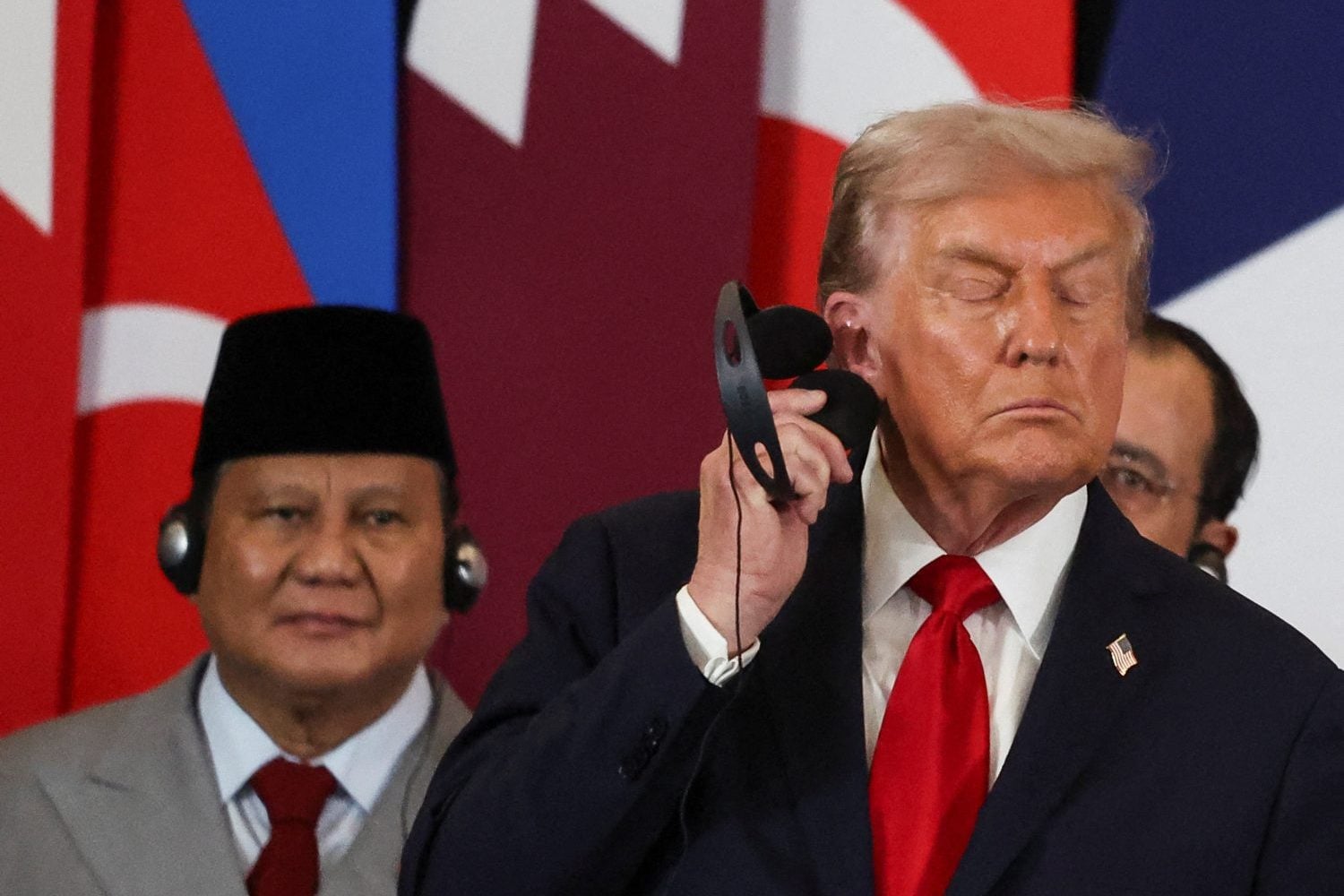
!Indonesian President Prabowo Subianto stands behind U.S. President Donald Trump
*Indonesian President Prabowo Subianto stands behind U.S. President Donald Trump*
Indonesian President Prabowo Subianto stands behind U.S. President Donald Trump at a summit on Gaza in Sharm el-Sheikh, Egypt, on Oct. 13, 2025. SUZANNE PLUNKETT/POOL/AFP via Getty Images
1. Get audio access with any FP subscription.
Subscribe Now
ALREADY AN FP SUBSCRIBER? LOGIN
October 6, 2026, 6:08 AM
Trump’s Second Term
Ongoing reports and analysis
That Indonesian President Prabowo Subianto skipped the annual inaugural proceedings of the U.N. General Assembly (UNGA) this year is not so unusual—after all, so did the leaders of China, Germany, India, Mexico, South Africa, and a host of other nations. Nonetheless, Prabowo’s absence has prompted speculation that he intended to send a message by avoiding a visit to the United States. Although Jakarta officially cited Prabowo’s need to address domestic priorities, some Indonesian experts see his absence as reflecting growing frustration with Washington following Jakarta’s attempts to align with Trump administration priorities.
At last year’s UNGA, Prabowo publicly offered considerable Indonesian resources in support of a Gaza settlement, pledging a financial contribution and potentially “20,000 or even more” peacekeepers in the territory. He also took the notable step of promising Indonesian recognition of Israel once Israel recognized a Palestinian state. In February, Prabowo participated in President Donald Trump’s inaugural Board of Peace meeting and linked Indonesia’s troops commitment to a U.S.-led stabilization force for Gaza. During the meeting, Prabowo declared that Indonesia “completely agree\[d]” with and was “fully committed” to Trump’s 20-point plan, praised Trump’s leadership, and expressed optimism that the plan could achieve “real peace.”
That Indonesian President Prabowo Subianto skipped the annual inaugural proceedings of the U.N. General Assembly (UNGA) this year is not so unusual—after all, so did the leaders of China, Germany, India, Mexico, South Africa, and a host of other nations. Nonetheless, Prabowo’s absence has prompted speculation that he intended to send a message by avoiding a visit to the United States. Although Jakarta officially cited Prabowo’s need to address domestic priorities, some Indonesian experts see his absence as reflecting growing frustration with Washington following Jakarta’s attempts to align with Trump administration priorities.
At last year’s UNGA, Prabowo publicly offered considerable Indonesian resources in support of a Gaza settlement, pledging a financial contribution and potentially “20,000 or even more” peacekeepers in the territory. He also took the notable step of promising Indonesian recognition of Israel once Israel recognized a Palestinian state. In February, Prabowo participated in President Donald Trump’s inaugural Board of Peace meeting and linked Indonesia’s troops commitment to a U.S.-led stabilization force for Gaza. During the meeting, Prabowo declared that Indonesia “completely agree\[d]” with and was “fully committed” to Trump’s 20-point plan, praised Trump’s leadership, and expressed optimism that the plan could achieve “real peace.”
At home, Prabowo’s support for Washington’s Gaza initiative was hardly cost-free. His willingness to contemplate recognizing Israel had already generated controversy in overwhelmingly pro-Palestinian Indonesia, but opposition intensified after Jakarta joined Trump’s Board of Peace and committed to deploy troops. Indonesian Muslim organizations and civil society groups questioned whether the initiative would genuinely advance Palestinian statehood or only subordinate Indonesian foreign policy to the United States and Israel. Public opinion was similarly skeptical. For example, a March 2026 survey found that 50.9 percent of respondents opposed Indonesia’s membership in the Board of Peace, while 44.9 percent opposed deploying Indonesian troops in Gaza, compared with just 33.8 percent who supported the deployment. The controversy eventually reached Prabowo’s own governing coalition as several politicians called for Indonesia to reconsider its involvement.
The Iran war has significantly worsened Prabowo’s domestic headaches over supporting Washington in the Middle East. His government suddenly found itself uncomfortably associated with a warmongering United States targeting another Muslim-majority state. In response, Prabowo froze Indonesia’s Board of Peace engagement and suspended its planned troop deployment to Gaza. Prabowo also placed explicit conditions on any reinstatement of Indonesia’s troop commitment, stressing that Indonesian forces would not disarm Hamas and would participate only with the explicit consent of Palestinian leaders—presumably including Hamas—and key Muslim-majority states, including Egypt, Pakistan, Saudi Arabia, and Turkey. In response to reports that Indonesia could
By using this website, you agree to our use of cookies. This use includes personalization of content and ads, and traffic analytics. Review our Privacy Policy for more information.
!Foreign Policy
Foreign Policy Get analysis and alerts more quickly in the mobile app.
Install
Back to Foreign Policy Magazine home page
* Latest
* Regions
+ Asia & the Pacific
+ China
+ Middle East & Africa
+ Americas
+ Europe
* Newsletters
Editors’ Picks
Evening roundup with our editors’ favorite stories of the day
!World Brief Icon
World Brief
Your guide to the most important world stories of the day
!China Brief Icon
China Brief
The latest news, analysis, and data from the country each week
Situation Report
Weekly update on what’s driving U.S. national security policy
FP Weekend
A curation of our best book reviews, deep dives, and other reads
!Africa Brief Icon
Africa Brief
Essential analysis of the stories shaping geopolitics on the continent
!South Asia Brief Icon
South Asia Brief
Weekly update on developments in India and its neighbors
The Reading List
Curated guides on geopolitics and current affairs
FP Bookshelf
A monthly guide to FP’s book reviews, excerpts, and reading recommendations
!Latin America Brief Icon
Latin America Brief
One-stop digest of politics, economics, and culture
!Southeast Asia Brief Icon
Southeast Asia Brief
A weekly dispatch with news from the region’s 11 countries
The New Geopolitics
A five-part masterclass in IR theory with Harvard Professor Stephen M. Walt
View All Newsletters
* FP Live
* Latest
* Trending:
* Brazil's election
* Canada-EU ties
Search this website
* Preferences
* My FP Feed
* Saved Articles
* Newsletters
* Magazine Archive
* Subscription Settings
* FAQs
* Log Out
Sign In
Sign In
Team access Team access
Subscribe Subscribe Team access Team access
Analysis: How Much More Trump Trouble Can Indonesia’s Prabowo Take?
*
*
* Bluesky
* X
Save
1. Create an FP account to save articles to read later.
Sign Up
ALREADY AN FP SUBSCRIBER? LOGIN
1. **Downloadable PDFs** are a benefit of an FP subscription.
Subscribe Now
ALREADY AN FP SUBSCRIBER? LOGIN
Gift
*
*
1. Gifting articles is a subscriber benefit.
Subscribe Now
ALREADY AN FP SUBSCRIBER? LOGIN
2. This article is an Insider exclusive.
Contact us at [email protected] to learn about upgrade options, unlocking the ability to gift this article.
Analysis
How Much More Trump Trouble Can Indonesia’s Prabowo Take?
Jakarta’s attempts to align with Washington face a growing backlash at home.
By **Derek Grossman**, a professor of political science and international relations at the University of Southern California.
!Indonesian President Prabowo Subianto stands behind U.S. President Donald Trump
*Indonesian President Prabowo Subianto stands behind U.S. President Donald Trump*
Indonesian President Prabowo Subianto stands behind U.S. President Donald Trump at a summit on Gaza in Sharm el-Sheikh, Egypt, on Oct. 13, 2025. SUZANNE PLUNKETT/POOL/AFP via Getty Images
1. Get audio access with any FP subscription.
Subscribe Now
ALREADY AN FP SUBSCRIBER? LOGIN
October 6, 2026, 6:08 AM
Trump’s Second Term
Ongoing reports and analysis
That Indonesian President Prabowo Subianto skipped the annual inaugural proceedings of the U.N. General Assembly (UNGA) this year is not so unusual—after all, so did the leaders of China, Germany, India, Mexico, South Africa, and a host of other nations. Nonetheless, Prabowo’s absence has prompted speculation that he intended to send a message by avoiding a visit to the United States. Although Jakarta officially cited Prabowo’s need to address domestic priorities, some Indonesian experts see his absence as reflecting growing frustration with Washington following Jakarta’s attempts to align with Trump administration priorities.
At last year’s UNGA, Prabowo publicly offered considerable Indonesian resources in support of a Gaza settlement, pledging a financial contribution and potentially “20,000 or even more” peacekeepers in the territory. He also took the notable step of promising Indonesian recognition of Israel once Israel recognized a Palestinian state. In February, Prabowo participated in President Donald Trump’s inaugural Board of Peace meeting and linked Indonesia’s troops commitment to a U.S.-led stabilization force for Gaza. During the meeting, Prabowo declared that Indonesia “completely agree\[d]” with and was “fully committed” to Trump’s 20-point plan, praised Trump’s leadership, and expressed optimism that the plan could achieve “real peace.”
That Indonesian President Prabowo Subianto skipped the annual inaugural proceedings of the U.N. General Assembly (UNGA) this year is not so unusual—after all, so did the leaders of China, Germany, India, Mexico, South Africa, and a host of other nations. Nonetheless, Prabowo’s absence has prompted speculation that he intended to send a message by avoiding a visit to the United States. Although Jakarta officially cited Prabowo’s need to address domestic priorities, some Indonesian experts see his absence as reflecting growing frustration with Washington following Jakarta’s attempts to align with Trump administration priorities.
At last year’s UNGA, Prabowo publicly offered considerable Indonesian resources in support of a Gaza settlement, pledging a financial contribution and potentially “20,000 or even more” peacekeepers in the territory. He also took the notable step of promising Indonesian recognition of Israel once Israel recognized a Palestinian state. In February, Prabowo participated in President Donald Trump’s inaugural Board of Peace meeting and linked Indonesia’s troops commitment to a U.S.-led stabilization force for Gaza. During the meeting, Prabowo declared that Indonesia “completely agree\[d]” with and was “fully committed” to Trump’s 20-point plan, praised Trump’s leadership, and expressed optimism that the plan could achieve “real peace.”
At home, Prabowo’s support for Washington’s Gaza initiative was hardly cost-free. His willingness to contemplate recognizing Israel had already generated controversy in overwhelmingly pro-Palestinian Indonesia, but opposition intensified after Jakarta joined Trump’s Board of Peace and committed to deploy troops. Indonesian Muslim organizations and civil society groups questioned whether the initiative would genuinely advance Palestinian statehood or only subordinate Indonesian foreign policy to the United States and Israel. Public opinion was similarly skeptical. For example, a March 2026 survey found that 50.9 percent of respondents opposed Indonesia’s membership in the Board of Peace, while 44.9 percent opposed deploying Indonesian troops in Gaza, compared with just 33.8 percent who supported the deployment. The controversy eventually reached Prabowo’s own governing coalition as several politicians called for Indonesia to reconsider its involvement.
The Iran war has significantly worsened Prabowo’s domestic headaches over supporting Washington in the Middle East. His government suddenly found itself uncomfortably associated with a warmongering United States targeting another Muslim-majority state. In response, Prabowo froze Indonesia’s Board of Peace engagement and suspended its planned troop deployment to Gaza. Prabowo also placed explicit conditions on any reinstatement of Indonesia’s troop commitment, stressing that Indonesian forces would not disarm Hamas and would participate only with the explicit consent of Palestinian leaders—presumably including Hamas—and key Muslim-majority states, including Egypt, Pakistan, Saudi Arabia, and Turkey. In response to reports that Indonesia could
🔗 Share Article
Tags:#إندونيسيا#برابوو سوبيانتو#ترامب#السياسة الخارجية#غزة#الشرق الأوسط
Source: Foreign Policy
For Context
Related reads from the same topic or latest developments