BEIRUT — The United States ambassador to the United Nations, Mike Waltz, on a visit to Lebanon, declared Monday after a meeting with Parliament Speaker Nabih Berri, an ally of Hezbollah, that the group "must disarm voluntarily," emphasizing that there cannot be "two armies" in the country.
"I say to Hezbollah that a country cannot function with two armies, and we hope it will hand over its weapons voluntarily," the U.S. diplomat said from Ain al-Tineh. While the envoy visited Lebanon to discuss the replacement of the U.N. peacekeeping force at the end of its mandate in late December — an issue raising fears of a security vacuum in the south — he noted that the U.N. force had "cost a lot of money over the past twenty years" and that something needed to be "done about it."
He said he hoped that "U.N. Resolution 1701 will continue to be implemented, with a few modifications." Adopted during the July 2006 war to end the 33-day war between Hezbollah and Israel, this resolution called for the withdrawal of Israeli forces and the deployment of the Lebanese Army, within a context of disarmament and the deployment of a strengthened UNIFIL. Waltz finally praised "the efforts of every Lebanese soldier" and conveyed Washington's desire to "provide support to Lebanese security institutions."
Parliament Speaker Nabih Berri told an-Nahar that the meeting had been “good” and that he had reaffirmed Lebanon’s commitment to UN Security Council Resolution 1701 to the US envoy.
“The framework agreement is out of the question for me,” Berri said. He added that Israel continues to violate international resolutions, carry out attacks, refuse to withdraw from occupied towns and prevent residents from returning to their land. He said he had brought these issues to the US ambassador’s attention.
Asked about reports of possible US sanctions against Lebanese figures considered close to Hezbollah, Berri said: “I have been hearing about these sanctions for 12 years, and we act only in the interest of our country.”
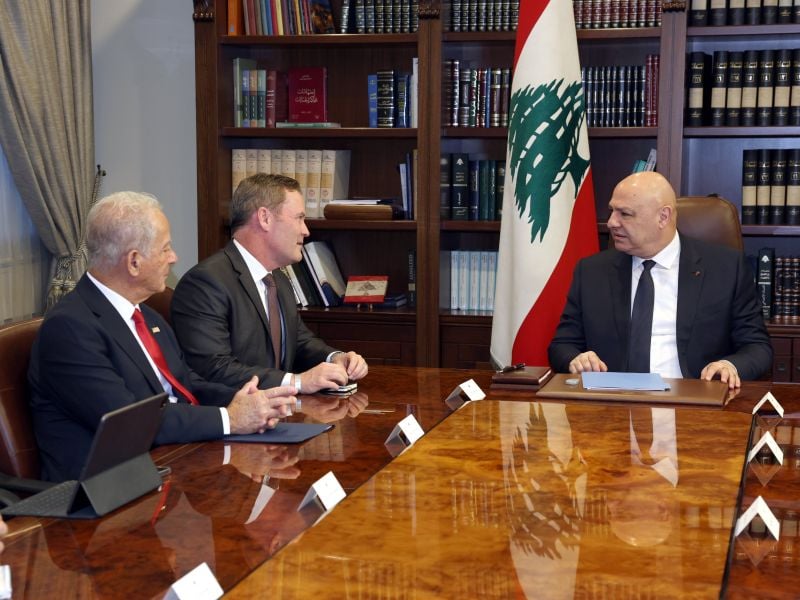
Earlier in the day, Waltz began his tour at the Baabda Presidential Palace, where he met with President Joseph Aoun, in the presence of U.S. Ambassador to Lebanon Michel Issa, and Simon Karam, head of the Lebanese delegation responsible for direct negotiations with Israel. According to the Lebanese presidency, discussions focused on recent developments in Lebanon and the region, as well as the period following UNIFIL's mandate expiration. Talks also addressed the situation in southern Lebanon, where, according to Baabda, Israel "continues its attacks and does not respect the provisions of the framework agreement."
Salam calls for a timetable for Israeli withdrawal and a state monopoly on arms
The U.S. diplomat finally visited the Grand Serail to meet with Prime Minister Nawaf Salam, who called for the revival of the tripartite framework agreement between Lebanon, Israel, and the United States and for the establishment of a “clear timetable” for its implementation. Signed in Washington at the end of June, it provides for a gradual withdrawal of the Israeli army from the occupied areas. So far, only a "pilot zone" in Zawtar Gharbieh, in the Nabatieh district, has been evacuated.
The Prime Minister thus emphasized "the need to translate the principles of reciprocity and step-by-step progress on which the agreement is based into concrete measures and tangible results on the ground." According to Salam, a “clear timetable” must ensure “parallel progress on two fronts”: that of Israel’s complete withdrawal from Lebanese territory and that of extending the state’s authority across the whole country, with the establishment of its monopoly on arms. The head of government also called for the establishment of “a reliable mechanism to verify compliance with the commitments of both parties.” This call comes as Tel Aviv and Washington are pressing Beirut to disarm Hezbollah, which categorically rejects this prospect and is working to rebuild its military capabilities.
The Prime Minister emphasized “the importance of the United States’ role in reviving the agreement, in order to ensure an end to Israeli aggression and a complete withdrawal,” stating that “the aim is to reach a lasting solution that restores Lebanon’s full sovereignty, rather than merely managing the conflict.” With regard to the post-UNIFIL period, Salam reaffirmed “the need to maintain an international presence in the South under a Security Council mandate, with tasks including monitoring, reporting, coordination, and communication, as well as support for the Lebanese Army to enable it to fulfill its responsibilities and for the State to extend its authority through it, whilst maintaining Resolution 1701 as the fundamental reference point for international arrangements in southern Lebanon.”
When asked by an MTV journalist at a press conference about not having met the Commander-in-Chief of the Lebanese Army, Rodolph Haykal, Mike Waltz replied that he had had to make choices due to a lack of time. “We considered it essential to prioritize meetings with the various U.N. bodies and political leaders,” said the U.S. ambassador, at a time when the Lebanese Army is coming under fire for its approach, which is seen as too conciliatory, regarding the disarmament of Hezbollah.
In a statement released Sunday, the U.S. Embassy in Beirut said that Waltz would discuss with Lebanese authorities "the establishment of a sovereign Lebanon, free from the influence of Hezbollah and Iran." The diplomat, who will continue his tour in Morocco, will also "discuss American support for the implementation" of the framework agreement signed at the end of June between Lebanon and Israel under Washington's auspices, while direct political talks between the two countries have been at a standstill since last August.
'Lebanon has a real opportunity'
On his X account, Waltz stated that "Lebanon has a real opportunity to build a sovereign and secure future" and that "the United States is here to support this effort and clearly specify the necessary conditions for its achievement." "That's why I am here, on the ground, so I can hear directly from the stakeholders about the transition and the next steps regarding the U.N. forces and aid agencies," he added.
This visit comes as the Lebanese Army is under scrutiny for its approach, seen as too conciliatory on the issue of Hezbollah's disarmament, which is stipulated in the agreement alongside a "gradual" withdrawal of the Israeli army from the country's south, at a time when Israeli attacks continue daily across southern Lebanon.
Mike Waltz from Beirut: Hezbollah 'must disarm voluntarily' - L'Orient Today
During his visit to Lebanon, U.S. Ambassador to the United Nations Mike Waltz said Hezbollah must disarm voluntarily, stressing that the country cannot function with two armies. As UNIFIL nears the end of its mandate, Prime Minister Nawaf Salam has called for a clear timetable for Israeli withdrawal and for the state to hold a monopoly on arms.
Cross Lines newsroom
Share this article
#مايك والتز#حزب الله#نزع السلاح#اليونيفيل#القرار 1701#نواف سلام
Original source: أخبار لبنان