Ebola Crisis: Historic Outbreak in Congo Hits Six-Month Mark
By using this website, you agree to our use of cookies. This use includes personalization of content and ads, and traffic analytics. Review our Privacy Policy for more information.
Foreign Policy Get analysis and alerts more quickly in the mobile app.
Install
Back to Foreign Policy Magazine home page
Evening roundup with our editors’ favorite stories of the day
World Brief
Your guide to the most important world stories of the day
China Brief
The latest news, analysis, and data from the country each week
Situation Report
Weekly update on what’s driving U.S. national security policy
FP Weekend
A curation of our best book reviews, deep dives, and other reads
Africa Brief
Essential analysis of the stories shaping geopolitics on the continent
South Asia Brief
Weekly update on developments in India and its neighbors
The Reading List
Curated guides on geopolitics and current affairs
FP Bookshelf
A monthly guide to FP’s book reviews, excerpts, and reading recommendations
Latin America Brief
One-stop digest of politics, economics, and culture
Southeast Asia Brief
A weekly dispatch with news from the region’s 11 countries
The New Geopolitics
A five-part masterclass in IR theory with Harvard Professor Stephen M. Walt
View All Newsletters
Give a gift Give a gift
Subscribe Subscribe Give a gift Give a gift
Africa Brief: Congo’s Escalating Ebola Crisis
1. Create an FP account to save articles to read later.
Sign Up
ALREADY AN FP SUBSCRIBER? LOGIN
PDF
1. **Downloadable PDFs** are a benefit of an FP subscription.
ALREADY AN FP SUBSCRIBER? LOGIN
Gift
1. Gifting articles is a subscriber benefit.
ALREADY AN FP SUBSCRIBER? LOGIN
2. This article is an Insider exclusive.
Contact us at [email protected] to learn about upgrade options, unlocking the ability to gift this article.
Africa Brief
Lagos-based Nosmot Gbadamosi reports from across Africa on what’s driving policy, economics, and culture in the world’s fastest-growing and youngest continent. Sign up for the latest news, expert analysis, and data insights. Delivered Wednesday.
Congo’s Escalating Ebola Crisis
Six months in, the “out of control” outbreak shows no sign of slowing down.
*Gbadamosi-Nosmot-foreign-policy-columnist10*
*Nosmot Gbadamosi*
By **Nosmot Gbadamosi**, a multimedia journalist and the writer of *Foreign Policy*’s weekly Africa Brief.
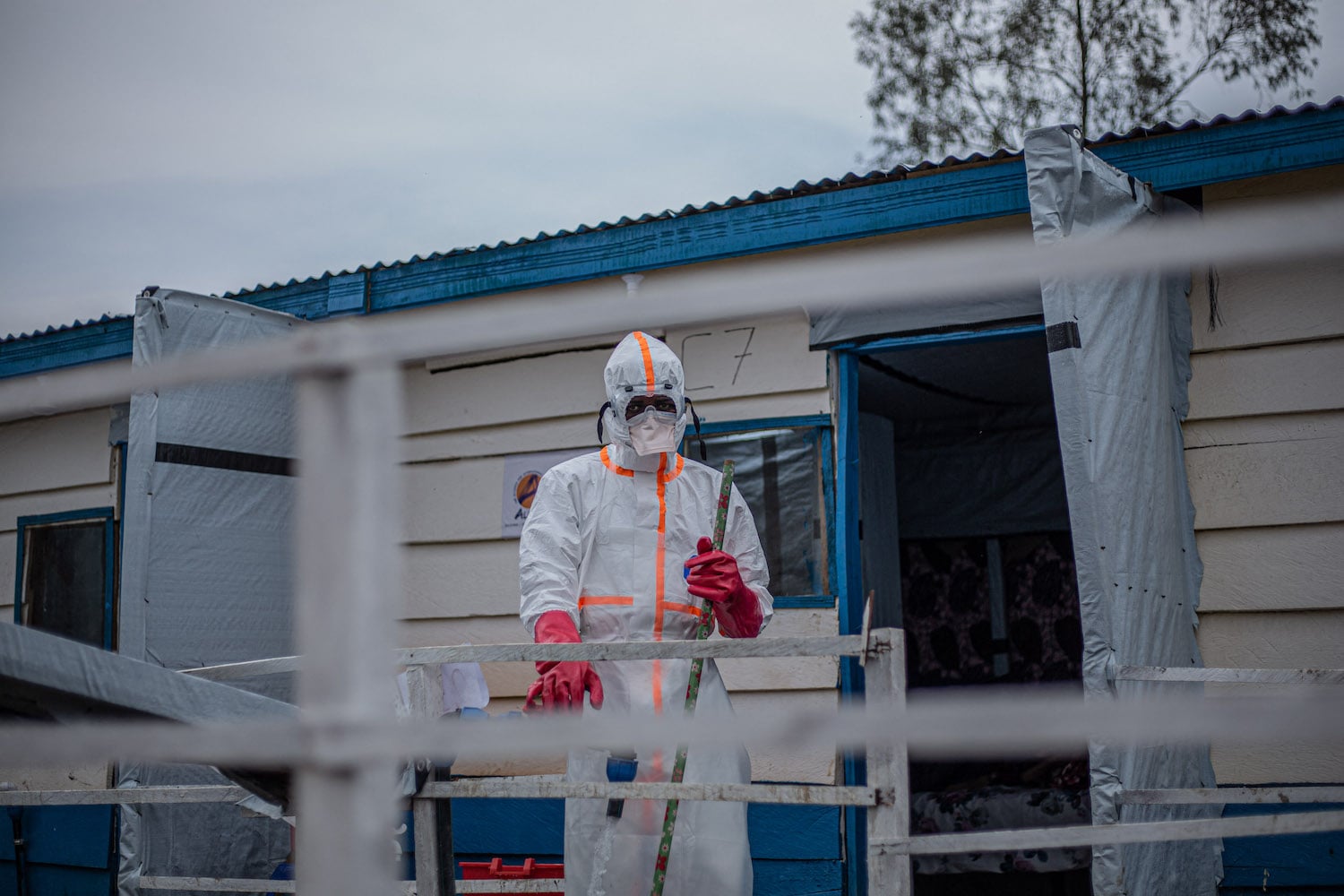
*A person wearing a full white protective suit with orange tape, red rubber gloves, goggles, and a face mask stands behind a white metal railing in front of a small building with blue trim and gray tarps hanging over the doorway.*
A hygienist wearing personal protective equipment begins cleaning and disinfection operations at the Rwampara Ebola Treatment Centre in Bunia, Democratic Republic of the Congo, on July 13. Benediction Murhabazi/AFP via Getty Images
My FP: Follow topics and authors to get straight to what you like. Exclusively for FP subscribers. Subscribe Now | Log In
Welcome to *Foreign Policy*’s Africa Brief.
The highlights this week: Health leaders issue new warnings about the **Ebola outbreak** in the Democratic Republic of the Congo, voters choose continuity in **Cape Verde’s** **presidential election**, and the board of an **African literary prize** exonerates a winner accused of using artificial intelligence.
Sign up to receive Africa Brief in your inbox every Wednesday.
‘A Collective Failure’
Six months into the fastest-growing Ebola outbreak in history, the rare Bundibugyo variant of the virus shows no sign of slowing down in the Democratic Republic of the Congo. It is exacerbated by an underfunded health system and armed conflict in eastern provinces, where global mining projects have led to increased disease transmission.
The outbreak is “still serious, and is still not under control,” said Jean Kaseya, the director-general of the Africa Centres for Disease Control and Prevention, or Africa CDC. The death toll since the outbreak began in May has passed 5,500 people, with more than 11,000 people infected, according to Congolese government figures released last week.
Infections are now spreading at double the rate as when the outbreak began, according to Kaseya. More than 80 percent of new cases are emerging outside of known contact lists, and more than 65 percent of deaths have occurred outside of healthcare facilities, he added.
Kaseya called the lack of coordination between Congo’s government and foreign donors “a collective failure,” urging donors to release $1.6 billion in pledged aid.
International donors have disbursed more than $962 million to organizations that are implementing Congo’s Ebola response. But around $700 million of that sum was unaccounted for as of last month, according to Kaseya. The Africa CDC said that it was too early to attribute this discrepancy to embezzlement, but an investigation is underway.
In 2020, Congo’s former health minister was convicted of embezzling more than $400,000 from funds intended to fight Ebola during the 2018-2020 outbreak.
Meanwhile, Congolese health workers—who have not been paid for months—have gone on strike. Médecins Sans Frontières (MSF) warned last week that ambulances had run out of fuel, staff were untrained, and that the Congolese government and United Nations agencies needed to “strengthen oversight and accountability.” MSF has called the outbreak “out of control.”
For Congo, dealing with the Ebola crisis requires tackling systemic issues beyond healthcare, including poverty, conflict, and inefficient governance. But Congolese President Félix Tshisekedi appears to be focused on cementing his grip on power. On Nov. 9, he signed a law that critics say could grant him a third term in office.
Congo’s 2006 constitution allows a maximum of two presidential terms and explicitly prevents parliament from changing those rules under any circumstance. The new law lowers the threshold for holding national referendums and permits constitutional overhauls through referendums “in case of absolute necessity.”
Tshisekedi became president in January 2019; his second term ends in 2028. He has said that he is not seeking a third term but would serve one if given a mandate by voters. “I have not asked for a third term, but I tell you this: If the people want me to have a third term, I will accept,” Tshisekedi said in May.
On Nov. 1, the Front for the Refoundation of the Nation, a new rebel alliance l
Congo’s Escalating Ebola Crisis
Six months into the fastest-growing Ebola outbreak in history, the Democratic Republic of the Congo shows no sign of containing the virus, as an underfunded health system and armed conflict deepen the crisis. The emergency coincides with allegations of mismanaged response funds and a new law that critics say could pave the way for a third presidential term for President Félix Tshisekedi.
Cross Lines newsroom
Share this article
#إيبولا#الكونغو الديمقراطية#أفريقيا#الصحة العامة#تشيسيكيدي#أفريقيا CDC
Original source: Foreign Policy