Live Updates: Rescuers Scour Himalayan Valleys for Survivors After Deadly Flood
New York Times
N
New York Times
Original Source
Hundreds killed and over 1,400 missing after a massive glacier collapse triggered a devastating flash flood sweeping through Nepal and Tibet. Rescue teams scour remote Himalayan valleys amid widespread destruction as survivors recount harrowing accounts of families swept away in minutes.
Nepal Flash Floods Live Updates: Hundreds Dead and More Than 1,000 Missing - The New York Times
Skip to contentSkip to site index
Thursday, August 27, 2026
Today’s Paper
* Home
* + U.S.
+ International
+ Canada
+ Español
+ 中文
Floods in
Nepal and Tibet
* Updates
* What to Know
* Path of Devastation
* Survivors’ Accounts
* Missing Foreigners
* Photos and Videos
SKIP ADVERTISEMENT
Current time in
Nepal
12:39 a.m. Aug. 28
Live
Updated
Aug. 27, 2026, 2:54 p.m. ET
3 minutes ago
Live Updates: Rescuers Scour Remote Valleys, as Survivors Describe Families Swept Away
Officials said hundreds were killed in Nepal and Tibet in a massive flood. Stunned witnesses described a torrent of debris and water carrying away villages in minutes.
*
*
*
Video
Anguished Families in Nepal Await Updates About Flood Victims
*Relatives of flood victims gathered outside a hospital in Nepal’s capital, Kathmandu, looking for their loved ones. More than 1,000 people were still missing on Thursday, the authorities said.
Credit
Credit...
Sabrina Dangol/Reuters*
See more of our coverage in your search results. Encuentra más de nuestra cobertura en los resultados de búsqueda. Add The New York Times on Google Agrega The New York Times en Google
Latest
Updated
Aug. 27, 2026, 2:54 p.m. ET
3 minutes ago
Anupreeta DasBinod Ghimire and Mujib Mashal
Here’s the latest.
Emergency workers and helicopters scoured steep Himalayan valleys on Thursday in a desperate search for survivors after a torrent of water, mud and ice killed hundreds — and perhaps many more — as it swept through a remote river valley that runs through Tibet and Nepal. More than 1,400 people were still missing.
A New York Times reporter and photographer who traveled to the region with rescuers found miles of devastation and distraught residents unsure if their families and neighbors would ever be found. In one Nepalese village, a man described what sounded like a thunderclap before a wave of muddy water crashed into his home, carrying away his wife and two daughters. “They all died and I lived,” he said, adding that he still clung to a slim hope they had somehow survived.
The floodcaught many of its victims without warning as it tore through a sliver of the Tibet region of China and then barreled into Nepal, a wall of water surging down the Bhotekoshi and Trishuli rivers. Its speed and force destroyed roads and bridges, toppled buildings and severed communications. Survivors described rapid floodwaters laden with debris that shattered houses, sweeping the occupants away and swallowing up people as they fled.
Scientists said the flood was probably unleashed by a massive rock landslide that coincided with the collapse of a glacier high in the mountains near the border on Wednesday morning. Warming temperatures caused by climate change may have destabilized the rock face and precipitated the disaster, scientists said, though they added it was too early to determine a precise cause.
Images captured the flood’s terrifying speed and force, and Times journalists traveling with the Nepali military surveyed the aftermath. One highway, near the Bhotekoshi River, had mostly disappeared. Scars on hillsides showed that in some placesthe river had risen as high as 650 feet during the flood.
Nepali officials reported at least 389 deaths, while the authorities in China, where far less information was being released, reported three in Tibet. The toll was expected to rise.
In Nepal, approximately 900 people, including about 500 foreign visitors, were unaccounted for as of Thursday morning, the country’s disaster management authority said. The missing foreigners included at least 288 from India, as well as travelers from the United States, Australia, Britain, Canada and Malaysia.The region is a major destination for trekkers, pilgrims and other tourists because of it’s beauty and high-altitude lakes, some of which are revered as sacred sites.
In China, at least 558 people were missing in Tibet’s Gyirong County, including 260 foreigners, Chinese state media reported. China’s foreign ministry said that 100 Chinese citizens were missing in Nepal.
Here’s what else we’re covering:
* **Warning System:** Nepal’s early flood warning system relied on a network of river gauges that was ill-equipped to sufficiently alert locals of the deadly wall of water that swept through the country’s valleys on Wednesday, according to scientists and disaster response researchers. Read more ›
* **Survivors:** Those caught in the destruction described fast-moving torrents that wiped out entire neighborhoods. Read more ›
* **Global Warming:** Climate change is heating up the Himalayas and supercharging the risk of disasters like the deadly flash flooding in Nepal and Tibet, though scientists are still determining the exact cause of this week’s catastrophe. Read more
Aug. 27, 2026, 2:23 p.m. ET
34 minutes ago
Anushka Patil
Chinese authorities warned on Thursday the landslide in Nepal that triggered a devastating flash floods had dammed streams, creating a large lake that is at risk of breaking through and causing more flooding. The new flooding would affect the Gyirong border crossing, which was entirely engulfed by water on Wednesday. The dam is currently holding back an estimated 70 million cubic feet of water, with much more expected to be added by rainfall over the next three days, China’s Ministry of Water Resources said.
Aug. 27, 2026, 1:45 p.m. ET
1 hour ago
Erica L. Green
White House reporter
President Trump was asked at an Oval Office news conference about Americans who might have gone missing after the deadly floods and mudslides in Nepal. He said that there were between 50 and 60 U.S. citizens in Nepal when the disaster happened. “We are sending aid, and we’ve spoken to the leadership, and we let them know anything they want will happen,” he said.
Image
*Credit...
Demetrius Freeman for The New York Times*
CHINA
Aftermath of
avalanche visible
on satellite
TIBET
Himalayas
Likely
avalanche
site
Gyirong
border
crossing
Bhote Koshi
River
NEPAL
Syapru
Besi
Trishuli River
Area of
flooding
Trishuli
Bazar
Farthest verified
destruction
Kathmandu
10 Miles
CHINA
Aftermath of
avalanche visible
on satellite
TIBET
Himalayas
Likely
avalanche
site
Gyirong
border
crossing
Bhotekoshi
River
Syapru
Besi
NEPAL
Area of
flooding
Trishuli River
Trishuli
Bazar
Farthest verified
destruction
10 Miles
Kathmandu
CHINA
Likely
avalanche
site
TIBET
Gyirong
border crossing
Syapru
Besi
Area of
flooding
NEPAL
Trishuli River
10 Miles
Trishuli
Bazar
Farthest verified
destruction
Kathmandu
Satellite image by Copernicus and Landsat via Google.
Pablo Robles and Leanne Abraham/The New York Times
Aug. 27, 2026, 1:18 p.m. ET
2 hours ago
Maxine Joselow and Leo Sands
Maxine Joselow reported from Washington, and Leo Sands from London.
Climate change raises the risk of deadly disasters.
Image
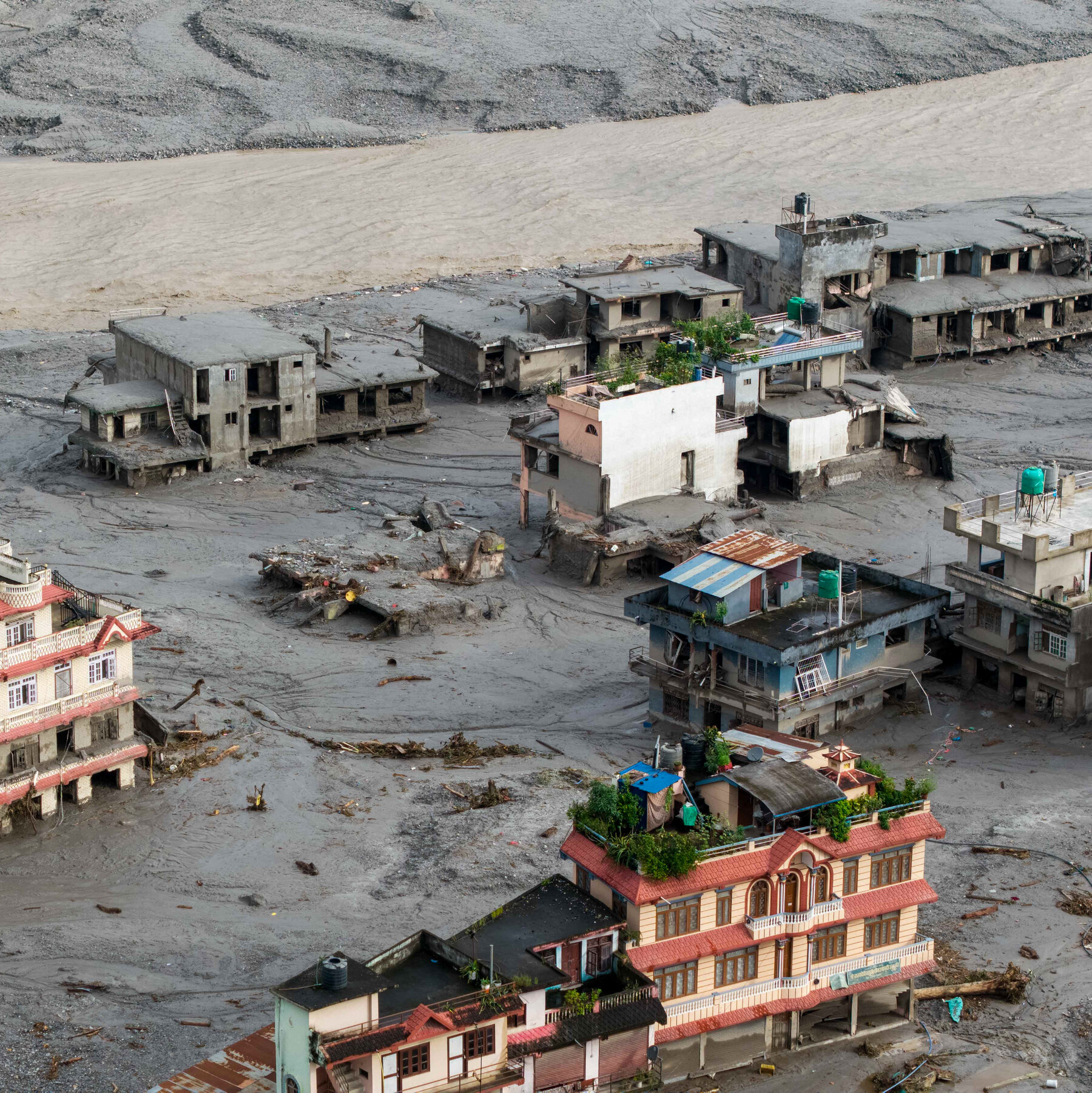
!Mud covers a village, seen from above.
*A mud-deluged area in Trishuli, Nepal, on Thursday. Chunks of glacial ice, mud and rock surged down a river Wednesday, overwhelming the area.
Credit...
Navesh Chitrakar/Reuters*
Climate change is heating up the Himalayas and supercharging the risk of disasters like the deadly flash flooding in Nepal and Tibet, though scientists are still determining the exact cause of this week’s catastrophe.
A group of glaciologists and geologists said on Thursday that the flooding was probably unleashed after an enormous chunk of bedrock collapsed underneath a glacier, triggering a landslide high in the mountains. At the same time, a chunk of ice snapped off the glacier itself and cascaded thousands of feet to the valley below, the scientists said.
As humans warm the planet by burning fossil fuels, the Himalayas are losing their permafrost, a mixture of soil, rocks and organic matter that has remained frozen for thousands of years. The tha
Skip to contentSkip to site index
Thursday, August 27, 2026
Today’s Paper
* Home
* + U.S.
+ International
+ Canada
+ Español
+ 中文
Floods in
Nepal and Tibet
* Updates
* What to Know
* Path of Devastation
* Survivors’ Accounts
* Missing Foreigners
* Photos and Videos
SKIP ADVERTISEMENT
Current time in
Nepal
12:39 a.m. Aug. 28
Live
Updated
Aug. 27, 2026, 2:54 p.m. ET
3 minutes ago
Live Updates: Rescuers Scour Remote Valleys, as Survivors Describe Families Swept Away
Officials said hundreds were killed in Nepal and Tibet in a massive flood. Stunned witnesses described a torrent of debris and water carrying away villages in minutes.
*
*
*
Video
Anguished Families in Nepal Await Updates About Flood Victims
*Relatives of flood victims gathered outside a hospital in Nepal’s capital, Kathmandu, looking for their loved ones. More than 1,000 people were still missing on Thursday, the authorities said.
Credit
Credit...
Sabrina Dangol/Reuters*
See more of our coverage in your search results. Encuentra más de nuestra cobertura en los resultados de búsqueda. Add The New York Times on Google Agrega The New York Times en Google
Latest
Updated
Aug. 27, 2026, 2:54 p.m. ET
3 minutes ago
Anupreeta DasBinod Ghimire and Mujib Mashal
Here’s the latest.
Emergency workers and helicopters scoured steep Himalayan valleys on Thursday in a desperate search for survivors after a torrent of water, mud and ice killed hundreds — and perhaps many more — as it swept through a remote river valley that runs through Tibet and Nepal. More than 1,400 people were still missing.
A New York Times reporter and photographer who traveled to the region with rescuers found miles of devastation and distraught residents unsure if their families and neighbors would ever be found. In one Nepalese village, a man described what sounded like a thunderclap before a wave of muddy water crashed into his home, carrying away his wife and two daughters. “They all died and I lived,” he said, adding that he still clung to a slim hope they had somehow survived.
The floodcaught many of its victims without warning as it tore through a sliver of the Tibet region of China and then barreled into Nepal, a wall of water surging down the Bhotekoshi and Trishuli rivers. Its speed and force destroyed roads and bridges, toppled buildings and severed communications. Survivors described rapid floodwaters laden with debris that shattered houses, sweeping the occupants away and swallowing up people as they fled.
Scientists said the flood was probably unleashed by a massive rock landslide that coincided with the collapse of a glacier high in the mountains near the border on Wednesday morning. Warming temperatures caused by climate change may have destabilized the rock face and precipitated the disaster, scientists said, though they added it was too early to determine a precise cause.
Images captured the flood’s terrifying speed and force, and Times journalists traveling with the Nepali military surveyed the aftermath. One highway, near the Bhotekoshi River, had mostly disappeared. Scars on hillsides showed that in some placesthe river had risen as high as 650 feet during the flood.
Nepali officials reported at least 389 deaths, while the authorities in China, where far less information was being released, reported three in Tibet. The toll was expected to rise.
In Nepal, approximately 900 people, including about 500 foreign visitors, were unaccounted for as of Thursday morning, the country’s disaster management authority said. The missing foreigners included at least 288 from India, as well as travelers from the United States, Australia, Britain, Canada and Malaysia.The region is a major destination for trekkers, pilgrims and other tourists because of it’s beauty and high-altitude lakes, some of which are revered as sacred sites.
In China, at least 558 people were missing in Tibet’s Gyirong County, including 260 foreigners, Chinese state media reported. China’s foreign ministry said that 100 Chinese citizens were missing in Nepal.
Here’s what else we’re covering:
* **Warning System:** Nepal’s early flood warning system relied on a network of river gauges that was ill-equipped to sufficiently alert locals of the deadly wall of water that swept through the country’s valleys on Wednesday, according to scientists and disaster response researchers. Read more ›
* **Survivors:** Those caught in the destruction described fast-moving torrents that wiped out entire neighborhoods. Read more ›
* **Global Warming:** Climate change is heating up the Himalayas and supercharging the risk of disasters like the deadly flash flooding in Nepal and Tibet, though scientists are still determining the exact cause of this week’s catastrophe. Read more
Aug. 27, 2026, 2:23 p.m. ET
34 minutes ago
Anushka Patil
Chinese authorities warned on Thursday the landslide in Nepal that triggered a devastating flash floods had dammed streams, creating a large lake that is at risk of breaking through and causing more flooding. The new flooding would affect the Gyirong border crossing, which was entirely engulfed by water on Wednesday. The dam is currently holding back an estimated 70 million cubic feet of water, with much more expected to be added by rainfall over the next three days, China’s Ministry of Water Resources said.
Aug. 27, 2026, 1:45 p.m. ET
1 hour ago
Erica L. Green
White House reporter
President Trump was asked at an Oval Office news conference about Americans who might have gone missing after the deadly floods and mudslides in Nepal. He said that there were between 50 and 60 U.S. citizens in Nepal when the disaster happened. “We are sending aid, and we’ve spoken to the leadership, and we let them know anything they want will happen,” he said.
Image
*Credit...
Demetrius Freeman for The New York Times*
CHINA
Aftermath of
avalanche visible
on satellite
TIBET
Himalayas
Likely
avalanche
site
Gyirong
border
crossing
Bhote Koshi
River
NEPAL
Syapru
Besi
Trishuli River
Area of
flooding
Trishuli
Bazar
Farthest verified
destruction
Kathmandu
10 Miles
CHINA
Aftermath of
avalanche visible
on satellite
TIBET
Himalayas
Likely
avalanche
site
Gyirong
border
crossing
Bhotekoshi
River
Syapru
Besi
NEPAL
Area of
flooding
Trishuli River
Trishuli
Bazar
Farthest verified
destruction
10 Miles
Kathmandu
CHINA
Likely
avalanche
site
TIBET
Gyirong
border crossing
Syapru
Besi
Area of
flooding
NEPAL
Trishuli River
10 Miles
Trishuli
Bazar
Farthest verified
destruction
Kathmandu
Satellite image by Copernicus and Landsat via Google.
Pablo Robles and Leanne Abraham/The New York Times
Aug. 27, 2026, 1:18 p.m. ET
2 hours ago
Maxine Joselow and Leo Sands
Maxine Joselow reported from Washington, and Leo Sands from London.
Climate change raises the risk of deadly disasters.
Image
!Mud covers a village, seen from above.
*A mud-deluged area in Trishuli, Nepal, on Thursday. Chunks of glacial ice, mud and rock surged down a river Wednesday, overwhelming the area.
Credit...
Navesh Chitrakar/Reuters*
Climate change is heating up the Himalayas and supercharging the risk of disasters like the deadly flash flooding in Nepal and Tibet, though scientists are still determining the exact cause of this week’s catastrophe.
A group of glaciologists and geologists said on Thursday that the flooding was probably unleashed after an enormous chunk of bedrock collapsed underneath a glacier, triggering a landslide high in the mountains. At the same time, a chunk of ice snapped off the glacier itself and cascaded thousands of feet to the valley below, the scientists said.
As humans warm the planet by burning fossil fuels, the Himalayas are losing their permafrost, a mixture of soil, rocks and organic matter that has remained frozen for thousands of years. The tha
🔗 Share Article
Tags:#نيبال#فيضانات#الهيمالايا#تغير المناخ#كوارث طبيعية#عمليات إنقاذ
Source: New York Times
For Context
Related reads from the same topic or latest developments