What’s the Matter With Eastern Germany?
Foreign Policy

Foreign Policy
Original Source
German historians attribute the far-right Alternative for Germany's dominance in the east to legacies of Cold War division and reunification terms, yet deeply disagree over root causes. Their disputes reveal fundamental divisions in understanding what actually transpired during communist rule and the post-1989 transition years.
The AfD's Success Suggests Something Went Wrong With East Germany's Reunification
!Foreign Policy
Foreign Policy
Get analysis and alerts more quickly in the mobile app.
Install
Back to Foreign Policy Magazine home page
* Latest
* Regions
+ Asia & the Pacific
+ China
+ Middle East & Africa
+ Americas
+ Europe
* Newsletters
Editors’ Picks
Evening roundup with our editors’ favorite stories of the day
!World Brief Icon
World Brief
Your guide to the most important world stories of the day
!China Brief Icon
China Brief
The latest news, analysis, and data from the country each week
Situation Report
Weekly update on what’s driving U.S. national security policy
FP Weekend
A curation of our best book reviews, deep dives, and other reads
!Africa Brief Icon
Africa Brief
Essential analysis of the stories shaping geopolitics on the continent
!South Asia Brief Icon
South Asia Brief
Weekly update on developments in India and its neighbors
The Reading List
Curated guides on geopolitics and current affairs
FP Bookshelf
A monthly guide to FP’s book reviews, excerpts, and reading recommendations
!Latin America Brief Icon
Latin America Brief
One-stop digest of politics, economics, and culture
!Southeast Asia Brief Icon
Southeast Asia Brief
A weekly dispatch with news from the region’s 11 countries
The New Geopolitics
A five-part masterclass in IR theory with Harvard Professor Stephen M. Walt
View All Newsletters
* FP Live
* Latest
* Trending:
* 25 years after 9/11
* Germany elections
Search this website
* Preferences
* My FP Feed
* Saved Articles
* Newsletters
* Magazine Archive
* Subscription Settings
* FAQs
* Log Out
Sign In
Sign In
Partner with FP at UNGA81 Partner with FP at UNGA81
Subscribe SubscribePartner with FP at UNGA81 Partner with FP at UNGA81
Analysis:
What’s the Matter With Eastern Germany?
*
*
* Facebook
* Bluesky
* X
* LinkedIn
* WhatsApp
* Reddit
Save
1. Create an FP account to save articles to read later.
Sign Up
ALREADY AN FP SUBSCRIBER? LOGIN
PDF
1. **Downloadable PDFs** are a benefit of an FP subscription.
Subscribe Now
ALREADY AN FP SUBSCRIBER? LOGIN
Gift
*
*
* WhatsApp
1. Gifting articles is a subscriber benefit.
Subscribe Now
ALREADY AN FP SUBSCRIBER? LOGIN
2. This article is an Insider exclusive.
Contact us at [email protected] to learn about upgrade options, unlocking the ability to gift this article.
Analysis
What’s the Matter With Eastern Germany?
German far-right populism traces back to reunification—but historians disagree about why.
By **Paul Hockenos**, a Berlin-based journalist.
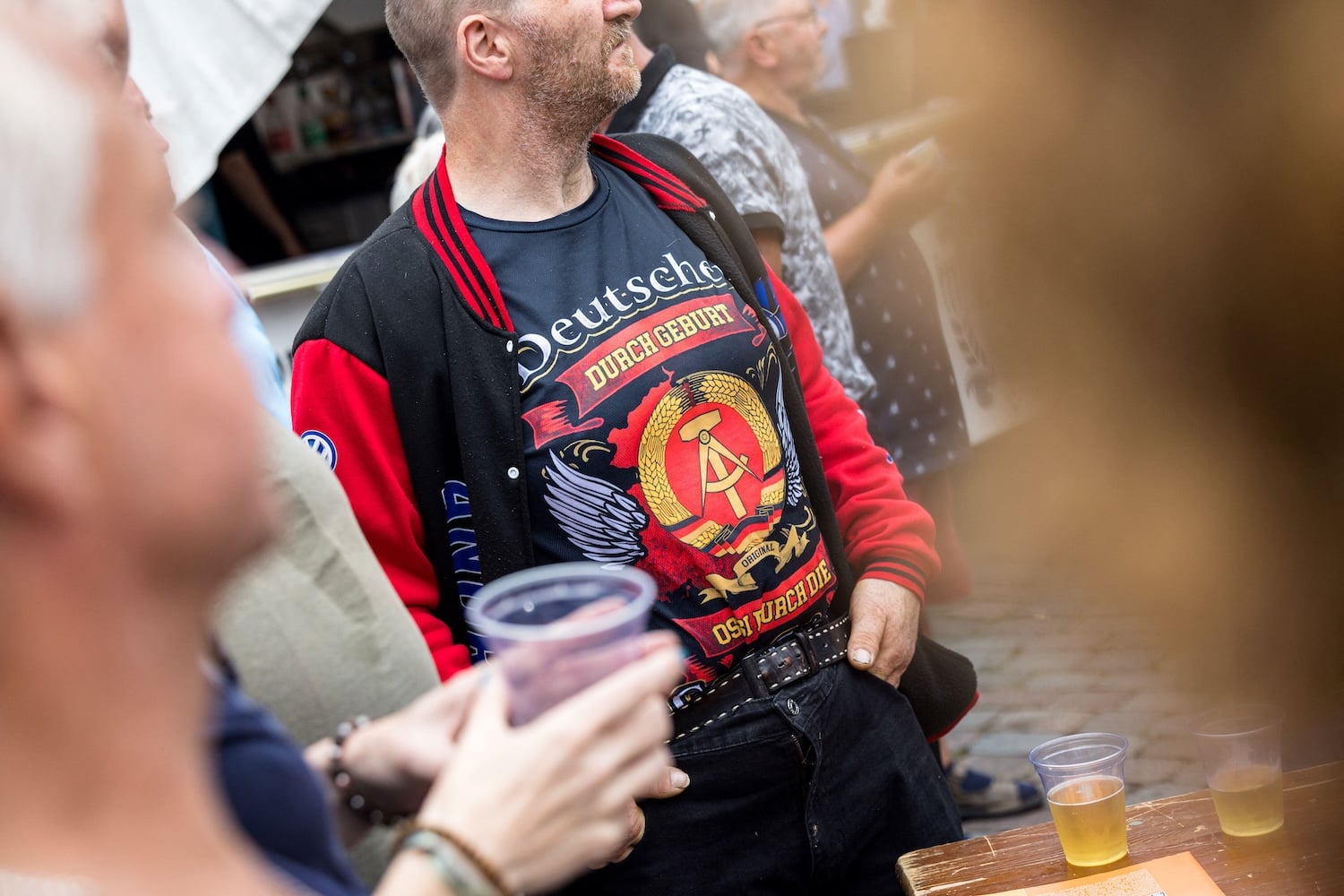
!A participant wears a t-shirt with the lettering 'German by birth' and the emblem of former German Democratic Republic GDR during an election campaign event of Germany's far-right Alternative for Germany (AfD) party in Apolda, eastern Germany on August 18, 2024, ahead of the state election in the eastern German state of Thuringia. The state election in Thuringia will be held on September 1, 2024.
*A participant wears a t-shirt with the lettering 'German by birth' and the emblem of former German Democratic Republic GDR during an election campaign event of Germany's far-right Alternative for Germany (AfD) party in Apolda, eastern Germany on August 18, 2024, ahead of the state election in the eastern German state of Thuringia. The state election in Thuringia will be held on September 1, 2024.*
A participant wears a t-shirt with the lettering 'German by birth' and the emblem of former German Democratic Republic GDR during an election campaign event of Germany's far-right Alternative for Germany (AfD) party in Apolda, eastern Germany on August 18, 2024, ahead of the state election in the eastern German state of Thuringia. The state election in Thuringia will be held on September 1, 2024. JENS SCHLUETER / AFP
September 17, 2026, 7:57 AM
There’s a widespread consensus in Germany that the far-right Alternative for Germany (AfD) is a xenophobic far-right party that threatens the republic’s postwar political order. But there’s no accord on remedies—and, relatedly, no agreement about the sources of the scourge .
What seems clear is that the AfD’s variety of national populism is most heavily anchored in eastern Germany and traces back to the country’s Cold War division, the terms of its eventual unification, and East-West relations since 1990. But that surface-level agreement about recent history masks deeper disagreements about what exactly happened during those periods.
There’s a widespread consensus in Germany that the far-right Alternative for Germany (AfD) is a xenophobic far-right party that threatens the republic’s postwar political order. But there’s no accord on remedies—and, relatedly, no agreement about the sources of the scourge .
What seems clear is that the AfD’s variety of national populism is most heavily anchored in eastern Germany and traces back to the country’s Cold War division, the terms of its eventual unification, and East-West relations since 1990. But that surface-level agreement about recent history masks deeper disagreements about what exactly happened during those periods.
The AfD is not solely an eastern German phenomenon: Parties like it exist across the European Union, in the United Kingdom, and in the United States, too. In western Germany, the AfD breaks into double digits everywhere and even tops 20 percent in places. But its popularity is twice as high across eastern Germany—where polled rates of xenophobic sentiment are also much higher. The record result of 44 percent in Saxony-Anhalt’s state elections on Sept. 6 is conceivable only in an eastern state, at least for now.
One school of German historians explains the eastern mentality through the prism of the German Democratic Republic’s (GDR) fundamentally totalitarian character. Its clearest proponent is Ilko-Sascha Kowalczuk, a historian affiliated with the Stasi Records Archive, the repository of the GDR’s secret police files. Kowalczuk hails from a GDR family that was closely tied to the regime, a story he tells in his book *Freiheitsschock* (*Freedom Shock*), but broke with his family and cast off the system’s Marxist-Leninist straitjacket, which cost him the opportunity to attend university. (After unification, he studied history at Humboldt University.) At 22, he joined the countrywide demonstrations that eventually chased out GDR hardliners and caused the Berlin Wall to fall.
Kowalczuk emphasizes the all-encompassing totality of a state that dictated every facet of life to its subjects: “from cradle to grave,” indoctrinating and controlling through schools, party, mass organizations, and the workplace. Most historians who argue along Kowalczuk’s lines hold that the Stasi itself, through informant networks and an all-knowing, all-powerful apparatus, kept the GDR’s population of 16 million in line. Kowalczuk, however, argues that the Stasi itself was not as powerful as claimed or thought (or as portrayed in *The Lives of Others*): Much of its power of intimidation stemmed from its reputation, not its actual reach. In other words, eastern Germans, argues Kowalczuk, could have acted more independently and even defiantly had they had the gumption—but they didn’t.
Kowalczuk argues that East Germans passively allowed themselves to be subjugated, browbeaten, restricted, and instructed by the regime. They were obedient pupils internalizing its narrow-minded, racist, authoritarian character and reproducing it in families, schools, and society. He casts eastern Germans essentially as sheep who relinquished freedom in exchange for certainty and security. In his view, the so-called peaceful revolution of 1989 wasn’t instigated by these cowed masses but by a tiny minority of dissidents and rebels—like himself. The public took to the streets only once the regime was on the run, and then portrayed themselves as freedom fighters—and victims. The newly liberated East Germans had no conception of an alternative state or s
!Foreign Policy
Foreign Policy
Get analysis and alerts more quickly in the mobile app.
Install
Back to Foreign Policy Magazine home page
* Latest
* Regions
+ Asia & the Pacific
+ China
+ Middle East & Africa
+ Americas
+ Europe
* Newsletters
Editors’ Picks
Evening roundup with our editors’ favorite stories of the day
!World Brief Icon
World Brief
Your guide to the most important world stories of the day
!China Brief Icon
China Brief
The latest news, analysis, and data from the country each week
Situation Report
Weekly update on what’s driving U.S. national security policy
FP Weekend
A curation of our best book reviews, deep dives, and other reads
!Africa Brief Icon
Africa Brief
Essential analysis of the stories shaping geopolitics on the continent
!South Asia Brief Icon
South Asia Brief
Weekly update on developments in India and its neighbors
The Reading List
Curated guides on geopolitics and current affairs
FP Bookshelf
A monthly guide to FP’s book reviews, excerpts, and reading recommendations
!Latin America Brief Icon
Latin America Brief
One-stop digest of politics, economics, and culture
!Southeast Asia Brief Icon
Southeast Asia Brief
A weekly dispatch with news from the region’s 11 countries
The New Geopolitics
A five-part masterclass in IR theory with Harvard Professor Stephen M. Walt
View All Newsletters
* FP Live
* Latest
* Trending:
* 25 years after 9/11
* Germany elections
Search this website
* Preferences
* My FP Feed
* Saved Articles
* Newsletters
* Magazine Archive
* Subscription Settings
* FAQs
* Log Out
Sign In
Sign In
Partner with FP at UNGA81 Partner with FP at UNGA81
Subscribe SubscribePartner with FP at UNGA81 Partner with FP at UNGA81
Analysis:
What’s the Matter With Eastern Germany?
*
*
* Bluesky
* X
Save
1. Create an FP account to save articles to read later.
Sign Up
ALREADY AN FP SUBSCRIBER? LOGIN
1. **Downloadable PDFs** are a benefit of an FP subscription.
Subscribe Now
ALREADY AN FP SUBSCRIBER? LOGIN
Gift
*
*
1. Gifting articles is a subscriber benefit.
Subscribe Now
ALREADY AN FP SUBSCRIBER? LOGIN
2. This article is an Insider exclusive.
Contact us at [email protected] to learn about upgrade options, unlocking the ability to gift this article.
Analysis
What’s the Matter With Eastern Germany?
German far-right populism traces back to reunification—but historians disagree about why.
By **Paul Hockenos**, a Berlin-based journalist.
!A participant wears a t-shirt with the lettering 'German by birth' and the emblem of former German Democratic Republic GDR during an election campaign event of Germany's far-right Alternative for Germany (AfD) party in Apolda, eastern Germany on August 18, 2024, ahead of the state election in the eastern German state of Thuringia. The state election in Thuringia will be held on September 1, 2024.
*A participant wears a t-shirt with the lettering 'German by birth' and the emblem of former German Democratic Republic GDR during an election campaign event of Germany's far-right Alternative for Germany (AfD) party in Apolda, eastern Germany on August 18, 2024, ahead of the state election in the eastern German state of Thuringia. The state election in Thuringia will be held on September 1, 2024.*
A participant wears a t-shirt with the lettering 'German by birth' and the emblem of former German Democratic Republic GDR during an election campaign event of Germany's far-right Alternative for Germany (AfD) party in Apolda, eastern Germany on August 18, 2024, ahead of the state election in the eastern German state of Thuringia. The state election in Thuringia will be held on September 1, 2024. JENS SCHLUETER / AFP
September 17, 2026, 7:57 AM
There’s a widespread consensus in Germany that the far-right Alternative for Germany (AfD) is a xenophobic far-right party that threatens the republic’s postwar political order. But there’s no accord on remedies—and, relatedly, no agreement about the sources of the scourge .
What seems clear is that the AfD’s variety of national populism is most heavily anchored in eastern Germany and traces back to the country’s Cold War division, the terms of its eventual unification, and East-West relations since 1990. But that surface-level agreement about recent history masks deeper disagreements about what exactly happened during those periods.
There’s a widespread consensus in Germany that the far-right Alternative for Germany (AfD) is a xenophobic far-right party that threatens the republic’s postwar political order. But there’s no accord on remedies—and, relatedly, no agreement about the sources of the scourge .
What seems clear is that the AfD’s variety of national populism is most heavily anchored in eastern Germany and traces back to the country’s Cold War division, the terms of its eventual unification, and East-West relations since 1990. But that surface-level agreement about recent history masks deeper disagreements about what exactly happened during those periods.
The AfD is not solely an eastern German phenomenon: Parties like it exist across the European Union, in the United Kingdom, and in the United States, too. In western Germany, the AfD breaks into double digits everywhere and even tops 20 percent in places. But its popularity is twice as high across eastern Germany—where polled rates of xenophobic sentiment are also much higher. The record result of 44 percent in Saxony-Anhalt’s state elections on Sept. 6 is conceivable only in an eastern state, at least for now.
One school of German historians explains the eastern mentality through the prism of the German Democratic Republic’s (GDR) fundamentally totalitarian character. Its clearest proponent is Ilko-Sascha Kowalczuk, a historian affiliated with the Stasi Records Archive, the repository of the GDR’s secret police files. Kowalczuk hails from a GDR family that was closely tied to the regime, a story he tells in his book *Freiheitsschock* (*Freedom Shock*), but broke with his family and cast off the system’s Marxist-Leninist straitjacket, which cost him the opportunity to attend university. (After unification, he studied history at Humboldt University.) At 22, he joined the countrywide demonstrations that eventually chased out GDR hardliners and caused the Berlin Wall to fall.
Kowalczuk emphasizes the all-encompassing totality of a state that dictated every facet of life to its subjects: “from cradle to grave,” indoctrinating and controlling through schools, party, mass organizations, and the workplace. Most historians who argue along Kowalczuk’s lines hold that the Stasi itself, through informant networks and an all-knowing, all-powerful apparatus, kept the GDR’s population of 16 million in line. Kowalczuk, however, argues that the Stasi itself was not as powerful as claimed or thought (or as portrayed in *The Lives of Others*): Much of its power of intimidation stemmed from its reputation, not its actual reach. In other words, eastern Germans, argues Kowalczuk, could have acted more independently and even defiantly had they had the gumption—but they didn’t.
Kowalczuk argues that East Germans passively allowed themselves to be subjugated, browbeaten, restricted, and instructed by the regime. They were obedient pupils internalizing its narrow-minded, racist, authoritarian character and reproducing it in families, schools, and society. He casts eastern Germans essentially as sheep who relinquished freedom in exchange for certainty and security. In his view, the so-called peaceful revolution of 1989 wasn’t instigated by these cowed masses but by a tiny minority of dissidents and rebels—like himself. The public took to the streets only once the regime was on the run, and then portrayed themselves as freedom fighters—and victims. The newly liberated East Germans had no conception of an alternative state or s
🔗 Share Article
Tags:#ألمانيا#اليمين المتطرف#إعادة التوحيد#حزب البديل#السياسة الألمانية#التاريخ المعاصر
Source: Foreign Policy
For Context
Related reads from the same topic or latest developments