Trump and Xi Won’t Find Common Ground on AI Safety
Foreign Policy

Foreign Policy
Original Source
As the U.S.-China summit approaches, prospects for cooperation between Washington and Beijing on AI regulation appear dim. The two leaders fundamentally differ on how they perceive AI risks and the appropriate regulatory approach.
U.S.-China Summit: Why Trump and Xi Won't Cooperate on AI Safety
By using this website, you agree to our use of cookies. This use includes personalization of content and ads, and traffic analytics. Review our Privacy Policy for more information.
!Foreign Policy
Foreign Policy
Get analysis and alerts more quickly in the mobile app.
Install
Back to Foreign Policy Magazine home page
* Latest
* Regions
+ Asia & the Pacific
+ China
+ Middle East & Africa
+ Americas
+ Europe
* Newsletters
Editors’ Picks
Evening roundup with our editors’ favorite stories of the day
!World Brief Icon
World Brief
Your guide to the most important world stories of the day
!China Brief Icon
China Brief
The latest news, analysis, and data from the country each week
Situation Report
Weekly update on what’s driving U.S. national security policy
FP Weekend
A curation of our best book reviews, deep dives, and other reads
!Africa Brief Icon
Africa Brief
Essential analysis of the stories shaping geopolitics on the continent
!South Asia Brief Icon
South Asia Brief
Weekly update on developments in India and its neighbors
The Reading List
Curated guides on geopolitics and current affairs
FP Bookshelf
A monthly guide to FP’s book reviews, excerpts, and reading recommendations
!Latin America Brief Icon
Latin America Brief
One-stop digest of politics, economics, and culture
!Southeast Asia Brief Icon
Southeast Asia Brief
A weekly dispatch with news from the region’s 11 countries
The New Geopolitics
A five-part masterclass in IR theory with Harvard Professor Stephen M. Walt
View All Newsletters
* FP Live
* Latest
* Trending:
* 25 years after 9/11
* Germany elections
Search this website
* Preferences
* My FP Feed
* Saved Articles
* Newsletters
* Magazine Archive
* Subscription Settings
* FAQs
* Log Out
Sign In
Sign In
Partner with FP at UNGA81 Partner with FP at UNGA81
Subscribe SubscribePartner with FP at UNGA81 Partner with FP at UNGA81
China Brief:
Trump and Xi Won’t Find Common Ground on AI Safety
*
*
* Facebook
* Bluesky
* X
* LinkedIn
* WhatsApp
* Reddit
Save
Save
1. Create an FP account to save articles to read later.
Sign Up
ALREADY AN FP SUBSCRIBER? LOGIN
PDF
PDF
1. **Downloadable PDFs** are a benefit of an FP subscription.
Subscribe Now
ALREADY AN FP SUBSCRIBER? LOGIN
Gift
Gift
*
*
* WhatsApp
1. Gifting articles is a subscriber benefit.
Subscribe Now
ALREADY AN FP SUBSCRIBER? LOGIN
2. This article is an Insider exclusive.
Contact us at [email protected] to learn about upgrade options, unlocking the ability to gift this article.
China Brief
A weekly digest of the stories you should be following in China, plus exclusive analysis. Delivered Tuesday.
Trump and Xi Won’t Find Common Ground on AI Safety
The leaders have fundamentally different ideas about the technology and how to regulate it.
!Palmer-James-foreign-policy-columnist20
*Palmer-James-foreign-policy-columnist20*
*James Palmer*
By **James Palmer**, a deputy editor at *Foreign Policy*.
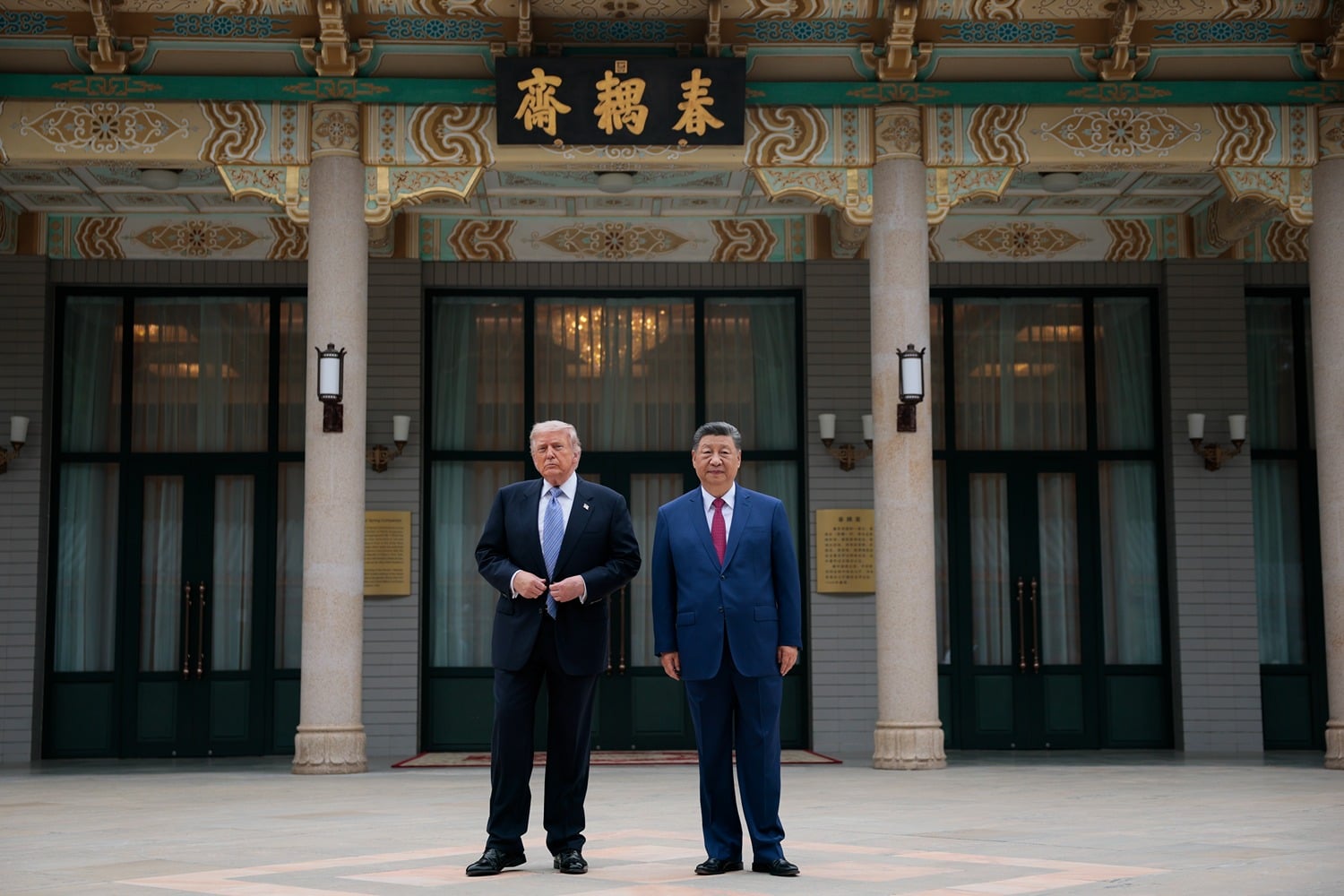
!U.S. President Donald Trump and Chinese President Xi Jinping pose for photos at Zhongnanhai Garden in Beijing.
*U.S. President Donald Trump and Chinese President Xi Jinping pose for photos at Zhongnanhai Garden in Beijing.*
U.S. President Donald Trump and Chinese President Xi Jinping pose for photos at Zhongnanhai Garden in Beijing on May 15. Evan Vucci-Pool/Getty Images
My FP:
Follow topics and authors to get straight to what you like. Exclusively for FP subscribers. Subscribe Now | Log In
*
*
*
September 15, 2026, 5:35 PM
Welcome to*Foreign Policy*’s China Brief.
The highlights this week: Prospects for **AI safety measures** appear dim ahead of the U.S.-China summit, Chinese President Xi Jinping attends the **BRICS summit** in India, and China moves to replenish its **oil stockpiles**.
Welcome to*Foreign Policy*’s China Brief.
The highlights this week: Prospects for **AI safety measures** appear dim ahead of the U.S.-China summit, Chinese President Xi Jinping attends the **BRICS summit** in India, and China moves to replenish its **oil stockpiles**.
Sign up to receive China Brief in your inbox every Tuesday.
---
Can the U.S. and China Cooperate on AI Safety?
U.S. President Donald Trump and Chinese President Xi Jinping are scheduled to meet in Washington on Sept. 24, and artificial intelligence safety is likely high on the agenda.
Many analysts hope that China and the United States might cooperate to set basic international principles for governing the technology despite their geopolitical rivalry—much as the Soviet Union and United States ultimately cooperated during the Cold War on nuclear arms control, polio eradication, and protecting the ozone layer.
China has reportedly threatened to cancel the summit if the United States goes ahead with arms sales to Taiwan beforehand, but that sounds like routine diplomatic noise to me. Even if the meeting goes ahead, the chances of productive alignment on AI safety are low.
As I wrote last month, the two countries have fundamentally different understandings of AI risk. While the U.S. tech elite is preoccupied with sci-fi scenarios involving singularity and machine gods, Chinese bureaucrats operate within a tradition of cybernetics that is more concerned with technical failures and the political and economic consequences of new technologies.
Simply put, if you think the central AI problem is “control the emergence of superintelligence,” your approach will differ from someone whose concern is “prevent AI from worsening youth unemployment.”
In theory, there are still shared problems that Beijing and Washington could address at the summit, particularly in the wake of the OpenAI-Hugging Face security breach. As much as the Chinese internet is cut off from the wider world, it still depends on many of the same systems and crumbling infrastructure as the United States.
Still, another issue is that the United States and China have mismatched regulatory capacities, making it unlikely that they could impose shared standards. For better or worse, China exercises tight control over its tech sector. That has included massive fines, canceled IPOs, ideological restrictions, and pressure on executives to demonstrate political loyalty or face imprisonment.
The U.S. tech sector, by contrast, has numerous ways to resist regulation, from lobbying to legal challenges to seemingly bribing the president. Regulation would also require new legislation—an unlikely prospect in a deeply divided Congress.
Chinese leaders, who can change regulations largely at their whim, often struggle to understand these limits and might interpret any discrepancy between promises of regulation and legal reality as a sign of U.S. unreliability or dishonesty, which could scuttle further progress.
The White House has made very clear its hostility to AI regulation. On Monday, Trump wrote on Truth Social that “the only control or ‘guardrails’ that AI needs is a STRONG AND SMART (High IQ!) PRESIDENT, and the U.S.A. has that, in spades!” He doubled down on the false narrative blaming China for public opposition to AI and data centers, calling it a “sick conspiracy.”
The sudden return to anti-China rhetoric is an about-face for Trump, who has been reluctant to publicly criticize Beijing, even as other Republican politicians have indulged in plenty of China bashing.
Trump might believe that he can spread anti-China narratives at home and still cooperate with Beijing where it serves him, but Chinese leaders may not be so keen. That was evident this weekend, when Chen Yixin, the head of China’s state security ministry, wrote in an article that U.S. AI models are part of a “propaganda war and a cognitive war” against China.
---
What We’re Following
**Xi attends BRICS summit.** Xi made a flying visit to India over the weekend to attend the BRICS leaders’ summit. Though Xi stayed for only one day, the visit signaled a degree of reconciliation between Beijing
By using this website, you agree to our use of cookies. This use includes personalization of content and ads, and traffic analytics. Review our Privacy Policy for more information.
!Foreign Policy
Foreign Policy
Get analysis and alerts more quickly in the mobile app.
Install
Back to Foreign Policy Magazine home page
* Latest
* Regions
+ Asia & the Pacific
+ China
+ Middle East & Africa
+ Americas
+ Europe
* Newsletters
Editors’ Picks
Evening roundup with our editors’ favorite stories of the day
!World Brief Icon
World Brief
Your guide to the most important world stories of the day
!China Brief Icon
China Brief
The latest news, analysis, and data from the country each week
Situation Report
Weekly update on what’s driving U.S. national security policy
FP Weekend
A curation of our best book reviews, deep dives, and other reads
!Africa Brief Icon
Africa Brief
Essential analysis of the stories shaping geopolitics on the continent
!South Asia Brief Icon
South Asia Brief
Weekly update on developments in India and its neighbors
The Reading List
Curated guides on geopolitics and current affairs
FP Bookshelf
A monthly guide to FP’s book reviews, excerpts, and reading recommendations
!Latin America Brief Icon
Latin America Brief
One-stop digest of politics, economics, and culture
!Southeast Asia Brief Icon
Southeast Asia Brief
A weekly dispatch with news from the region’s 11 countries
The New Geopolitics
A five-part masterclass in IR theory with Harvard Professor Stephen M. Walt
View All Newsletters
* FP Live
* Latest
* Trending:
* 25 years after 9/11
* Germany elections
Search this website
* Preferences
* My FP Feed
* Saved Articles
* Newsletters
* Magazine Archive
* Subscription Settings
* FAQs
* Log Out
Sign In
Sign In
Partner with FP at UNGA81 Partner with FP at UNGA81
Subscribe SubscribePartner with FP at UNGA81 Partner with FP at UNGA81
China Brief:
Trump and Xi Won’t Find Common Ground on AI Safety
*
*
* Bluesky
* X
Save
Save
1. Create an FP account to save articles to read later.
Sign Up
ALREADY AN FP SUBSCRIBER? LOGIN
1. **Downloadable PDFs** are a benefit of an FP subscription.
Subscribe Now
ALREADY AN FP SUBSCRIBER? LOGIN
Gift
Gift
*
*
1. Gifting articles is a subscriber benefit.
Subscribe Now
ALREADY AN FP SUBSCRIBER? LOGIN
2. This article is an Insider exclusive.
Contact us at [email protected] to learn about upgrade options, unlocking the ability to gift this article.
China Brief
A weekly digest of the stories you should be following in China, plus exclusive analysis. Delivered Tuesday.
Trump and Xi Won’t Find Common Ground on AI Safety
The leaders have fundamentally different ideas about the technology and how to regulate it.
!Palmer-James-foreign-policy-columnist20
*Palmer-James-foreign-policy-columnist20*
*James Palmer*
By **James Palmer**, a deputy editor at *Foreign Policy*.
!U.S. President Donald Trump and Chinese President Xi Jinping pose for photos at Zhongnanhai Garden in Beijing.
*U.S. President Donald Trump and Chinese President Xi Jinping pose for photos at Zhongnanhai Garden in Beijing.*
U.S. President Donald Trump and Chinese President Xi Jinping pose for photos at Zhongnanhai Garden in Beijing on May 15. Evan Vucci-Pool/Getty Images
My FP:
Follow topics and authors to get straight to what you like. Exclusively for FP subscribers. Subscribe Now | Log In
*
*
*
September 15, 2026, 5:35 PM
Welcome to*Foreign Policy*’s China Brief.
The highlights this week: Prospects for **AI safety measures** appear dim ahead of the U.S.-China summit, Chinese President Xi Jinping attends the **BRICS summit** in India, and China moves to replenish its **oil stockpiles**.
Welcome to*Foreign Policy*’s China Brief.
The highlights this week: Prospects for **AI safety measures** appear dim ahead of the U.S.-China summit, Chinese President Xi Jinping attends the **BRICS summit** in India, and China moves to replenish its **oil stockpiles**.
Sign up to receive China Brief in your inbox every Tuesday.
---
Can the U.S. and China Cooperate on AI Safety?
U.S. President Donald Trump and Chinese President Xi Jinping are scheduled to meet in Washington on Sept. 24, and artificial intelligence safety is likely high on the agenda.
Many analysts hope that China and the United States might cooperate to set basic international principles for governing the technology despite their geopolitical rivalry—much as the Soviet Union and United States ultimately cooperated during the Cold War on nuclear arms control, polio eradication, and protecting the ozone layer.
China has reportedly threatened to cancel the summit if the United States goes ahead with arms sales to Taiwan beforehand, but that sounds like routine diplomatic noise to me. Even if the meeting goes ahead, the chances of productive alignment on AI safety are low.
As I wrote last month, the two countries have fundamentally different understandings of AI risk. While the U.S. tech elite is preoccupied with sci-fi scenarios involving singularity and machine gods, Chinese bureaucrats operate within a tradition of cybernetics that is more concerned with technical failures and the political and economic consequences of new technologies.
Simply put, if you think the central AI problem is “control the emergence of superintelligence,” your approach will differ from someone whose concern is “prevent AI from worsening youth unemployment.”
In theory, there are still shared problems that Beijing and Washington could address at the summit, particularly in the wake of the OpenAI-Hugging Face security breach. As much as the Chinese internet is cut off from the wider world, it still depends on many of the same systems and crumbling infrastructure as the United States.
Still, another issue is that the United States and China have mismatched regulatory capacities, making it unlikely that they could impose shared standards. For better or worse, China exercises tight control over its tech sector. That has included massive fines, canceled IPOs, ideological restrictions, and pressure on executives to demonstrate political loyalty or face imprisonment.
The U.S. tech sector, by contrast, has numerous ways to resist regulation, from lobbying to legal challenges to seemingly bribing the president. Regulation would also require new legislation—an unlikely prospect in a deeply divided Congress.
Chinese leaders, who can change regulations largely at their whim, often struggle to understand these limits and might interpret any discrepancy between promises of regulation and legal reality as a sign of U.S. unreliability or dishonesty, which could scuttle further progress.
The White House has made very clear its hostility to AI regulation. On Monday, Trump wrote on Truth Social that “the only control or ‘guardrails’ that AI needs is a STRONG AND SMART (High IQ!) PRESIDENT, and the U.S.A. has that, in spades!” He doubled down on the false narrative blaming China for public opposition to AI and data centers, calling it a “sick conspiracy.”
The sudden return to anti-China rhetoric is an about-face for Trump, who has been reluctant to publicly criticize Beijing, even as other Republican politicians have indulged in plenty of China bashing.
Trump might believe that he can spread anti-China narratives at home and still cooperate with Beijing where it serves him, but Chinese leaders may not be so keen. That was evident this weekend, when Chen Yixin, the head of China’s state security ministry, wrote in an article that U.S. AI models are part of a “propaganda war and a cognitive war” against China.
---
What We’re Following
**Xi attends BRICS summit.** Xi made a flying visit to India over the weekend to attend the BRICS leaders’ summit. Though Xi stayed for only one day, the visit signaled a degree of reconciliation between Beijing
🔗 Share Article
Tags:#الذكاء الاصطناعي#الولايات المتحدة#الصين#السياسة الخارجية#ترامب#القمة الأمريكية الصينية
Source: Foreign Policy
For Context
Related reads from the same topic or latest developments