How Ronald Reagan Used Diplomacy to End the Cold War
Foreign Policy

Foreign Policy
Original Source
A new film highlighting Ronald Reagan's reliance on State Department expertise before his meetings with Soviet leader Mikhail Gorbachev reveals how methodical diplomacy achieved the most significant arms-control breakthrough with the Soviet Union since 1972. The approach contrasts sharply with the chaotic and unconventional negotiating tactics of more recent administrations.
Ronald Reagan Used Diplomacy to Break Through With the Soviets
By using this website, you agree to our use of cookies. This use includes personalization of content and ads, and traffic analytics. Review our Privacy Policy for more information.
!Foreign Policy
Foreign Policy
Get analysis and alerts more quickly in the mobile app.
Install
Back to Foreign Policy Magazine home page
* Latest
* Regions
+ Asia & the Pacific
+ China
+ Middle East & Africa
+ Americas
+ Europe
* Newsletters
Editors’ Picks
Evening roundup with our editors’ favorite stories of the day
!World Brief Icon
World Brief
Your guide to the most important world stories of the day
!China Brief Icon
China Brief
The latest news, analysis, and data from the country each week
Situation Report
Weekly update on what’s driving U.S. national security policy
FP Weekend
A curation of our best book reviews, deep dives, and other reads
!Africa Brief Icon
Africa Brief
Essential analysis of the stories shaping geopolitics on the continent
!South Asia Brief Icon
South Asia Brief
Weekly update on developments in India and its neighbors
The Reading List
Curated guides on geopolitics and current affairs
FP Bookshelf
A monthly guide to FP’s book reviews, excerpts, and reading recommendations
!Latin America Brief Icon
Latin America Brief
One-stop digest of politics, economics, and culture
!Southeast Asia Brief Icon
Southeast Asia Brief
A weekly dispatch with news from the region’s 11 countries
The New Geopolitics
A five-part masterclass in IR theory with Harvard Professor Stephen M. Walt
View All Newsletters
* FP Live
* Latest
* Trending:
* Iran war
* Colombia's earthquake recovery
Search this website
* Preferences
* My FP Feed
* Saved Articles
* Newsletters
* Magazine Archive
* Subscription Settings
* FAQs
* Log Out
Sign In
Sign In
Partner with FP at UNGA81 Partner with FP at UNGA81
Subscribe SubscribePartner with FP at UNGA81 Partner with FP at UNGA81
Analysis:
How Ronald Reagan Used Diplomacy to End the Cold War
*
*
* Facebook
* Bluesky
* X
* LinkedIn
* WhatsApp
* Reddit
Save
Save
1. Create an FP account to save articles to read later.
Sign Up
ALREADY AN FP SUBSCRIBER? LOGIN
PDF
PDF
1. **Downloadable PDFs** are a benefit of an FP subscription.
Subscribe Now
ALREADY AN FP SUBSCRIBER? LOGIN
Gift
Gift
*
*
* WhatsApp
1. Gifting articles is a subscriber benefit.
Subscribe Now
ALREADY AN FP SUBSCRIBER? LOGIN
2. This article is an Insider exclusive.
Contact us at [email protected] to learn about upgrade options, unlocking the ability to gift this article.
Analysis
How Ronald Reagan Used Diplomacy to End the Cold War
A new movie shows how the president conferred with State Department experts before each meeting.
!A pencil drawing of a man smiling and wearing glasses
*A pencil drawing of a man smiling and wearing glasses*
*Julian E. Zelizer*
By **Julian E. Zelizer**, a columnist at *Foreign Policy* and a professor of history and public affairs at Princeton University. Sign up for Julian’s newsletter, The Long View, here.
!Two men in Western suits sit in wooden chairs with striped cushions on a stage. One leans in with one leg crossed over the other as they talk.
*Two men in Western suits sit in wooden chairs with striped cushions on a stage. One leans in with one leg crossed over the other as they talk.*
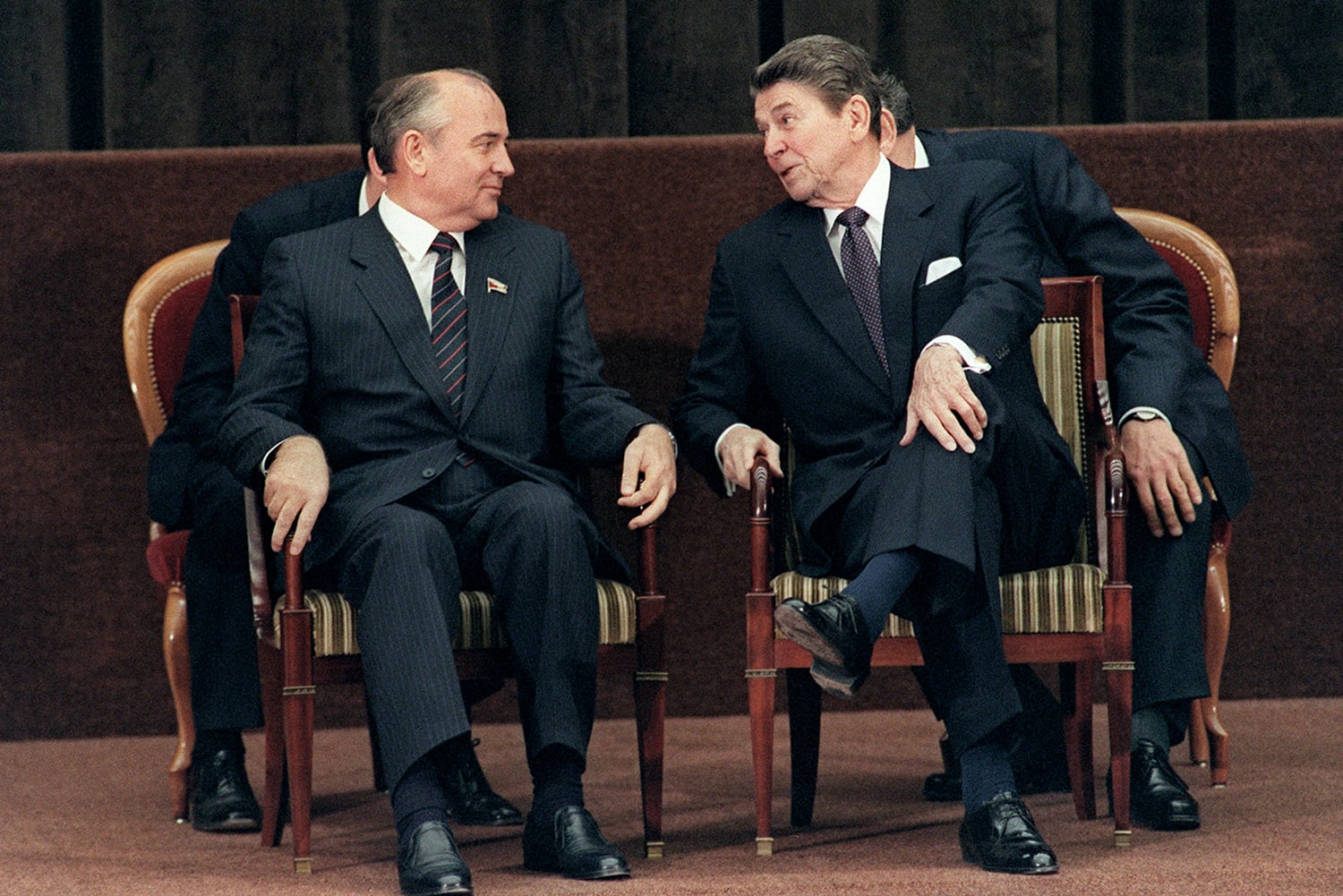
U.S. President Ronald Reagan (right) talks to Soviet leader Mikhail Gorbachev during a summit in Geneva on Nov. 21, 1985. AFP via Getty Images
My FP:
Follow topics and authors to get straight to what you like. Exclusively for FP subscribers. Subscribe Now | Log In
*
*
August 17, 2026, 12:01 AM
President Donald Trump has handled the war with Iran in an unconventional fashion, to say the least. Based on the reporting that has emerged thus far, the president’s long-standing hostility toward Iran, dating back to the 1979 hostage crisis, combined with Israeli Prime Minister Benjamin Netanyahu’s determination to decapitate one of his country’s fiercest adversaries, helped drive the military operations that have now been underway for nearly six months at a cost of at least $37.5 billion.
Since the war began, negotiations over a resolution have been chaotic. Americans have witnessed announcements of ceasefires, violations of those ceasefires, and statements from the administration that bear little resemblance to what is unfolding on their screens. Changing and often contradictory administration statements have suggested that the goals of the war include toppling the governing regime, ushering in democracy, destroying the country’s nuclear and military capabilities, and, most recently, keeping open the Strait of Hormuz—which had been open until the war began. The president has never sought authorization for this war from Congress.
President Donald Trump has handled the war with Iran in an unconventional fashion, to say the least. Based on the reporting that has emerged thus far, the president’s long-standing hostility toward Iran, dating back to the 1979 hostage crisis, combined with Israeli Prime Minister Benjamin Netanyahu’s determination to decapitate one of his country’s fiercest adversaries, helped drive the military operations that have now been underway for nearly six months at a cost of at least $37.5 billion.
Since the war began, negotiations over a resolution have been chaotic. Americans have witnessed announcements of ceasefires, violations of those ceasefires, and statements from the administration that bear little resemblance to what is unfolding on their screens. Changing and often contradictory administration statements have suggested that the goals of the war include toppling the governing regime, ushering in democracy, destroying the country’s nuclear and military capabilities, and, most recently, keeping open the Strait of Hormuz—which had been open until the war began. The president has never sought authorization for this war from Congress.
Currently, the administration appears to be reduced to negotiating a deal that leaves the Iranian regime in place with degraded military capabilities, allows it to retain nuclear material, although in facilities that remain buried or difficult to access—and grants it greater control over the Strait of Hormuz, including, potentially, the ability to charge fees to ships passing through. As with much of Trump’s transactional approach to foreign policy, reports suggest there is no clear plan or coherent strategy within the White House. On any day, a Truth Social post could set the conversation in a different direction. Secretary of State Marco Rubio, who presides over a State Department that has been severely depleted of much of its expertise, has only gradually become more involved in the deliberations.
The chaos that has characterized efforts to end the conflict stands in stark contrast to the way most previous presidents have handled difficult negotiations with adversaries. Take, for example, the case of Ronald Reagan after 1985. As a new movie starring Jeff Daniels as Reagan, “The Brink of War,” illustrates, the emergence of Soviet leader Mikhail Gorbachev opened the door to a major arms-control agreement with the United States’ most formidable rival.
---
Few Americans could
have predicted that Reagan would emerge as the president responsible for the most significant arms control breakthrough with the Soviet Union since 1972, when President Richard Nixon and Soviet leader Leonid Brezhnev signed the SALT I agreement. Throughout much of the 1970s, Reagan built his reputation by attacking Republicans who embraced Nixon’s policy of detente, which sought to ease relations with the Soviet Union through diplomacy and economic cooperation. In the 1976 Republican primaries, Reagan nearly defeated Republican President Gerald Ford by making detente—and its chief architect, Secretary of State Henry Kissinger—a central target of his campaign.
Upon taking office in 1981, Reagan filled much o
By using this website, you agree to our use of cookies. This use includes personalization of content and ads, and traffic analytics. Review our Privacy Policy for more information.
!Foreign Policy
Foreign Policy
Get analysis and alerts more quickly in the mobile app.
Install
Back to Foreign Policy Magazine home page
* Latest
* Regions
+ Asia & the Pacific
+ China
+ Middle East & Africa
+ Americas
+ Europe
* Newsletters
Editors’ Picks
Evening roundup with our editors’ favorite stories of the day
!World Brief Icon
World Brief
Your guide to the most important world stories of the day
!China Brief Icon
China Brief
The latest news, analysis, and data from the country each week
Situation Report
Weekly update on what’s driving U.S. national security policy
FP Weekend
A curation of our best book reviews, deep dives, and other reads
!Africa Brief Icon
Africa Brief
Essential analysis of the stories shaping geopolitics on the continent
!South Asia Brief Icon
South Asia Brief
Weekly update on developments in India and its neighbors
The Reading List
Curated guides on geopolitics and current affairs
FP Bookshelf
A monthly guide to FP’s book reviews, excerpts, and reading recommendations
!Latin America Brief Icon
Latin America Brief
One-stop digest of politics, economics, and culture
!Southeast Asia Brief Icon
Southeast Asia Brief
A weekly dispatch with news from the region’s 11 countries
The New Geopolitics
A five-part masterclass in IR theory with Harvard Professor Stephen M. Walt
View All Newsletters
* FP Live
* Latest
* Trending:
* Iran war
* Colombia's earthquake recovery
Search this website
* Preferences
* My FP Feed
* Saved Articles
* Newsletters
* Magazine Archive
* Subscription Settings
* FAQs
* Log Out
Sign In
Sign In
Partner with FP at UNGA81 Partner with FP at UNGA81
Subscribe SubscribePartner with FP at UNGA81 Partner with FP at UNGA81
Analysis:
How Ronald Reagan Used Diplomacy to End the Cold War
*
*
* Bluesky
* X
Save
Save
1. Create an FP account to save articles to read later.
Sign Up
ALREADY AN FP SUBSCRIBER? LOGIN
1. **Downloadable PDFs** are a benefit of an FP subscription.
Subscribe Now
ALREADY AN FP SUBSCRIBER? LOGIN
Gift
Gift
*
*
1. Gifting articles is a subscriber benefit.
Subscribe Now
ALREADY AN FP SUBSCRIBER? LOGIN
2. This article is an Insider exclusive.
Contact us at [email protected] to learn about upgrade options, unlocking the ability to gift this article.
Analysis
How Ronald Reagan Used Diplomacy to End the Cold War
A new movie shows how the president conferred with State Department experts before each meeting.
!A pencil drawing of a man smiling and wearing glasses
*A pencil drawing of a man smiling and wearing glasses*
*Julian E. Zelizer*
By **Julian E. Zelizer**, a columnist at *Foreign Policy* and a professor of history and public affairs at Princeton University. Sign up for Julian’s newsletter, The Long View, here.
!Two men in Western suits sit in wooden chairs with striped cushions on a stage. One leans in with one leg crossed over the other as they talk.
*Two men in Western suits sit in wooden chairs with striped cushions on a stage. One leans in with one leg crossed over the other as they talk.*
U.S. President Ronald Reagan (right) talks to Soviet leader Mikhail Gorbachev during a summit in Geneva on Nov. 21, 1985. AFP via Getty Images
My FP:
Follow topics and authors to get straight to what you like. Exclusively for FP subscribers. Subscribe Now | Log In
*
*
August 17, 2026, 12:01 AM
President Donald Trump has handled the war with Iran in an unconventional fashion, to say the least. Based on the reporting that has emerged thus far, the president’s long-standing hostility toward Iran, dating back to the 1979 hostage crisis, combined with Israeli Prime Minister Benjamin Netanyahu’s determination to decapitate one of his country’s fiercest adversaries, helped drive the military operations that have now been underway for nearly six months at a cost of at least $37.5 billion.
Since the war began, negotiations over a resolution have been chaotic. Americans have witnessed announcements of ceasefires, violations of those ceasefires, and statements from the administration that bear little resemblance to what is unfolding on their screens. Changing and often contradictory administration statements have suggested that the goals of the war include toppling the governing regime, ushering in democracy, destroying the country’s nuclear and military capabilities, and, most recently, keeping open the Strait of Hormuz—which had been open until the war began. The president has never sought authorization for this war from Congress.
President Donald Trump has handled the war with Iran in an unconventional fashion, to say the least. Based on the reporting that has emerged thus far, the president’s long-standing hostility toward Iran, dating back to the 1979 hostage crisis, combined with Israeli Prime Minister Benjamin Netanyahu’s determination to decapitate one of his country’s fiercest adversaries, helped drive the military operations that have now been underway for nearly six months at a cost of at least $37.5 billion.
Since the war began, negotiations over a resolution have been chaotic. Americans have witnessed announcements of ceasefires, violations of those ceasefires, and statements from the administration that bear little resemblance to what is unfolding on their screens. Changing and often contradictory administration statements have suggested that the goals of the war include toppling the governing regime, ushering in democracy, destroying the country’s nuclear and military capabilities, and, most recently, keeping open the Strait of Hormuz—which had been open until the war began. The president has never sought authorization for this war from Congress.
Currently, the administration appears to be reduced to negotiating a deal that leaves the Iranian regime in place with degraded military capabilities, allows it to retain nuclear material, although in facilities that remain buried or difficult to access—and grants it greater control over the Strait of Hormuz, including, potentially, the ability to charge fees to ships passing through. As with much of Trump’s transactional approach to foreign policy, reports suggest there is no clear plan or coherent strategy within the White House. On any day, a Truth Social post could set the conversation in a different direction. Secretary of State Marco Rubio, who presides over a State Department that has been severely depleted of much of its expertise, has only gradually become more involved in the deliberations.
The chaos that has characterized efforts to end the conflict stands in stark contrast to the way most previous presidents have handled difficult negotiations with adversaries. Take, for example, the case of Ronald Reagan after 1985. As a new movie starring Jeff Daniels as Reagan, “The Brink of War,” illustrates, the emergence of Soviet leader Mikhail Gorbachev opened the door to a major arms-control agreement with the United States’ most formidable rival.
---
Few Americans could
have predicted that Reagan would emerge as the president responsible for the most significant arms control breakthrough with the Soviet Union since 1972, when President Richard Nixon and Soviet leader Leonid Brezhnev signed the SALT I agreement. Throughout much of the 1970s, Reagan built his reputation by attacking Republicans who embraced Nixon’s policy of detente, which sought to ease relations with the Soviet Union through diplomacy and economic cooperation. In the 1976 Republican primaries, Reagan nearly defeated Republican President Gerald Ford by making detente—and its chief architect, Secretary of State Henry Kissinger—a central target of his campaign.
Upon taking office in 1981, Reagan filled much o
🔗 Share Article
Tags:#الحرب الباردة#الدبلوماسية الأمريكية#رونالد ريغان#السياسة الخارجية#السيطرة على التسلح
Source: Foreign Policy
For Context
Related reads from the same topic or latest developments


