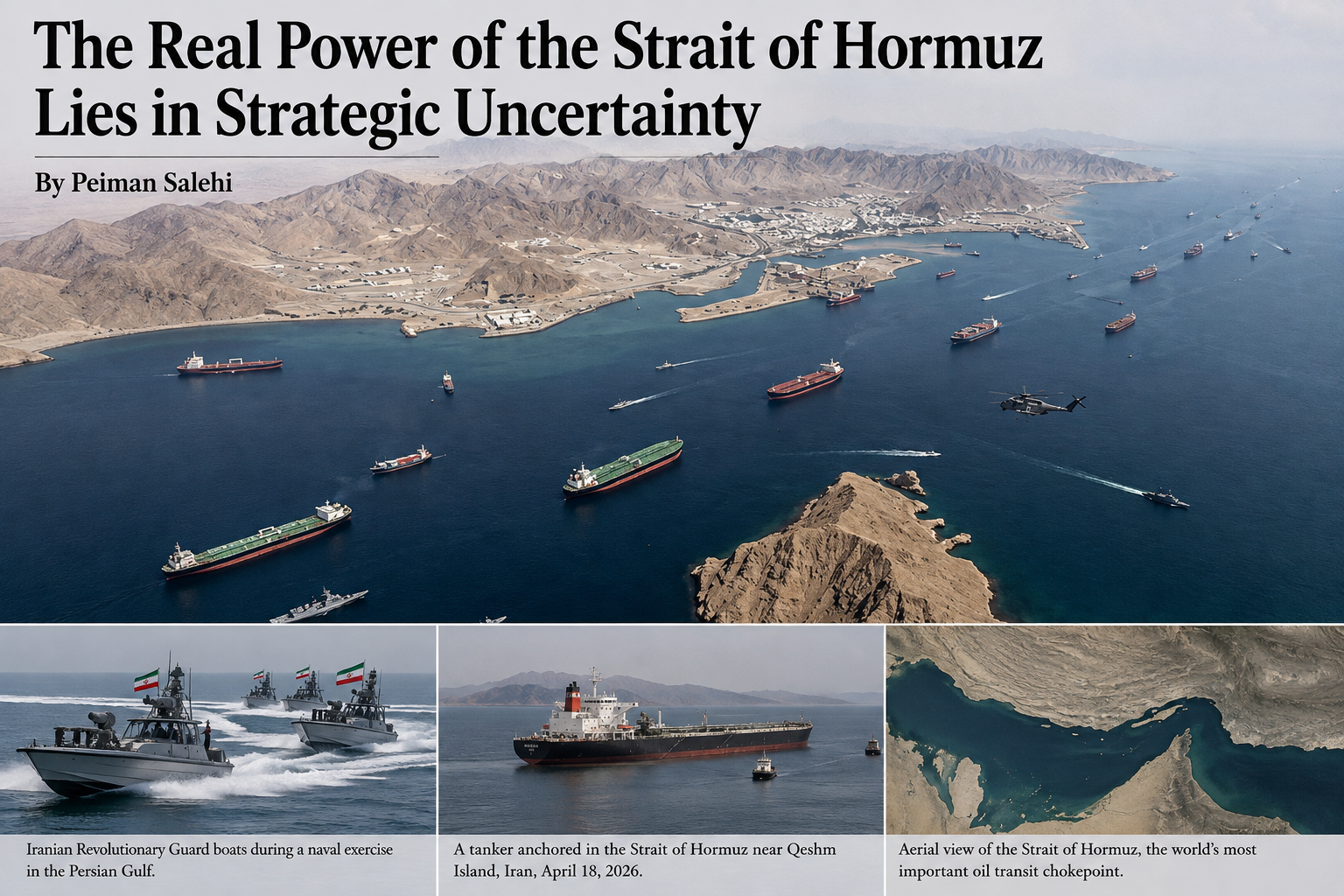
The Real Power of the Strait of Hormuz Lies in Strategic Uncertainty

Peiman Salehi
Writer at CROSS LINES
By Peiman Salehi Whenever tensions return to the Persian Gulf, debate over the Strait of Hormuz quickly narrows to two familiar questions: how much revenue flows through it and whether closing it would unite the world against Iran.
By Peiman Salehi
Whenever tensions return to the Persian Gulf, debate over the Strait of Hormuz quickly narrows to two familiar questions: how much revenue flows through it and whether closing it would unite the world against Iran. Both questions, however, overlook what gives the strait its real strategic value.
Hormuz is more than a maritime trade route. It is a geopolitical lever. Yet much of the discussion continues to treat it as little more than an economic chokepoint, reducing one of the world's most important strategic waterways to a debate over shipping and transit fees.
The case for the strait's enduring importance is well established, but it is worth revisiting because it is often underestimated. Even with expanding pipeline networks and alternative export routes, there is no realistic substitute for Hormuz in the foreseeable future. Nor is the issue limited to oil. Petrochemical exports, chemical products, essential imports and large segments of the supply chains serving the southern Persian Gulf states still depend on the uninterrupted flow of maritime traffic through this narrow passage.
From a cost-benefit perspective, it is difficult to imagine Gulf producers investing the enormous financial and political resources required to replace Hormuz entirely when preserving its security remains significantly cheaper. This helps explain why many Gulf states, despite their political differences with Tehran, have generally favored preventing prolonged instability in the strait rather than allowing tensions to spiral into a sustained disruption.
For Iran, however, the importance of Hormuz extends well beyond economics. Its strategic value should not be measured solely by shipping revenue or by the question of whether Tehran could close the waterway. That framework misunderstands the nature of the leverage itself.
The real question is not whether the Strait of Hormuz remains open or closed. A complete closure, even if it were ever attempted, would almost certainly be temporary. The lasting source of leverage lies elsewhere: in shaping perceptions of security around the strait.
That distinction changes how Hormuz should be understood—not as a switch that is either on or off, but as a strategic variable capable of influencing political, military and economic calculations far beyond the Persian Gulf.
The mistake is to assume that the strategic question is whether the strait is open or closed. Every actor involved, including Iran, understands that a complete closure could only be temporary. What carries lasting strategic weight is not closure itself but the ability to shape the security environment surrounding the waterway.
Iran's leverage lies in its capacity to convey a simple message: the long-term security of the Strait of Hormuz cannot be separated from Iran's own security interests and regional role. That message matters because markets respond less to events than to expectations.
Global energy markets rarely wait for disruption. They react to the possibility of disruption. Insurance companies, tanker operators, shipping firms and commodity traders continuously price geopolitical risk into their decisions. A single naval confrontation, the seizure of a vessel or even heightened military tensions can drive insurance premiums and freight costs sharply higher, long before any sustained interruption to maritime traffic occurs. In many cases, perceived risk has a greater economic impact than an actual blockade.
This is what gives Hormuz its strategic significance. Iran does not necessarily need to close the strait to influence regional calculations. Nor does it need to generate direct revenue from it. Simply possessing the ability to affect the security environment around one of the world's most important maritime corridors creates leverage that extends well beyond the Gulf itself.
There is a useful parallel in Iran's own experience under U.S. sanctions. Washington's influence over the Iranian economy did not stem solely from sanctions themselves. It also came from maintaining uncertainty about their future. Businesses, investors and policymakers were rarely certain whether restrictions would be tightened, eased or removed. That uncertainty became part of the economic landscape, shaping investment decisions and long-term planning even without constant changes in sanctions policy.
Strategic uncertainty, in other words, can become an instrument of power. Once uncertainty is built into the calculations of governments, markets and private actors, it begins to influence behavior on its own. States do not always shape their adversaries' decisions through direct action. Often, they do so by forcing others to account for uncertainty in every strategic calculation.
The same logic applies to the Strait of Hormuz. Its greatest strategic value lies not in closure, but in uncertainty. That is why Iran gains little by declaring that the strait will always remain open or by threatening that it will inevitably be closed. Both positions eliminate the very ambiguity that gives the strait its strategic weight.
A more effective message is a conditional one: the security and normal functioning of the Strait of Hormuz depend on the behavior of those interacting with Iran. This is not a strategy built on permanent confrontation. It is a strategy of deterrence, based on influencing the calculations of others before a crisis escalates.
If managed carefully, this ambiguity can become one of Iran's most enduring sources of strategic leverage. It requires neither a blockade nor repeated military demonstrations. It requires a consistent understanding among regional and international actors that any attempt to undermine Iran's security interests will inevitably increase the geopolitical and economic risks associated with one of the world's most critical maritime corridors.
This also explains why much of the debate over whether closing Hormuz would provoke international condemnation misses the broader strategic picture. The central issue is not whether Iran would receive global approval. It is whether governments, insurers, energy companies and financial markets incorporate Iran's role into their long-term security calculations. Once they do, the leverage already exists.
Ultimately, the strategic value of the Strait of Hormuz cannot be measured in barrels of oil, shipping fees or the number of tankers passing through it each day. Its real value lies in its ability to shape expectations, alter risk calculations and influence political decision-making far beyond the Persian Gulf.
Geography gave Iran this advantage. Whether it becomes lasting strategic capital depends on how intelligently it is incorporated into Tehran's broader regional strategy and diplomatic posture. The real power of the Strait of Hormuz, therefore, lies not in the ability to close it, but in the ability to ensure that no lasting security architecture for the Persian Gulf can be designed without taking Iran into account. That is a far more durable form of influence than any temporary blockade could ever achieve.
Whenever tensions return to the Persian Gulf, debate over the Strait of Hormuz quickly narrows to two familiar questions: how much revenue flows through it and whether closing it would unite the world against Iran. Both questions, however, overlook what gives the strait its real strategic value.
Hormuz is more than a maritime trade route. It is a geopolitical lever. Yet much of the discussion continues to treat it as little more than an economic chokepoint, reducing one of the world's most important strategic waterways to a debate over shipping and transit fees.
The case for the strait's enduring importance is well established, but it is worth revisiting because it is often underestimated. Even with expanding pipeline networks and alternative export routes, there is no realistic substitute for Hormuz in the foreseeable future. Nor is the issue limited to oil. Petrochemical exports, chemical products, essential imports and large segments of the supply chains serving the southern Persian Gulf states still depend on the uninterrupted flow of maritime traffic through this narrow passage.
From a cost-benefit perspective, it is difficult to imagine Gulf producers investing the enormous financial and political resources required to replace Hormuz entirely when preserving its security remains significantly cheaper. This helps explain why many Gulf states, despite their political differences with Tehran, have generally favored preventing prolonged instability in the strait rather than allowing tensions to spiral into a sustained disruption.
For Iran, however, the importance of Hormuz extends well beyond economics. Its strategic value should not be measured solely by shipping revenue or by the question of whether Tehran could close the waterway. That framework misunderstands the nature of the leverage itself.
The real question is not whether the Strait of Hormuz remains open or closed. A complete closure, even if it were ever attempted, would almost certainly be temporary. The lasting source of leverage lies elsewhere: in shaping perceptions of security around the strait.
That distinction changes how Hormuz should be understood—not as a switch that is either on or off, but as a strategic variable capable of influencing political, military and economic calculations far beyond the Persian Gulf.
The mistake is to assume that the strategic question is whether the strait is open or closed. Every actor involved, including Iran, understands that a complete closure could only be temporary. What carries lasting strategic weight is not closure itself but the ability to shape the security environment surrounding the waterway.
Iran's leverage lies in its capacity to convey a simple message: the long-term security of the Strait of Hormuz cannot be separated from Iran's own security interests and regional role. That message matters because markets respond less to events than to expectations.
Global energy markets rarely wait for disruption. They react to the possibility of disruption. Insurance companies, tanker operators, shipping firms and commodity traders continuously price geopolitical risk into their decisions. A single naval confrontation, the seizure of a vessel or even heightened military tensions can drive insurance premiums and freight costs sharply higher, long before any sustained interruption to maritime traffic occurs. In many cases, perceived risk has a greater economic impact than an actual blockade.
This is what gives Hormuz its strategic significance. Iran does not necessarily need to close the strait to influence regional calculations. Nor does it need to generate direct revenue from it. Simply possessing the ability to affect the security environment around one of the world's most important maritime corridors creates leverage that extends well beyond the Gulf itself.
There is a useful parallel in Iran's own experience under U.S. sanctions. Washington's influence over the Iranian economy did not stem solely from sanctions themselves. It also came from maintaining uncertainty about their future. Businesses, investors and policymakers were rarely certain whether restrictions would be tightened, eased or removed. That uncertainty became part of the economic landscape, shaping investment decisions and long-term planning even without constant changes in sanctions policy.
Strategic uncertainty, in other words, can become an instrument of power. Once uncertainty is built into the calculations of governments, markets and private actors, it begins to influence behavior on its own. States do not always shape their adversaries' decisions through direct action. Often, they do so by forcing others to account for uncertainty in every strategic calculation.
The same logic applies to the Strait of Hormuz. Its greatest strategic value lies not in closure, but in uncertainty. That is why Iran gains little by declaring that the strait will always remain open or by threatening that it will inevitably be closed. Both positions eliminate the very ambiguity that gives the strait its strategic weight.
A more effective message is a conditional one: the security and normal functioning of the Strait of Hormuz depend on the behavior of those interacting with Iran. This is not a strategy built on permanent confrontation. It is a strategy of deterrence, based on influencing the calculations of others before a crisis escalates.
If managed carefully, this ambiguity can become one of Iran's most enduring sources of strategic leverage. It requires neither a blockade nor repeated military demonstrations. It requires a consistent understanding among regional and international actors that any attempt to undermine Iran's security interests will inevitably increase the geopolitical and economic risks associated with one of the world's most critical maritime corridors.
This also explains why much of the debate over whether closing Hormuz would provoke international condemnation misses the broader strategic picture. The central issue is not whether Iran would receive global approval. It is whether governments, insurers, energy companies and financial markets incorporate Iran's role into their long-term security calculations. Once they do, the leverage already exists.
Ultimately, the strategic value of the Strait of Hormuz cannot be measured in barrels of oil, shipping fees or the number of tankers passing through it each day. Its real value lies in its ability to shape expectations, alter risk calculations and influence political decision-making far beyond the Persian Gulf.
Geography gave Iran this advantage. Whether it becomes lasting strategic capital depends on how intelligently it is incorporated into Tehran's broader regional strategy and diplomatic posture. The real power of the Strait of Hormuz, therefore, lies not in the ability to close it, but in the ability to ensure that no lasting security architecture for the Persian Gulf can be designed without taking Iran into account. That is a far more durable form of influence than any temporary blockade could ever achieve.
🔗 Share Article
For Context
Related reads from the same topic or latest developments