China’s Quiet Bet on Methanol Is Paying Off
Foreign Policy

Foreign Policy
Original Source
An abandoned Ford methanol project in China reveals how Beijing pursued multiple technological pathways simultaneously, allowing one to eventually mature commercially. While the U.S. abandoned the technology, China sustained investment in methanol vehicles, now operating one of the world's largest fleets of methanol-powered commercial vehicles.
Ford's Abandoned Methanol China Project Is Oddly Revealing
!Foreign Policy
Foreign Policy
Get analysis and alerts more quickly in the mobile app.
Install
Back to Foreign Policy Magazine home page
* Latest
* Regions
+ Asia & the Pacific
+ China
+ Middle East & Africa
+ Americas
+ Europe
* Newsletters
Editors’ Picks
Evening roundup with our editors’ favorite stories of the day
!World Brief Icon
World Brief
Your guide to the most important world stories of the day
!China Brief Icon
China Brief
The latest news, analysis, and data from the country each week
Situation Report
Weekly update on what’s driving U.S. national security policy
FP Weekend
A curation of our best book reviews, deep dives, and other reads
!Africa Brief Icon
Africa Brief
Essential analysis of the stories shaping geopolitics on the continent
!South Asia Brief Icon
South Asia Brief
Weekly update on developments in India and its neighbors
The Reading List
Curated guides on geopolitics and current affairs
FP Bookshelf
A monthly guide to FP’s book reviews, excerpts, and reading recommendations
!Latin America Brief Icon
Latin America Brief
One-stop digest of politics, economics, and culture
!Southeast Asia Brief Icon
Southeast Asia Brief
A weekly dispatch with news from the region’s 11 countries
The New Geopolitics
A five-part masterclass in IR theory with Harvard Professor Stephen M. Walt
View All Newsletters
* FP Live
* Latest
* Trending:
* Iran war
* Britain's new prime minister
Search this website
* Preferences
* My FP Feed
* Saved Articles
* Newsletters
* Magazine Archive
* Subscription Settings
* FAQs
* Log Out
Sign In
Sign In
Equip your team with FP Enterprise Equip your team with FP Enterprise
SUBSCRIBE SUBSCRIBEUpgrade & get a limited-edition tote Upgrade & get a limited-edition tote
Analysis:
China’s Quiet Bet on Methanol Is Paying Off
*
*
* Facebook
* Bluesky
* X
* LinkedIn
* WhatsApp
* Reddit
Save
1. Create an FP account to save articles to read later.
Sign Up
ALREADY AN FP SUBSCRIBER? LOGIN
PDF
1. **Downloadable PDFs** are a benefit of an FP subscription.
Subscribe Now
ALREADY AN FP SUBSCRIBER? LOGIN
Gift
*
*
* WhatsApp
1. Gifting articles is a subscriber benefit.
Subscribe Now
ALREADY AN FP SUBSCRIBER? LOGIN
2. This article is an Insider exclusive.
Contact us at [email protected] to learn about upgrade options, unlocking the ability to gift this article.
Analysis
China’s Quiet Bet on Methanol Is Paying Off
An abandoned project reveals why industrial policy must preserve technological options.
By **Lizzi C. Lee**, a fellow on Chinese economy at the Asia Society Policy Institute’s Center for China Analysis, and **Fengming Lu**, a lecturer (assistant professor) in the Coral Bell School of Asia Pacific Affairs at the Australian National University.
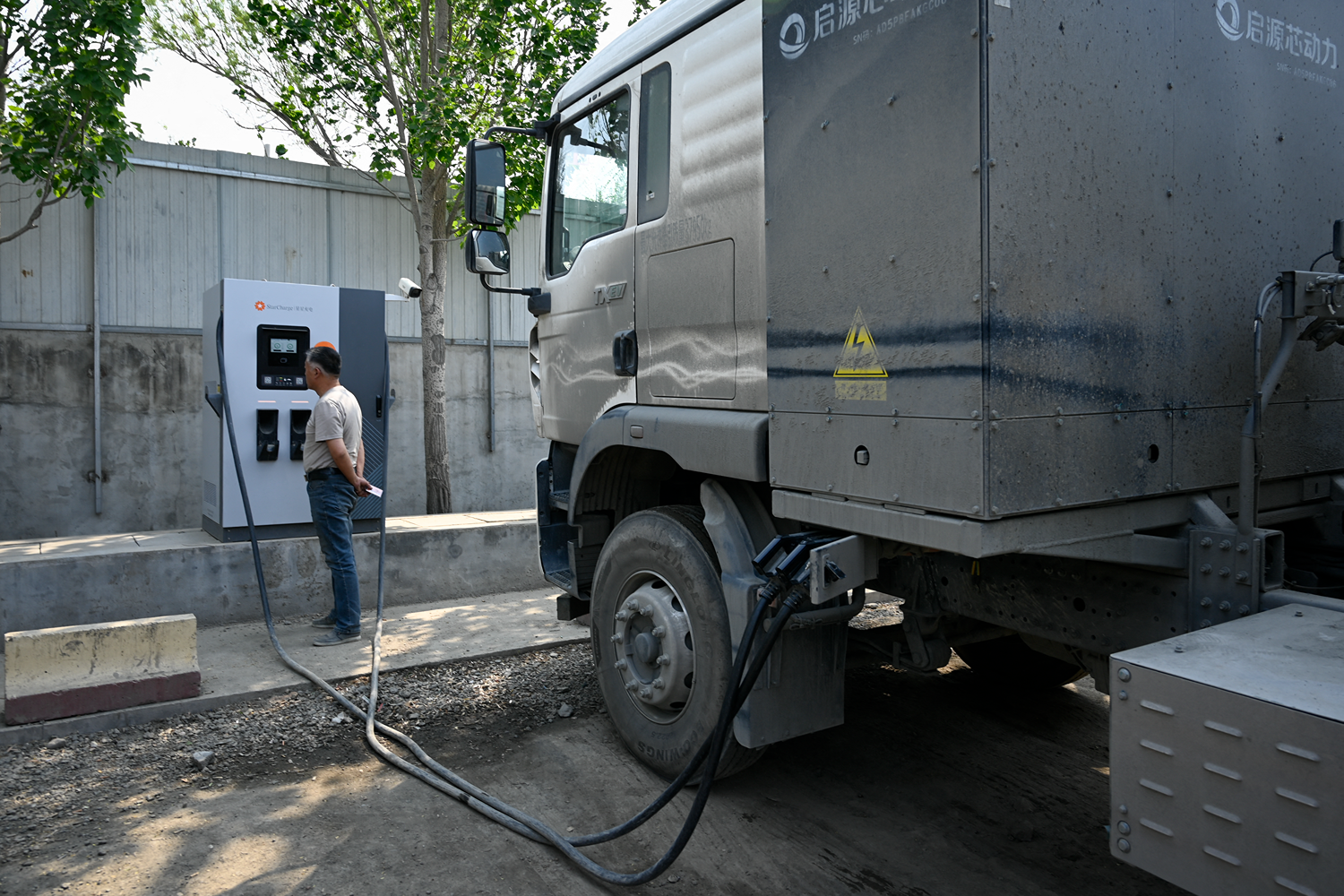
!A driver checks the status of his electric truck at a charging station in Beijing on April 23.
*A driver checks the status of his electric truck at a charging station in Beijing on April 23.*
A driver checks the status of his electric truck at a charging station in Beijing on April 23. Peter Catterall/AFP via Getty Images
1. Get audio access with any FP subscription.
Subscribe Now
ALREADY AN FP SUBSCRIBER? LOGIN
August 3, 2026, 4:59 PM
China is an electric vehicle giant, with companies such as BYD and Geely dominating global markets. But a lesser-known technology is also part of that clean transport story: methanol-powered flexible-fuel vehicles. That story begins with an almost forgotten collaboration, one powered by the U.S. motor giant Ford, that began in 1995.
The partnership never produced a commercial breakthrough. Ford eventually abandoned methanol, while China moved on to other technologies. Yet nearly three decades later, methanol vehicles have reappeared in China, where Geely now operates one of the world’s largest fleets of methanol-powered commercial vehicles.
China is an electric vehicle giant, with companies such as BYD and Geely dominating global markets. But a lesser-known technology is also part of that clean transport story: methanol-powered flexible-fuel vehicles. That story begins with an almost forgotten collaboration, one powered by the U.S. motor giant Ford, that began in 1995.
The partnership never produced a commercial breakthrough. Ford eventually abandoned methanol, while China moved on to other technologies. Yet nearly three decades later, methanol vehicles have reappeared in China, where Geely now operates one of the world’s largest fleets of methanol-powered commercial vehicles.
Tech leadership, especially in Big Tech forms of innovation, involves more than the technology itself. As the Ford story shows, a critical element is whether governments, firms, and local institutions are willing to sustain multiple technological pathways long enough for one of them to mature.
Ford’s interest in methanol long predated its push into China. Methanol is a relatively convenient alternative fuel for conventional internal combustion engines. Existing gasoline engines can be modified to run on methanol blends or even pure methanol, and it can be produced from a wide range of feedstocks, from coal to biomass.
The flexibility makes it particularly attractive for countries seeking greater energy security. Yet methanol has faced significant technical and commercial challenges as it has a lower energy density than gasoline, requiring larger fuel tanks for the same driving range; corrodes engines; and doesn’t perform well off a cold start.
Ford had experimented with alternative fuels since the Model T, which could run on gasoline, ethanol, or kerosene. After the oil shocks of the 1970s, the company renewed its investment in flexible-fuel vehicles as the United States searched for ways to reduce oil dependence and urban air pollution. By the early 1990s, it had accumulated significant expertise in cars capable of running on high blends of ethanol or methanol.
China approached the technology from a different direction. Its concern was energy security. The country had abundant coal reserves but relatively limited oil supplies, and Chinese researchers saw methanol made from coal as a potential substitute for petroleum. Coal-producing provinces, especially Shanxi, also viewed it as a way to create new industries from existing resource advantages.
Those complementary interests created the basis for cooperation. In 1995, Ford began working with China’s State Science and Technology Commission, the predecessor of today’s Ministry of Science and Technology, on a flexible-fuel vehicle program. The broader initiative eventually involved the U.S. Energy Department, the U.S. National Science Foundation, the Massachusetts Institute of Technology, Tsinghua University, Shanxi province, and several industrial partners. It was a coalition of governmental and nongovernmental, central and local, and technology and industry partners across the Pacific that would be politically unthinkable today in an era of far tenser U.S.-China relations.
For Ford, the project was part of a broader effort to establish a foothold in China after the company lost a major contest to General Motors for Shanghai’s second passenger-car joint venture. While expanding its commercial vehicle and auto components footprint, Ford also sought to establish deeper partnerships, hoping to leverage China’s emerging automotive agenda while building relationships with Chinese political stakeholders. The methanol program fit that strategy. The partners studied the “three Es” of methanol—energy, economy, and environment—and found particular promise in coal-rich regions.
It all sounded like a marriage made in heaven, but the partnership crumbled as the brutal realities of commercial logic shifted.
By the late 1990s, U.S. oil companies had largely stopped expanding public methanol fueling infrastructure. Without filling stations, methanol vehicles had little chance of achieving scale. Ford ended developmen
!Foreign Policy
Foreign Policy
Get analysis and alerts more quickly in the mobile app.
Install
Back to Foreign Policy Magazine home page
* Latest
* Regions
+ Asia & the Pacific
+ China
+ Middle East & Africa
+ Americas
+ Europe
* Newsletters
Editors’ Picks
Evening roundup with our editors’ favorite stories of the day
!World Brief Icon
World Brief
Your guide to the most important world stories of the day
!China Brief Icon
China Brief
The latest news, analysis, and data from the country each week
Situation Report
Weekly update on what’s driving U.S. national security policy
FP Weekend
A curation of our best book reviews, deep dives, and other reads
!Africa Brief Icon
Africa Brief
Essential analysis of the stories shaping geopolitics on the continent
!South Asia Brief Icon
South Asia Brief
Weekly update on developments in India and its neighbors
The Reading List
Curated guides on geopolitics and current affairs
FP Bookshelf
A monthly guide to FP’s book reviews, excerpts, and reading recommendations
!Latin America Brief Icon
Latin America Brief
One-stop digest of politics, economics, and culture
!Southeast Asia Brief Icon
Southeast Asia Brief
A weekly dispatch with news from the region’s 11 countries
The New Geopolitics
A five-part masterclass in IR theory with Harvard Professor Stephen M. Walt
View All Newsletters
* FP Live
* Latest
* Trending:
* Iran war
* Britain's new prime minister
Search this website
* Preferences
* My FP Feed
* Saved Articles
* Newsletters
* Magazine Archive
* Subscription Settings
* FAQs
* Log Out
Sign In
Sign In
Equip your team with FP Enterprise Equip your team with FP Enterprise
SUBSCRIBE SUBSCRIBEUpgrade & get a limited-edition tote Upgrade & get a limited-edition tote
Analysis:
China’s Quiet Bet on Methanol Is Paying Off
*
*
* Bluesky
* X
Save
1. Create an FP account to save articles to read later.
Sign Up
ALREADY AN FP SUBSCRIBER? LOGIN
1. **Downloadable PDFs** are a benefit of an FP subscription.
Subscribe Now
ALREADY AN FP SUBSCRIBER? LOGIN
Gift
*
*
1. Gifting articles is a subscriber benefit.
Subscribe Now
ALREADY AN FP SUBSCRIBER? LOGIN
2. This article is an Insider exclusive.
Contact us at [email protected] to learn about upgrade options, unlocking the ability to gift this article.
Analysis
China’s Quiet Bet on Methanol Is Paying Off
An abandoned project reveals why industrial policy must preserve technological options.
By **Lizzi C. Lee**, a fellow on Chinese economy at the Asia Society Policy Institute’s Center for China Analysis, and **Fengming Lu**, a lecturer (assistant professor) in the Coral Bell School of Asia Pacific Affairs at the Australian National University.
!A driver checks the status of his electric truck at a charging station in Beijing on April 23.
*A driver checks the status of his electric truck at a charging station in Beijing on April 23.*
A driver checks the status of his electric truck at a charging station in Beijing on April 23. Peter Catterall/AFP via Getty Images
1. Get audio access with any FP subscription.
Subscribe Now
ALREADY AN FP SUBSCRIBER? LOGIN
August 3, 2026, 4:59 PM
China is an electric vehicle giant, with companies such as BYD and Geely dominating global markets. But a lesser-known technology is also part of that clean transport story: methanol-powered flexible-fuel vehicles. That story begins with an almost forgotten collaboration, one powered by the U.S. motor giant Ford, that began in 1995.
The partnership never produced a commercial breakthrough. Ford eventually abandoned methanol, while China moved on to other technologies. Yet nearly three decades later, methanol vehicles have reappeared in China, where Geely now operates one of the world’s largest fleets of methanol-powered commercial vehicles.
China is an electric vehicle giant, with companies such as BYD and Geely dominating global markets. But a lesser-known technology is also part of that clean transport story: methanol-powered flexible-fuel vehicles. That story begins with an almost forgotten collaboration, one powered by the U.S. motor giant Ford, that began in 1995.
The partnership never produced a commercial breakthrough. Ford eventually abandoned methanol, while China moved on to other technologies. Yet nearly three decades later, methanol vehicles have reappeared in China, where Geely now operates one of the world’s largest fleets of methanol-powered commercial vehicles.
Tech leadership, especially in Big Tech forms of innovation, involves more than the technology itself. As the Ford story shows, a critical element is whether governments, firms, and local institutions are willing to sustain multiple technological pathways long enough for one of them to mature.
Ford’s interest in methanol long predated its push into China. Methanol is a relatively convenient alternative fuel for conventional internal combustion engines. Existing gasoline engines can be modified to run on methanol blends or even pure methanol, and it can be produced from a wide range of feedstocks, from coal to biomass.
The flexibility makes it particularly attractive for countries seeking greater energy security. Yet methanol has faced significant technical and commercial challenges as it has a lower energy density than gasoline, requiring larger fuel tanks for the same driving range; corrodes engines; and doesn’t perform well off a cold start.
Ford had experimented with alternative fuels since the Model T, which could run on gasoline, ethanol, or kerosene. After the oil shocks of the 1970s, the company renewed its investment in flexible-fuel vehicles as the United States searched for ways to reduce oil dependence and urban air pollution. By the early 1990s, it had accumulated significant expertise in cars capable of running on high blends of ethanol or methanol.
China approached the technology from a different direction. Its concern was energy security. The country had abundant coal reserves but relatively limited oil supplies, and Chinese researchers saw methanol made from coal as a potential substitute for petroleum. Coal-producing provinces, especially Shanxi, also viewed it as a way to create new industries from existing resource advantages.
Those complementary interests created the basis for cooperation. In 1995, Ford began working with China’s State Science and Technology Commission, the predecessor of today’s Ministry of Science and Technology, on a flexible-fuel vehicle program. The broader initiative eventually involved the U.S. Energy Department, the U.S. National Science Foundation, the Massachusetts Institute of Technology, Tsinghua University, Shanxi province, and several industrial partners. It was a coalition of governmental and nongovernmental, central and local, and technology and industry partners across the Pacific that would be politically unthinkable today in an era of far tenser U.S.-China relations.
For Ford, the project was part of a broader effort to establish a foothold in China after the company lost a major contest to General Motors for Shanghai’s second passenger-car joint venture. While expanding its commercial vehicle and auto components footprint, Ford also sought to establish deeper partnerships, hoping to leverage China’s emerging automotive agenda while building relationships with Chinese political stakeholders. The methanol program fit that strategy. The partners studied the “three Es” of methanol—energy, economy, and environment—and found particular promise in coal-rich regions.
It all sounded like a marriage made in heaven, but the partnership crumbled as the brutal realities of commercial logic shifted.
By the late 1990s, U.S. oil companies had largely stopped expanding public methanol fueling infrastructure. Without filling stations, methanol vehicles had little chance of achieving scale. Ford ended developmen
🔗 Share Article
Tags:#الصين#السيارات الكهربائية#الميثانول#السياسة الصناعية#الطاقة#التكنولوجيا
Source: Foreign Policy
For Context
Related reads from the same topic or latest developments


