Will Myanmar Get What It Wants From ASEAN?
Foreign Policy

Foreign Policy
Original Source
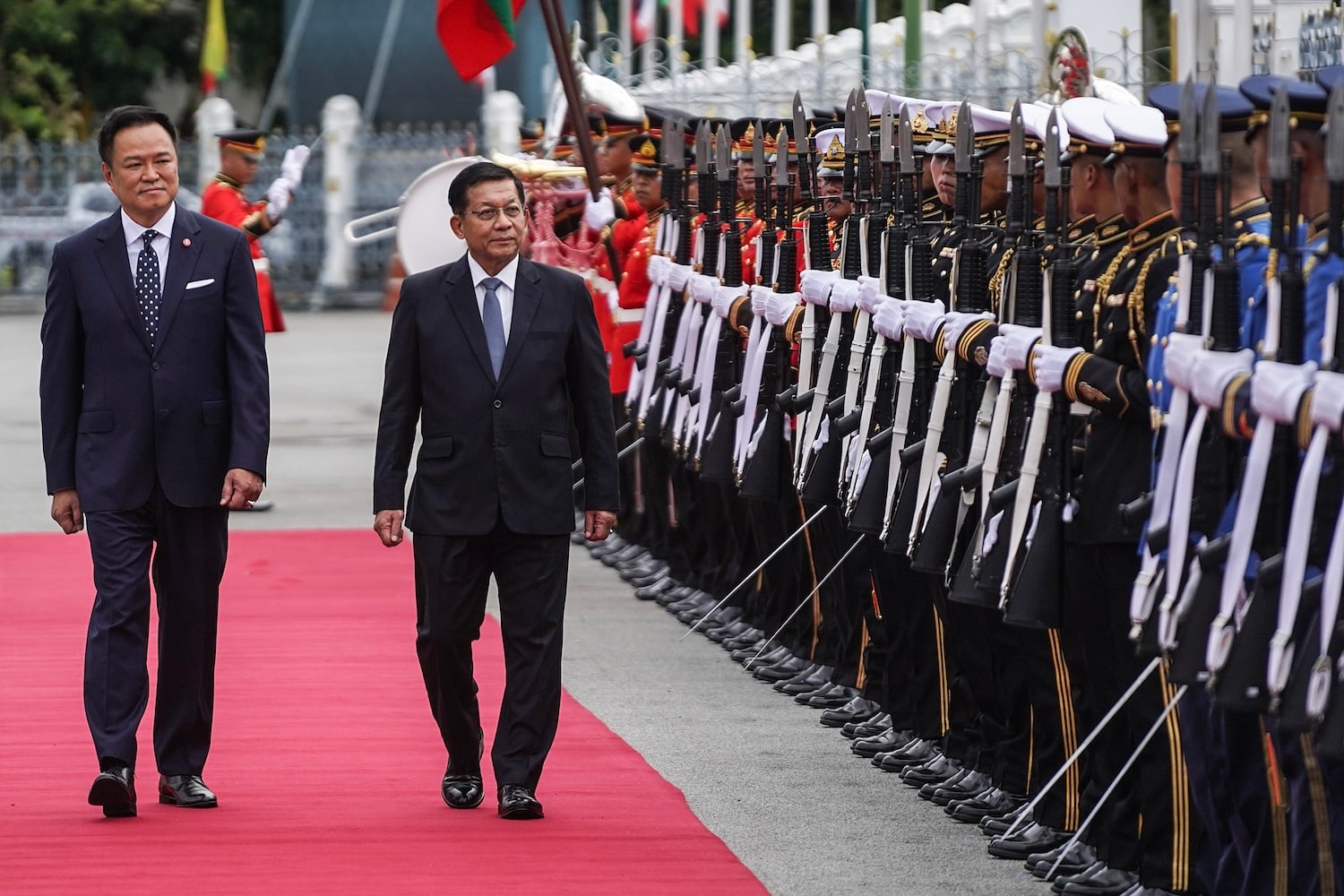
Myanmar's junta leader Min Aung Hlaing visited Bangkok to advance his country's diplomatic normalization with ASEAN, following years of isolation after the 2021 coup. However, Myanmar's rigid rejection of ASEAN's five-point consensus may undermine its efforts to regain full membership.
Myanmar Junta Leader Min Aung Hlaing Visits Bangkok as Part of ASEAN Normalization Push
!Foreign Policy
Foreign Policy
Get analysis and alerts more quickly in the mobile app.
Install
Back to Foreign Policy Magazine home page
* Latest
* Regions
+ Asia & the Pacific
+ China
+ Middle East & Africa
+ Americas
+ Europe
* Newsletters
Editors’ Picks
Evening roundup with our editors’ favorite stories of the day
!World Brief Icon
World Brief
Your guide to the most important world stories of the day
!China Brief Icon
China Brief
The latest news, analysis, and data from the country each week
Situation Report
Weekly update on what’s driving U.S. national security policy
FP Weekend
A curation of our best book reviews, deep dives, and other reads
!Africa Brief Icon
Africa Brief
Essential analysis of the stories shaping geopolitics on the continent
!South Asia Brief Icon
South Asia Brief
Weekly update on developments in India and its neighbors
The Reading List
Curated guides on geopolitics and current affairs
FP Bookshelf
A monthly guide to FP’s book reviews, excerpts, and reading recommendations
!Latin America Brief Icon
Latin America Brief
One-stop digest of politics, economics, and culture
!Southeast Asia Brief Icon
Southeast Asia Brief
A weekly dispatch with news from the region’s 11 countries
The New Geopolitics
A five-part masterclass in IR theory with Harvard Professor Stephen M. Walt
View All Newsletters
* FP Live
* Latest
* Trending:
* Europe's record heatwave
* Gaza plan
* Ceuta's future
* Colombia's new president
Search this website
* Preferences
* My FP Feed
* Saved Articles
* Newsletters
* Magazine Archive
* Subscription Settings
* FAQs
* Log Out
Sign In
Sign In
Partner with FP at UNGA81 Partner with FP at UNGA81
Subscribe SubscribePartner with FP at UNGA81 Partner with FP at UNGA81
Southeast Asia Brief:
Will Myanmar Get What It Wants From ASEAN?
*
*
* Facebook
* Bluesky
* X
* LinkedIn
* WhatsApp
* Reddit
Save
1. Create an FP account to save articles to read later.
Sign Up
ALREADY AN FP SUBSCRIBER? LOGIN
PDF
1. **Downloadable PDFs** are a benefit of an FP subscription.
Subscribe Now
ALREADY AN FP SUBSCRIBER? LOGIN
Gift
*
*
* WhatsApp
1. Gifting articles is a subscriber benefit.
Subscribe Now
ALREADY AN FP SUBSCRIBER? LOGIN
2. This article is an Insider exclusive.
Contact us at [email protected] to learn about upgrade options, unlocking the ability to gift this article.
Southeast Asia Brief
A weekly dispatch on the politics, economics, and culture of a pivotal region, caught between China and the United States but still going its own way. Written by Bangkok-based journalist **Joseph Rachman**.
Will Myanmar Get What It Wants From ASEAN?
A Bangkok visit by junta leader Min Aung Hlaing reinforced the two countries’ ties.
!Joseph Rachman: A pencil drawing of a man wearing glasses in a t-shirt
*Joseph Rachman: A pencil drawing of a man wearing glasses in a t-shirt*
*Joseph Rachman*
By **Joseph Rachman**, the writer of *Foreign Policy*’s weekly Southeast Asia Brief.
!Myanmar’s President Min Aung Hlaing, accompanied by Thai Prime Minister Anutin Charnvirakul, reviews a guard of honor during an official welcoming ceremony at the Government House in Bangkok on Aug. 6.
*Myanmar’s President Min Aung Hlaing, accompanied by Thai Prime Minister Anutin Charnvirakul, reviews a guard of honor during an official welcoming ceremony at the Government House in Bangkok on Aug. 6.*
Myanmar’s President Min Aung Hlaing, accompanied by Thai Prime Minister Anutin Charnvirakul, reviews a guard of honor during an official welcoming ceremony at the Government House in Bangkok on Aug. 6. Anusak Laowilas/NurPhoto via Getty Images
*
August 12, 2026, 1:00 AM
Welcome to *Foreign Policy*’s Southeast Asia Brief.
The highlights this week: Myanmar junta leader Min Aung Hlaing **visits Bangkok** as part of an ongoing **diplomatic push**; the Philippines’ **growth slumps**; and a school shooting **puts Thailand’s gun culture** in the global spotlight.
Welcome to *Foreign Policy*’s Southeast Asia Brief.
The highlights this week: Myanmar junta leader Min Aung Hlaing **visits Bangkok** as part of an ongoing **diplomatic push**; the Philippines’ **growth slumps**; and a school shooting **puts Thailand’s gun culture** in the global spotlight.
---
Min Aung Hlaing in Bangkok
Myanmar junta leader Min Aung Hlaing visited Bangkok last week, part of an ongoing and successful diplomatic push following sham elections held in 2025-2026 and his own inauguration as president in April.
The visit to Thailand follows an official visit to India from May to June, China in June, and Laos in July. It marks the latest phase in Thailand’s continued normalization of relations with Myanmar. Sharing a 1,500-mile border with the country, Thailand’s foreign minister has said they need to be realistic in their dealings. (But not everyone is on board.)
The trip is also part of the push for Myanmar to normalize relations with the Association of Southeast Asian Nations (ASEAN), which has excluded Myanmar’s leaders from its summits since the 2021 coup. Thailand has been a key backer of this push. In July, it hosted an informal meeting between Myanmar’s foreign minister and ASEAN foreign ministers.
The joint statement issued by the two country’s foreign ministries included a laundry list of topics. These included more cooperation against transnational crimes, including drug smuggling and scams; cooperation against transboundary pollution such as haze and water pollution; a push to boost bilateral trade to $12 billion; and memorandums of understanding on labor, tourism, and space.
With the exception of tourism and space—the former peripheral given the civil war, the latter fanciful—these are all important issues for Thailand. Transnational crimeaffects Thai citizens. Water pollution linked to rare-earth mining in Myanmar is poisoning its most important rivers. And some 4 million citizens of Myanmar work in Thailand.
Whether this meeting will have any real effect, though, is doubtful. Myanmar is making a show of cracking down on some issues such as scams. Its parliament recently voted to impose the death penalty for those who coerce people to work in scam centers.
But many of the damaging activities take place in areas controlled not by the military government but by Myanmar’s multitude of armed groups. Here, I am told, the Thai military has done its own quiet outreach with limited success.
On ASEAN normalization, Myanmar has made progress. Thailand pledged in the joint statement to support Myanmar’s “full and equal participation in ASEAN.”
And in May, at the ASEAN leader’s summit in Cebu, Philippines, the rotating chair—President Ferdinand Marcos Jr. of the Philippines—spoke of the need for a new approach.
But Myanmar’s newfound confidence is also encouraging a truculence that could backfire.
Following the meeting in Bangkok, the Philippines called for the “complete and unconditional release” of opposition leader Aung San Suu Kyi. This was rebuffed by Myanmar’s Foreign Ministry.
To be accepted as a full member again, Myanmar also needs to overturn the five-point consensus.
Agreed to by ASEAN leaders as well as Min Aung Hlaing in the aftermath of the 2021 coup, the five-point consensus lays out the following principles: an end to violence in Myanmar, “constructive dialogue among all parties,” a special ASEAN envoy to help with talks, humanitarian aid, and an ASEAN delegation to the country.
To date, there has been basically nil progress on these points. So if the consensus stands, it impedes normalization.
In July, as Myanmar’s government began to see diplomatic breakthroughs, its parliament voted to formally to reject the five-point consensus. And on July 31, Min Aung Hlaing gave a speech criticizing it as “discriminatory” and “not the consensus of all ASEAN member states.”
Singapore, which will serve as ASEAN chair next year, will b
!Foreign Policy
Foreign Policy
Get analysis and alerts more quickly in the mobile app.
Install
Back to Foreign Policy Magazine home page
* Latest
* Regions
+ Asia & the Pacific
+ China
+ Middle East & Africa
+ Americas
+ Europe
* Newsletters
Editors’ Picks
Evening roundup with our editors’ favorite stories of the day
!World Brief Icon
World Brief
Your guide to the most important world stories of the day
!China Brief Icon
China Brief
The latest news, analysis, and data from the country each week
Situation Report
Weekly update on what’s driving U.S. national security policy
FP Weekend
A curation of our best book reviews, deep dives, and other reads
!Africa Brief Icon
Africa Brief
Essential analysis of the stories shaping geopolitics on the continent
!South Asia Brief Icon
South Asia Brief
Weekly update on developments in India and its neighbors
The Reading List
Curated guides on geopolitics and current affairs
FP Bookshelf
A monthly guide to FP’s book reviews, excerpts, and reading recommendations
!Latin America Brief Icon
Latin America Brief
One-stop digest of politics, economics, and culture
!Southeast Asia Brief Icon
Southeast Asia Brief
A weekly dispatch with news from the region’s 11 countries
The New Geopolitics
A five-part masterclass in IR theory with Harvard Professor Stephen M. Walt
View All Newsletters
* FP Live
* Latest
* Trending:
* Europe's record heatwave
* Gaza plan
* Ceuta's future
* Colombia's new president
Search this website
* Preferences
* My FP Feed
* Saved Articles
* Newsletters
* Magazine Archive
* Subscription Settings
* FAQs
* Log Out
Sign In
Sign In
Partner with FP at UNGA81 Partner with FP at UNGA81
Subscribe SubscribePartner with FP at UNGA81 Partner with FP at UNGA81
Southeast Asia Brief:
Will Myanmar Get What It Wants From ASEAN?
*
*
* Bluesky
* X
Save
1. Create an FP account to save articles to read later.
Sign Up
ALREADY AN FP SUBSCRIBER? LOGIN
1. **Downloadable PDFs** are a benefit of an FP subscription.
Subscribe Now
ALREADY AN FP SUBSCRIBER? LOGIN
Gift
*
*
1. Gifting articles is a subscriber benefit.
Subscribe Now
ALREADY AN FP SUBSCRIBER? LOGIN
2. This article is an Insider exclusive.
Contact us at [email protected] to learn about upgrade options, unlocking the ability to gift this article.
Southeast Asia Brief
A weekly dispatch on the politics, economics, and culture of a pivotal region, caught between China and the United States but still going its own way. Written by Bangkok-based journalist **Joseph Rachman**.
Will Myanmar Get What It Wants From ASEAN?
A Bangkok visit by junta leader Min Aung Hlaing reinforced the two countries’ ties.
!Joseph Rachman: A pencil drawing of a man wearing glasses in a t-shirt
*Joseph Rachman: A pencil drawing of a man wearing glasses in a t-shirt*
*Joseph Rachman*
By **Joseph Rachman**, the writer of *Foreign Policy*’s weekly Southeast Asia Brief.
!Myanmar’s President Min Aung Hlaing, accompanied by Thai Prime Minister Anutin Charnvirakul, reviews a guard of honor during an official welcoming ceremony at the Government House in Bangkok on Aug. 6.
*Myanmar’s President Min Aung Hlaing, accompanied by Thai Prime Minister Anutin Charnvirakul, reviews a guard of honor during an official welcoming ceremony at the Government House in Bangkok on Aug. 6.*
Myanmar’s President Min Aung Hlaing, accompanied by Thai Prime Minister Anutin Charnvirakul, reviews a guard of honor during an official welcoming ceremony at the Government House in Bangkok on Aug. 6. Anusak Laowilas/NurPhoto via Getty Images
*
August 12, 2026, 1:00 AM
Welcome to *Foreign Policy*’s Southeast Asia Brief.
The highlights this week: Myanmar junta leader Min Aung Hlaing **visits Bangkok** as part of an ongoing **diplomatic push**; the Philippines’ **growth slumps**; and a school shooting **puts Thailand’s gun culture** in the global spotlight.
Welcome to *Foreign Policy*’s Southeast Asia Brief.
The highlights this week: Myanmar junta leader Min Aung Hlaing **visits Bangkok** as part of an ongoing **diplomatic push**; the Philippines’ **growth slumps**; and a school shooting **puts Thailand’s gun culture** in the global spotlight.
---
Min Aung Hlaing in Bangkok
Myanmar junta leader Min Aung Hlaing visited Bangkok last week, part of an ongoing and successful diplomatic push following sham elections held in 2025-2026 and his own inauguration as president in April.
The visit to Thailand follows an official visit to India from May to June, China in June, and Laos in July. It marks the latest phase in Thailand’s continued normalization of relations with Myanmar. Sharing a 1,500-mile border with the country, Thailand’s foreign minister has said they need to be realistic in their dealings. (But not everyone is on board.)
The trip is also part of the push for Myanmar to normalize relations with the Association of Southeast Asian Nations (ASEAN), which has excluded Myanmar’s leaders from its summits since the 2021 coup. Thailand has been a key backer of this push. In July, it hosted an informal meeting between Myanmar’s foreign minister and ASEAN foreign ministers.
The joint statement issued by the two country’s foreign ministries included a laundry list of topics. These included more cooperation against transnational crimes, including drug smuggling and scams; cooperation against transboundary pollution such as haze and water pollution; a push to boost bilateral trade to $12 billion; and memorandums of understanding on labor, tourism, and space.
With the exception of tourism and space—the former peripheral given the civil war, the latter fanciful—these are all important issues for Thailand. Transnational crimeaffects Thai citizens. Water pollution linked to rare-earth mining in Myanmar is poisoning its most important rivers. And some 4 million citizens of Myanmar work in Thailand.
Whether this meeting will have any real effect, though, is doubtful. Myanmar is making a show of cracking down on some issues such as scams. Its parliament recently voted to impose the death penalty for those who coerce people to work in scam centers.
But many of the damaging activities take place in areas controlled not by the military government but by Myanmar’s multitude of armed groups. Here, I am told, the Thai military has done its own quiet outreach with limited success.
On ASEAN normalization, Myanmar has made progress. Thailand pledged in the joint statement to support Myanmar’s “full and equal participation in ASEAN.”
And in May, at the ASEAN leader’s summit in Cebu, Philippines, the rotating chair—President Ferdinand Marcos Jr. of the Philippines—spoke of the need for a new approach.
But Myanmar’s newfound confidence is also encouraging a truculence that could backfire.
Following the meeting in Bangkok, the Philippines called for the “complete and unconditional release” of opposition leader Aung San Suu Kyi. This was rebuffed by Myanmar’s Foreign Ministry.
To be accepted as a full member again, Myanmar also needs to overturn the five-point consensus.
Agreed to by ASEAN leaders as well as Min Aung Hlaing in the aftermath of the 2021 coup, the five-point consensus lays out the following principles: an end to violence in Myanmar, “constructive dialogue among all parties,” a special ASEAN envoy to help with talks, humanitarian aid, and an ASEAN delegation to the country.
To date, there has been basically nil progress on these points. So if the consensus stands, it impedes normalization.
In July, as Myanmar’s government began to see diplomatic breakthroughs, its parliament voted to formally to reject the five-point consensus. And on July 31, Min Aung Hlaing gave a speech criticizing it as “discriminatory” and “not the consensus of all ASEAN member states.”
Singapore, which will serve as ASEAN chair next year, will b
🔗 Share Article
Tags:#ميانمار#آسيان#دبلوماسية#تايلاند#انقلاب عسكري#مين أونج هلاينج
Source: Foreign Policy
For Context
Related reads from the same topic or latest developments


