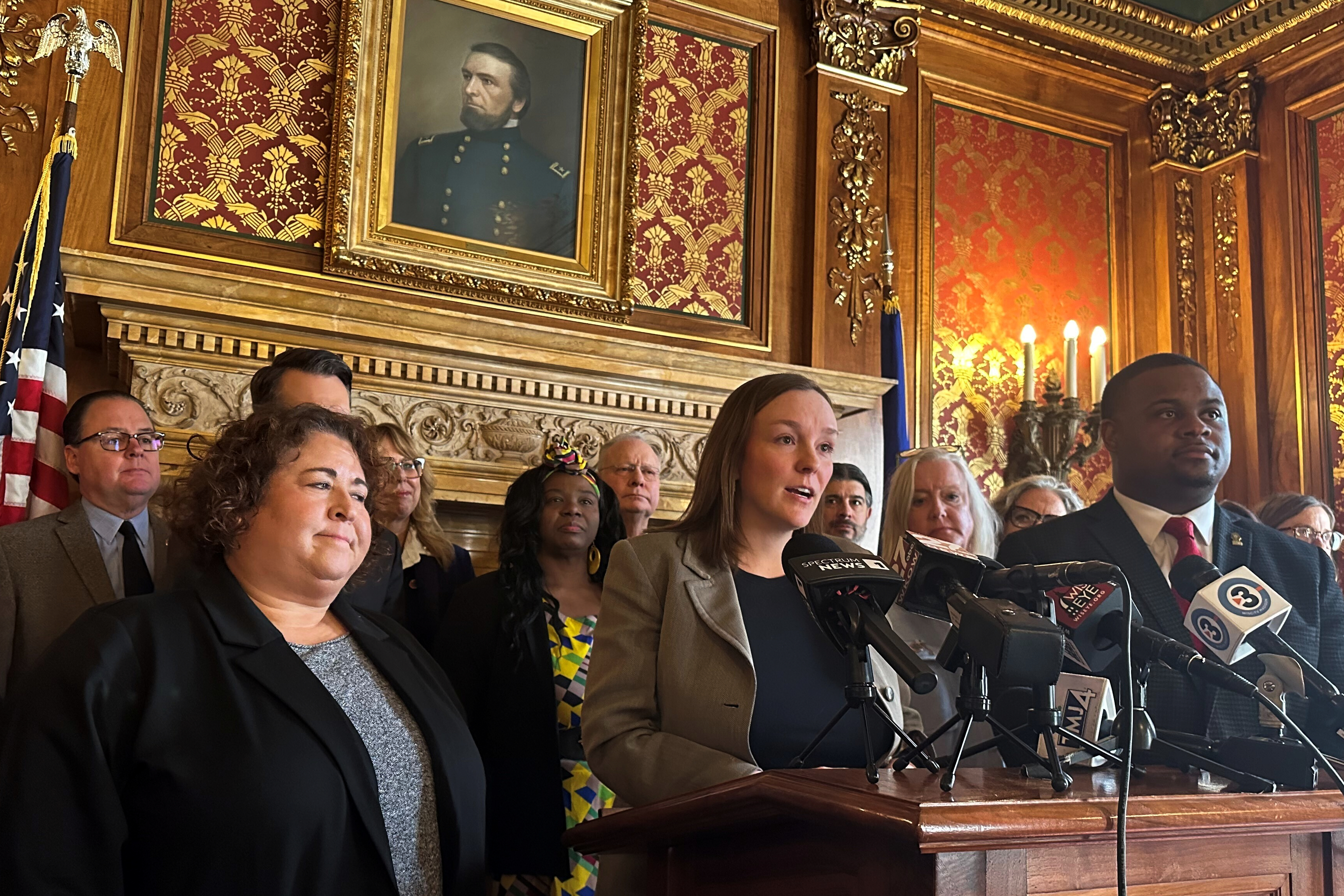
When Danielle Bensky first went to The Donald J Trump and Jeffrey Epstein Memorial Reading Room, she didn’t know what to expect.
“What happens if I walk in and survivors’ names are just plastered everywhere?” Bensky wondered about the reading room, a traveling exhibition of Epstein investigative files, first held in a New York City gallery this May. “I was a little worried in the beginning that this would be a form of exploitation for survivors.
“Instead, it was just so beautifully done.”
The reading room is meant to bring attention to Epstein’s crimes and law enforcement’s decades-long failure to act. The former financier, who counted numerous high-profile men among his associates, was arrested in 2019 for sexual abuse of teen girls but killed himself in jail.
While Ghislaine Maxwell was arrested and found guilty of luring teen girls into Epstein’s orbit, documents reveal that law enforcement officials were well aware of their crimes decades prior. Survivors have called for greater transparency and legal actions against any other participants in their sexual abuse.
Bensky also didn’t know what would happen when David Garrett, founder of event organizer the Institute for Primary Facts, floated an idea to make the exhibit more interactive. There was a cork board in the final room and Garrett told Bensky he was going to keep it there when this exhibition opened to the public, so visitors could leave notes.
“I was like, ‘Oh, that’s such a great idea,” said Bensky, who is among the Epstein survivors pushing for accountability and justice. “That’ll be so cool to see.”
About a week after the reading room officially opened, Bensky returned and saw “at least six or seven corkboards that were full and overflowing with notes”. There were notes with drawings and notes with abject sadness and “sometimes, it was pure rage”.
“Sometimes, it would be a note directly to a survivor. Sometimes it was a note directly to themselves, and it got everybody involved,” she said. “Even members of survivors’ families were leaving notes. It was just a really beautiful display of our democracy.”
Bensky said the notes have given her hope amid years of institutional failures.
“Being seen in this process has been pretty remarkable.” Visitors have written, “We’re here with you, we stand with you, and we believe you” – demonstrating the “really beautiful empathy that comes with every single note”, Bensky said.
“There have been days where I felt like I couldn’t really do much. I felt really debilitated,” Bensky said. “The reading room can be a lot when you’re walking through your trauma all day, and you’re meeting all kinds of people.
“But so many of us will just go and sit in the room with all the notes and read the notes, and it’s like, ‘Wow, what an extraordinary thing to actually be seen and be believed by so many people at this point.’”
Liz Stein, an Epstein survivor, expressed similar sentiments about the power of these notes.
“It started out with one bulletin board, and I will never forget seeing that one initial bulletin board and just really feeling like, ‘Oh my goodness, people are really reacting to that,’” Stein said. When the first reading room installation ended, these notes “took up the better part of the downstairs of the exhibit”.
“The love that people show us is overwhelming, and every time we do these events with the reading room, every single time, people hug us, they tell us what we mean to them, and a lot of times they’ll say, ‘But it doesn’t matter. I’m just someone you don’t know from somewhere you don’t live,’” Stein said.
“And it’s like, no, we might not know your individual names, but we feel the love.”
“This wall with the note cards is a really tangible visual representation of how much support we have, and that fuels us in a way that I don’t think people quite understand.”
Garrett said that the idea for a notes space came at the last minute. He thought that people might experience deep emotions from the exhibit and might feel the need for support.
So, organizers put up a cork board with information about the national suicide prevention hotline as well as resources for those experiencing gender-based violence. Without thinking about it too much, Garrett decided to leave some extra notecards and pens.
“We just put them out and said, “if you want to write a note to the survivors, you can do that,” he told the Guardian. “We didn’t think that we would need more than that two foot by three foot corkboard.”
“By the end of the first day, not only was the corkboard full, but [notes] were taped up all around the cork board.” After just one day, visitors had left about 300 cards.
For the next 10 days, the producer would buy more cork boards everyday. There were 30 by the time the reading room ended its initial exhibition. “Every surface on that basement downstairs was full of cork boards and full of cards.”
The reading room would come to have seven stops – New York City; Washington DC; Des Moines, Iowa; Columbus, Ohio; Detroit, Michigan; Dallas, Texas; and Fort Lauderdale, Florida – and a traveling bookmobile that made about two dozen stops. In total, visitors left approximately 12,500 or 13,000 notes, Garrett said.
The reading room kicked off several months before highly contentious midterm elections dealt Republicans numerous blows which, some commentators said, was due to voters rejecting Trump. The president and Maga Republicans have been saddled by his administration’s handling of the files since he took office.
The White House rejected criticism of Trump’s handling of the files.
“Just as President Trump has said, he’s been totally exonerated on anything relating to Epstein,” White House spokeswoman Lauren Bis said.
“And by releasing thousands of pages of documents, cooperating with the House oversight committee’s subpoena request, signing the Epstein Files Transparency Act, and calling for more investigations into Epstein’s Democrat friends, President Trump has done more for Epstein’s victims than anyone before him.”
Trump’s DoJ rebuffed criticism of their handling of these files and condemned the reading room.
“This sham tour is traveling to politically competitive areas and shamefully using victims as political pawns,” a DoJ spokesperson said in a statement.
“The non-profit’s fundraising ploy, which often hosts candidates for office, is a disgrace. It’s thanks to this Department of Justice that they even have those files, released in compliance with the Epstein Files Transparency Act under the most transparent administration to date.”
The words from supporters, both in person and notes, have provided encouragement to keep pushing for justice in spite of institutional roadblocks, Stein said.
“Your courage is louder than the people who tried to silence you,” was among Stein’s favorite notes. Another, Stein recalled, said: “One of these girls could have been me or my friends.”
“Money and power should not dictate justice,” Stein said of another memorable note.
Bensky also recalled one particularly powerful message.
“There was one that was just so simple,” Bensky recalled. “I think it literally just said: ‘It wasn’t your fault.’”
‘We feel the love’: Epstein survivors overwhelmed by messages of support at pop-up art exhibition
Visitors to the traveling "reading room" exhibition, which displays Epstein investigative files and highlights decades of law enforcement inaction, left roughly 12,500 to 13,000 notes of support for survivors, who say the messages fuel their fight for justice. The Justice Department condemned the tour as a sham that uses victims as political pawns, while the White House defended President Trump's handling of the files.
Cross Lines newsroom
Share this article
#إبستين#ناجيات#غرفة القراءة#وزارة العدل#ترامب#الولايات المتحدة
Original source: The Guardian US