PoliticsAvailable in English
Investigators search for cause in Florida plane crash that killed all nine onboard
Editorial
Cross Lines editing
Source
The Guardian US
The Guardian US
T
The Guardian US
Original Source
Investigators are searching for the cause of a private jet crash in a densely populated area of Palm Beach County, Florida, that killed all nine people on board. Audio recordings of the pilot's exchanges with air traffic control suggest that ice buildup, rather than engine failure, may have been responsible.
Investigators are searching for the cause of a plane crash in a heavily populated area of Palm Beach county, Florida, that killed all nine people onboard.
The private Learjet 60, with the tail number N722BD, was en route from Austin-Bergstrom international airport in Texas to North Eleuthera airport in the Bahamas on Sunday when it suddenly plummeted out of the sky.
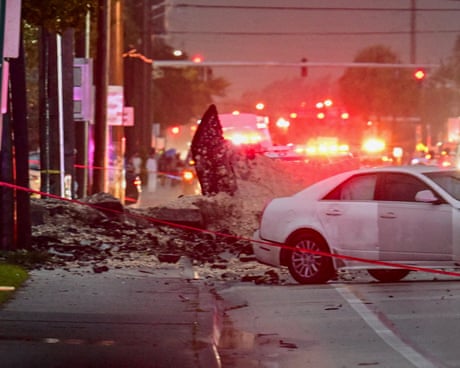
It crashed at about 12.50pm local time on Sunday, exploding on impact, resulting in scattered debris all over the crash site, near a mobile home community.
Zachary Gorwitz, a Miami-based aviation attorney, told the Miami Herald that it was uncommon for a plane to fall so quickly mid-flight and nosedive, indicating the crash may be the result of an icing issue rather than engine failure.
Gorwitz reviewed the audio recording between the plane’s pilot and air traffic control, which highlighted the fast descent of the plane – about 7 miles (11km) in 60 seconds. The pilot had informed air traffic control that she was experiencing ice and turbulence issues within minutes of the crash.
The recording led Gorwitz to believe the plane was experiencing an icing issue, in which ice particles build up on key parts of the plane. The attorney added that the ice particles could have accumulated on the plane’s horizontal stabilizer, located on the rear of the aircraft to prevent the nose from tipping too far up or down.
He added in the case of engine failure, there is a more gradual descent, telling the Miami Herald, “there was no gliding here” and that typically aircraft accidents occur shortly around takeoff or landing.
Gorwitz added there was a lot of surface debris from the crash site as the plane nosedived at more than 600 miles per hour, “so it’s really not surprising that there wouldn’t be a lot of surface debris because of the incredible force of the impact.”
Bombardier, which owns the Learjet brand, told the Miami Herald in statement: “We cannot comment on the potential cause of this accident until the investigation is complete, and we will fully support the investigating authorities and cooperate as needed.”
Share Article
Tags:#تحطم طائرة#فلوريدا#لير جت#تحقيقات الطيران#بالم بيتش#حوادث
Source: The Guardian US
For Context
Related reads from the same topic or latest developments

Same context
Lindsay Clancy back in court seeking to dismiss murder charges after mistrial

Follow-up
Abdul El-Sayed’s campaign reports record fundraising day as Haley Stevens faces backlash for endorsing his opponent – live

Follow-up