Brazil’s Election Won’t Fix Its Biggest Problems
Foreign Policy

Foreign Policy
Original Source
Despite fierce competition between Lula and Bolsonaro in Brazil's upcoming election, neither candidate can address the nation's core challenges: anemic economic growth and entrenched corruption. Brazil remains trapped in a cycle of crisis, reform, and backsliding.
Brazil Election: Corruption, Slow Growth Haunt Lula and Bolsonaro
By using this website, you agree to our use of cookies. This use includes personalization of content and ads, and traffic analytics. Review our Privacy Policy for more information.
!Foreign Policy
Foreign Policy
Get analysis and alerts more quickly in the mobile app.
Install
Back to Foreign Policy Magazine home page
* Latest
* Regions
+ Asia & the Pacific
+ China
+ Middle East & Africa
+ Americas
+ Europe
* Newsletters
Editors’ Picks
Evening roundup with our editors’ favorite stories of the day
!World Brief Icon
World Brief
Your guide to the most important world stories of the day
!China Brief Icon
China Brief
The latest news, analysis, and data from the country each week
Situation Report
Weekly update on what’s driving U.S. national security policy
FP Weekend
A curation of our best book reviews, deep dives, and other reads
!Africa Brief Icon
Africa Brief
Essential analysis of the stories shaping geopolitics on the continent
!South Asia Brief Icon
South Asia Brief
Weekly update on developments in India and its neighbors
The Reading List
Curated guides on geopolitics and current affairs
FP Bookshelf
A monthly guide to FP’s book reviews, excerpts, and reading recommendations
!Latin America Brief Icon
Latin America Brief
One-stop digest of politics, economics, and culture
!Southeast Asia Brief Icon
Southeast Asia Brief
A weekly dispatch with news from the region’s 11 countries
The New Geopolitics
A five-part masterclass in IR theory with Harvard Professor Stephen M. Walt
View All Newsletters
* FP Live
* Latest
* Trending:
* 25 years after 9/11
* Germany elections
Search this website
* Preferences
* My FP Feed
* Saved Articles
* Newsletters
* Magazine Archive
* Subscription Settings
* FAQs
* Log Out
Sign In
Sign In
Partner with FP at UNGA81 Partner with FP at UNGA81
Subscribe SubscribePartner with FP at UNGA81 Partner with FP at UNGA81
Argument:
Brazil’s Election Won’t Fix Its Biggest Problems
*
*
* Facebook
* Bluesky
* X
* LinkedIn
* WhatsApp
* Reddit
Save
1. Create an FP account to save articles to read later.
Sign Up
ALREADY AN FP SUBSCRIBER? LOGIN
PDF
1. **Downloadable PDFs** are a benefit of an FP subscription.
Subscribe Now
ALREADY AN FP SUBSCRIBER? LOGIN
Gift
*
*
* WhatsApp
1. Gifting articles is a subscriber benefit.
Subscribe Now
ALREADY AN FP SUBSCRIBER? LOGIN
2. This article is an Insider exclusive.
Contact us at [email protected] to learn about upgrade options, unlocking the ability to gift this article.
Argument
An expert’s point of view on a current event.
Brazil’s Election Won’t Fix Its Biggest Problems
Slow growth and corruption have dogged the right and the left.
By **Adam Goldsmith**, the director for Latin America at Greenmantle.
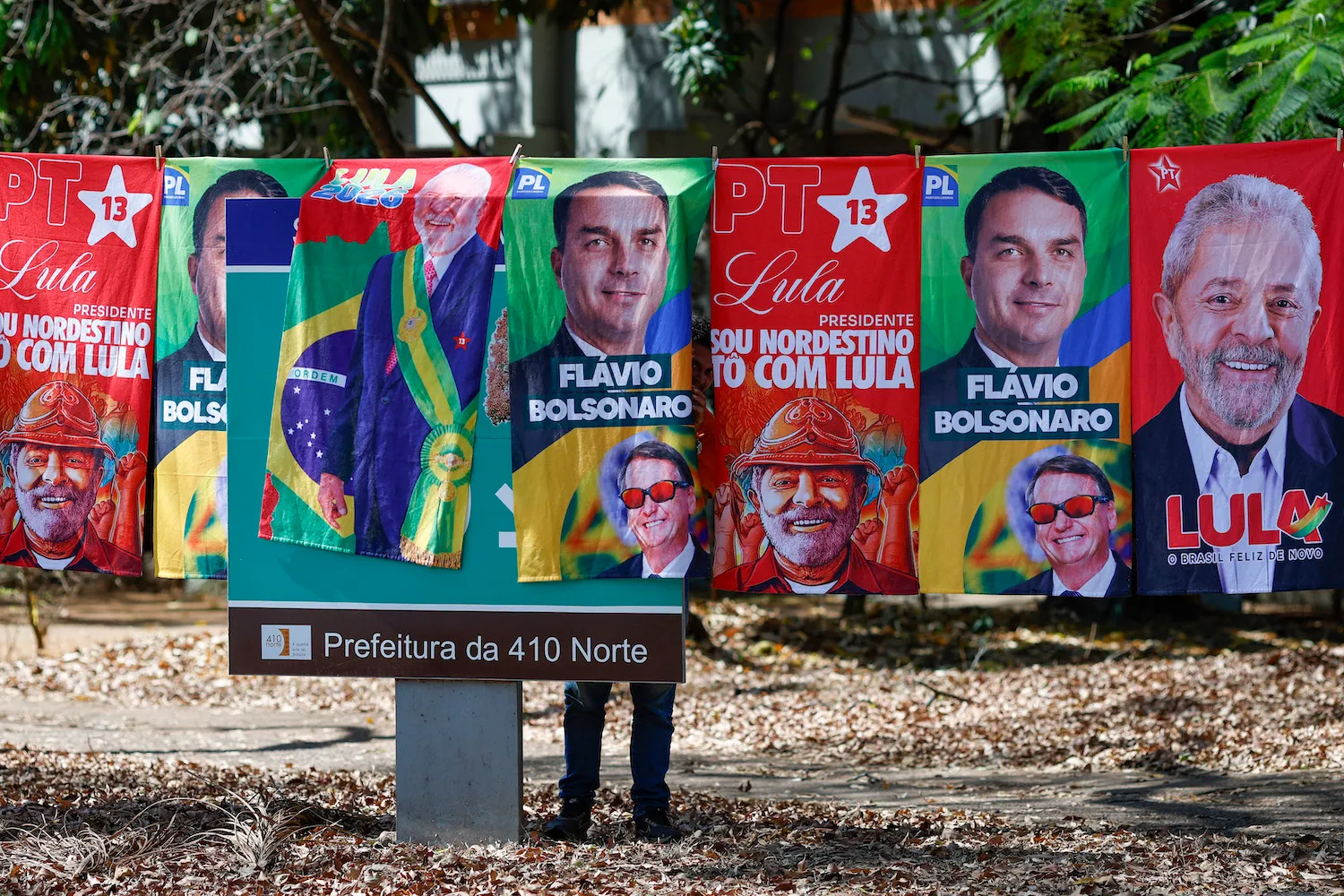
!Half a dozen colorful towels hang from a clothesline, with a person's legs visible beneath them where he stands behind the display. Some of the towels are green and yellow and show Bolsonaro's face; others are mainly red and show images of Lula.
*Half a dozen colorful towels hang from a clothesline, with a person's legs visible beneath them where he stands behind the display. Some of the towels are green and yellow and show Bolsonaro's face; others are mainly red and show images of Lula.*
A vendor sells towels depicting Brazil’s two leading presidential candidates, incumbent President Luiz Inácio Lula da Silva and Flávio Bolsonaro, in Brasília, Brazil, on Sept. 11. Sergio Lima/AFP via Getty Images
1. Get audio access with any FP subscription.
Subscribe Now
ALREADY AN FP SUBSCRIBER? LOGIN
September 15, 2026, 10:43 AM
On Oct. 4, Brazilians will vote in the first round of a presidential election with two clear front-runners who appear to be opposites. Incumbent President Luiz Inácio Lula da Silva is running on a platform of economic populism, social liberalism, and political stability. His main challenger, Sen. Flávio Bolsonaro, is campaigning as the torchbearer of the socially conservative movement that his now-convicted father, President Jair Bolsonaro, launched in 2018.
Despite these competing visions, both candidates are unlikely to solve Brazil’s core issues: anemic long-term growth and entrenched corruption. Hastening growth requires structurally lower interest rates, which means deep fiscal reform. Addressing corruption and impunity, meanwhile, would require a wholesale reappraisal of Brazil’s post-dictatorship justice system.
On Oct. 4, Brazilians will vote in the first round of a presidential election with two clear front-runners who appear to be opposites. Incumbent President Luiz Inácio Lula da Silva is running on a platform of economic populism, social liberalism, and political stability. His main challenger, Sen. Flávio Bolsonaro, is campaigning as the torchbearer of the socially conservative movement that his now-convicted father, President Jair Bolsonaro, launched in 2018.
Despite these competing visions, both candidates are unlikely to solve Brazil’s core issues: anemic long-term growth and entrenched corruption. Hastening growth requires structurally lower interest rates, which means deep fiscal reform. Addressing corruption and impunity, meanwhile, would require a wholesale reappraisal of Brazil’s post-dictatorship justice system.
Brazil’s problem is not an inability to reform. It is the country’s inability to institutionalize those changes into lasting solutions. The country has passed legislation attempting to address slow growth and corruption multiple times since redemocratization in the 1980s, but in most cases, politicians either later watered down those reforms or rolled them back entirely.
Brazil is trapped in a cycle of crisis, reform, and backsliding. Breaking out of this cycle is possible, but only if the country can overcome the fragmented political landscape that makes it difficult for voters to attribute policy outcomes to the politicians responsible for them.
---
Brazil has high levels
of sovereign debt, facing steep borrowing costs from lenders. These higher rates propagate through the financial system and raise the cost of investment, which in turn slows growth.
The painful recessions that followed Latin American sovereign debt defaults in the 1980s are a reminder of the kind of danger that Brazil is flirting with by allowing high debt levels. In response to that upheaval, peer countries such as Chile, Colombia, and Peru enshrined rules that strictly limited deficits. This reduced the inflationary impulse and investor risk, allowing for structurally lower interest rates.
Brazil’s reform response was shallower, eventually forcing it to seek out the International Monetary Fund (IMF) for relief in 1998 and 2002.
In the early 2010s, rising deficits and a government-fueled credit boom engendered a massive debt crisis and led to Brazil’s worst recession in a century. That crisis also produced a once-in-a-generation reform process. Brazil’s Congress capped public spending growth at 0 percent in real terms and liberalized the country’s deeply dysfunctional labor market.
Experts widely credit these reforms—especially the spending cap—with bringing Brazil’s interest rates to record lows, reigniting private investment, and permanently increasing the economy’s employment potential. Jair Bolsonaro took office in 2019 and initially maintained this reform-minded momentum. Nevertheless, by 2021, ahead of a reelection bid the following year, he launched a massive expansion of Bolsa Familia, Brazil’s cash transfer program for low-income families.
The program was already a successful policy, but in tripling the budgetary outlay, Jair Bolsonaro converted it into a populist mechanism. Congress was only too eager to abandon its reform approach and return to unconstrained spending. Meanwhile, at the Supreme Court, justices struck down two key provisions of the labor reform that had been important disincentives for spurious litigation.
The cycle of
By using this website, you agree to our use of cookies. This use includes personalization of content and ads, and traffic analytics. Review our Privacy Policy for more information.
!Foreign Policy
Foreign Policy
Get analysis and alerts more quickly in the mobile app.
Install
Back to Foreign Policy Magazine home page
* Latest
* Regions
+ Asia & the Pacific
+ China
+ Middle East & Africa
+ Americas
+ Europe
* Newsletters
Editors’ Picks
Evening roundup with our editors’ favorite stories of the day
!World Brief Icon
World Brief
Your guide to the most important world stories of the day
!China Brief Icon
China Brief
The latest news, analysis, and data from the country each week
Situation Report
Weekly update on what’s driving U.S. national security policy
FP Weekend
A curation of our best book reviews, deep dives, and other reads
!Africa Brief Icon
Africa Brief
Essential analysis of the stories shaping geopolitics on the continent
!South Asia Brief Icon
South Asia Brief
Weekly update on developments in India and its neighbors
The Reading List
Curated guides on geopolitics and current affairs
FP Bookshelf
A monthly guide to FP’s book reviews, excerpts, and reading recommendations
!Latin America Brief Icon
Latin America Brief
One-stop digest of politics, economics, and culture
!Southeast Asia Brief Icon
Southeast Asia Brief
A weekly dispatch with news from the region’s 11 countries
The New Geopolitics
A five-part masterclass in IR theory with Harvard Professor Stephen M. Walt
View All Newsletters
* FP Live
* Latest
* Trending:
* 25 years after 9/11
* Germany elections
Search this website
* Preferences
* My FP Feed
* Saved Articles
* Newsletters
* Magazine Archive
* Subscription Settings
* FAQs
* Log Out
Sign In
Sign In
Partner with FP at UNGA81 Partner with FP at UNGA81
Subscribe SubscribePartner with FP at UNGA81 Partner with FP at UNGA81
Argument:
Brazil’s Election Won’t Fix Its Biggest Problems
*
*
* Bluesky
* X
Save
1. Create an FP account to save articles to read later.
Sign Up
ALREADY AN FP SUBSCRIBER? LOGIN
1. **Downloadable PDFs** are a benefit of an FP subscription.
Subscribe Now
ALREADY AN FP SUBSCRIBER? LOGIN
Gift
*
*
1. Gifting articles is a subscriber benefit.
Subscribe Now
ALREADY AN FP SUBSCRIBER? LOGIN
2. This article is an Insider exclusive.
Contact us at [email protected] to learn about upgrade options, unlocking the ability to gift this article.
Argument
An expert’s point of view on a current event.
Brazil’s Election Won’t Fix Its Biggest Problems
Slow growth and corruption have dogged the right and the left.
By **Adam Goldsmith**, the director for Latin America at Greenmantle.
!Half a dozen colorful towels hang from a clothesline, with a person's legs visible beneath them where he stands behind the display. Some of the towels are green and yellow and show Bolsonaro's face; others are mainly red and show images of Lula.
*Half a dozen colorful towels hang from a clothesline, with a person's legs visible beneath them where he stands behind the display. Some of the towels are green and yellow and show Bolsonaro's face; others are mainly red and show images of Lula.*
A vendor sells towels depicting Brazil’s two leading presidential candidates, incumbent President Luiz Inácio Lula da Silva and Flávio Bolsonaro, in Brasília, Brazil, on Sept. 11. Sergio Lima/AFP via Getty Images
1. Get audio access with any FP subscription.
Subscribe Now
ALREADY AN FP SUBSCRIBER? LOGIN
September 15, 2026, 10:43 AM
On Oct. 4, Brazilians will vote in the first round of a presidential election with two clear front-runners who appear to be opposites. Incumbent President Luiz Inácio Lula da Silva is running on a platform of economic populism, social liberalism, and political stability. His main challenger, Sen. Flávio Bolsonaro, is campaigning as the torchbearer of the socially conservative movement that his now-convicted father, President Jair Bolsonaro, launched in 2018.
Despite these competing visions, both candidates are unlikely to solve Brazil’s core issues: anemic long-term growth and entrenched corruption. Hastening growth requires structurally lower interest rates, which means deep fiscal reform. Addressing corruption and impunity, meanwhile, would require a wholesale reappraisal of Brazil’s post-dictatorship justice system.
On Oct. 4, Brazilians will vote in the first round of a presidential election with two clear front-runners who appear to be opposites. Incumbent President Luiz Inácio Lula da Silva is running on a platform of economic populism, social liberalism, and political stability. His main challenger, Sen. Flávio Bolsonaro, is campaigning as the torchbearer of the socially conservative movement that his now-convicted father, President Jair Bolsonaro, launched in 2018.
Despite these competing visions, both candidates are unlikely to solve Brazil’s core issues: anemic long-term growth and entrenched corruption. Hastening growth requires structurally lower interest rates, which means deep fiscal reform. Addressing corruption and impunity, meanwhile, would require a wholesale reappraisal of Brazil’s post-dictatorship justice system.
Brazil’s problem is not an inability to reform. It is the country’s inability to institutionalize those changes into lasting solutions. The country has passed legislation attempting to address slow growth and corruption multiple times since redemocratization in the 1980s, but in most cases, politicians either later watered down those reforms or rolled them back entirely.
Brazil is trapped in a cycle of crisis, reform, and backsliding. Breaking out of this cycle is possible, but only if the country can overcome the fragmented political landscape that makes it difficult for voters to attribute policy outcomes to the politicians responsible for them.
---
Brazil has high levels
of sovereign debt, facing steep borrowing costs from lenders. These higher rates propagate through the financial system and raise the cost of investment, which in turn slows growth.
The painful recessions that followed Latin American sovereign debt defaults in the 1980s are a reminder of the kind of danger that Brazil is flirting with by allowing high debt levels. In response to that upheaval, peer countries such as Chile, Colombia, and Peru enshrined rules that strictly limited deficits. This reduced the inflationary impulse and investor risk, allowing for structurally lower interest rates.
Brazil’s reform response was shallower, eventually forcing it to seek out the International Monetary Fund (IMF) for relief in 1998 and 2002.
In the early 2010s, rising deficits and a government-fueled credit boom engendered a massive debt crisis and led to Brazil’s worst recession in a century. That crisis also produced a once-in-a-generation reform process. Brazil’s Congress capped public spending growth at 0 percent in real terms and liberalized the country’s deeply dysfunctional labor market.
Experts widely credit these reforms—especially the spending cap—with bringing Brazil’s interest rates to record lows, reigniting private investment, and permanently increasing the economy’s employment potential. Jair Bolsonaro took office in 2019 and initially maintained this reform-minded momentum. Nevertheless, by 2021, ahead of a reelection bid the following year, he launched a massive expansion of Bolsa Familia, Brazil’s cash transfer program for low-income families.
The program was already a successful policy, but in tripling the budgetary outlay, Jair Bolsonaro converted it into a populist mechanism. Congress was only too eager to abandon its reform approach and return to unconstrained spending. Meanwhile, at the Supreme Court, justices struck down two key provisions of the labor reform that had been important disincentives for spurious litigation.
The cycle of
🔗 Share Article
Tags:#البرازيل#الانتخابات#الاقتصاد#الفساد#لولا#بولسونارو
Source: Foreign Policy
For Context
Related reads from the same topic or latest developments