Are Drone Incursions Europe’s New Normal?
Foreign Policy

Foreign Policy
Original Source
NATO intercepted a suspected Russian drone over Lithuanian airspace, amid mounting European accusations of repeated provocations on alliance borders. As military escalation continues near NATO territory, European leaders vow to increase costs on Russian hybrid attacks, while U.S. support remains uncertain.
NATO Intercepts Suspected Russian Drone in Lithuania
!Foreign Policy
Foreign Policy
Get analysis and alerts more quickly in the mobile app.
Install
Back to Foreign Policy Magazine home page
* Latest
* Regions
+ Asia & the Pacific
+ China
+ Middle East & Africa
+ Americas
+ Europe
* Newsletters
Editors’ Picks
Evening roundup with our editors’ favorite stories of the day
!World Brief Icon
World Brief
Your guide to the most important world stories of the day
!China Brief Icon
China Brief
The latest news, analysis, and data from the country each week
Situation Report
Weekly update on what’s driving U.S. national security policy
FP Weekend
A curation of our best book reviews, deep dives, and other reads
!Africa Brief Icon
Africa Brief
Essential analysis of the stories shaping geopolitics on the continent
!South Asia Brief Icon
South Asia Brief
Weekly update on developments in India and its neighbors
The Reading List
Curated guides on geopolitics and current affairs
FP Bookshelf
A monthly guide to FP’s book reviews, excerpts, and reading recommendations
!Latin America Brief Icon
Latin America Brief
One-stop digest of politics, economics, and culture
!Southeast Asia Brief Icon
Southeast Asia Brief
A weekly dispatch with news from the region’s 11 countries
The New Geopolitics
A five-part masterclass in IR theory with Harvard Professor Stephen M. Walt
View All Newsletters
* FP Live
* Latest
* Trending:
* 25 years after 9/11
* Germany elections
Search this website
* Preferences
* My FP Feed
* Saved Articles
* Newsletters
* Magazine Archive
* Subscription Settings
* FAQs
* Log Out
Sign In
Sign In
Partner with FP at UNGA81 Partner with FP at UNGA81
Subscribe SubscribePartner with FP at UNGA81 Partner with FP at UNGA81
World Brief:
Are Drone Incursions Europe’s New Normal?
*
*
* Facebook
* Bluesky
* X
* LinkedIn
* WhatsApp
* Reddit
Save
1. Create an FP account to save articles to read later.
Sign Up
ALREADY AN FP SUBSCRIBER? LOGIN
PDF
1. **Downloadable PDFs** are a benefit of an FP subscription.
Subscribe Now
ALREADY AN FP SUBSCRIBER? LOGIN
Gift
*
*
* WhatsApp
1. Gifting articles is a subscriber benefit.
Subscribe Now
ALREADY AN FP SUBSCRIBER? LOGIN
2. This article is an Insider exclusive.
Contact us at [email protected] to learn about upgrade options, unlocking the ability to gift this article.
World Brief
FP’s flagship daily newsletter, catching you up on 24 hours of news in five minutes. Delivered weekdays.
Are Drone Incursions Europe’s New Normal?
NATO suspects that Russia is behind the latest airspace violation in Lithuania.
!An illustration of Alexandra Sharp, World Brief newsletter writer
*An illustration of Alexandra Sharp, World Brief newsletter writer*
*Alexandra Sharp*
By **Alexandra Sharp**, the World Brief writer at *Foreign Policy*.
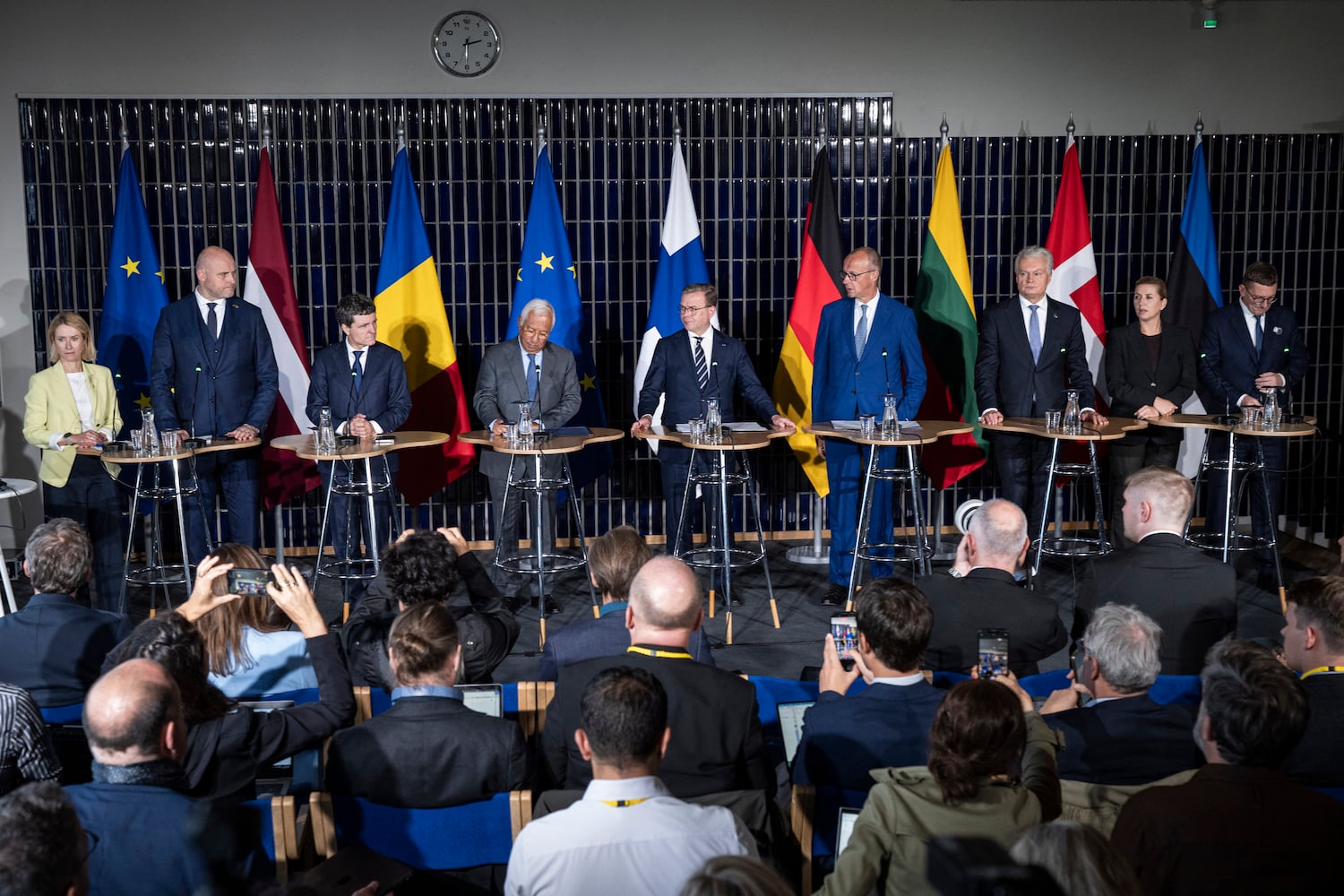
!Senior European leaders stand behind tables during a joint press conference of the European Arctic Summit in Finland.
*Senior European leaders stand behind tables during a joint press conference of the European Arctic Summit in Finland.*
From left, European Union foreign-policy chief Kaja Kallas, Latvian Prime Minister Andris Kulbergs, Romanian President Nicusor Dan, European Council President António Costa, Finnish Prime Minister Petteri Orpo, German Chancellor Friedrich Merz, Lithuanian President Gitanas Nauseda, Danish Prime Minister Mette Frederiksen, and Estonian Prime Minister Kristen Michal hold a joint press conference during the European Arctic Summit in Rovaniemi, Finland, on Sept. 14. Jouni Porsanger/Lehtikuva/AFP via Getty Images
*
*
*
September 15, 2026, 4:52 PM
Russia’s War in Ukraine
Understanding the conflict four years on.
More on this topic
Welcome back to World Brief, where we’re looking at **NATO** intercepting a drone in **Lithuania**, the threat of **Houthi** attacks in **Saudi Arabia**, and a long-running maritime dispute between **Thailand** and **Cambodia**.
---
**‘Get Out and Stay Out—or Else’**
NATO deployed fighter jets overnight on Tuesday to shoot down a drone that violated Lithuanian airspace. Although local authorities did not initially comment on the drone’s origin or purpose, European officials were quick to point fingers at Russia, which has repeatedly been accused of orchestrating military incursions, arson attacks, and other acts of sabotage against Ukraine’s European allies.
Welcome back to World Brief, where we’re looking at **NATO** intercepting a drone in **Lithuania**, the threat of **Houthi** attacks in **Saudi Arabia**, and a long-running maritime dispute between **Thailand** and **Cambodia**.
Sign up to receive World Brief in your inbox every weekday.
---
**‘Get Out and Stay Out—or Else’**
NATO deployed fighter jets overnight on Tuesday to shoot down a drone that violated Lithuanian airspace. Although local authorities did not initially comment on the drone’s origin or purpose, European officials were quick to point fingers at Russia, which has repeatedly been accused of orchestrating military incursions, arson attacks, and other acts of sabotage against Ukraine’s European allies.
Over the past few years, NATO members have blamed both Russia and Ukraine of launching stray missiles, drones, and aircraft into the territories of Denmark, Estonia, Germany, Latvia, Lithuania, Poland, and Romania, among others. However, allegations against Moscow have become particularly vehement this week following an attack on a civilian train in Ukraine near the Polish border on Sunday, which narrowly missed a separate train carrying several senior European leaders, including former British Prime Minister Boris Johnson and former Swedish Prime Minister Carl Bildt.
“It’s difficult not to interpret the incident, so far out west and so near the border of a NATO member state, as a message from \[Russian President Vladimir] Putin to Europe: Get out and stay out—or else,” argued*Foreign Policy* editor in chief Ravi Agrawal, who was aboard the diplomatic train when the strike occurred.
But the alliance does not appear to have been cowed. Russian strikes so close to NATO territory show Putin’s “desperation and also his desire to sow fear and terror,” NATO chief Mark Rutte said on Monday. European Commission President Ursula von der Leyen echoed that sentiment, saying, “Russia will find our resolve only growing stronger.”
That resolve continues to be tested. According to Lithuanian military officials, Tuesday’s drone incursion potentially entered from neighboring Belarus, which remains closely allied with Russia, and “likely” carried explosives.
Meanwhile, in a separate incident late Monday, Denmark accused a Russian warship of firing two emergency flares at a Danish helicopter in the Baltic Sea. Vladimir Barbin, Russia’s ambassador in Copenhagen, insisted on Tuesday that “dangerous maneuvers” made by the Danish aircraft were to blame for the incident; however, Copenhagen dismissed those allegations and summoned Barbin in response.
“One thing is very clear: Putin will not stop unless he is stopped,” European Union foreign-policy chief Kaja Kallas said on Tuesday, pledging to ramp up measures against the Kremlin’s so-called hybrid attacks. “So, as Russia is willing to take greater risks, Europe must impose a greater cost.”
But if NATO’s European members are hoping to strengthen their threats with support from the United States, they might be out of luck. Rather than condemning Russian incursions into NATO airspace, U.S. President Donald Trump has instead urged Ukrainian President Volodymyr Zelensky to cease strikes on Russian diesel facilities, arguing that the ensuing fuel shortages are “hurting the world.”
On Monday, Trump claimed that Moscow and Kyiv had agreed not to hit energy targets, but Zelensky stressed that Ukraine would only stop striking Russian territory if NATO could secure a genuine promise from the Kremlin not to attack critical Ukrainian infrastructure.
---
**Today’s Most Read**
* **Trump
!Foreign Policy
Foreign Policy
Get analysis and alerts more quickly in the mobile app.
Install
Back to Foreign Policy Magazine home page
* Latest
* Regions
+ Asia & the Pacific
+ China
+ Middle East & Africa
+ Americas
+ Europe
* Newsletters
Editors’ Picks
Evening roundup with our editors’ favorite stories of the day
!World Brief Icon
World Brief
Your guide to the most important world stories of the day
!China Brief Icon
China Brief
The latest news, analysis, and data from the country each week
Situation Report
Weekly update on what’s driving U.S. national security policy
FP Weekend
A curation of our best book reviews, deep dives, and other reads
!Africa Brief Icon
Africa Brief
Essential analysis of the stories shaping geopolitics on the continent
!South Asia Brief Icon
South Asia Brief
Weekly update on developments in India and its neighbors
The Reading List
Curated guides on geopolitics and current affairs
FP Bookshelf
A monthly guide to FP’s book reviews, excerpts, and reading recommendations
!Latin America Brief Icon
Latin America Brief
One-stop digest of politics, economics, and culture
!Southeast Asia Brief Icon
Southeast Asia Brief
A weekly dispatch with news from the region’s 11 countries
The New Geopolitics
A five-part masterclass in IR theory with Harvard Professor Stephen M. Walt
View All Newsletters
* FP Live
* Latest
* Trending:
* 25 years after 9/11
* Germany elections
Search this website
* Preferences
* My FP Feed
* Saved Articles
* Newsletters
* Magazine Archive
* Subscription Settings
* FAQs
* Log Out
Sign In
Sign In
Partner with FP at UNGA81 Partner with FP at UNGA81
Subscribe SubscribePartner with FP at UNGA81 Partner with FP at UNGA81
World Brief:
Are Drone Incursions Europe’s New Normal?
*
*
* Bluesky
* X
Save
1. Create an FP account to save articles to read later.
Sign Up
ALREADY AN FP SUBSCRIBER? LOGIN
1. **Downloadable PDFs** are a benefit of an FP subscription.
Subscribe Now
ALREADY AN FP SUBSCRIBER? LOGIN
Gift
*
*
1. Gifting articles is a subscriber benefit.
Subscribe Now
ALREADY AN FP SUBSCRIBER? LOGIN
2. This article is an Insider exclusive.
Contact us at [email protected] to learn about upgrade options, unlocking the ability to gift this article.
World Brief
FP’s flagship daily newsletter, catching you up on 24 hours of news in five minutes. Delivered weekdays.
Are Drone Incursions Europe’s New Normal?
NATO suspects that Russia is behind the latest airspace violation in Lithuania.
!An illustration of Alexandra Sharp, World Brief newsletter writer
*An illustration of Alexandra Sharp, World Brief newsletter writer*
*Alexandra Sharp*
By **Alexandra Sharp**, the World Brief writer at *Foreign Policy*.
!Senior European leaders stand behind tables during a joint press conference of the European Arctic Summit in Finland.
*Senior European leaders stand behind tables during a joint press conference of the European Arctic Summit in Finland.*
From left, European Union foreign-policy chief Kaja Kallas, Latvian Prime Minister Andris Kulbergs, Romanian President Nicusor Dan, European Council President António Costa, Finnish Prime Minister Petteri Orpo, German Chancellor Friedrich Merz, Lithuanian President Gitanas Nauseda, Danish Prime Minister Mette Frederiksen, and Estonian Prime Minister Kristen Michal hold a joint press conference during the European Arctic Summit in Rovaniemi, Finland, on Sept. 14. Jouni Porsanger/Lehtikuva/AFP via Getty Images
*
*
*
September 15, 2026, 4:52 PM
Russia’s War in Ukraine
Understanding the conflict four years on.
Welcome back to World Brief, where we’re looking at **NATO** intercepting a drone in **Lithuania**, the threat of **Houthi** attacks in **Saudi Arabia**, and a long-running maritime dispute between **Thailand** and **Cambodia**.
---
**‘Get Out and Stay Out—or Else’**
NATO deployed fighter jets overnight on Tuesday to shoot down a drone that violated Lithuanian airspace. Although local authorities did not initially comment on the drone’s origin or purpose, European officials were quick to point fingers at Russia, which has repeatedly been accused of orchestrating military incursions, arson attacks, and other acts of sabotage against Ukraine’s European allies.
Welcome back to World Brief, where we’re looking at **NATO** intercepting a drone in **Lithuania**, the threat of **Houthi** attacks in **Saudi Arabia**, and a long-running maritime dispute between **Thailand** and **Cambodia**.
Sign up to receive World Brief in your inbox every weekday.
---
**‘Get Out and Stay Out—or Else’**
NATO deployed fighter jets overnight on Tuesday to shoot down a drone that violated Lithuanian airspace. Although local authorities did not initially comment on the drone’s origin or purpose, European officials were quick to point fingers at Russia, which has repeatedly been accused of orchestrating military incursions, arson attacks, and other acts of sabotage against Ukraine’s European allies.
Over the past few years, NATO members have blamed both Russia and Ukraine of launching stray missiles, drones, and aircraft into the territories of Denmark, Estonia, Germany, Latvia, Lithuania, Poland, and Romania, among others. However, allegations against Moscow have become particularly vehement this week following an attack on a civilian train in Ukraine near the Polish border on Sunday, which narrowly missed a separate train carrying several senior European leaders, including former British Prime Minister Boris Johnson and former Swedish Prime Minister Carl Bildt.
“It’s difficult not to interpret the incident, so far out west and so near the border of a NATO member state, as a message from \[Russian President Vladimir] Putin to Europe: Get out and stay out—or else,” argued*Foreign Policy* editor in chief Ravi Agrawal, who was aboard the diplomatic train when the strike occurred.
But the alliance does not appear to have been cowed. Russian strikes so close to NATO territory show Putin’s “desperation and also his desire to sow fear and terror,” NATO chief Mark Rutte said on Monday. European Commission President Ursula von der Leyen echoed that sentiment, saying, “Russia will find our resolve only growing stronger.”
That resolve continues to be tested. According to Lithuanian military officials, Tuesday’s drone incursion potentially entered from neighboring Belarus, which remains closely allied with Russia, and “likely” carried explosives.
Meanwhile, in a separate incident late Monday, Denmark accused a Russian warship of firing two emergency flares at a Danish helicopter in the Baltic Sea. Vladimir Barbin, Russia’s ambassador in Copenhagen, insisted on Tuesday that “dangerous maneuvers” made by the Danish aircraft were to blame for the incident; however, Copenhagen dismissed those allegations and summoned Barbin in response.
“One thing is very clear: Putin will not stop unless he is stopped,” European Union foreign-policy chief Kaja Kallas said on Tuesday, pledging to ramp up measures against the Kremlin’s so-called hybrid attacks. “So, as Russia is willing to take greater risks, Europe must impose a greater cost.”
But if NATO’s European members are hoping to strengthen their threats with support from the United States, they might be out of luck. Rather than condemning Russian incursions into NATO airspace, U.S. President Donald Trump has instead urged Ukrainian President Volodymyr Zelensky to cease strikes on Russian diesel facilities, arguing that the ensuing fuel shortages are “hurting the world.”
On Monday, Trump claimed that Moscow and Kyiv had agreed not to hit energy targets, but Zelensky stressed that Ukraine would only stop striking Russian territory if NATO could secure a genuine promise from the Kremlin not to attack critical Ukrainian infrastructure.
---
**Today’s Most Read**
* **Trump
🔗 Share Article
Tags:#حلف الناتو#روسيا#أوروبا#الصراع الأوكراني#الأمن القومي#الهجمات الهجينة
Source: Foreign Policy
For Context
Related reads from the same topic or latest developments