PoliticsAvailable in English
Fame, Fortune, and Murder in 1960s France
Editorial
Cross Lines editing
Source
Foreign Policy
Foreign Policy

Foreign Policy
Original Source
The review examines Edward Chisholm's Murder in Paris '68, which revisits the scandal surrounding the death of Stevan Markovic, an associate of movie star Alain Delon. The author argues that the affair reveals far more than its central figures, illuminating the nature of fame and fortune in 1960s France and the lingering legacy of World War II.
Review: Edward Chisholm's 'Murder in Paris '68' Revisits a Famous Scandal to Explain France
By using this website, you agree to our use of cookies. This use includes personalization of content and ads, and traffic analytics. Review our Privacy Policy for more information.
!Foreign Policy
Foreign Policy Get analysis and alerts more quickly in the mobile app.
Install
Back to Foreign Policy Magazine home page
* Latest
* Regions
+ Asia & the Pacific
+ China
+ Middle East & Africa
+ Americas
+ Europe
* Newsletters
Editors’ Picks
Evening roundup with our editors’ favorite stories of the day
!World Brief Icon
World Brief
Your guide to the most important world stories of the day
!China Brief Icon
China Brief
The latest news, analysis, and data from the country each week
Situation Report
Weekly update on what’s driving U.S. national security policy
FP Weekend
A curation of our best book reviews, deep dives, and other reads
!Africa Brief Icon
Africa Brief
Essential analysis of the stories shaping geopolitics on the continent
!South Asia Brief Icon
South Asia Brief
Weekly update on developments in India and its neighbors
The Reading List
Curated guides on geopolitics and current affairs
FP Bookshelf
A monthly guide to FP’s book reviews, excerpts, and reading recommendations
!Latin America Brief Icon
Latin America Brief
One-stop digest of politics, economics, and culture
!Southeast Asia Brief Icon
Southeast Asia Brief
A weekly dispatch with news from the region’s 11 countries
The New Geopolitics
A five-part masterclass in IR theory with Harvard Professor Stephen M. Walt
View All Newsletters
* FP Live
* Latest
* Trending:
* Israel's election
* Lula wins in Brazil
* U.S. midterms
Search this website
* Preferences
* My FP Feed
* Saved Articles
* Newsletters
* Magazine Archive
* Subscription Settings
* FAQs
* Log Out
Sign In
Sign In
Team access Team access
Subscribe Subscribe Team access Team access
Review: Fame, Fortune, and Murder in 1960s France
*
*
* Facebook
* Bluesky
* X
* LinkedIn
* WhatsApp
* Reddit
Save
1. Create an FP account to save articles to read later.
Sign Up
ALREADY AN FP SUBSCRIBER? LOGIN
PDF
1. **Downloadable PDFs** are a benefit of an FP subscription.
Subscribe Now
ALREADY AN FP SUBSCRIBER? LOGIN
Gift
*
*
* WhatsApp
1. Gifting articles is a subscriber benefit.
Subscribe Now
ALREADY AN FP SUBSCRIBER? LOGIN
2. This article is an Insider exclusive.
Contact us at [email protected] to learn about upgrade options, unlocking the ability to gift this article.
Review
Fame, Fortune, and Murder in 1960s France
What a scandal involving movie star Alain Delon can—and can’t—tell us about French society.
October 30, 2026, 2:45 PM
By **Marie Le Conte**, a freelance political journalist based in London.
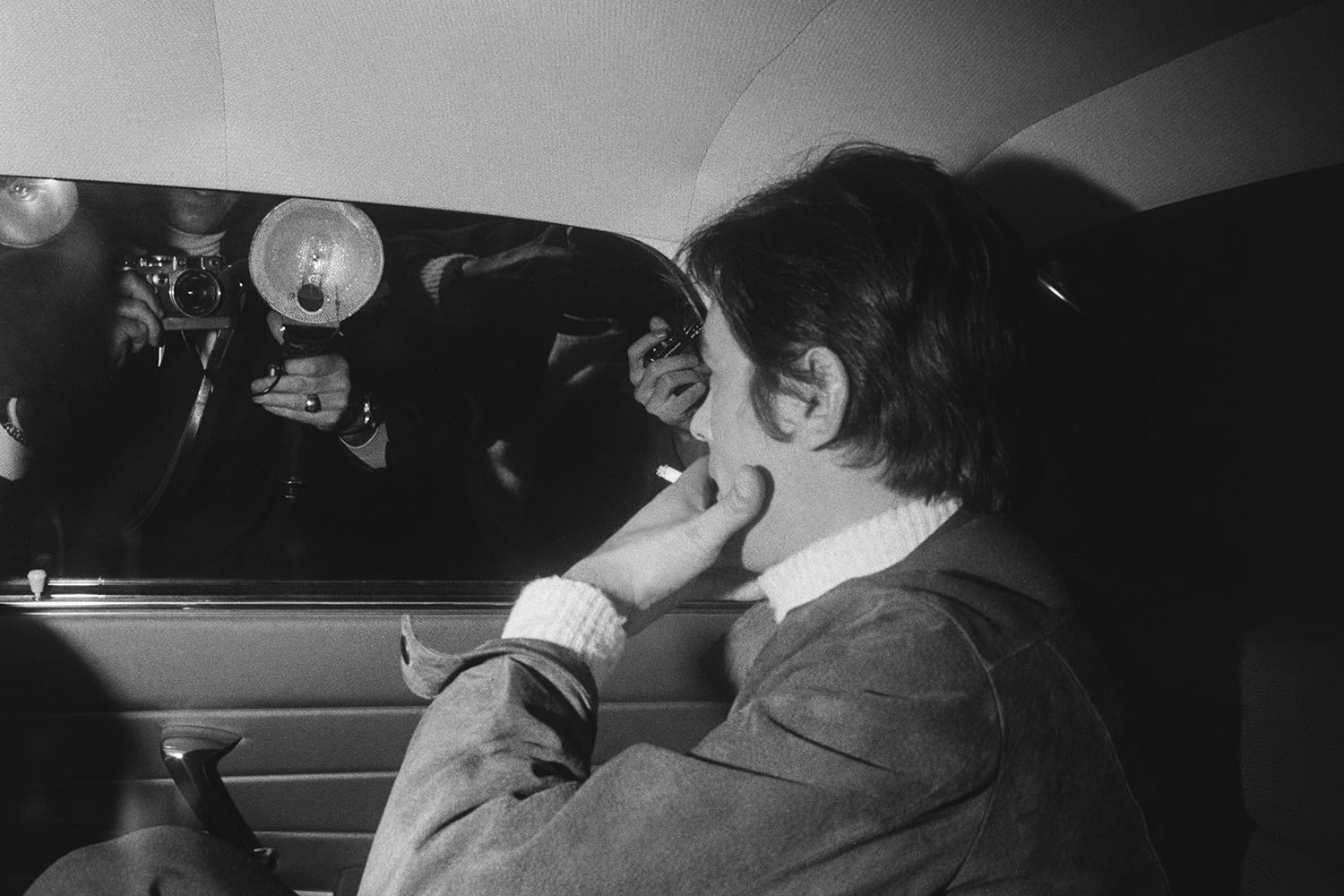
!A black-and-white photograph taken from inside a vehicle, showing the profile of a person with dark hair smoking a cigarette while looking out the window. Through the glass, the reflections of photographers holding cameras with flashbulbs are visible, pressing close to the car.
*A black-and-white photograph taken from inside a vehicle, showing the profile of a person with dark hair smoking a cigarette while looking out the window. Through the glass, the reflections of photographers holding cameras with flashbulbs are visible, pressing close to the car.*
French actor Alain Delon in the back of a car surrounded by photographers as he leaves a Paris courthouse in 1968. Gamma-Rapho via Getty Images
It helps if you think of the so-called Markovic affair as an accordion. At the beginning, the story is at its thinnest—small and compact. The year is 1968, and a dead body is found, by accident, in a ditch. The corpse is assumed to be that of a vagabond. He receives a half-hearted autopsy—his skull was smashed in, an obvious cause of death—and gets put in the ground.
Still, the judge investigating the case studies the autopsy report and wonders if there is more to it than meets the eye. Would a random, lowly criminal really have perfectly manicured fingernails? A fingerprint match confirms his hunch: The body belonged to Stevan Markovic, an associate of Alain Delon. That’s where *Murder in Paris ’68* really picks up.
It helps if you think of the so-called Markovic affair as an accordion. At the beginning, the story is at its thinnest—small and compact. The year is 1968, and a dead body is found, by accident, in a ditch. The corpse is assumed to be that of a vagabond. He receives a half-hearted autopsy—his skull was smashed in, an obvious cause of death—and gets put in the ground.
***Murder in Paris ’68: A True Story of Death and Glamour***, Edward Chisholm, Pegasus Crime, 416 pp., $32, November 2026
Still, the judge investigating the case studies the autopsy report and wonders if there is more to it than meets the eye. Would a random, lowly criminal really have perfectly manicured fingernails? A fingerprint match confirms his hunch: The body belonged to Stevan Markovic, an associate of Alain Delon. That’s where *Murder in Paris ’68* really picks up.
“Associate” is a loose term, but, as author Edward Chisholm explains over the course of roughly 400 pages, it’s better to be vague than incorrect. It’s tough to describe what the two men meant to each other. Markovic was a young man from Yugoslavia who had come to France illegally in hope of a better life. Delon was a movie star, and one of the most beautiful men in the world. They liked and loathed each other, acting as close friends and betraying one another remorselessly. Before his death, Markovic wrote to his brother saying that, if anything were to happen to him, Delon would be “10,000% responsible.”
The scandal following both Markovic’s death centered on this murky and complex relationship. But, according to Chisholm, it had to do with much more than that. The affair was about the nature of fame and fortune in the 1960s, the influence World War II still had on French politics, and a country desperately trying to move toward the future yet weighed down by its heavy past. There was one man at the center of it, sure, but in Chisholm’s telling, you can easily grab the accordion and open it wide, showcasing its countless folds.
---
!A black-and-white, candid outdoor photograph of a man with short hair holding a baby, while a woman with blonde hair and sunglasses on her head stands beside him. The baby is holding a small round snack, and both adults are looking down toward the child with gentle expressions.
*A black-and-white, candid outdoor photograph of a man with short hair holding a baby, while a woman with blonde hair and sunglasses on her head stands beside him. The baby is holding a small round snack, and both adults are looking down toward the child with gentle expressions.*
Delon with his wife, Nathalie, and their son in Monte Carlo in 1965.Archive Photos via Getty Images
Really, the story begins a decade earlier. In 1955, a 19-year-old Delon left the army after three years. His military record was far from spotless. He spent nearly a third of his time there in prison—for “\[o]perating a vehicle without authorization and without a valid licence, resulting in a serious accident,” “\[p]ossession of a prohibited weapon,” and “\[c]ausing public scandal while ashore,” among other offences. His file concluded that he was “\[a] bad element in every respect.”
Now a civilian again, his first port of call was Toulon, in the south of France. He was there to see an old acquaintance, François Marcantoni, a Corsican gangster and former French Resistance fighter who, like many others at the time, moved relentlessly between worlds.
France in the 1950s and 1960s was still fundamentally shaped by the war—by the Nazi occupation and its collaborators in the Vic
By using this website, you agree to our use of cookies. This use includes personalization of content and ads, and traffic analytics. Review our Privacy Policy for more information.
!Foreign Policy
Foreign Policy Get analysis and alerts more quickly in the mobile app.
Install
Back to Foreign Policy Magazine home page
* Latest
* Regions
+ Asia & the Pacific
+ China
+ Middle East & Africa
+ Americas
+ Europe
* Newsletters
Editors’ Picks
Evening roundup with our editors’ favorite stories of the day
!World Brief Icon
World Brief
Your guide to the most important world stories of the day
!China Brief Icon
China Brief
The latest news, analysis, and data from the country each week
Situation Report
Weekly update on what’s driving U.S. national security policy
FP Weekend
A curation of our best book reviews, deep dives, and other reads
!Africa Brief Icon
Africa Brief
Essential analysis of the stories shaping geopolitics on the continent
!South Asia Brief Icon
South Asia Brief
Weekly update on developments in India and its neighbors
The Reading List
Curated guides on geopolitics and current affairs
FP Bookshelf
A monthly guide to FP’s book reviews, excerpts, and reading recommendations
!Latin America Brief Icon
Latin America Brief
One-stop digest of politics, economics, and culture
!Southeast Asia Brief Icon
Southeast Asia Brief
A weekly dispatch with news from the region’s 11 countries
The New Geopolitics
A five-part masterclass in IR theory with Harvard Professor Stephen M. Walt
View All Newsletters
* FP Live
* Latest
* Trending:
* Israel's election
* Lula wins in Brazil
* U.S. midterms
Search this website
* Preferences
* My FP Feed
* Saved Articles
* Newsletters
* Magazine Archive
* Subscription Settings
* FAQs
* Log Out
Sign In
Sign In
Team access Team access
Subscribe Subscribe Team access Team access
Review: Fame, Fortune, and Murder in 1960s France
*
*
* Bluesky
* X
Save
1. Create an FP account to save articles to read later.
Sign Up
ALREADY AN FP SUBSCRIBER? LOGIN
1. **Downloadable PDFs** are a benefit of an FP subscription.
Subscribe Now
ALREADY AN FP SUBSCRIBER? LOGIN
Gift
*
*
1. Gifting articles is a subscriber benefit.
Subscribe Now
ALREADY AN FP SUBSCRIBER? LOGIN
2. This article is an Insider exclusive.
Contact us at [email protected] to learn about upgrade options, unlocking the ability to gift this article.
Review
Fame, Fortune, and Murder in 1960s France
What a scandal involving movie star Alain Delon can—and can’t—tell us about French society.
October 30, 2026, 2:45 PM
By **Marie Le Conte**, a freelance political journalist based in London.
!A black-and-white photograph taken from inside a vehicle, showing the profile of a person with dark hair smoking a cigarette while looking out the window. Through the glass, the reflections of photographers holding cameras with flashbulbs are visible, pressing close to the car.
*A black-and-white photograph taken from inside a vehicle, showing the profile of a person with dark hair smoking a cigarette while looking out the window. Through the glass, the reflections of photographers holding cameras with flashbulbs are visible, pressing close to the car.*
French actor Alain Delon in the back of a car surrounded by photographers as he leaves a Paris courthouse in 1968. Gamma-Rapho via Getty Images
It helps if you think of the so-called Markovic affair as an accordion. At the beginning, the story is at its thinnest—small and compact. The year is 1968, and a dead body is found, by accident, in a ditch. The corpse is assumed to be that of a vagabond. He receives a half-hearted autopsy—his skull was smashed in, an obvious cause of death—and gets put in the ground.
Still, the judge investigating the case studies the autopsy report and wonders if there is more to it than meets the eye. Would a random, lowly criminal really have perfectly manicured fingernails? A fingerprint match confirms his hunch: The body belonged to Stevan Markovic, an associate of Alain Delon. That’s where *Murder in Paris ’68* really picks up.
It helps if you think of the so-called Markovic affair as an accordion. At the beginning, the story is at its thinnest—small and compact. The year is 1968, and a dead body is found, by accident, in a ditch. The corpse is assumed to be that of a vagabond. He receives a half-hearted autopsy—his skull was smashed in, an obvious cause of death—and gets put in the ground.
***Murder in Paris ’68: A True Story of Death and Glamour***, Edward Chisholm, Pegasus Crime, 416 pp., $32, November 2026
Still, the judge investigating the case studies the autopsy report and wonders if there is more to it than meets the eye. Would a random, lowly criminal really have perfectly manicured fingernails? A fingerprint match confirms his hunch: The body belonged to Stevan Markovic, an associate of Alain Delon. That’s where *Murder in Paris ’68* really picks up.
“Associate” is a loose term, but, as author Edward Chisholm explains over the course of roughly 400 pages, it’s better to be vague than incorrect. It’s tough to describe what the two men meant to each other. Markovic was a young man from Yugoslavia who had come to France illegally in hope of a better life. Delon was a movie star, and one of the most beautiful men in the world. They liked and loathed each other, acting as close friends and betraying one another remorselessly. Before his death, Markovic wrote to his brother saying that, if anything were to happen to him, Delon would be “10,000% responsible.”
The scandal following both Markovic’s death centered on this murky and complex relationship. But, according to Chisholm, it had to do with much more than that. The affair was about the nature of fame and fortune in the 1960s, the influence World War II still had on French politics, and a country desperately trying to move toward the future yet weighed down by its heavy past. There was one man at the center of it, sure, but in Chisholm’s telling, you can easily grab the accordion and open it wide, showcasing its countless folds.
---
!A black-and-white, candid outdoor photograph of a man with short hair holding a baby, while a woman with blonde hair and sunglasses on her head stands beside him. The baby is holding a small round snack, and both adults are looking down toward the child with gentle expressions.
*A black-and-white, candid outdoor photograph of a man with short hair holding a baby, while a woman with blonde hair and sunglasses on her head stands beside him. The baby is holding a small round snack, and both adults are looking down toward the child with gentle expressions.*
Delon with his wife, Nathalie, and their son in Monte Carlo in 1965.Archive Photos via Getty Images
Really, the story begins a decade earlier. In 1955, a 19-year-old Delon left the army after three years. His military record was far from spotless. He spent nearly a third of his time there in prison—for “\[o]perating a vehicle without authorization and without a valid licence, resulting in a serious accident,” “\[p]ossession of a prohibited weapon,” and “\[c]ausing public scandal while ashore,” among other offences. His file concluded that he was “\[a] bad element in every respect.”
Now a civilian again, his first port of call was Toulon, in the south of France. He was there to see an old acquaintance, François Marcantoni, a Corsican gangster and former French Resistance fighter who, like many others at the time, moved relentlessly between worlds.
France in the 1950s and 1960s was still fundamentally shaped by the war—by the Nazi occupation and its collaborators in the Vic
Share Article
Tags:#آلان ديلون#فرنسا#ستينيات القرن العشرين#جريمة قتل#الحرب العالمية الثانية#الشهرة
Source: Foreign Policy
For Context
Related reads from the same topic or latest developments