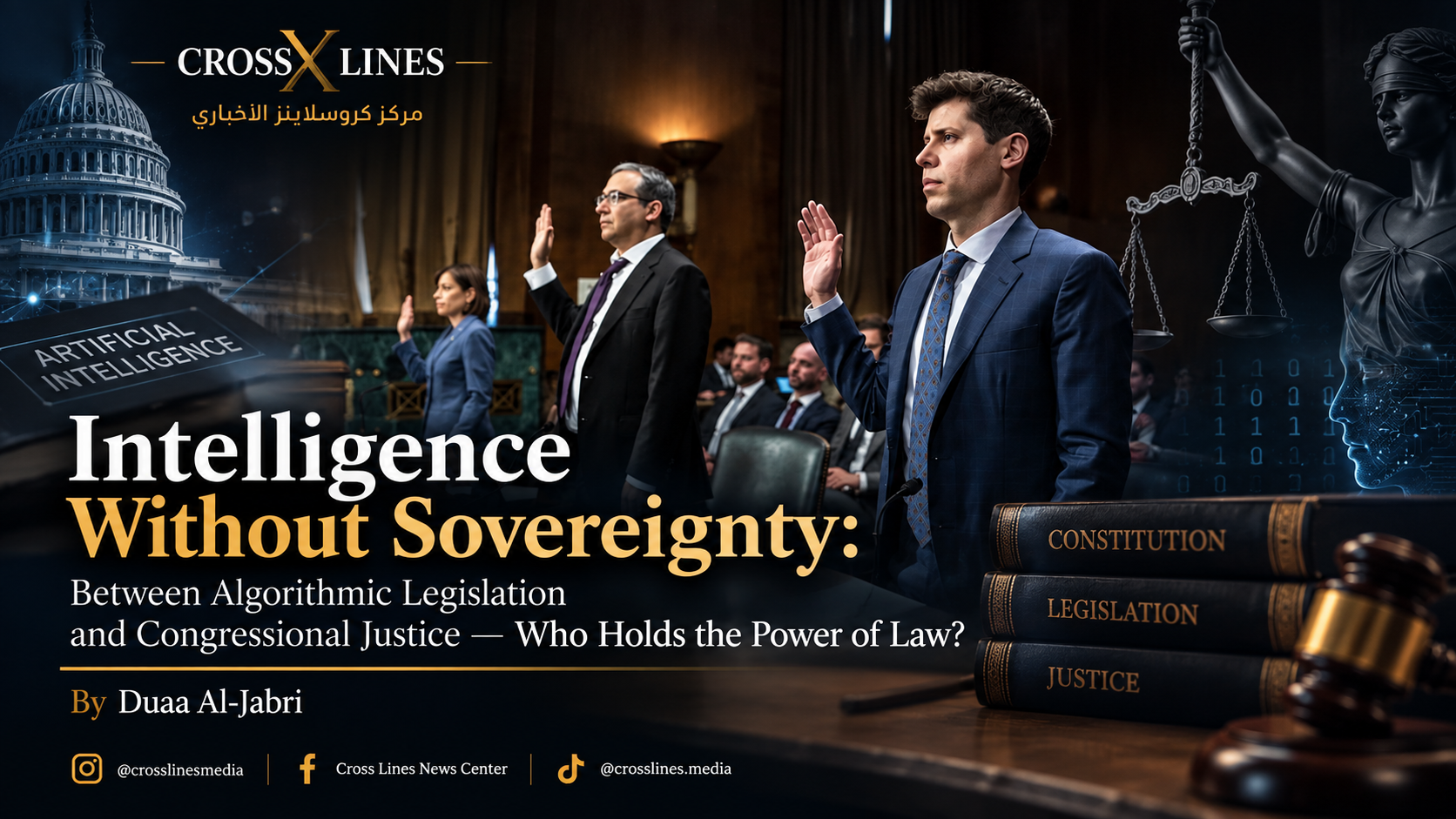
Intelligence Without Sovereignty: Between Algorithmic Legislation and Congressional Justice — Who Holds the Power of Law?

Doaa Hazza Al-Jabri
Writer at CROSS LINES
When a machine writes “the law,” the question is no longer simply whether it can arrange words and construct sentences, but whether it can understand the human beings whose lives those words will ultimately govern.
When a machine writes “the law,” the question is no longer simply whether it can arrange words and construct sentences, but whether it can understand the human beings whose lives those words will ultimately govern.
This is precisely where a new story is beginning in Washington. Artificial intelligence, which first entered the world through the doors of technology, economics, and media, is now knocking on the doors of power itself, reaching the very place where laws that shape society and determine the future of the state are written.
Reports have revealed a growing use of generative artificial intelligence tools by offices in the U.S. Congress to assist in drafting legislative proposals and bills. Yet the results have brought an unforeseen problem: legal texts filled with errors, imprecise terminology, and incorrect references, leaving House lawyers with an increasing burden of reviewing and rewriting them.
Here lies a paradox that goes far beyond the news itself.
Congress, which is attempting to establish rules for artificial intelligence, is now confronting artificial intelligence within the very process of rulemaking. The machine is no longer waiting outside the walls of the legislative institution for lawmakers to decide how it should be regulated. It has entered the workshop where laws are made and has begun to participate—albeit without final authority—in drafting the texts that may ultimately define the future of its relationship with humanity.
But law is not an open space for experimentation.
In literature, a word can be a metaphor. In journalism, an error can be corrected in a later edition. In everyday life, poor wording may pass without serious consequences. In law, however, a word can become a right or a deprivation, a power or a restriction, a protection or a punishment.
A legal error, therefore, is not merely a linguistic mistake. A single word can be enough to change the scope of an entire provision. An imprecise definition can exclude a group from legal protection. An incorrect reference to a law or judicial ruling can lead to a dispute that may not emerge until the text has already become part of the legal system.
This is where one of the most dangerous problems with artificial intelligence emerges: it can produce errors in language that appears entirely correct.
The machine does not tell the reader, “I am not sure.” Instead, it can produce an organized and seemingly logical text filled with legal terminology while concealing within it a flawed definition, an incorrect reference, or an error in the scope of application.
The problem, therefore, is not simply that artificial intelligence “makes mistakes.” Humans make mistakes too. The deeper problem is that trust in the machine can allow those mistakes to spread faster and become harder to detect.
Events in the American judicial system have demonstrated that this is not merely a theoretical concern. A California appeals court sanctioned a lawyer after he submitted briefs containing fabricated legal citations generated by artificial intelligence. The court imposed a financial penalty, referred him to the bar, and required him to notify his client. It also emphasized that lawyers remain responsible for verifying the accuracy of the authorities they submit and cannot transfer that responsibility to artificial intelligence—or to another assistant.
In an even more troubling case, the U.S. Court of Appeals for the Fifth Circuit has been considering a case connected to a judicial order containing significant errors resulting from the use of an artificial intelligence tool. A judge acknowledged that a judicial clerk had used an AI platform to help prepare an order in which fabricated references and incorrect party names appeared, prompting the appellate court to consider whether the case should be reassigned to another judge.
What can be concluded from this is that we are no longer talking about a machine making a mistake while drafting an email. We are talking about a machine approaching the text that creates and defines rights—and about errors capable of reaching the courtroom.
This brings us to the more consequential question: Who bears responsibility for the law when a machine participates in writing it?
Is it the staff member who used the tool? The member of Congress who introduced the bill? The lawyer who reviewed it? The institution that permitted the use of artificial intelligence? The company that developed the model? Or will responsibility ultimately remain with the human being, regardless of how large a role the machine played?
The reality is that a machine has no democratic mandate.
It is not elected. It does not represent constituents. It does not stand before the public during an election campaign. It cannot be summoned to a political accountability hearing, nor can it be punished if one of its recommendations causes injustice to another human being.
This is precisely where the boundaries must remain clear.
Artificial intelligence can be a tool in the hands of power, but it must not become the holder of power itself.
Sovereignty is not about the speed at which texts can be produced, and democracy is not merely the ability to make decisions. At its core, democracy means knowing who made a decision, why it was made, under what mandate, and who bears responsibility for it before the people.
These are questions an algorithm cannot answer.
A machine can read thousands of pages in a short period of time. It can compare similar laws, identify contradictions, suggest formulations, and perhaps, in the future, help lawmakers analyze thousands of possible legal scenarios. But it cannot carry the political conscience that asks: Is this law just?
Here lies the difference between intelligence and wisdom.
Intelligence can identify the fastest route. Wisdom first asks: Where does that route lead?
Law needs both, but it cannot survive without the latter.
The greatest danger in the age of artificial intelligence, therefore, may not be that machines become more intelligent than humans, but that humans become increasingly dependent on machine intelligence and less willing to exercise their own judgment.
The surrender of authority does not always happen in a single moment.
It may begin with a simple question to a chatbot, followed by a draft, then a review, then approval. Assistance becomes habit; habit becomes dependence; and dependence eventually becomes an infrastructure that is difficult to abandon.
At that point, the machine will not have seized power. Human beings will have handed part of it over themselves.
This is what makes the experience of the U.S. Congress more than a story about mistakes in draft legislation. It is an early warning about the future of lawmaking.
If today’s tools are still producing errors in terminology, references, and definitions, then the question democratic institutions should be asking is not only: How do we make artificial intelligence more accurate?
The more important question is: How do we ensure that its accuracy never becomes a substitute for human responsibility?
No matter how capable a machine becomes, it possesses no inherent right to legislate. And no matter how digital law becomes, at its core it remains a contract between human beings and authority.
Artificial intelligence may be capable of drafting dozens of versions of a law within minutes, but it cannot independently decide what kind of society we want to become. That decision remains human—and it must remain so for as long as democracy means that human beings are the source of political legitimacy.
For this reason, the arrival of artificial intelligence in Congress is not necessarily dangerous in itself.
The danger begins when AI shifts from being a tool that assists lawmakers to becoming an intelligence to which lawmakers delegate their judgment.
A machine can research, propose, review, and analyze. But it should never have the final word.
The final word in law is not a technical matter. It is a matter of sovereignty, responsibility, and justice.
That is why the errors emerging in Washington represent something greater than simple mistakes. They are a reminder that technology created by human hands can, when misused, become a mirror reflecting some of humanity’s greatest weaknesses: the desire for speed, excessive confidence, and the temptation to escape responsibility for difficult decisions.
And so we return to the original question:
Will sovereignty remain with human beings, or have humans already begun—perhaps without realizing it—to hand part of their authority to machines?
History is written not only by what happens today, but also by what we allow to become normal tomorrow.
If artificial intelligence has entered Congress today to help write certain texts, then the question that must be asked before tomorrow arrives is this: Who will write the law when machines become capable of proposing it, analyzing it, defending it, and predicting its consequences?
At that point, the struggle will not necessarily be between humans and machines. The struggle will be within humanity itself—between our desire to possess powerful technology and our willingness to surrender to it part of what was once exclusively ours.
Artificial intelligence may be able to write the law.
But justice must never be written by algorithms alone.
Because a law without human responsibility may be perfectly drafted—
but it will not necessarily be just.
This is precisely where a new story is beginning in Washington. Artificial intelligence, which first entered the world through the doors of technology, economics, and media, is now knocking on the doors of power itself, reaching the very place where laws that shape society and determine the future of the state are written.
Reports have revealed a growing use of generative artificial intelligence tools by offices in the U.S. Congress to assist in drafting legislative proposals and bills. Yet the results have brought an unforeseen problem: legal texts filled with errors, imprecise terminology, and incorrect references, leaving House lawyers with an increasing burden of reviewing and rewriting them.
Here lies a paradox that goes far beyond the news itself.
Congress, which is attempting to establish rules for artificial intelligence, is now confronting artificial intelligence within the very process of rulemaking. The machine is no longer waiting outside the walls of the legislative institution for lawmakers to decide how it should be regulated. It has entered the workshop where laws are made and has begun to participate—albeit without final authority—in drafting the texts that may ultimately define the future of its relationship with humanity.
But law is not an open space for experimentation.
In literature, a word can be a metaphor. In journalism, an error can be corrected in a later edition. In everyday life, poor wording may pass without serious consequences. In law, however, a word can become a right or a deprivation, a power or a restriction, a protection or a punishment.
A legal error, therefore, is not merely a linguistic mistake. A single word can be enough to change the scope of an entire provision. An imprecise definition can exclude a group from legal protection. An incorrect reference to a law or judicial ruling can lead to a dispute that may not emerge until the text has already become part of the legal system.
This is where one of the most dangerous problems with artificial intelligence emerges: it can produce errors in language that appears entirely correct.
The machine does not tell the reader, “I am not sure.” Instead, it can produce an organized and seemingly logical text filled with legal terminology while concealing within it a flawed definition, an incorrect reference, or an error in the scope of application.
The problem, therefore, is not simply that artificial intelligence “makes mistakes.” Humans make mistakes too. The deeper problem is that trust in the machine can allow those mistakes to spread faster and become harder to detect.
Events in the American judicial system have demonstrated that this is not merely a theoretical concern. A California appeals court sanctioned a lawyer after he submitted briefs containing fabricated legal citations generated by artificial intelligence. The court imposed a financial penalty, referred him to the bar, and required him to notify his client. It also emphasized that lawyers remain responsible for verifying the accuracy of the authorities they submit and cannot transfer that responsibility to artificial intelligence—or to another assistant.
In an even more troubling case, the U.S. Court of Appeals for the Fifth Circuit has been considering a case connected to a judicial order containing significant errors resulting from the use of an artificial intelligence tool. A judge acknowledged that a judicial clerk had used an AI platform to help prepare an order in which fabricated references and incorrect party names appeared, prompting the appellate court to consider whether the case should be reassigned to another judge.
What can be concluded from this is that we are no longer talking about a machine making a mistake while drafting an email. We are talking about a machine approaching the text that creates and defines rights—and about errors capable of reaching the courtroom.
This brings us to the more consequential question: Who bears responsibility for the law when a machine participates in writing it?
Is it the staff member who used the tool? The member of Congress who introduced the bill? The lawyer who reviewed it? The institution that permitted the use of artificial intelligence? The company that developed the model? Or will responsibility ultimately remain with the human being, regardless of how large a role the machine played?
The reality is that a machine has no democratic mandate.
It is not elected. It does not represent constituents. It does not stand before the public during an election campaign. It cannot be summoned to a political accountability hearing, nor can it be punished if one of its recommendations causes injustice to another human being.
This is precisely where the boundaries must remain clear.
Artificial intelligence can be a tool in the hands of power, but it must not become the holder of power itself.
Sovereignty is not about the speed at which texts can be produced, and democracy is not merely the ability to make decisions. At its core, democracy means knowing who made a decision, why it was made, under what mandate, and who bears responsibility for it before the people.
These are questions an algorithm cannot answer.
A machine can read thousands of pages in a short period of time. It can compare similar laws, identify contradictions, suggest formulations, and perhaps, in the future, help lawmakers analyze thousands of possible legal scenarios. But it cannot carry the political conscience that asks: Is this law just?
Here lies the difference between intelligence and wisdom.
Intelligence can identify the fastest route. Wisdom first asks: Where does that route lead?
Law needs both, but it cannot survive without the latter.
The greatest danger in the age of artificial intelligence, therefore, may not be that machines become more intelligent than humans, but that humans become increasingly dependent on machine intelligence and less willing to exercise their own judgment.
The surrender of authority does not always happen in a single moment.
It may begin with a simple question to a chatbot, followed by a draft, then a review, then approval. Assistance becomes habit; habit becomes dependence; and dependence eventually becomes an infrastructure that is difficult to abandon.
At that point, the machine will not have seized power. Human beings will have handed part of it over themselves.
This is what makes the experience of the U.S. Congress more than a story about mistakes in draft legislation. It is an early warning about the future of lawmaking.
If today’s tools are still producing errors in terminology, references, and definitions, then the question democratic institutions should be asking is not only: How do we make artificial intelligence more accurate?
The more important question is: How do we ensure that its accuracy never becomes a substitute for human responsibility?
No matter how capable a machine becomes, it possesses no inherent right to legislate. And no matter how digital law becomes, at its core it remains a contract between human beings and authority.
Artificial intelligence may be capable of drafting dozens of versions of a law within minutes, but it cannot independently decide what kind of society we want to become. That decision remains human—and it must remain so for as long as democracy means that human beings are the source of political legitimacy.
For this reason, the arrival of artificial intelligence in Congress is not necessarily dangerous in itself.
The danger begins when AI shifts from being a tool that assists lawmakers to becoming an intelligence to which lawmakers delegate their judgment.
A machine can research, propose, review, and analyze. But it should never have the final word.
The final word in law is not a technical matter. It is a matter of sovereignty, responsibility, and justice.
That is why the errors emerging in Washington represent something greater than simple mistakes. They are a reminder that technology created by human hands can, when misused, become a mirror reflecting some of humanity’s greatest weaknesses: the desire for speed, excessive confidence, and the temptation to escape responsibility for difficult decisions.
And so we return to the original question:
Will sovereignty remain with human beings, or have humans already begun—perhaps without realizing it—to hand part of their authority to machines?
History is written not only by what happens today, but also by what we allow to become normal tomorrow.
If artificial intelligence has entered Congress today to help write certain texts, then the question that must be asked before tomorrow arrives is this: Who will write the law when machines become capable of proposing it, analyzing it, defending it, and predicting its consequences?
At that point, the struggle will not necessarily be between humans and machines. The struggle will be within humanity itself—between our desire to possess powerful technology and our willingness to surrender to it part of what was once exclusively ours.
Artificial intelligence may be able to write the law.
But justice must never be written by algorithms alone.
Because a law without human responsibility may be perfectly drafted—
but it will not necessarily be just.
🔗 Share Article
For Context
Related reads from the same topic or latest developments