Poll: Americans see rule of law declining in U.S.
Axios
A
Axios
Original Source
A majority of Americans believe the rule of law has weakened over the past decade, according to a large survey of over 23,000 adults. While 78% of respondents affirm that government officials must always follow laws and the Constitution, just 28% trust that political leaders will actually be held accountable if they don't.
Poll: Americans see rule of law declining in U.S.
*
* Newsletters
*
* Axios Pro
* Axios Live
* The Axios Show
Axios
Axios
2 hours ago - Politics & Policy
Poll: Americans see rule of law declining in U.S.
* Margaret Talev
*
*
*
Add Axios on Google
Add Axios as your preferred source to
see more of our stories on Google.
Add Axios on Google
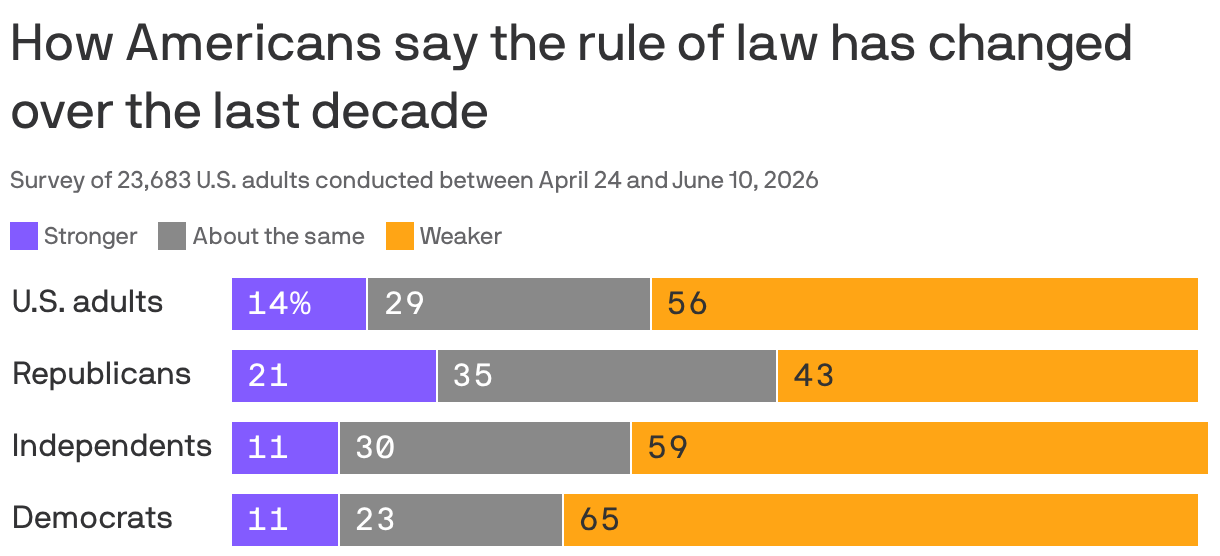
*Data: Charles F. Kettering Foundation and Gallup; Note: Values shown may not total 100% due to rounding and exclusion of "don't know" responses; Chart: Noah Bressner/Axios Visuals*
A majority of Americans say the rule of law in the U.S. is weaker now than a decade ago, when Donald Trump was first elected president, according to a massive new survey of more than 23,000 U.S. adults.
**Driving the news:** 78% of those responding to the survey by Gallup and the Charles F. Kettering Foundation for its Democracy for All Project say government officials must always follow laws and the Constitution.
* But just 28% trust that political leaders will be held accountable if they don't.
**Zoom in:** Throwing out incumbents was respondents' top choice (17%) when asked what one step could be taken to most improve U.S. democracy. That response reflects a prominent theme of a midterm campaign that's shadowed by widespread voter dissatisfaction.
* Other steps suggested by survey respondents included electoral reform and improved voting access (13%) and limiting executive power (9%).
**One stunning stat:** Older Republicans (65+) appear significantly less trusting of election officials now than just a year ago, with 42% saying it's reasonable to assume that election officials acted improperly if election outcomes are surprising, up from 30%.
**By the numbers:** The share of Americans who say the rule of law is weaker now than in 2016 is four times higher than the share who think it's stronger (56% compared with 14%), while 29% say it's unchanged. Democrats and independents were much likelier than Republicans to say it's weaker.
* The top reason respondents cited for getting involved in a social or political cause: Feeling an important right or freedom is being threatened (27%), followed by feeling you can make a difference (26%) and seeing officials abuse or misuse power (19%).
* 57% said they prefer candidates who challenge powerful or established interests, while 42% prefer candidates who work within the establishment.
**What we're watching**: Two-thirds of Americans said democracy is the best form of government, the same as last year. But across several measures, the data show the public more pessimistic now than in 2025:
* 49% say they don't agree with the idea that U.S. leaders are committed to having a strong democracy, up from 44% a year ago.
* 47% say they're comfortable openly expressing opinions about government and laws, down from 52%.
* 56% say democracy is doing poorly, up from 51% the year before. That sense is largely being driven by rising concerns from Republicans and Republican-leaning independents, while Democrats and neutral independents already were highly critical.
* Respondents give the state of democracy higher marks at the local level than the national level.
**What they're saying:** "People care about democracy, and that is something worth building on," said Derek Barker, senior program officer for research initiatives at Kettering.
* "Right now, it's a matter of getting through this period where people are really concerned about how it's performing and how leaders are acting in office."
*Methodology: The Gallup Poll conducted this survey for the Gallup-Kettering Foundation's Democracy for All Project. The survey was completed by 23,683 U.S. adults, aged 18 and older, including 10,800 respondents recruited for the study and 12,883 supplemental respondents from a third-party sample provider.*
* *21,652 respondents completed the survey as a web survey April 24-May 21, 2026, and 2,031 respondents completed the survey as a mail survey April 24-June 10, 2026.*
* *For results based on this sample, the maximum margin of sampling error, which takes into account the design effect from weighting, is ±1 percentage point at the 95% confidence level.*
*
*
*
Add Axios on Google
What to read next
*
*
*
*
*
*
Smarter, faster on what matters.
Explore Axios Newsletters
* About Axios
* Advertise with us
* Careers
* Contact us
* Newsletters
* Axios Live
* Axios HQ
* Privacy policy
* Terms of use
*
Axios Homepage
Axios Media Inc., 2026
*
* Newsletters
*
* Axios Pro
* Axios Live
* The Axios Show
Axios
Axios
2 hours ago - Politics & Policy
Poll: Americans see rule of law declining in U.S.
* Margaret Talev
*
*
*
Add Axios on Google
Add Axios as your preferred source to
see more of our stories on Google.
Add Axios on Google
*Data: Charles F. Kettering Foundation and Gallup; Note: Values shown may not total 100% due to rounding and exclusion of "don't know" responses; Chart: Noah Bressner/Axios Visuals*
A majority of Americans say the rule of law in the U.S. is weaker now than a decade ago, when Donald Trump was first elected president, according to a massive new survey of more than 23,000 U.S. adults.
**Driving the news:** 78% of those responding to the survey by Gallup and the Charles F. Kettering Foundation for its Democracy for All Project say government officials must always follow laws and the Constitution.
* But just 28% trust that political leaders will be held accountable if they don't.
**Zoom in:** Throwing out incumbents was respondents' top choice (17%) when asked what one step could be taken to most improve U.S. democracy. That response reflects a prominent theme of a midterm campaign that's shadowed by widespread voter dissatisfaction.
* Other steps suggested by survey respondents included electoral reform and improved voting access (13%) and limiting executive power (9%).
**One stunning stat:** Older Republicans (65+) appear significantly less trusting of election officials now than just a year ago, with 42% saying it's reasonable to assume that election officials acted improperly if election outcomes are surprising, up from 30%.
**By the numbers:** The share of Americans who say the rule of law is weaker now than in 2016 is four times higher than the share who think it's stronger (56% compared with 14%), while 29% say it's unchanged. Democrats and independents were much likelier than Republicans to say it's weaker.
* The top reason respondents cited for getting involved in a social or political cause: Feeling an important right or freedom is being threatened (27%), followed by feeling you can make a difference (26%) and seeing officials abuse or misuse power (19%).
* 57% said they prefer candidates who challenge powerful or established interests, while 42% prefer candidates who work within the establishment.
**What we're watching**: Two-thirds of Americans said democracy is the best form of government, the same as last year. But across several measures, the data show the public more pessimistic now than in 2025:
* 49% say they don't agree with the idea that U.S. leaders are committed to having a strong democracy, up from 44% a year ago.
* 47% say they're comfortable openly expressing opinions about government and laws, down from 52%.
* 56% say democracy is doing poorly, up from 51% the year before. That sense is largely being driven by rising concerns from Republicans and Republican-leaning independents, while Democrats and neutral independents already were highly critical.
* Respondents give the state of democracy higher marks at the local level than the national level.
**What they're saying:** "People care about democracy, and that is something worth building on," said Derek Barker, senior program officer for research initiatives at Kettering.
* "Right now, it's a matter of getting through this period where people are really concerned about how it's performing and how leaders are acting in office."
*Methodology: The Gallup Poll conducted this survey for the Gallup-Kettering Foundation's Democracy for All Project. The survey was completed by 23,683 U.S. adults, aged 18 and older, including 10,800 respondents recruited for the study and 12,883 supplemental respondents from a third-party sample provider.*
* *21,652 respondents completed the survey as a web survey April 24-May 21, 2026, and 2,031 respondents completed the survey as a mail survey April 24-June 10, 2026.*
* *For results based on this sample, the maximum margin of sampling error, which takes into account the design effect from weighting, is ±1 percentage point at the 95% confidence level.*
*
*
*
Add Axios on Google
What to read next
*
*
*
*
*
*
Smarter, faster on what matters.
Explore Axios Newsletters
* About Axios
* Advertise with us
* Careers
* Contact us
* Newsletters
* Axios Live
* Axios HQ
* Privacy policy
* Terms of use
*
Axios Homepage
Axios Media Inc., 2026
🔗 Share Article
Tags:#سياسة أمريكية#سيادة القانون#استطلاعات رأي عام#الديمقراطية#الثقة السياسية#الانتخابات
Source: Axios
For Context
Related reads from the same topic or latest developments