Where Is King Abdullah?
Foreign Policy

Foreign Policy
Original Source
Amid intensifying Iranian attacks and growing domestic criticism over his ties to the United States, Jordan's King Abdullah II has withdrawn from public view, abandoning the high-profile communications strategy that defined his reign since 1999. The monarch appears to have concluded that silence is the best defense of his controversial alliance with Washington.
Where Is King Abdullah?
!Foreign Policy
Foreign Policy
Get analysis and alerts more quickly in the mobile app.
Install
Back to Foreign Policy Magazine home page
* Latest
* Regions
+ Asia & the Pacific
+ China
+ Middle East & Africa
+ Americas
+ Europe
* Newsletters
Editors’ Picks
Evening roundup with our editors’ favorite stories of the day
!World Brief Icon
World Brief
Your guide to the most important world stories of the day
!China Brief Icon
China Brief
The latest news, analysis, and data from the country each week
Situation Report
Weekly update on what’s driving U.S. national security policy
FP Weekend
A curation of our best book reviews, deep dives, and other reads
!Africa Brief Icon
Africa Brief
Essential analysis of the stories shaping geopolitics on the continent
!South Asia Brief Icon
South Asia Brief
Weekly update on developments in India and its neighbors
The Reading List
Curated guides on geopolitics and current affairs
FP Bookshelf
A monthly guide to FP’s book reviews, excerpts, and reading recommendations
!Latin America Brief Icon
Latin America Brief
One-stop digest of politics, economics, and culture
!Southeast Asia Brief Icon
Southeast Asia Brief
A weekly dispatch with news from the region’s 11 countries
The New Geopolitics
A five-part masterclass in IR theory with Harvard Professor Stephen M. Walt
View All Newsletters
* FP Live
* Latest
* Trending:
* Iran war
* Brazil's election kicks off
Search this website
* Preferences
* My FP Feed
* Saved Articles
* Newsletters
* Magazine Archive
* Subscription Settings
* FAQs
* Log Out
Sign In
Sign In
Campus and team access Campus and team access
Subscribe SubscribeCampus and team access Campus and team access
Analysis:
Where Is King Abdullah?
*
*
* Facebook
* Bluesky
* X
* LinkedIn
* WhatsApp
* Reddit
Save
1. Create an FP account to save articles to read later.
Sign Up
ALREADY AN FP SUBSCRIBER? LOGIN
PDF
1. **Downloadable PDFs** are a benefit of an FP subscription.
Subscribe Now
ALREADY AN FP SUBSCRIBER? LOGIN
Gift
*
*
* WhatsApp
1. Gifting articles is a subscriber benefit.
Subscribe Now
ALREADY AN FP SUBSCRIBER? LOGIN
2. This article is an Insider exclusive.
Contact us at [email protected] to learn about upgrade options, unlocking the ability to gift this article.
Analysis
Where Is King Abdullah?
Facing regional turmoil and domestic criticism, Jordan’s ruler is spending more time overseas and less time talking to the press.
By **Aaron Magid**, the author of a recent biography on King Abdullah.
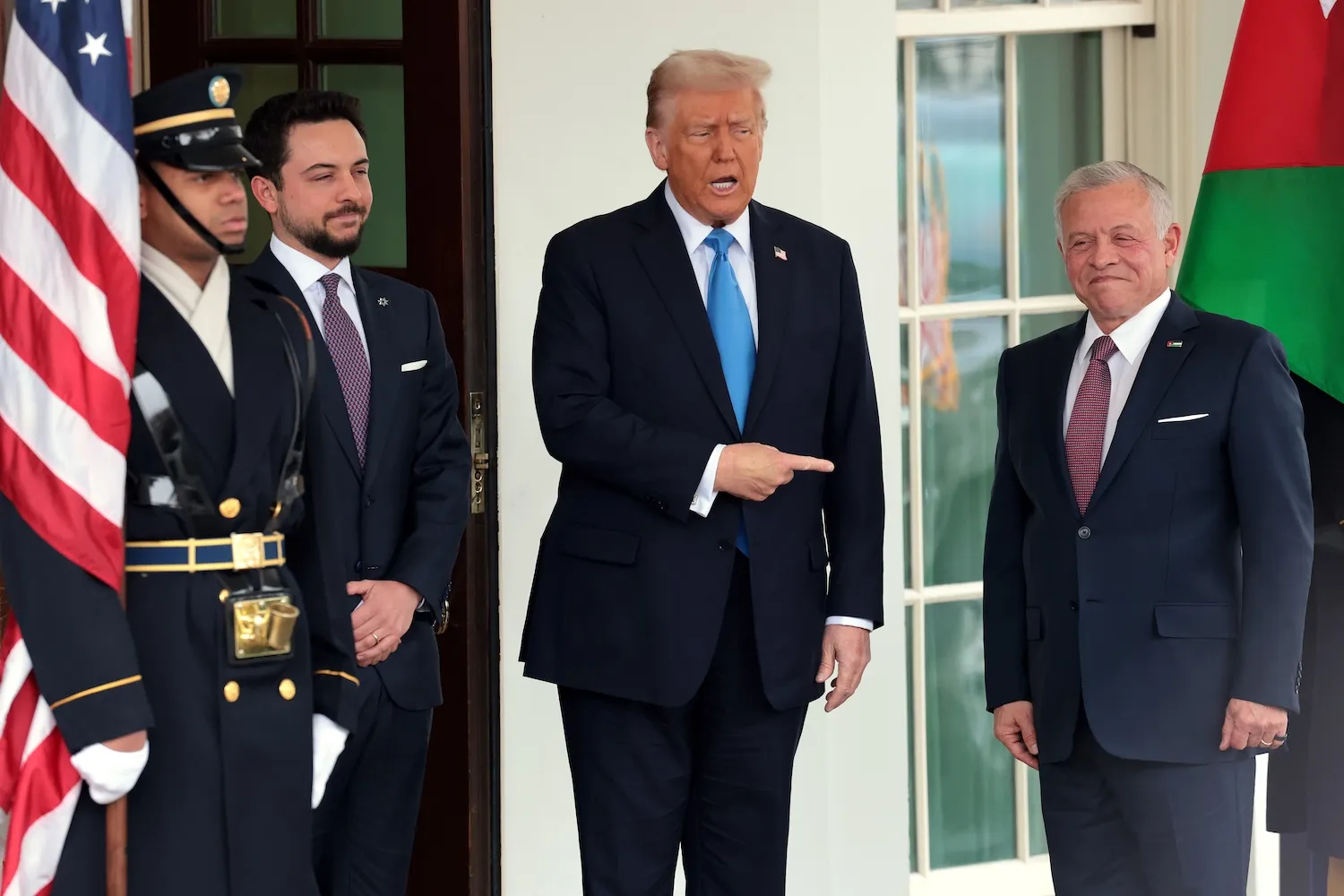
!Trump points at King Abdullah with a severe expression on his face, mouth opens as he speaks, while Abdullah smiles. They stand on one of the White House porticos. A military officer or guard in formal dress uniform stands beside them with a flag, and another man stands in the doorway to inside behind them.
*Trump points at King Abdullah with a severe expression on his face, mouth opens as he speaks, while Abdullah smiles. They stand on one of the White House porticos. A military officer or guard in formal dress uniform stands beside them with a flag, and another man stands in the doorway to inside behind them.*
U.S. President Donald Trump (second from right) greets Jordan's King Abdullah II (right) at the White House in Washington on Feb. 11, 2025. Win McNamee/Getty Images
*
*
August 24, 2026, 9:38 AM
In the largest attack by a nation-state targeting Jordanian soil in 50 years, Iran has fired hundreds of ballistic missiles and drones at the Hashemite Kingdom since February. Fatalities were recorded on July 17 when an Iranian strike killed three U.S. soldiers at Azraq’s Muwaffaq Salti Air Base. King Abdullah II declined to give a speech or hold a press conference about the killings. In fact, amid an intensifying debate over Jordan’s security partnership with Washington, the king still has not commented on the attack or offered a public defense of his policies. Instead, Abdullah left Jordan for a week in July and visited the United Kingdom—without even meeting the country’s premier. This week, Abdullah is touring China.
What explains the king’s distant approach, which stands in stark contrast to his high-profile governing strategy after coming to power in 1999? It may be that, committed to maintaining strong ties to an unpopular ally, the king has concluded that keeping quiet is the best strategy.
In the largest attack by a nation-state targeting Jordanian soil in 50 years, Iran has fired hundreds of ballistic missiles and drones at the Hashemite Kingdom since February. Fatalities were recorded on July 17 when an Iranian strike killed three U.S. soldiers at Azraq’s Muwaffaq Salti Air Base. King Abdullah II declined to give a speech or hold a press conference about the killings. In fact, amid an intensifying debate over Jordan’s security partnership with Washington, the king still has not commented on the attack or offered a public defense of his policies. Instead, Abdullah left Jordan for a week in July and visited the United Kingdom—without even meeting the country’s premier. This week, Abdullah is touring China.
What explains the king’s distant approach, which stands in stark contrast to his high-profile governing strategy after coming to power in 1999? It may be that, committed to maintaining strong ties to an unpopular ally, the king has concluded that keeping quiet is the best strategy.
Many Jordanians are critical of Abdullah’s willingness to host thousands of U.S. troops. Led by former minister Amjad al-Majali, hundreds of people signed a July letter demanding the expulsion of U.S. forces, asserting that foreign soldiers unnecessarily drag Amman into regional conflict. A mere 12 percent of Jordanians view U.S. President Donald Trump’s foreign policies favorably, according to a recent survey. When lawmaker Ali al-Khalayla requested that the legislature offer condolences for the soldiers’ deaths, his proposal was rejected; members of parliament called U.S. troops a “group of murderers” for Washington’s support of Israel during the Gaza war.
This, of course, is the reaction that Iran seeks to provoke with its missile attacks and taunts against Amman. For now, there is little evidence that it will succeed. For decades, Abdullah’s alliance with Washington has recently provided him with around $1.5 billion in annual aid and sophisticated weaponry. It is improbable that he would take the extraordinary measure of expelling U.S. forces and risk Trump’s ire, even as public frustration rises.
King Abdullah is not going anywhere. But his low profile reflects the fact that the monarchy has no good solutions to the mounting problems that Jordan faces.
---
Abdullah’s avoidance did not
begin with the Iran war. Last year, Jordan took the unprecedented step of banning the Muslim Brotherhood. Accusing the kingdom’s most influential opposition organization of harming national security, Jordanian authorities seized the Muslim Brotherhood’s assets and raided its headquarters. The Islamic Action Front, historically considered the Brotherhood’s political wing, won the most seats in the 2024 parliamentary election. Yet, Abdullah has not publicly addressed the 2025 crackdown on the organization, nor clarified to Jordanians why this escalation was necessary.
The Hashemite ruler was not always so evasive. In 1999, his first year as monarch, Amman expelled senior Hamas operatives from the kingdom, a controversial move since roughly half of Jordan’s population is of Palestinian origin. Abdullah did not shy away from explaining the policy, telling the Beirut-based magazine *Al-Hawadeth* that the restrictions against Hamas were implemented after locating weapons in the Palestinian militant group’s offices.
Shortly before the Bush administration’s 2003 invasion of Iraq, the Hashemite ruler gave a principled address outlining his opposition to the Iraq war despite his country’s dependence on U.S. assistance. A decade ago, Abdullah offered condolen
!Foreign Policy
Foreign Policy
Get analysis and alerts more quickly in the mobile app.
Install
Back to Foreign Policy Magazine home page
* Latest
* Regions
+ Asia & the Pacific
+ China
+ Middle East & Africa
+ Americas
+ Europe
* Newsletters
Editors’ Picks
Evening roundup with our editors’ favorite stories of the day
!World Brief Icon
World Brief
Your guide to the most important world stories of the day
!China Brief Icon
China Brief
The latest news, analysis, and data from the country each week
Situation Report
Weekly update on what’s driving U.S. national security policy
FP Weekend
A curation of our best book reviews, deep dives, and other reads
!Africa Brief Icon
Africa Brief
Essential analysis of the stories shaping geopolitics on the continent
!South Asia Brief Icon
South Asia Brief
Weekly update on developments in India and its neighbors
The Reading List
Curated guides on geopolitics and current affairs
FP Bookshelf
A monthly guide to FP’s book reviews, excerpts, and reading recommendations
!Latin America Brief Icon
Latin America Brief
One-stop digest of politics, economics, and culture
!Southeast Asia Brief Icon
Southeast Asia Brief
A weekly dispatch with news from the region’s 11 countries
The New Geopolitics
A five-part masterclass in IR theory with Harvard Professor Stephen M. Walt
View All Newsletters
* FP Live
* Latest
* Trending:
* Iran war
* Brazil's election kicks off
Search this website
* Preferences
* My FP Feed
* Saved Articles
* Newsletters
* Magazine Archive
* Subscription Settings
* FAQs
* Log Out
Sign In
Sign In
Campus and team access Campus and team access
Subscribe SubscribeCampus and team access Campus and team access
Analysis:
Where Is King Abdullah?
*
*
* Bluesky
* X
Save
1. Create an FP account to save articles to read later.
Sign Up
ALREADY AN FP SUBSCRIBER? LOGIN
1. **Downloadable PDFs** are a benefit of an FP subscription.
Subscribe Now
ALREADY AN FP SUBSCRIBER? LOGIN
Gift
*
*
1. Gifting articles is a subscriber benefit.
Subscribe Now
ALREADY AN FP SUBSCRIBER? LOGIN
2. This article is an Insider exclusive.
Contact us at [email protected] to learn about upgrade options, unlocking the ability to gift this article.
Analysis
Where Is King Abdullah?
Facing regional turmoil and domestic criticism, Jordan’s ruler is spending more time overseas and less time talking to the press.
By **Aaron Magid**, the author of a recent biography on King Abdullah.
!Trump points at King Abdullah with a severe expression on his face, mouth opens as he speaks, while Abdullah smiles. They stand on one of the White House porticos. A military officer or guard in formal dress uniform stands beside them with a flag, and another man stands in the doorway to inside behind them.
*Trump points at King Abdullah with a severe expression on his face, mouth opens as he speaks, while Abdullah smiles. They stand on one of the White House porticos. A military officer or guard in formal dress uniform stands beside them with a flag, and another man stands in the doorway to inside behind them.*
U.S. President Donald Trump (second from right) greets Jordan's King Abdullah II (right) at the White House in Washington on Feb. 11, 2025. Win McNamee/Getty Images
*
*
August 24, 2026, 9:38 AM
In the largest attack by a nation-state targeting Jordanian soil in 50 years, Iran has fired hundreds of ballistic missiles and drones at the Hashemite Kingdom since February. Fatalities were recorded on July 17 when an Iranian strike killed three U.S. soldiers at Azraq’s Muwaffaq Salti Air Base. King Abdullah II declined to give a speech or hold a press conference about the killings. In fact, amid an intensifying debate over Jordan’s security partnership with Washington, the king still has not commented on the attack or offered a public defense of his policies. Instead, Abdullah left Jordan for a week in July and visited the United Kingdom—without even meeting the country’s premier. This week, Abdullah is touring China.
What explains the king’s distant approach, which stands in stark contrast to his high-profile governing strategy after coming to power in 1999? It may be that, committed to maintaining strong ties to an unpopular ally, the king has concluded that keeping quiet is the best strategy.
In the largest attack by a nation-state targeting Jordanian soil in 50 years, Iran has fired hundreds of ballistic missiles and drones at the Hashemite Kingdom since February. Fatalities were recorded on July 17 when an Iranian strike killed three U.S. soldiers at Azraq’s Muwaffaq Salti Air Base. King Abdullah II declined to give a speech or hold a press conference about the killings. In fact, amid an intensifying debate over Jordan’s security partnership with Washington, the king still has not commented on the attack or offered a public defense of his policies. Instead, Abdullah left Jordan for a week in July and visited the United Kingdom—without even meeting the country’s premier. This week, Abdullah is touring China.
What explains the king’s distant approach, which stands in stark contrast to his high-profile governing strategy after coming to power in 1999? It may be that, committed to maintaining strong ties to an unpopular ally, the king has concluded that keeping quiet is the best strategy.
Many Jordanians are critical of Abdullah’s willingness to host thousands of U.S. troops. Led by former minister Amjad al-Majali, hundreds of people signed a July letter demanding the expulsion of U.S. forces, asserting that foreign soldiers unnecessarily drag Amman into regional conflict. A mere 12 percent of Jordanians view U.S. President Donald Trump’s foreign policies favorably, according to a recent survey. When lawmaker Ali al-Khalayla requested that the legislature offer condolences for the soldiers’ deaths, his proposal was rejected; members of parliament called U.S. troops a “group of murderers” for Washington’s support of Israel during the Gaza war.
This, of course, is the reaction that Iran seeks to provoke with its missile attacks and taunts against Amman. For now, there is little evidence that it will succeed. For decades, Abdullah’s alliance with Washington has recently provided him with around $1.5 billion in annual aid and sophisticated weaponry. It is improbable that he would take the extraordinary measure of expelling U.S. forces and risk Trump’s ire, even as public frustration rises.
King Abdullah is not going anywhere. But his low profile reflects the fact that the monarchy has no good solutions to the mounting problems that Jordan faces.
---
Abdullah’s avoidance did not
begin with the Iran war. Last year, Jordan took the unprecedented step of banning the Muslim Brotherhood. Accusing the kingdom’s most influential opposition organization of harming national security, Jordanian authorities seized the Muslim Brotherhood’s assets and raided its headquarters. The Islamic Action Front, historically considered the Brotherhood’s political wing, won the most seats in the 2024 parliamentary election. Yet, Abdullah has not publicly addressed the 2025 crackdown on the organization, nor clarified to Jordanians why this escalation was necessary.
The Hashemite ruler was not always so evasive. In 1999, his first year as monarch, Amman expelled senior Hamas operatives from the kingdom, a controversial move since roughly half of Jordan’s population is of Palestinian origin. Abdullah did not shy away from explaining the policy, telling the Beirut-based magazine *Al-Hawadeth* that the restrictions against Hamas were implemented after locating weapons in the Palestinian militant group’s offices.
Shortly before the Bush administration’s 2003 invasion of Iraq, the Hashemite ruler gave a principled address outlining his opposition to the Iraq war despite his country’s dependence on U.S. assistance. A decade ago, Abdullah offered condolen
🔗 Share Article
Tags:#الأردن#الملك عبدالله الثاني#العلاقات الأمريكية الأردنية#إيران#الشرق الأوسط#السياسة الخارجية
Source: Foreign Policy
For Context
Related reads from the same topic or latest developments


