The Houthis Are Risking Everything for Iran
Foreign Policy

Foreign Policy
Original Source
The Houthis risk pushing a newly consolidated Saudi Arabia toward an all-out ground war by following Tehran's orders to escalate in the Red Sea. By betting their limited military capabilities on Iran's strategic ambitions, the group faces an existential threat it may not survive.
The Houthis Are Risking Everything for Iran
!Foreign Policy
Foreign Policy
Get analysis and alerts more quickly in the mobile app.
Install
Back to Foreign Policy Magazine home page
* Latest
* Regions
+ Asia & the Pacific
+ China
+ Middle East & Africa
+ Americas
+ Europe
* Newsletters
View All Newsletters
* FP Live
* Latest
* Trending:
* Europe's record heatwave
* Gaza plan
* Ceuta's future
* Colombia's new president
Search this website
* Preferences
* My FP Feed
* Saved Articles
* Newsletters
* Magazine Archive
* Subscription Settings
* FAQs
* Log Out
Sign In
Sign In
Partner with FP at UNGA81 Partner with FP at UNGA81
Subscribe SubscribePartner with FP at UNGA81 Partner with FP at UNGA81
Analysis:
The Houthis Are Risking Everything for Iran
*
*
* Facebook
* Bluesky
* X
* LinkedIn
* WhatsApp
* Reddit
Save
1. Create an FP account to save articles to read later.
Sign Up
ALREADY AN FP SUBSCRIBER? LOGIN
PDF
1. **Downloadable PDFs** are a benefit of an FP subscription.
Subscribe Now
ALREADY AN FP SUBSCRIBER? LOGIN
Gift
*
*
* WhatsApp
1. Gifting articles is a subscriber benefit.
Subscribe Now
ALREADY AN FP SUBSCRIBER? LOGIN
2. This article is an Insider exclusive.
Contact us at [email protected] to learn about upgrade options, unlocking the ability to gift this article.
Analysis
The Houthis Are Risking Everything for Iran
Tehran’s proxy risks pushing a newly consolidated Saudi Arabia into an all-out ground war.
By **Fatima Abo Alasrar**, a writer at the Ideology Machine, a publication on authoritarian information systems.
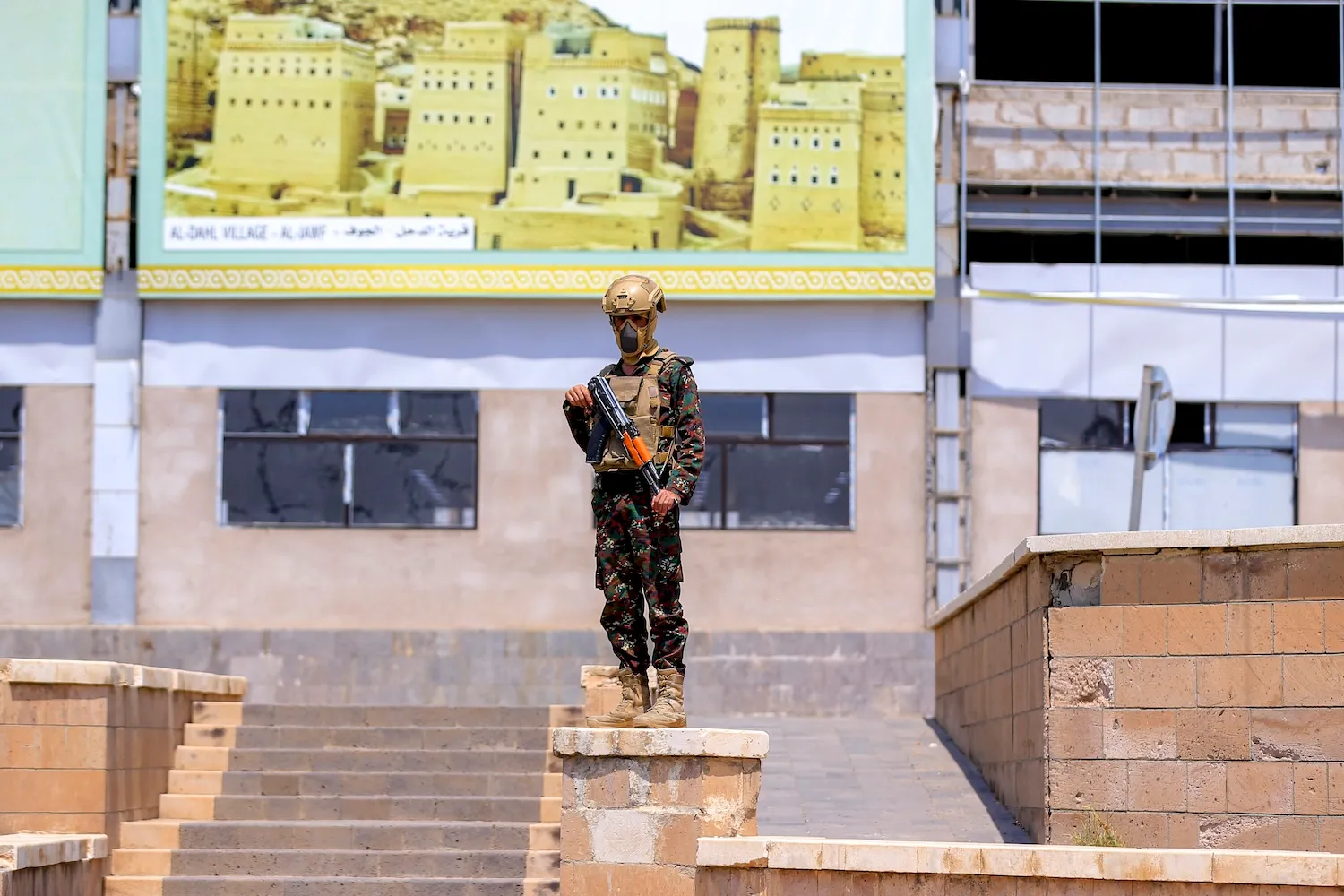
!A member of the Houthi authorities' security forces stands guard at Sanaa International Airport, Yemen, on Aug. 8.
*A member of the Houthi authorities' security forces stands guard at Sanaa International Airport, Yemen, on Aug. 8.*
A member of the Houthi authorities' security forces stands guard at Sanaa International Airport, Yemen, on Aug. 8. Mohammed Huwais/AFP via Getty Images
*
*
August 12, 2026, 1:00 AM
Middle East Crisis
News, analysis, and background.
MORE ON THIS TOPIC
Early in the Iran war, the Houthis declared that if Iran came under attack, the Red Sea would run “red with the blood of its enemies.” That warning hung in the air for months as the Houthis continued to issue threats of closure without any action. But Tehran picked the moment carefully. As the White House insisted that the Strait of Hormuz remained open—a claim that Tehran denied—Tehran activated the Houthis at Bab el-Mandeb to demonstrate at the second chokepoint what Iran could not settle at the first.
Kicking off events, Tehran flew a sanctioned Iranian aircraft into Yemen’s Sanaa airport in defiance of Saudi inspection mechanisms. Yemen’s internationally recognized government, operating with Saudi coalition air support, cratered the runway to stop the plane. The Houthis, who have complied with the Saudi restrictions for years, found a pretext to retaliate. The series of escalations that followed, from striking Saudi Arabia’s Abha airport to attacking Saudi Aramco facilities, were sufficient to induce global economic panic, as the price of Brent crude closed above $100 a barrel for the first time since the war started.
Early in the Iran war, the Houthis declared that if Iran came under attack, the Red Sea would run “red with the blood of its enemies.” That warning hung in the air for months as the Houthis continued to issue threats of closure without any action. But Tehran picked the moment carefully. As the White House insisted that the Strait of Hormuz remained open—a claim that Tehran denied—Tehran activated the Houthis at Bab el-Mandeb to demonstrate at the second chokepoint what Iran could not settle at the first.
Kicking off events, Tehran flew a sanctioned Iranian aircraft into Yemen’s Sanaa airport in defiance of Saudi inspection mechanisms. Yemen’s internationally recognized government, operating with Saudi coalition air support, cratered the runway to stop the plane. The Houthis, who have complied with the Saudi restrictions for years, found a pretext to retaliate. The series of escalations that followed, from striking Saudi Arabia’s Abha airport to attacking Saudi Aramco facilities, were sufficient to induce global economic panic, as the price of Brent crude closed above $100 a barrel for the first time since the war started.
The intent to activate Bab el-Mandeb as an Iranian front had been telegraphed openly just a week before the Houthi-Saudi escalation. In fact, in a column titled “Close Bab el-Mandeb and See the Result,” Hossein Shariatmadari, former Iranian Supreme Leader Ali Khamenei’s appointee as managing editor of *Kayhan*, argued that Iran could do the job itself, reaching the strait with its own precision missiles sent from 2,300 kilometers away.
The pressure in the Red Sea was quickly paired with Iraqi militia drone strikes on major Saudi energy facilities in Riyadh and the Eastern Province, completing a unified axis operation designed to squeeze Riyadh from every side while creating a global economic panic.
But while Tehran strategically benefits from projecting its power on another chokepoint, for the Houthis, this escalation raises the stakes in an ongoing battle with Saudi Arabia. Last Thursday, for instance, Houthis attacked a Yemeni government camp and left at least 30 government soldiers dead. It was one of the deadliest days of the conflict so far.
Unlike in 2015, when Riyadh fought its first war in Yemen without experience or a unified Yemeni army, Saudi Arabia has now moved to consolidate power within Yemen and unite factions under one leadership. Through attacking the Southern Transitional Council over the past year, it signaled that it is far less inclined to yield under pressure. The tactical cost of firing drones remains negligible for the Houthis, but the strategic risk is existential.
By letting Tehran dictate the timing of this maritime war, the Houthis risk pushing Saudi Arabia into a total confrontation that could ignite a ground war in Yemen, one that the group may not have sufficient funding or weaponry to sustain.
---
The latest actions
in the Red Sea are the exact playbook that the Houthis have run for a decade. At a fraction of the cost of the interceptors sent to stop them, whether through a cheap drone, an anti-ship missile, or a radio warning that costs nothing at all, the Houthis impose burdens on Riyadh and Washington out of all proportion to their spending. In the process, they stretch U.S. air defenses already committed at Hormuz.
Iranian Quds Force commander Esmail Qaani has said as much, describing a security belt of the resistance running “from the Strait of Hormuz to Bab el-Mandeb.” What the Houthis announced on July 20 was the execution of an Iranian instruction. Just a week before the Houthis announced their closure of the chokepoint, reports emerged that Iran had instructed the Houthis to close the route if Washington struck its power infrastructure—meaning that their missiles and drones were already in position.
Tellingly, and in contrast to Tehran’s operational bluster, much of the coverage in Houthi media frames this as an economic war and not a military one. What the movement figured out over years of conflict is that durable pressure comes from the ability to issue a threat rather than the need to execute one, which is why the July blockade announcement ran on radio and via email. Houthi outlets are now claiming that underwriters are dropping Saudi-linked vessels altogether. Whether true or not, reporting it serves the primary objective of forcing markets to price in the threat ahead of time.
Writing in *al-Ahed*, the Hezbollah-aligned analyst Jihad Haidar argued that the real test of U.S. military power is not how many warships are deployed or strikes are flown, but whether shippers will transit and underwriters will take on the risk. As long as insurance markets refuse the coverage, total military superio
!Foreign Policy
Foreign Policy
Get analysis and alerts more quickly in the mobile app.
Install
Back to Foreign Policy Magazine home page
* Latest
* Regions
+ Asia & the Pacific
+ China
+ Middle East & Africa
+ Americas
+ Europe
* Newsletters
View All Newsletters
* FP Live
* Latest
* Trending:
* Europe's record heatwave
* Gaza plan
* Ceuta's future
* Colombia's new president
Search this website
* Preferences
* My FP Feed
* Saved Articles
* Newsletters
* Magazine Archive
* Subscription Settings
* FAQs
* Log Out
Sign In
Sign In
Partner with FP at UNGA81 Partner with FP at UNGA81
Subscribe SubscribePartner with FP at UNGA81 Partner with FP at UNGA81
Analysis:
The Houthis Are Risking Everything for Iran
*
*
* Bluesky
* X
Save
1. Create an FP account to save articles to read later.
Sign Up
ALREADY AN FP SUBSCRIBER? LOGIN
1. **Downloadable PDFs** are a benefit of an FP subscription.
Subscribe Now
ALREADY AN FP SUBSCRIBER? LOGIN
Gift
*
*
1. Gifting articles is a subscriber benefit.
Subscribe Now
ALREADY AN FP SUBSCRIBER? LOGIN
2. This article is an Insider exclusive.
Contact us at [email protected] to learn about upgrade options, unlocking the ability to gift this article.
Analysis
The Houthis Are Risking Everything for Iran
Tehran’s proxy risks pushing a newly consolidated Saudi Arabia into an all-out ground war.
By **Fatima Abo Alasrar**, a writer at the Ideology Machine, a publication on authoritarian information systems.
!A member of the Houthi authorities' security forces stands guard at Sanaa International Airport, Yemen, on Aug. 8.
*A member of the Houthi authorities' security forces stands guard at Sanaa International Airport, Yemen, on Aug. 8.*
A member of the Houthi authorities' security forces stands guard at Sanaa International Airport, Yemen, on Aug. 8. Mohammed Huwais/AFP via Getty Images
*
*
August 12, 2026, 1:00 AM
Middle East Crisis
News, analysis, and background.
Early in the Iran war, the Houthis declared that if Iran came under attack, the Red Sea would run “red with the blood of its enemies.” That warning hung in the air for months as the Houthis continued to issue threats of closure without any action. But Tehran picked the moment carefully. As the White House insisted that the Strait of Hormuz remained open—a claim that Tehran denied—Tehran activated the Houthis at Bab el-Mandeb to demonstrate at the second chokepoint what Iran could not settle at the first.
Kicking off events, Tehran flew a sanctioned Iranian aircraft into Yemen’s Sanaa airport in defiance of Saudi inspection mechanisms. Yemen’s internationally recognized government, operating with Saudi coalition air support, cratered the runway to stop the plane. The Houthis, who have complied with the Saudi restrictions for years, found a pretext to retaliate. The series of escalations that followed, from striking Saudi Arabia’s Abha airport to attacking Saudi Aramco facilities, were sufficient to induce global economic panic, as the price of Brent crude closed above $100 a barrel for the first time since the war started.
Early in the Iran war, the Houthis declared that if Iran came under attack, the Red Sea would run “red with the blood of its enemies.” That warning hung in the air for months as the Houthis continued to issue threats of closure without any action. But Tehran picked the moment carefully. As the White House insisted that the Strait of Hormuz remained open—a claim that Tehran denied—Tehran activated the Houthis at Bab el-Mandeb to demonstrate at the second chokepoint what Iran could not settle at the first.
Kicking off events, Tehran flew a sanctioned Iranian aircraft into Yemen’s Sanaa airport in defiance of Saudi inspection mechanisms. Yemen’s internationally recognized government, operating with Saudi coalition air support, cratered the runway to stop the plane. The Houthis, who have complied with the Saudi restrictions for years, found a pretext to retaliate. The series of escalations that followed, from striking Saudi Arabia’s Abha airport to attacking Saudi Aramco facilities, were sufficient to induce global economic panic, as the price of Brent crude closed above $100 a barrel for the first time since the war started.
The intent to activate Bab el-Mandeb as an Iranian front had been telegraphed openly just a week before the Houthi-Saudi escalation. In fact, in a column titled “Close Bab el-Mandeb and See the Result,” Hossein Shariatmadari, former Iranian Supreme Leader Ali Khamenei’s appointee as managing editor of *Kayhan*, argued that Iran could do the job itself, reaching the strait with its own precision missiles sent from 2,300 kilometers away.
The pressure in the Red Sea was quickly paired with Iraqi militia drone strikes on major Saudi energy facilities in Riyadh and the Eastern Province, completing a unified axis operation designed to squeeze Riyadh from every side while creating a global economic panic.
But while Tehran strategically benefits from projecting its power on another chokepoint, for the Houthis, this escalation raises the stakes in an ongoing battle with Saudi Arabia. Last Thursday, for instance, Houthis attacked a Yemeni government camp and left at least 30 government soldiers dead. It was one of the deadliest days of the conflict so far.
Unlike in 2015, when Riyadh fought its first war in Yemen without experience or a unified Yemeni army, Saudi Arabia has now moved to consolidate power within Yemen and unite factions under one leadership. Through attacking the Southern Transitional Council over the past year, it signaled that it is far less inclined to yield under pressure. The tactical cost of firing drones remains negligible for the Houthis, but the strategic risk is existential.
By letting Tehran dictate the timing of this maritime war, the Houthis risk pushing Saudi Arabia into a total confrontation that could ignite a ground war in Yemen, one that the group may not have sufficient funding or weaponry to sustain.
---
The latest actions
in the Red Sea are the exact playbook that the Houthis have run for a decade. At a fraction of the cost of the interceptors sent to stop them, whether through a cheap drone, an anti-ship missile, or a radio warning that costs nothing at all, the Houthis impose burdens on Riyadh and Washington out of all proportion to their spending. In the process, they stretch U.S. air defenses already committed at Hormuz.
Iranian Quds Force commander Esmail Qaani has said as much, describing a security belt of the resistance running “from the Strait of Hormuz to Bab el-Mandeb.” What the Houthis announced on July 20 was the execution of an Iranian instruction. Just a week before the Houthis announced their closure of the chokepoint, reports emerged that Iran had instructed the Houthis to close the route if Washington struck its power infrastructure—meaning that their missiles and drones were already in position.
Tellingly, and in contrast to Tehran’s operational bluster, much of the coverage in Houthi media frames this as an economic war and not a military one. What the movement figured out over years of conflict is that durable pressure comes from the ability to issue a threat rather than the need to execute one, which is why the July blockade announcement ran on radio and via email. Houthi outlets are now claiming that underwriters are dropping Saudi-linked vessels altogether. Whether true or not, reporting it serves the primary objective of forcing markets to price in the threat ahead of time.
Writing in *al-Ahed*, the Hezbollah-aligned analyst Jihad Haidar argued that the real test of U.S. military power is not how many warships are deployed or strikes are flown, but whether shippers will transit and underwriters will take on the risk. As long as insurance markets refuse the coverage, total military superio
🔗 Share Article
Tags:#الحوثيون#إيران#البحر الأحمر#السعودية#الشرق الأوسط#الصراع اليمني
Source: Foreign Policy
For Context
Related reads from the same topic or latest developments


