Yes, the Iran War Really Is Similar to Vietnam
Foreign Policy

Foreign Policy
Original Source
A striking analysis reveals how the current Iran War mirrors the Vietnam conflict in its vague objectives, ideologically-driven leadership, and absence of a clear exit strategy. History, it appears, is repeating itself in Washington.
How Similar Is the Iran War to Vietnam?
!Foreign Policy
Foreign Policy
Get analysis and alerts more quickly in the mobile app.
Install
Back to Foreign Policy Magazine home page
* Latest
* Regions
+ Asia & the Pacific
+ China
+ Middle East & Africa
+ Americas
+ Europe
* Newsletters
Editors’ Picks
Evening roundup with our editors’ favorite stories of the day
!World Brief Icon
World Brief
Your guide to the most important world stories of the day
!China Brief Icon
China Brief
The latest news, analysis, and data from the country each week
Situation Report
Weekly update on what’s driving U.S. national security policy
FP Weekend
A curation of our best book reviews, deep dives, and other reads
!Africa Brief Icon
Africa Brief
Essential analysis of the stories shaping geopolitics on the continent
!South Asia Brief Icon
South Asia Brief
Weekly update on developments in India and its neighbors
The Reading List
Curated guides on geopolitics and current affairs
FP Bookshelf
A monthly guide to FP’s book reviews, excerpts, and reading recommendations
!Latin America Brief Icon
Latin America Brief
One-stop digest of politics, economics, and culture
!Southeast Asia Brief Icon
Southeast Asia Brief
A weekly dispatch with news from the region’s 11 countries
The New Geopolitics
A five-part masterclass in IR theory with Harvard Professor Stephen M. Walt
View All Newsletters
* FP Live
* Latest
* Trending:
* Europe's record heatwave
* Gaza plan
* Ceuta's future
Search this website
* Preferences
* My FP Feed
* Saved Articles
* Newsletters
* Magazine Archive
* Subscription Settings
* FAQs
* Log Out
Sign In
Sign In
Partner with FP at UNGA81 Partner with FP at UNGA81
Subscribe SubscribePartner with FP at UNGA81 Partner with FP at UNGA81
Analysis:
Yes, the Iran War Really Is Similar to Vietnam
*
*
* Facebook
* Bluesky
* X
* LinkedIn
* WhatsApp
* Reddit
Save
1. Create an FP account to save articles to read later.
Sign Up
ALREADY AN FP SUBSCRIBER? LOGIN
PDF
1. **Downloadable PDFs** are a benefit of an FP subscription.
Subscribe Now
ALREADY AN FP SUBSCRIBER? LOGIN
Gift
*
*
* WhatsApp
1. Gifting articles is a subscriber benefit.
Subscribe Now
ALREADY AN FP SUBSCRIBER? LOGIN
2. This article is an Insider exclusive.
Contact us at [email protected] to learn about upgrade options, unlocking the ability to gift this article.
Analysis
Yes, the Iran War Really Is Similar to Vietnam
Trump’s war is “The Best and the Brightest”—but without the best and the brightest.
!Howard French
*Howard French*
*Howard W. French*
By **Howard W. French**, a columnist at *Foreign Policy*.
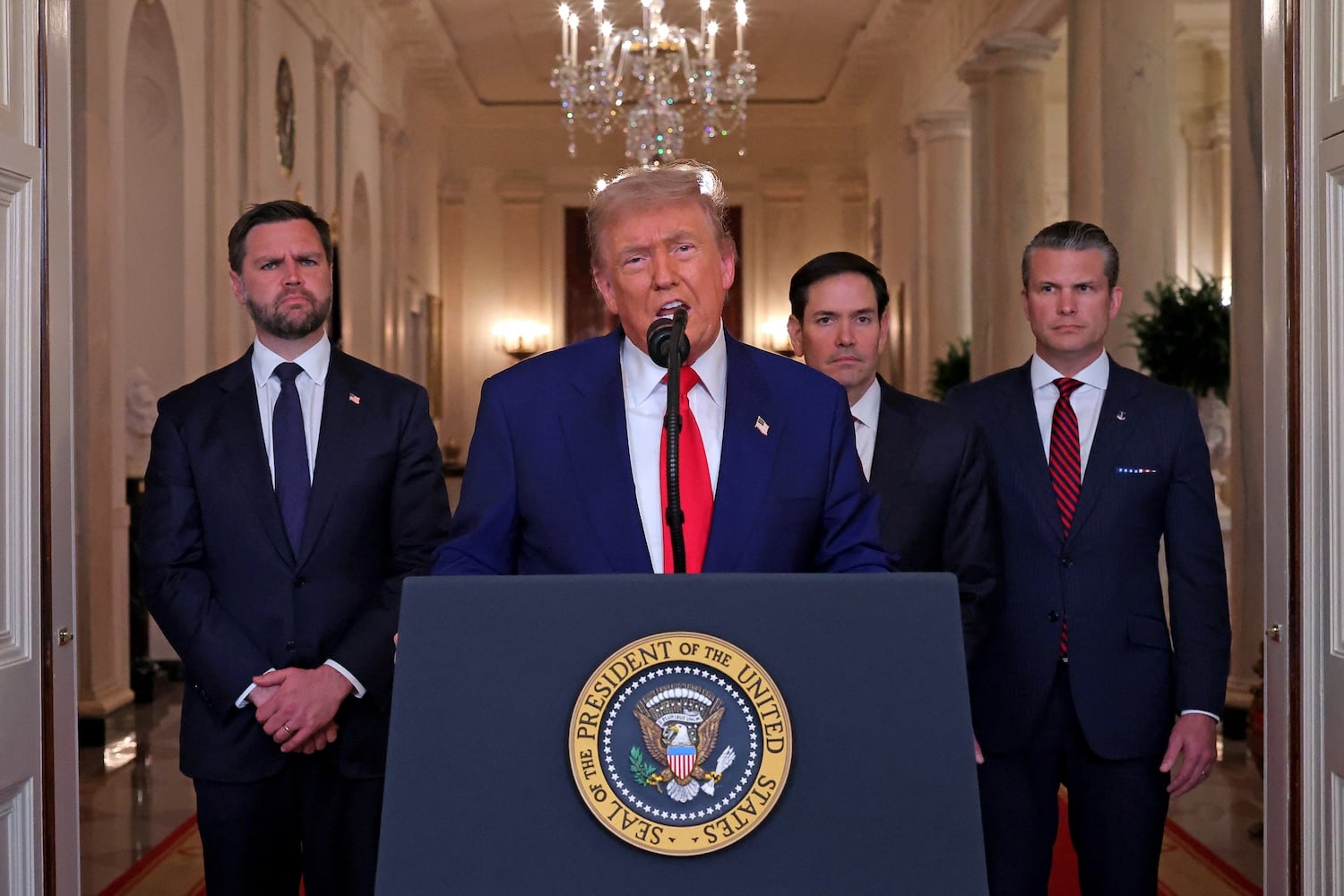
!Trump speaks at a podium; Vance, Rubio, and Hegseth stand behind him.
*Trump speaks at a podium; Vance, Rubio, and Hegseth stand behind him.*
U.S. President Donald Trump addresses the nation alongside Vice President J.D. Vance, Secretary of State Marco Rubio, and Defense Secretary Pete Hegseth, seen in the White House in Washington on June 21, 2025. Carlos Barria/Pool/AFP via Getty Images
*
*
August 14, 2026, 12:25 PM
Iran War
Analysis and news.
One of the sturdiest conventions about human affairs is the notion that “those who cannot remember the past are condemned to repeat it.”
This sage original formulation comes from the Spanish-born American philosopher and poet George Santayana, but close variations abound, correctly or wrongly attributed to a wide variety of thinkers and politicians, from Edmund Burke to Winston Churchill.
One of the sturdiest conventions about human affairs is the notion that “those who cannot remember the past are condemned to repeat it.”
This sage original formulation comes from the Spanish-born American philosopher and poet George Santayana, but close variations abound, correctly or wrongly attributed to a wide variety of thinkers and politicians, from Edmund Burke to Winston Churchill.
Last week, I reread a modern classic by the late journalist David Halberstam, *The Best and the Brightest*. Originally published in 1972, Halberstam’s account of the arrogant way the administrations of Presidents John F. Kennedy and Lyndon B. Johnson led the United States into a senseless and unwinnable conflict in Vietnam offers a series of potent reminders of the wisdom of Santayana’s insight at a moment when Washington has once again stumbled into war.
Much has changed about the United States and the world since the Vietnam War, which was a human tragedy and a profound debacle from the perspective of U.S. power. But many of the basics of the cognitive blindness that Washington displayed in pursuing that conflict are on exhibit in the Iran war today. They have even deepened and become more glaring.
***The Best and the Brightest***, David Halberstam, Ballantine Books, 720 pp., $20, October 1993 (first ed. 1972), paperback
One might start with Halberstam’s title, which at first glance may appear to be an endorsement of the intellectual brilliance that Kennedy assembled around him and relied upon for foreign-policy advice. The title is, in fact, meant to be ironic. Kennedy’s advisors, many of whom were retained by Johnson, were indeed avatars of almost absurd excellence, measured by their achievements prior to entering the president’s inner circle.
McGeorge Bundy, to take one, had graduated at the top of his class at the elite boarding school Groton, where he once feigned to “read” an assignment out loud that he had not bothered to write, extemporaneously delivering his composed thoughts so coherently that his professor and fellow students were left stunned. After racking up numerous distinctions at Yale and Harvard, Bundy was named dean of Harvard’s Faculty of Arts and Sciences at the age of 34, when most academics are struggling to obtain tenure. He eventually served as Kennedy’s, and later Johnson’s, national security advisor.
Robert McNamara, a former head of Ford Motor Company who served under both presidents as secretary of defense, was another of the brilliant technocrats, men who believed fervently in the ability of applied reason, intelligence, and learning—sheer brain power, in other words—to overcome all but the rarest of problems. One of McNamara’s reputed superpowers was his sophistication with data, coupled with a legendary memory.
As Halberstam writes, “Once, sitting at CINCPAC \[a military presentation] for eight hours watching hundreds and thousands of slides flashed across the screen showing what was in the pipeline to Vietnam and what was already there, he finally said, after seven hours, ‘Stop the projector. This slide, number 869, contradicts slide 11.’ Everyone was impressed, and many a little frightened.”
The current U.S. president, Donald Trump, is fond of pointing out that the present war and the Vietnam conflict bear little comparison because, despite his initial boast that the Iran campaign would be concluded in a matter of weeks, it remains incomparably shorter than the latter. It is hard, nonetheless, for anyone who reads Halberstam today to come away less than impressed by how much the two wars already share with each other.
Each was pursued with ill-defined and frequently shifting goals. Each proceeded on the basis of designs drawn up by ideologically driven people bereft of expertise in the country that Washington had decided to go to war against. The planning of each was conducted largely in secret, with little public airing of strategy or aims, let alone consultation with Congress or with allies. Each gave almost no room for dissenting voices to be heard. Each placed unshakeable faith in the ability of superior U.S. technology and overwhelming firepower to ensure victory. Neither White House thought clearly about what victory would look like, or how to know when and how to get out. And as the respective tragedies unfolded, each fell under the spell of its own rhetoric. “Being verbal seemed to be an end in itself,” Halberstam wrote in an updated foreword for the 1993 edition of his classic.
Th
!Foreign Policy
Foreign Policy
Get analysis and alerts more quickly in the mobile app.
Install
Back to Foreign Policy Magazine home page
* Latest
* Regions
+ Asia & the Pacific
+ China
+ Middle East & Africa
+ Americas
+ Europe
* Newsletters
Editors’ Picks
Evening roundup with our editors’ favorite stories of the day
!World Brief Icon
World Brief
Your guide to the most important world stories of the day
!China Brief Icon
China Brief
The latest news, analysis, and data from the country each week
Situation Report
Weekly update on what’s driving U.S. national security policy
FP Weekend
A curation of our best book reviews, deep dives, and other reads
!Africa Brief Icon
Africa Brief
Essential analysis of the stories shaping geopolitics on the continent
!South Asia Brief Icon
South Asia Brief
Weekly update on developments in India and its neighbors
The Reading List
Curated guides on geopolitics and current affairs
FP Bookshelf
A monthly guide to FP’s book reviews, excerpts, and reading recommendations
!Latin America Brief Icon
Latin America Brief
One-stop digest of politics, economics, and culture
!Southeast Asia Brief Icon
Southeast Asia Brief
A weekly dispatch with news from the region’s 11 countries
The New Geopolitics
A five-part masterclass in IR theory with Harvard Professor Stephen M. Walt
View All Newsletters
* FP Live
* Latest
* Trending:
* Europe's record heatwave
* Gaza plan
* Ceuta's future
Search this website
* Preferences
* My FP Feed
* Saved Articles
* Newsletters
* Magazine Archive
* Subscription Settings
* FAQs
* Log Out
Sign In
Sign In
Partner with FP at UNGA81 Partner with FP at UNGA81
Subscribe SubscribePartner with FP at UNGA81 Partner with FP at UNGA81
Analysis:
Yes, the Iran War Really Is Similar to Vietnam
*
*
* Bluesky
* X
Save
1. Create an FP account to save articles to read later.
Sign Up
ALREADY AN FP SUBSCRIBER? LOGIN
1. **Downloadable PDFs** are a benefit of an FP subscription.
Subscribe Now
ALREADY AN FP SUBSCRIBER? LOGIN
Gift
*
*
1. Gifting articles is a subscriber benefit.
Subscribe Now
ALREADY AN FP SUBSCRIBER? LOGIN
2. This article is an Insider exclusive.
Contact us at [email protected] to learn about upgrade options, unlocking the ability to gift this article.
Analysis
Yes, the Iran War Really Is Similar to Vietnam
Trump’s war is “The Best and the Brightest”—but without the best and the brightest.
!Howard French
*Howard French*
*Howard W. French*
By **Howard W. French**, a columnist at *Foreign Policy*.
!Trump speaks at a podium; Vance, Rubio, and Hegseth stand behind him.
*Trump speaks at a podium; Vance, Rubio, and Hegseth stand behind him.*
U.S. President Donald Trump addresses the nation alongside Vice President J.D. Vance, Secretary of State Marco Rubio, and Defense Secretary Pete Hegseth, seen in the White House in Washington on June 21, 2025. Carlos Barria/Pool/AFP via Getty Images
*
*
August 14, 2026, 12:25 PM
Iran War
Analysis and news.
One of the sturdiest conventions about human affairs is the notion that “those who cannot remember the past are condemned to repeat it.”
This sage original formulation comes from the Spanish-born American philosopher and poet George Santayana, but close variations abound, correctly or wrongly attributed to a wide variety of thinkers and politicians, from Edmund Burke to Winston Churchill.
One of the sturdiest conventions about human affairs is the notion that “those who cannot remember the past are condemned to repeat it.”
This sage original formulation comes from the Spanish-born American philosopher and poet George Santayana, but close variations abound, correctly or wrongly attributed to a wide variety of thinkers and politicians, from Edmund Burke to Winston Churchill.
Last week, I reread a modern classic by the late journalist David Halberstam, *The Best and the Brightest*. Originally published in 1972, Halberstam’s account of the arrogant way the administrations of Presidents John F. Kennedy and Lyndon B. Johnson led the United States into a senseless and unwinnable conflict in Vietnam offers a series of potent reminders of the wisdom of Santayana’s insight at a moment when Washington has once again stumbled into war.
Much has changed about the United States and the world since the Vietnam War, which was a human tragedy and a profound debacle from the perspective of U.S. power. But many of the basics of the cognitive blindness that Washington displayed in pursuing that conflict are on exhibit in the Iran war today. They have even deepened and become more glaring.
***The Best and the Brightest***, David Halberstam, Ballantine Books, 720 pp., $20, October 1993 (first ed. 1972), paperback
One might start with Halberstam’s title, which at first glance may appear to be an endorsement of the intellectual brilliance that Kennedy assembled around him and relied upon for foreign-policy advice. The title is, in fact, meant to be ironic. Kennedy’s advisors, many of whom were retained by Johnson, were indeed avatars of almost absurd excellence, measured by their achievements prior to entering the president’s inner circle.
McGeorge Bundy, to take one, had graduated at the top of his class at the elite boarding school Groton, where he once feigned to “read” an assignment out loud that he had not bothered to write, extemporaneously delivering his composed thoughts so coherently that his professor and fellow students were left stunned. After racking up numerous distinctions at Yale and Harvard, Bundy was named dean of Harvard’s Faculty of Arts and Sciences at the age of 34, when most academics are struggling to obtain tenure. He eventually served as Kennedy’s, and later Johnson’s, national security advisor.
Robert McNamara, a former head of Ford Motor Company who served under both presidents as secretary of defense, was another of the brilliant technocrats, men who believed fervently in the ability of applied reason, intelligence, and learning—sheer brain power, in other words—to overcome all but the rarest of problems. One of McNamara’s reputed superpowers was his sophistication with data, coupled with a legendary memory.
As Halberstam writes, “Once, sitting at CINCPAC \[a military presentation] for eight hours watching hundreds and thousands of slides flashed across the screen showing what was in the pipeline to Vietnam and what was already there, he finally said, after seven hours, ‘Stop the projector. This slide, number 869, contradicts slide 11.’ Everyone was impressed, and many a little frightened.”
The current U.S. president, Donald Trump, is fond of pointing out that the present war and the Vietnam conflict bear little comparison because, despite his initial boast that the Iran campaign would be concluded in a matter of weeks, it remains incomparably shorter than the latter. It is hard, nonetheless, for anyone who reads Halberstam today to come away less than impressed by how much the two wars already share with each other.
Each was pursued with ill-defined and frequently shifting goals. Each proceeded on the basis of designs drawn up by ideologically driven people bereft of expertise in the country that Washington had decided to go to war against. The planning of each was conducted largely in secret, with little public airing of strategy or aims, let alone consultation with Congress or with allies. Each gave almost no room for dissenting voices to be heard. Each placed unshakeable faith in the ability of superior U.S. technology and overwhelming firepower to ensure victory. Neither White House thought clearly about what victory would look like, or how to know when and how to get out. And as the respective tragedies unfolded, each fell under the spell of its own rhetoric. “Being verbal seemed to be an end in itself,” Halberstam wrote in an updated foreword for the 1993 edition of his classic.
Th
🔗 Share Article
Tags:#حرب إيران#فيتنام#السياسة الأمريكية#التحليل الاستراتيجي#الأخطاء التاريخية#الشرق الأوسط
Source: Foreign Policy
For Context
Related reads from the same topic or latest developments


