Every major Nvidia customer is now a competitor as Microsoft reveals new Maia chip
Axios
A
Axios
Original Source
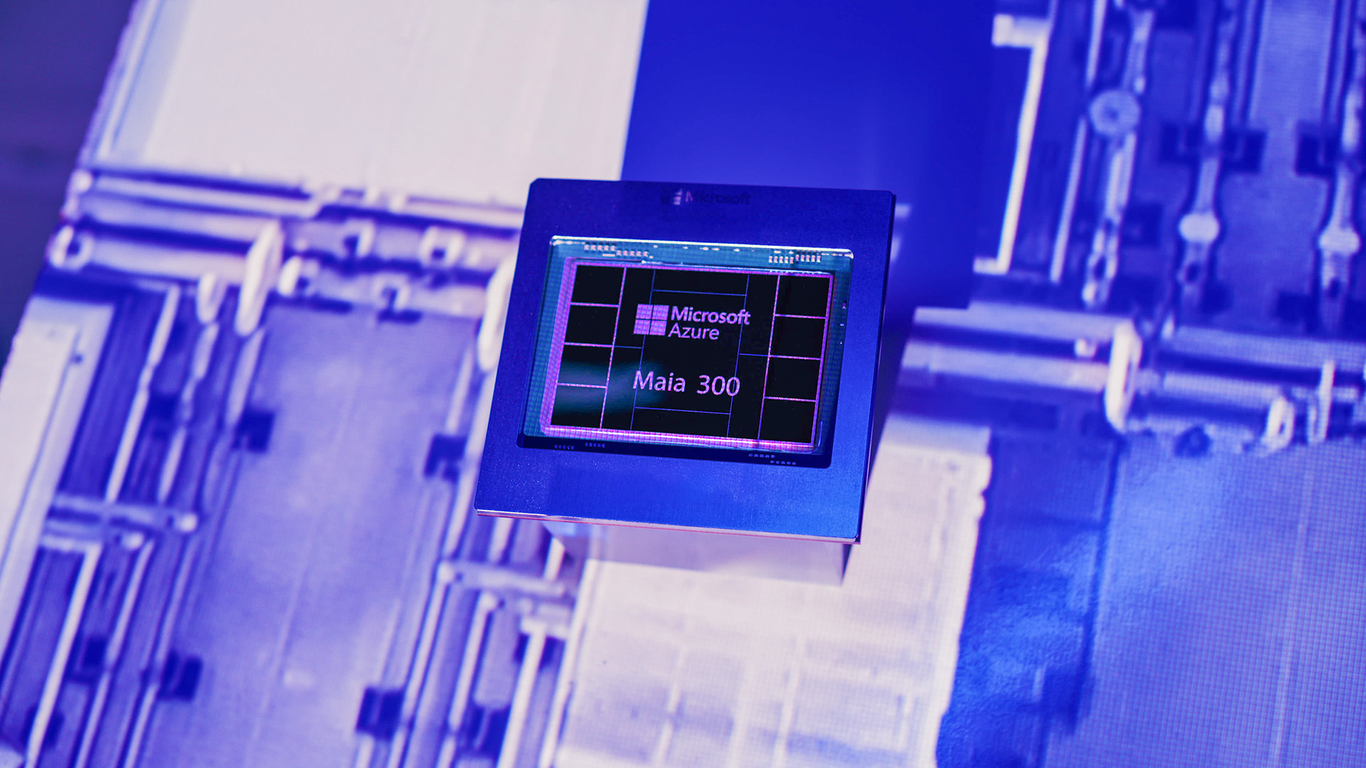
Microsoft's unveiling of its Maia 300 AI accelerator chip marks a pivotal shift in the trillion-dollar AI race, as the tech giant and its peers move to reduce dependence on Nvidia's dominant processors. Nearly all major AI players are now developing custom silicon to cut costs and gain greater control over their infrastructure.
Microsoft, Big Tech challenge Nvidia with move to custom silicon
*
* Newsletters
*
* Axios Pro
* Axios Live
* The Axios Show
Axios
Axios
2 hours ago - Business
The AI chip war is turning Nvidia's customers into rivals
* Ina Fried
*
*
*
Add Axios on Google
Add Axios as your preferred source to
see more of our stories on Google.
Add Axios on Google
!Microsoft's prototype Maia 300 chip
*Image: Microsoft*
The trillion-dollar AI race is moving from software to silicon, as Microsoft's massive bet on its proprietary Maia chips proves Big Tech wants to wean itself off Nvidia's dominance.
**Why it matters:** Microsoft's plan to power its AI products with custom silicon shows how every major Nvidia customer is now a competitor, seeking lower costs, improved performance and more control.
* The shift is particularly significant for inference — the computing needed to generate AI responses — as more sophisticated AI models and agents drive demand for computing power.
**Driving the news:** Microsoft unveiled Maia 300, its latest custom AI accelerator, saying it will begin deploying the chip in 2027 and it will become the primary inference system for its own products and services.
* The company says Maia 300 will deliver 40% more AI tokens per megawatt than leading GPU-based systems.
* It's also designed to minimize unnecessary data movement between chips and memory, a growing bottleneck as AI models become more complex.
**The big picture:** Microsoft's plan is part of a much broader shift, with nearly all major AI players seeking Nvidia alternatives.
* **Google** has been developing its own Tensor Processing Units for years, with its latest generation including separate versions optimized for training AI models and running inference.
* **OpenAI** is developing its Jalapeño chip with Broadcom, initially focusing on inference workloads. The company said in August that its first chip was outperforming Nvidia hardware on certain workloads and that it was already developing subsequent generations.
* **Amazon** has its own Trainium family of AI chips, which are being used by customers including Anthropic. OpenAI has also committed to using Amazon's custom silicon as part of a massive infrastructure agreement.
* **Anthropic** confirmed in August that it is exploring its own chip designs, even as it continues to rely on chips from Nvidia, Amazon and other suppliers.
* **Meta** also has an internal chip development program, while continuing to buy substantial computing capacity from Nvidia and other suppliers.
**Between the lines:** Nvidia isn't necessarily losing business just because its customers are developing competing chips.
* Nvidia's revenue more than doubled to $96 billion in the second quarter, a reminder that overall demand for AI computing leaves room for Nvidia chips and new offerings from Microsoft and others.
* Like Microsoft, most Nvidia competitors are focused on inference, where margins are highest, while Nvidia remains dominant for training.
* Still, Nvidia has begun to leverage its balance sheet to bankroll the AI buildout, so any competition that even slightly reduces its strength is noteworthy because it could weaken its centrality to continued growth.
**What they're saying:** Building competitive AI hardware requires designing entire systems, optimizing everything from memory and networking to software and power consumption, Rani Borkar, Microsoft's president of Azure Hardware Systems and Innovation, told Axios.
* "We prioritize Maia for inference," Borkar said, describing it as the largest and fastest-growing opportunity for AI computing and an area where Microsoft can distinguish itself on cost and efficiency.
* "For us, it's not an either-or strategy," she said. "We want a broad ecosystem while investing deeply in our first-party silicon."
**Yes, but:** Microsoft's plans to make Maia its primary inference platform apply specifically to Microsoft's own services, not necessarily to third-party Azure customers, including OpenAI.
* Borkar also cautioned that the shift won't happen overnight. Maia 300 deployments will begin in 2027, but reaching multi-gigawatt scale will take time, extending beyond next year.
**The catch:** As Axios previously reported, companies developing their own chips remain dependent on the same limited manufacturing capacity, advanced packaging and high-bandwidth memory that Nvidia relies on.
* That means even if custom chips can reduce dependence on Nvidia, they don't eliminate broader supply-chain constraints.
**The bottom line:** Nvidia remains central to the AI boom, but its biggest customers increasingly want to control more of the technology powering their own services — and capture more of the economic benefits for themselves.
*
*
*
Add Axios on Google
What to read next
*
*
*
*
*
*
Smarter, faster on what matters.
Explore Axios Newsletters
* About Axios
* Advertise with us
* Careers
* Contact us
* Newsletters
* Axios Live
* Axios HQ
* Privacy policy
* Terms of use
*
Axios Homepage
Axios Media Inc., 2026
*
* Newsletters
*
* Axios Pro
* Axios Live
* The Axios Show
Axios
Axios
2 hours ago - Business
The AI chip war is turning Nvidia's customers into rivals
* Ina Fried
*
*
*
Add Axios on Google
Add Axios as your preferred source to
see more of our stories on Google.
Add Axios on Google
!Microsoft's prototype Maia 300 chip
*Image: Microsoft*
The trillion-dollar AI race is moving from software to silicon, as Microsoft's massive bet on its proprietary Maia chips proves Big Tech wants to wean itself off Nvidia's dominance.
**Why it matters:** Microsoft's plan to power its AI products with custom silicon shows how every major Nvidia customer is now a competitor, seeking lower costs, improved performance and more control.
* The shift is particularly significant for inference — the computing needed to generate AI responses — as more sophisticated AI models and agents drive demand for computing power.
**Driving the news:** Microsoft unveiled Maia 300, its latest custom AI accelerator, saying it will begin deploying the chip in 2027 and it will become the primary inference system for its own products and services.
* The company says Maia 300 will deliver 40% more AI tokens per megawatt than leading GPU-based systems.
* It's also designed to minimize unnecessary data movement between chips and memory, a growing bottleneck as AI models become more complex.
**The big picture:** Microsoft's plan is part of a much broader shift, with nearly all major AI players seeking Nvidia alternatives.
* **Google** has been developing its own Tensor Processing Units for years, with its latest generation including separate versions optimized for training AI models and running inference.
* **OpenAI** is developing its Jalapeño chip with Broadcom, initially focusing on inference workloads. The company said in August that its first chip was outperforming Nvidia hardware on certain workloads and that it was already developing subsequent generations.
* **Amazon** has its own Trainium family of AI chips, which are being used by customers including Anthropic. OpenAI has also committed to using Amazon's custom silicon as part of a massive infrastructure agreement.
* **Anthropic** confirmed in August that it is exploring its own chip designs, even as it continues to rely on chips from Nvidia, Amazon and other suppliers.
* **Meta** also has an internal chip development program, while continuing to buy substantial computing capacity from Nvidia and other suppliers.
**Between the lines:** Nvidia isn't necessarily losing business just because its customers are developing competing chips.
* Nvidia's revenue more than doubled to $96 billion in the second quarter, a reminder that overall demand for AI computing leaves room for Nvidia chips and new offerings from Microsoft and others.
* Like Microsoft, most Nvidia competitors are focused on inference, where margins are highest, while Nvidia remains dominant for training.
* Still, Nvidia has begun to leverage its balance sheet to bankroll the AI buildout, so any competition that even slightly reduces its strength is noteworthy because it could weaken its centrality to continued growth.
**What they're saying:** Building competitive AI hardware requires designing entire systems, optimizing everything from memory and networking to software and power consumption, Rani Borkar, Microsoft's president of Azure Hardware Systems and Innovation, told Axios.
* "We prioritize Maia for inference," Borkar said, describing it as the largest and fastest-growing opportunity for AI computing and an area where Microsoft can distinguish itself on cost and efficiency.
* "For us, it's not an either-or strategy," she said. "We want a broad ecosystem while investing deeply in our first-party silicon."
**Yes, but:** Microsoft's plans to make Maia its primary inference platform apply specifically to Microsoft's own services, not necessarily to third-party Azure customers, including OpenAI.
* Borkar also cautioned that the shift won't happen overnight. Maia 300 deployments will begin in 2027, but reaching multi-gigawatt scale will take time, extending beyond next year.
**The catch:** As Axios previously reported, companies developing their own chips remain dependent on the same limited manufacturing capacity, advanced packaging and high-bandwidth memory that Nvidia relies on.
* That means even if custom chips can reduce dependence on Nvidia, they don't eliminate broader supply-chain constraints.
**The bottom line:** Nvidia remains central to the AI boom, but its biggest customers increasingly want to control more of the technology powering their own services — and capture more of the economic benefits for themselves.
*
*
*
Add Axios on Google
What to read next
*
*
*
*
*
*
Smarter, faster on what matters.
Explore Axios Newsletters
* About Axios
* Advertise with us
* Careers
* Contact us
* Newsletters
* Axios Live
* Axios HQ
* Privacy policy
* Terms of use
*
Axios Homepage
Axios Media Inc., 2026
🔗 Share Article
Tags:#الذكاء الاصطناعي#إنفيديا#مايكروسوفت#رقائق سيليكونية#التكنولوجيا
Source: Axios
For Context
Related reads from the same topic or latest developments