Palestinians Asked for Help Against Settlers. Israelis Detained Palestinian Workers Instead.
The Intercept
T
The Intercept
Original Source
Israeli forces arrested Palestinian workers installing a protective fence around a home in Qusra village, while allowing Israeli settlers who were trespassing to roam freely. The incident exemplifies how Israeli military actions often embolden settler violence against Palestinians in the occupied West Bank.
Israel Detains Workers Helping Protect Palestinians From Settlers
Support Us
Support Us
* Iran
* Midterms
* Justice
* War on Gaza
* Unmasking ICE
* Chilling Dissent
Support Us
* Special Investigations
* Voices
* Podcasts
* TomDispatch
* Press Freedom Defense Fund
* Join the Newsletter
* About
* Contact Us
* How to Donate
* Impact & Reports
* Jobs
* Become a Source
*
*
*
*
*
*
*
*
*
© THE INTERCEPT
ALL RIGHTS RESERVED
Terms of UsePrivacy
* Iran
* Midterms
* Justice
* War on Gaza
* Unmasking ICE
* Chilling Dissent
* About
* Support Us
Palestinians Asked for Help Against Settlers. Israelis Detained Palestinian Workers Instead.
In the besieged West Bank village of Qusra, the workers were building a fence for keeping settlers out. Soldiers allowed the settlers to trespass.
Kavitha Chekuru
August 26 2026, 12:27 p.m. ET
*
* Share on Facebook
*
* Share on X
* Share on LinkedIn
* Share on WhatsApp
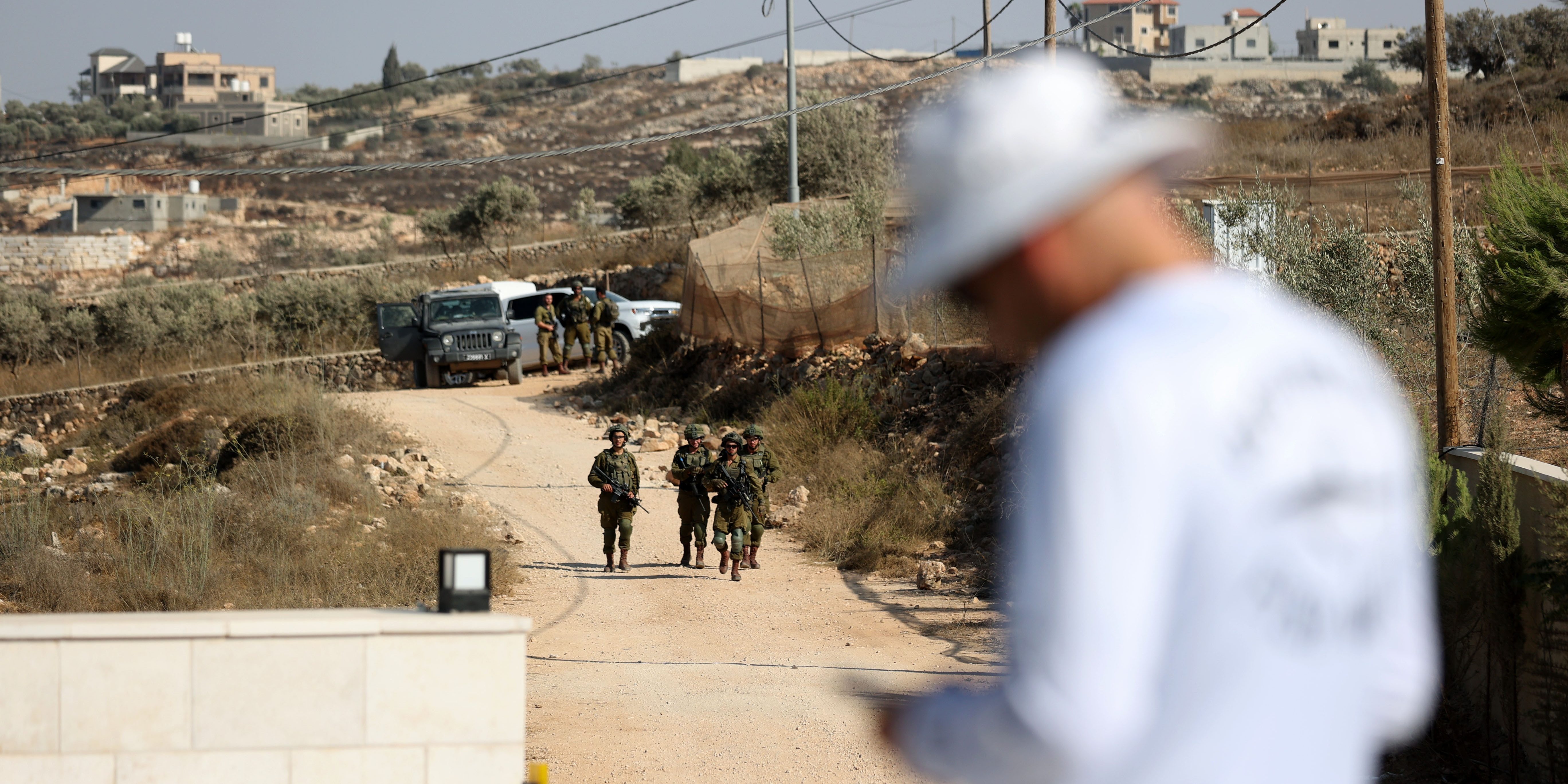
!QUSRA, WEST BANK, PALESTINE - AUGUST 20: Israeli army soldiers patrol as Palestinian residents remain confined inside their homes in the village of Qusra, south of Nablus in the West Bank, on August 20, 2026, after the Israeli military declared three residential properties a 'closed military zone' following repeated attacks and blockade by Israeli settlers. The restrictions began on Aug. 9, when settlers surrounded the homes and limited residents' movement and access to food, water and electricity. The 13-day blockade, which affects a home owned by Palestinian-American Loui Ridi, has drawn international attention, leading U.S. Ambassador to Israel Mike Huckabee, a long-time supporter of West Bank settlements, to issue a rare statement condemning the actions of the extremist settlers and describing them as 'terrorists' as local families appeal for an immediate end to the military isolation. Ridi said Huckabee's remarks were a positive step but had not changed conditions on the ground, and called on the US government to provide protection for him and his family. (Photo by Issam Rimawi/Anadolu via Getty Images)
Israeli army soldiers patrol as Palestinian residents remain confined inside their homes and nearby settlers attack, in the village of Qusra, south of Nablus in the Occupied West Bank, on Aug. 20, 2026.
Photo: Issam Rimawi/Anadolu via Getty Images
Shortly before midnight
on August 4, Israeli settlers arrived at the home of Loui Abu Ridi, a Palestinian American, in the village of Qusra in the occupied West Bank.
By then, settlers had already been attacking the house for months. The Abu Ridi family had hired contractors to install an additional fence around their property, and when the settlers drove up to the home on an ATV on August 4, workers were busy erecting the fence.
“We called the Israeli police so they would protect us from them,” Qusai Abu Ridi, Loui’s brother, told The Intercept. “The army came after half an hour.”
About two and a half hours after the settlers’ arrival, the Israeli military did take action — but not against the settlers.
The workers installing the fence would end up arrested and taken away by Israeli soldiers while the settlers who were trespassing roamed around the property freely, according to security camera footage reviewed by The Intercept.
The Israeli military’s actions that night against the workers stand as an example of the Israeli government’s broader role in and response to settler violence in the occupied West Bank — emboldening the settlers’ lawless behavior as they forcibly displace Palestinians from their homes and land.
Just a few days later on August 9, settlers began a siege on three homes in Qusra, including the Abu Ridi’s, blocking the main road and trapping families inside their houses with limited water and food.
Despite claims by the Israeli military that it has removed Israeli citizens since the siege began in Qusra and that they are minimizing the impact of operations on Palestinian civil life, the videos from before and during the siege show a village that remains under threat from settlers — with Israeli soldiers doing little to stop them.
> “We are still under siege. There’s military all around the house.”
“We are still under siege. There’s military all around the house,” said Abu Ridi, after traveling from Ohio last week to protect his home in Qusra. “The IDF” — Israel Defense Forces — “presence is not helping the situation. It’s not giving us the freedom to go in and out.”
The siege has led to international condemnation of the impunity afforded to settlers — including rare, harshly worded remarks from the far-right U.S. ambassador to Israel, Mike Huckabee.
In statements to The Intercept, the Israeli military referred to the settlers as “rioters” but did not answer questions about the incident on August 4.
“IDF soldiers are currently permanently stationed in the area until further notice, in order to protect its residents and prevent friction,” an Israeli military spokesperson said. “The IDF is operating with the tools at its disposal and will continue to work to restore order in the area, prevent disturbances, and ensure the security of all residents of the area, both Palestinians and Israelis.”
**“Complicit With the Settlers”**
On August 4, Qusai Abu Ridi said he called the police for help when the settlers arrived.
In a security video just a few minutes before midnight, Israeli soldiers can be seen approaching the gate before some of the settlers walk up to them and talk. About two minutes later, the soldiers and settlers walk together through the gate and up to the house.
“The settlers entered with them and were talking to each other and praising each other,” Qusai Abu Ridi said. Video from around 12:12 a.m. shows the Israeli settlers moving around the property freely and unescorted as they exit through the gate.
Abu Ridi and the workers were eventually taken to one side of the house where security video shows them facing the wall with their hands up to be searched. Just after 2 a.m., video shows two workers being taken by Israeli soldiers. Both men are blindfolded with their arms tied behind their backs.
Most Read
Qusai Abu Ridi said that they tried to tell the soldiers that they had called because they wanted protection from the soldiers.
“One of the soldiers replied, ‘Shut up, not a word, do not say a word,’” he recalled of the incident. “The army was complicit with the settlers. They were the ones who attacked us, and we were the ones who were mistreated.”
From the U.S., Loui Abu Ridi had watched the incident unfold live through the security camera feed until it cut out.
“It truly was a terrifying moment,” he said. “Imagine you’re watching your brother for two hours, and then they cut off the camera.” He added, “Then you start imagining what they’re doing.”
The workers were held for a few hours before being released without charge, according to Loui Abu Ridi.
He said, “Their crime was trying to protect my house from the settlers.”
**Months of Attacks**
The attack on Qusra is the latest in an escalation of violence by Israeli settlers this year across the occupied West Bank. According to the United Nations, there were about 190 attacks in each of the first four months of this year. This has been coupled with the Israeli government increasing money for and approvals of settlements, which are illegal under international law.
Human rights groups have documented both the rise of settler violence and criticized the Israeli government for its lack of action and even complicity in the attacks. According to a recent U.N. report on the Occupied Palestinian Territory, “the increasing participation of Israeli security forces in settler attacks amounts to a de facto collapse of the distinction between settlers and soldiers.”
Before the current siege on Qusra, attacks by Israeli settlers on the village had been ramping up for months. Loui Abu Ridi told The Intercept that the first attack on his home was in January of this year.
> “Anything that can
Support Us
Support Us
* Iran
* Midterms
* Justice
* War on Gaza
* Unmasking ICE
* Chilling Dissent
Support Us
* Special Investigations
* Voices
* Podcasts
* TomDispatch
* Press Freedom Defense Fund
* Join the Newsletter
* About
* Contact Us
* How to Donate
* Impact & Reports
* Jobs
* Become a Source
*
*
*
*
*
*
*
*
*
© THE INTERCEPT
ALL RIGHTS RESERVED
Terms of UsePrivacy
* Iran
* Midterms
* Justice
* War on Gaza
* Unmasking ICE
* Chilling Dissent
* About
* Support Us
Palestinians Asked for Help Against Settlers. Israelis Detained Palestinian Workers Instead.
In the besieged West Bank village of Qusra, the workers were building a fence for keeping settlers out. Soldiers allowed the settlers to trespass.
Kavitha Chekuru
August 26 2026, 12:27 p.m. ET
*
* Share on Facebook
*
* Share on X
* Share on LinkedIn
* Share on WhatsApp
!QUSRA, WEST BANK, PALESTINE - AUGUST 20: Israeli army soldiers patrol as Palestinian residents remain confined inside their homes in the village of Qusra, south of Nablus in the West Bank, on August 20, 2026, after the Israeli military declared three residential properties a 'closed military zone' following repeated attacks and blockade by Israeli settlers. The restrictions began on Aug. 9, when settlers surrounded the homes and limited residents' movement and access to food, water and electricity. The 13-day blockade, which affects a home owned by Palestinian-American Loui Ridi, has drawn international attention, leading U.S. Ambassador to Israel Mike Huckabee, a long-time supporter of West Bank settlements, to issue a rare statement condemning the actions of the extremist settlers and describing them as 'terrorists' as local families appeal for an immediate end to the military isolation. Ridi said Huckabee's remarks were a positive step but had not changed conditions on the ground, and called on the US government to provide protection for him and his family. (Photo by Issam Rimawi/Anadolu via Getty Images)
Israeli army soldiers patrol as Palestinian residents remain confined inside their homes and nearby settlers attack, in the village of Qusra, south of Nablus in the Occupied West Bank, on Aug. 20, 2026.
Photo: Issam Rimawi/Anadolu via Getty Images
Shortly before midnight
on August 4, Israeli settlers arrived at the home of Loui Abu Ridi, a Palestinian American, in the village of Qusra in the occupied West Bank.
By then, settlers had already been attacking the house for months. The Abu Ridi family had hired contractors to install an additional fence around their property, and when the settlers drove up to the home on an ATV on August 4, workers were busy erecting the fence.
“We called the Israeli police so they would protect us from them,” Qusai Abu Ridi, Loui’s brother, told The Intercept. “The army came after half an hour.”
About two and a half hours after the settlers’ arrival, the Israeli military did take action — but not against the settlers.
The workers installing the fence would end up arrested and taken away by Israeli soldiers while the settlers who were trespassing roamed around the property freely, according to security camera footage reviewed by The Intercept.
The Israeli military’s actions that night against the workers stand as an example of the Israeli government’s broader role in and response to settler violence in the occupied West Bank — emboldening the settlers’ lawless behavior as they forcibly displace Palestinians from their homes and land.
Just a few days later on August 9, settlers began a siege on three homes in Qusra, including the Abu Ridi’s, blocking the main road and trapping families inside their houses with limited water and food.
Despite claims by the Israeli military that it has removed Israeli citizens since the siege began in Qusra and that they are minimizing the impact of operations on Palestinian civil life, the videos from before and during the siege show a village that remains under threat from settlers — with Israeli soldiers doing little to stop them.
> “We are still under siege. There’s military all around the house.”
“We are still under siege. There’s military all around the house,” said Abu Ridi, after traveling from Ohio last week to protect his home in Qusra. “The IDF” — Israel Defense Forces — “presence is not helping the situation. It’s not giving us the freedom to go in and out.”
The siege has led to international condemnation of the impunity afforded to settlers — including rare, harshly worded remarks from the far-right U.S. ambassador to Israel, Mike Huckabee.
In statements to The Intercept, the Israeli military referred to the settlers as “rioters” but did not answer questions about the incident on August 4.
“IDF soldiers are currently permanently stationed in the area until further notice, in order to protect its residents and prevent friction,” an Israeli military spokesperson said. “The IDF is operating with the tools at its disposal and will continue to work to restore order in the area, prevent disturbances, and ensure the security of all residents of the area, both Palestinians and Israelis.”
**“Complicit With the Settlers”**
On August 4, Qusai Abu Ridi said he called the police for help when the settlers arrived.
In a security video just a few minutes before midnight, Israeli soldiers can be seen approaching the gate before some of the settlers walk up to them and talk. About two minutes later, the soldiers and settlers walk together through the gate and up to the house.
“The settlers entered with them and were talking to each other and praising each other,” Qusai Abu Ridi said. Video from around 12:12 a.m. shows the Israeli settlers moving around the property freely and unescorted as they exit through the gate.
Abu Ridi and the workers were eventually taken to one side of the house where security video shows them facing the wall with their hands up to be searched. Just after 2 a.m., video shows two workers being taken by Israeli soldiers. Both men are blindfolded with their arms tied behind their backs.
Most Read
Qusai Abu Ridi said that they tried to tell the soldiers that they had called because they wanted protection from the soldiers.
“One of the soldiers replied, ‘Shut up, not a word, do not say a word,’” he recalled of the incident. “The army was complicit with the settlers. They were the ones who attacked us, and we were the ones who were mistreated.”
From the U.S., Loui Abu Ridi had watched the incident unfold live through the security camera feed until it cut out.
“It truly was a terrifying moment,” he said. “Imagine you’re watching your brother for two hours, and then they cut off the camera.” He added, “Then you start imagining what they’re doing.”
The workers were held for a few hours before being released without charge, according to Loui Abu Ridi.
He said, “Their crime was trying to protect my house from the settlers.”
**Months of Attacks**
The attack on Qusra is the latest in an escalation of violence by Israeli settlers this year across the occupied West Bank. According to the United Nations, there were about 190 attacks in each of the first four months of this year. This has been coupled with the Israeli government increasing money for and approvals of settlements, which are illegal under international law.
Human rights groups have documented both the rise of settler violence and criticized the Israeli government for its lack of action and even complicity in the attacks. According to a recent U.N. report on the Occupied Palestinian Territory, “the increasing participation of Israeli security forces in settler attacks amounts to a de facto collapse of the distinction between settlers and soldiers.”
Before the current siege on Qusra, attacks by Israeli settlers on the village had been ramping up for months. Loui Abu Ridi told The Intercept that the first attack on his home was in January of this year.
> “Anything that can
🔗 Share Article
Tags:#فلسطين#الضفة الغربية#المستوطنون الإسرائيليون#العنف الاستيطاني#انتهاكات حقوق الإنسان
Source: The Intercept
For Context
Related reads from the same topic or latest developments


